
Chapter 7, “Gravitation,” in NCERT Class 11 Physics (Part 1) builds up the law of universal gravitation, Kepler’s laws of planetary motion, gravitational potential energy, escape speed, and the physics of orbiting satellites. Below are complete, independently worked solutions to all 21 exercise questions (7.1 to 7.21) from the current rationalised NCERT textbook (2026-27 reprint) – not generic or invented problems, but the real end-of-chapter questions as they appear in the official book, solved from first principles.
NCERT Exercise Solutions: Class 11 Physics Chapter 7 – Gravitation
Q7. 1 Conceptual questions on shielding, weightlessness, and tides — Question: (a) You can shield a charge from electrical forces by putting it inside a…
Question: (a) You can shield a charge from electrical forces by putting it inside a hollow conductor. Can you shield a body from the gravitational influence of nearby matter by putting it inside a hollow sphere or by some other means? (b) An astronaut inside a small spaceship orbiting around the earth cannot detect gravity. If the space station orbiting around the earth has a large size, can he hope to detect gravity? (c) If you compare the gravitational force on the earth due to the sun to that due to the moon, you would find that the Sun’s pull is greater than the moon’s pull. However, the tidal effect of the moon’s pull is greater than the tidal effect of the sun. Why?
Last Updated: September 23, 2026
Solution:
(a) No. Unlike electric charge, gravitational mass is always positive – there is no “negative mass” to arrange in a way that cancels an external gravitational field. A hollow conducting shell can screen electric fields because free charges on it rearrange to cancel the field inside; there is no equivalent effect for gravity, so a body cannot be shielded from gravitational influence by enclosing it in a shell.
(b) Yes. Over a small region, all parts of a small spaceship fall with essentially the same acceleration, so no relative (apparent) gravity is felt – this is why astronauts float. But over a very large station, different parts are at slightly different distances from the Earth’s centre and experience slightly different gravitational pull and direction. This difference (a tidal effect) would show up as a small relative “weight” or stretching force, so gravity could, in principle, be detected in a sufficiently large station.
(c) Tidal effects depend on the difference in gravitational pull between the near and far sides of a body, which varies as 1/r³ (the gradient of the 1/r² force), not as 1/r² like the force itself. Even though the Sun’s force on Earth is larger in absolute terms, the Moon is much closer, and the tidal (1/r³) dependence favours the nearer body strongly. Using M(sun) = 2 × 10^30 kg, r(sun) = 1.5 × 10^11 m, M(moon) = 7.35 × 10^22 kg, r(moon) = 3.84 × 10^8 m: the ratio of tidal effects works out to (M(moon)/r(moon)³) ÷ (M(sun)/r(sun)³) ≈ 2.2, i.e. the Moon’s tidal effect is about 2.2 times the Sun’s, even though the Sun’s direct gravitational force on Earth is about 175 times larger.
Q7. 2 Choose the correct alternative — Question: Choose the correct alternative: (a) Acceleration due to gravity…
Question: Choose the correct alternative: (a) Acceleration due to gravity increases/decreases with increasing altitude. (b) Acceleration due to gravity increases/decreases with increasing depth (assume the Earth to be a sphere of uniform density). (c) Acceleration due to gravity is independent of the mass of the earth/mass of the body. (d) The formula -GMm(1/r2 – 1/r1) is more/less accurate than the formula mg(r2 – r1) for the difference in potential energy between two points r2 and r1 distance away from the centre of the Earth.
Solution:
(a) Decreases – g at height h is g/(1 + h/R)², which falls as h increases.
(b) Decreases – g at depth d is g(1 – d/R), which falls linearly to zero at the centre.
(c) Independent of the mass of the body – g = GM(earth)/R² does not involve the falling body’s own mass (all bodies fall with the same g), though it obviously does depend on the Earth’s mass.
(d) The exact expression -GMm(1/r2 – 1/r1) is more accurate. The approximation mg(r2 – r1) assumes g is constant, which is only valid when (r2 – r1) is much smaller than r1 (near the surface); the exact 1/r formula for potential energy holds at any separation.
Q7. 3 Orbital size of a faster planet — Question: Suppose there existed a planet that went around the Sun twice as fast as the…
Question: Suppose there existed a planet that went around the Sun twice as fast as the Earth. What would be its orbital size as compared to that of the Earth?
Solution: By Kepler’s third law, T² ∝ r³, so r ∝ T^(2/3). If the new planet’s period T’ = T/2 (twice as fast means half the period), then r’/r = (T’/T)^(2/3) = (1/2)^(2/3) ≈ 0.63. So the new planet’s orbital radius would be about 0.63 times (roughly 63% of) the Earth’s orbital radius.
Q7. 4 Mass of Jupiter from Io's orbit — Question: Io, one of the satellites of Jupiter, has an orbital period of 1.769 days and…
Question: Io, one of the satellites of Jupiter, has an orbital period of 1.769 days and the radius of the orbit is 4.22 × 10^8 m. Show that the mass of Jupiter is about one-thousandth that of the Sun.
Solution: For a body orbiting Jupiter under gravity, M(Jupiter) = 4π²r³/(GT²).
T = 1.769 × 86400 s = 1.5284 × 10^5 s, so T² = 2.336 × 10^10 s².
r³ = (4.22 × 10^8)³ = 7.51 × 10^25 m³.
M(Jupiter) = (4π² × 7.51 × 10^25) / (6.67 × 10^-11 × 2.336 × 10^10) ≈ 1.90 × 10^27 kg.
Mass of the Sun = 1.99 × 10^30 kg. Ratio = 1.90 × 10^27 / 1.99 × 10^30 ≈ 9.6 × 10^-4, i.e. about 1/1045 – confirming Jupiter’s mass is roughly one-thousandth the Sun’s mass.
Q7. 5 Period of a star's revolution around the galaxy — Question: Let us assume that our galaxy consists of 2.5 × 10^11 stars, each of one…
Question: Let us assume that our galaxy consists of 2.5 × 10^11 stars, each of one solar mass. How long will a star at a distance of 50,000 light years from the galactic centre take to complete one revolution? Take the diameter of the Milky Way to be 10^5 light years.
Solution: Treating the mass enclosed within the star’s orbit as concentrated at the galactic centre (a standard simplification), total enclosed mass M = 2.5 × 10^11 × 2 × 10^30 kg = 5 × 10^41 kg.
r = 50,000 ly = 5 × 10^4 × 9.46 × 10^15 m = 4.73 × 10^20 m.
T = 2π√(r³/GM). r³ = 1.058 × 10^62 m³; GM = 6.67 × 10^-11 × 5 × 10^41 = 3.34 × 10^31.
r³/GM = 3.17 × 10^30; square root ≈ 1.78 × 10^15 s.
T = 2π × 1.78 × 10^15 ≈ 1.12 × 10^16 s. Converting (1 year = 3.156 × 10^7 s): T ≈ 3.5 × 10^8 years (roughly 350 million years).
Q7. 6 Choose the correct alternative — Question: Choose the correct alternative: (a) If the zero of potential energy is taken…
Question: Choose the correct alternative: (a) If the zero of potential energy is taken at infinity, the total energy of an orbiting satellite is negative of its kinetic/potential energy. (b) The energy required to launch an orbiting satellite out of Earth’s gravitational influence is more/less than the energy required to project a stationary object at the same height (as the satellite) out of the Earth’s influence.
Solution:
(a) Negative of its kinetic energy. For a circular orbit of radius r, PE = -GMm/r and KE = GMm/2r, so total energy E = -GMm/2r = -KE (and also E = PE/2).
(b) Less. A stationary object at the same height has energy -GMm/r and needs GMm/r to escape (reach E = 0). An orbiting satellite already has kinetic energy GMm/2r, so its total energy is -GMm/2r, and it only needs an additional GMm/2r to escape – exactly half of what the stationary object needs.
Q7. 7 What escape speed depends on — Question: Does the escape speed of a body from the Earth depend on (a) the mass of the…
Question: Does the escape speed of a body from the Earth depend on (a) the mass of the body, (b) the location from where it is projected, (c) the direction of projection, (d) the height of the location from where the body is launched?
Solution: Escape speed is v(e) = √(2GM/r), where r is the distance from Earth’s centre at launch. It does not depend on (a) the mass of the projected body, or (c) the direction of projection (ignoring atmospheric drag). It does depend on (d) the height of the launch point (larger r means smaller required v(e)), which is really the same variable as (b) the location, since location determines r.
Q7. 8 What stays constant for a comet in an elliptical orbit — Question: A comet orbits the Sun in a highly elliptical orbit. Does the comet have a…
Question: A comet orbits the Sun in a highly elliptical orbit. Does the comet have a constant (a) linear speed, (b) angular speed, (c) angular momentum, (d) kinetic energy, (e) potential energy, (f) total energy throughout its orbit?
Solution: Only (c) angular momentum and (f) total energy are constant. Angular momentum is conserved because gravity is a central force (zero torque about the Sun) – this is the basis of Kepler’s second law (equal areas in equal times), which itself tells us linear and angular speed both vary (faster near the Sun, slower far away), ruling out (a) and (b). Total mechanical energy is conserved because gravity is a conservative force, but kinetic and potential energy individually change as the comet moves nearer to or farther from the Sun, ruling out (d) and (e).
Q7. 9 Symptoms affecting an astronaut in space — Question: Which of the following symptoms is likely to afflict an astronaut in space:…
Question: Which of the following symptoms is likely to afflict an astronaut in space: (a) swollen feet, (b) swollen face, (c) headache, (d) orientational problem?
Solution: In the absence of gravity, body fluids that normally pool in the lower body under gravity shift upward toward the head and chest, causing (b) a puffy/swollen face (and thinner legs, not swollen feet – so (a) does not occur). The lack of a “down” direction cue also causes (d) orientational (spatial disorientation) problems. Headache (c) can occur secondary to fluid shift but is not the primary, classic symptom the question is testing; the standard answer is (b) and (d).
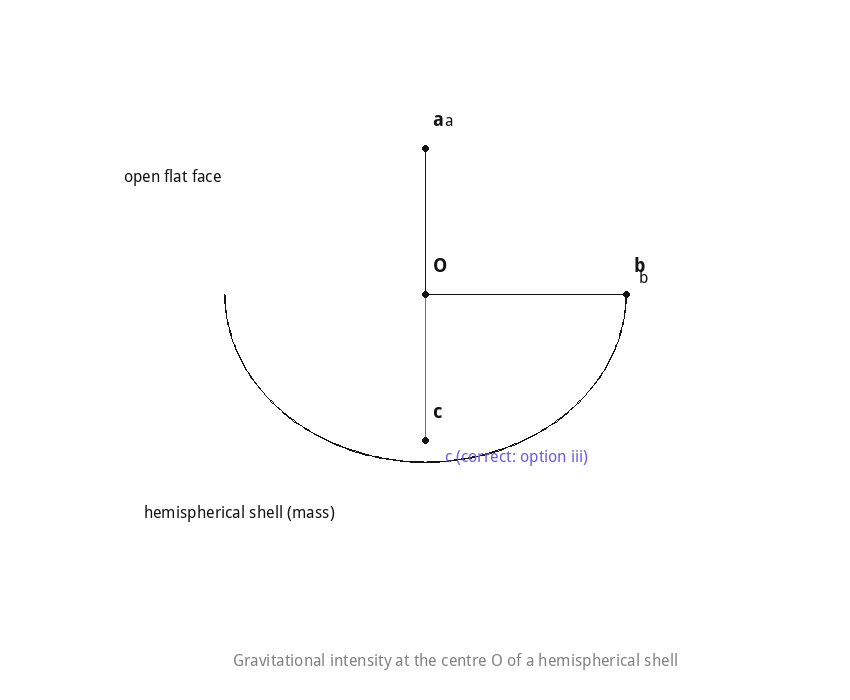
Q7. 10 Gravitational intensity at the centre of a hemispherical shell — Question: The gravitational intensity at the centre of a hemispherical shell of uniform…
Question: The gravitational intensity at the centre of a hemispherical shell of uniform mass density has the direction indicated by the arrow (see figure) (i) a, (ii) b, (iii) c, (iv) 0.
Solution: Inside a complete spherical shell, the field is zero everywhere by symmetry (contributions from all directions cancel). Removing the upper half of the shell destroys that symmetry: the remaining lower hemisphere pulls the point at the (former) centre downward, toward the mass that remains. So the intensity is not zero; it points straight down, along the symmetry axis of the hemisphere, toward the curved (mass-bearing) side and away from the open flat face – this corresponds to option (iii), the arrow labelled “c” in the textbook figure.
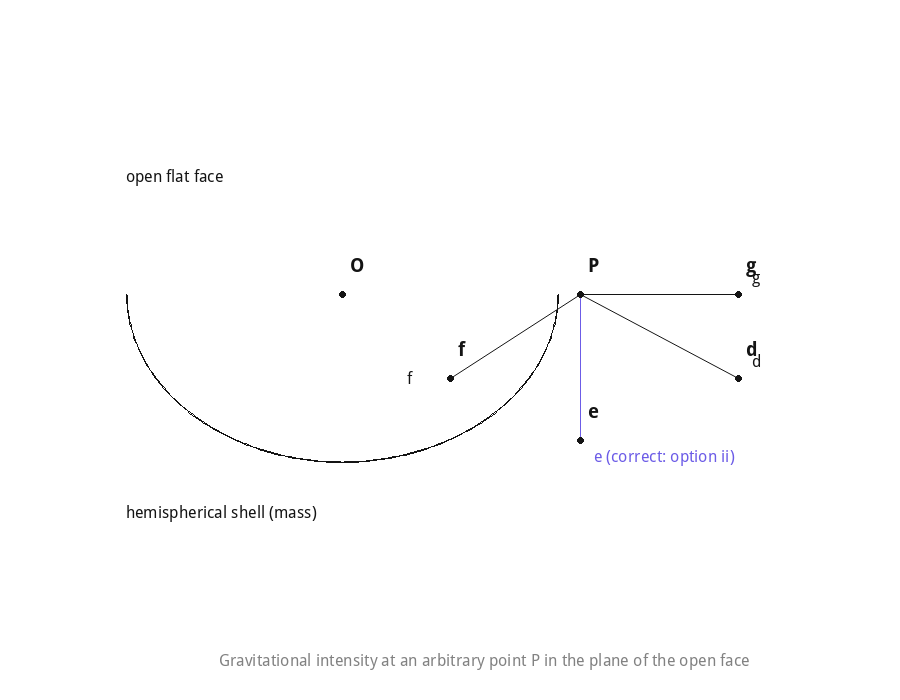
Q7. 11 Gravitational intensity at an arbitrary point P (same hemispherical shell) — Question: For the above problem, the direction of the gravitational intensity at an…
Question: For the above problem, the direction of the gravitational intensity at an arbitrary point P (in the plane of the open face, not necessarily the centre) is indicated by the arrow (i) d, (ii) e, (iii) f, (iv) g.
Solution: Think of the full sphere as two hemispherical shells (upper and lower). Inside a full shell the net field at every point is zero, so the field from the upper half and the field from the lower half must cancel exactly at every point in the flat (equatorial) plane, not just at the centre. By the mirror symmetry of the two halves, this forces the component of each hemisphere’s field parallel to the flat face to vanish, leaving only a component perpendicular to the face. So at any point P in that plane – not just the centre – the field due to the lower hemisphere alone points straight down (perpendicular to the flat face), the same direction as at the centre. This corresponds to option (ii), the arrow labelled “e.”
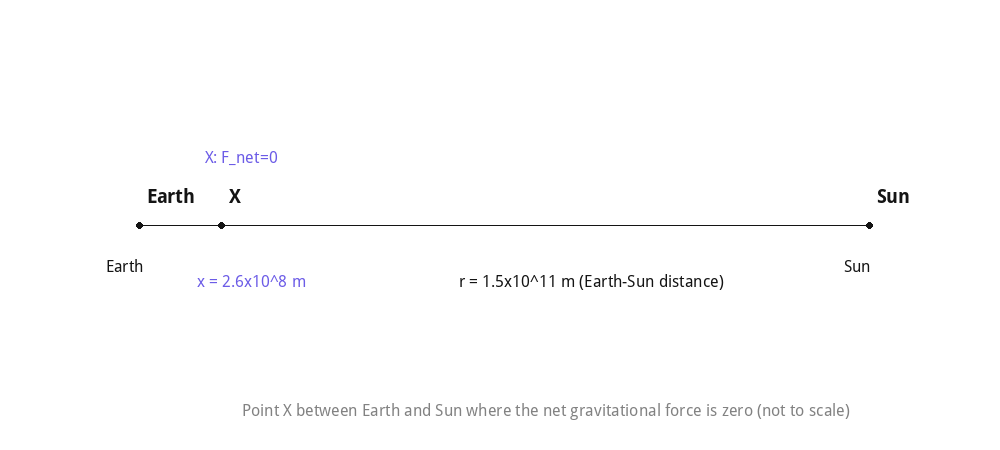
Q7. 12 Where gravitational force is zero between Earth and Sun — Question: A rocket is fired from the Earth towards the Sun. At what distance from the…
Question: A rocket is fired from the Earth towards the Sun. At what distance from the Earth’s centre is the gravitational force on the rocket zero? Mass of the Sun = 2 × 10^30 kg, mass of the Earth = 6 × 10^24 kg. Neglect the effect of other planets etc. (orbital radius = 1.5 × 10^11 m).
Solution: Let x be the distance from Earth’s centre (toward the Sun) where the pulls balance:
GM(earth)/x² = GM(sun)/(r – x)², where r = 1.5 × 10^11 m.
(r – x)/x = √(M(sun)/M(earth)) = √(2 × 10^30 / 6 × 10^24) = √(3.33 × 10^5) ≈ 577.4.
r = x(1 + 577.4) = 578.4x, so x = r/578.4 = 1.5 × 10^11 / 578.4 ≈ 2.6 × 10^8 m from Earth’s centre.
Q7. 13 "Weighing" the Sun — Question: How will you "weigh the Sun," that is, estimate its mass? The mean orbital…
Question: How will you “weigh the Sun,” that is, estimate its mass? The mean orbital radius of the Earth around the Sun is 1.5 × 10^8 km.
Solution: Treat the Earth’s orbit as (approximately) circular and use M(sun) = 4π²r³/(GT²), with r = 1.5 × 10^11 m and T = 1 year = 3.156 × 10^7 s.
r³ = 3.375 × 10^33 m³; T² = 9.96 × 10^14 s²; GT² = 6.67 × 10^-11 × 9.96 × 10^14 = 6.64 × 10^4.
M(sun) = 4π² × 3.375 × 10^33 / 6.64 × 10^4 ≈ 2.0 × 10^30 kg.
Q7. 14 Distance of Saturn from the Sun — Question: A Saturn year is 29.5 times the Earth year. How far is Saturn from the Sun if…
Question: A Saturn year is 29.5 times the Earth year. How far is Saturn from the Sun if the Earth is 1.50 × 10^8 km away from the Sun?
Solution: By Kepler’s third law, r(Saturn)/r(Earth) = (T(Saturn)/T(Earth))^(2/3) = 29.5^(2/3).
29.5^(1/3) ≈ 3.09, so 29.5^(2/3) ≈ 9.55.
r(Saturn) = 1.50 × 10^8 × 9.55 ≈ 1.43 × 10^9 km.
Q7. 15 Gravitational force at a height equal to half Earth's radius — Question: A body weighs 63 N on the surface of the Earth. What is the gravitational…
Question: A body weighs 63 N on the surface of the Earth. What is the gravitational force on it due to the Earth at a height equal to half the radius of the Earth?
Solution: At height h = R/2, distance from Earth’s centre = R + R/2 = 1.5R. Since force ∝ 1/(distance)²:
F = 63 × (R / 1.5R)² = 63 × (1/1.5)² = 63 × 0.444 ≈ 28 N.
Q7. 16 Weight halfway to Earth's centre — Question: Assuming the Earth to be a sphere of uniform mass density, how much would a…
Question: Assuming the Earth to be a sphere of uniform mass density, how much would a body weigh halfway down to the centre of the Earth if it weighed 250 N on the surface?
Solution: Inside a uniform-density Earth, g(depth d) = g(surface) × (1 – d/R). At d = R/2, g is halved.
Weight = 250 × 0.5 = 125 N.
Q7. 17 Maximum height of a rocket fired at 5 km/s — Question: A rocket is fired vertically with a speed of 5 km/s from the Earth's surface.…
Question: A rocket is fired vertically with a speed of 5 km/s from the Earth’s surface. How far from the Earth does the rocket go before returning to the Earth? Mass of the Earth = 6.0 × 10^24 kg, mean radius of the Earth = 6.4 × 10^6 m, G = 6.67 × 10^-11 N m² kg^-2.
Solution: Using energy conservation between launch and the highest point (speed = 0), with g = GM/R² ≈ 9.8 m/s²:
½v² = gRh / (R + h), which rearranges to h = v²R / (2gR – v²).
v² = (5000)² = 2.5 × 10^7 m²/s²; 2gR = 2 × 9.8 × 6.4 × 10^6 = 1.2544 × 10^8.
2gR – v² = 1.0044 × 10^8.
h = (2.5 × 10^7 × 6.4 × 10^6) / 1.0044 × 10^8 ≈ 1.6 × 10^6 m.
So the rocket rises about 1.6 × 10^6 m (1600 km) above the surface, i.e. to a distance of about R + h ≈ 8.0 × 10^6 m from Earth’s centre, before falling back.
Q7. 18 Final speed of a body launched at 3× escape speed — Question: The escape speed of a projectile on the Earth's surface is 11.2 km/s. A body…
Question: The escape speed of a projectile on the Earth’s surface is 11.2 km/s. A body is projected out with thrice this speed. What is the speed of the body far away from the Earth? Ignore the presence of the Sun and other planets.
Solution: By energy conservation, ½v² – ½v(e)² = ½v(final)² (since ½v(e)² equals the magnitude of PE per unit mass at the surface, and PE → 0 far away).
With v = 3v(e): v(final)² = 9v(e)² – v(e)² = 8v(e)², so v(final) = v(e)√8 = 11.2 × 2.828 ≈ 31.7 km/s.
Q7. 19 Energy to escape from a 400 km orbit — Question: A satellite orbits the Earth at a height of 400 km above the surface. How much…
Question: A satellite orbits the Earth at a height of 400 km above the surface. How much energy must be expended to rocket the satellite out of the Earth’s gravitational influence? Mass of the satellite = 200 kg; mass of the Earth = 6.0 × 10^24 kg; radius of the Earth = 6.4 × 10^6 m; G = 6.67 × 10^-11 N m² kg^-2.
Solution: Orbital radius r = R + h = 6.4 × 10^6 + 4 × 10^5 = 6.8 × 10^6 m. Total energy of a circularly orbiting satellite is E = -GMm/2r; escaping requires raising E to 0, i.e. supplying |E| = GMm/2r.
GMm = 6.67 × 10^-11 × 6 × 10^24 × 200 = 8.00 × 10^16.
Energy required = 8.00 × 10^16 / (2 × 6.8 × 10^6) ≈ 5.9 × 10^9 J.
Q7. 20 Collision speed of two approaching stars — Question: Two stars each of one solar mass (= 2 × 10^30 kg) are approaching each other…
Question: Two stars each of one solar mass (= 2 × 10^30 kg) are approaching each other for a head-on collision. When they are at a distance 10^9 km, their speeds are negligible. What is the speed with which they collide? The radius of each star is 10^4 km. Assume the stars remain undistorted until they collide. (Use the known value of G.)
Solution: Use conservation of energy for the two-star system (equal masses M, so by symmetry each moves with the same speed v at collision, when their centres are separated by d(f) = 2 × radius = 2 × 10^4 km = 2 × 10^7 m):
-GM²/d(i) + 0 = -GM²/d(f) + 2(½Mv²), with d(i) = 10^9 km = 10^12 m (initial separation, speeds negligible).
v² = GM(1/d(f) – 1/d(i)) ≈ GM/d(f) (since 1/d(i) is negligible compared to 1/d(f)).
GM = 6.67 × 10^-11 × 2 × 10^30 = 1.334 × 10^20.
v² = 1.334 × 10^20 / 2 × 10^7 = 6.67 × 10^12.
v = √(6.67 × 10^12) ≈ 2.6 × 10^6 m/s (about 2600 km/s) – the speed of each star at the moment of collision.
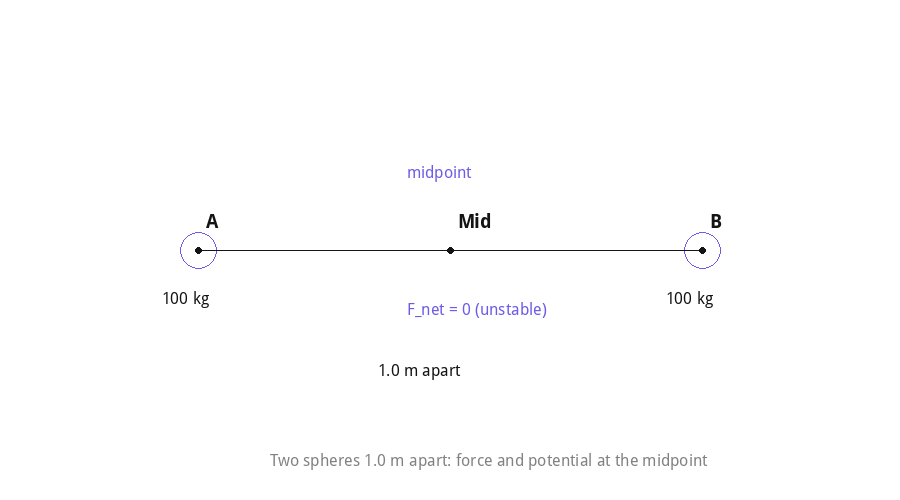
Q7. 21 Force and potential at the midpoint between two spheres — Question: Two heavy spheres each of mass 100 kg and radius 0.10 m are placed 1.0 m apart…
Question: Two heavy spheres each of mass 100 kg and radius 0.10 m are placed 1.0 m apart on a horizontal table. What is the gravitational force and potential at the mid-point of the line joining the centres of the spheres? Is an object placed at that point in equilibrium? If so, is the equilibrium stable or unstable?
Solution: Distance from the midpoint to each sphere’s centre: r = 0.5 m.
Force: Each sphere pulls an object at the midpoint with equal magnitude GM(100)/(0.5)² but in opposite directions (toward each sphere), so the net gravitational force is zero.
Potential: Potentials add as scalars: V = -2 × GM/r = -2 × (6.67 × 10^-11 × 100) / 0.5 ≈ -2.67 × 10^-8 J/kg.
Equilibrium: Yes, the object is in equilibrium (net force zero), but it is an unstable equilibrium: any small displacement along the line joining the spheres brings the object closer to one sphere and farther from the other; since gravitational attraction grows as 1/r², the nearer sphere’s pull now dominates and pulls the object further away from the midpoint rather than restoring it.
Notes and Extra Questions
A few points worth remembering while revising this chapter, beyond the exercise solutions above:
Kepler’s three laws in brief: (1) planets move in ellipses with the Sun at one focus; (2) the radius vector from the Sun to a planet sweeps out equal areas in equal times (a direct consequence of angular momentum conservation, since gravity is a central force); (3) T² ∝ r³ for all planets orbiting the same central body.
g variation formulas to keep straight: with altitude h, g’ = g/(1 + h/R)² (or g(1 – 2h/R) for h << R); with depth d, g’ = g(1 – d/R) – note that g decreases in both directions from the surface, reaching a maximum at the surface itself, not at the centre or in space.
Escape speed vs. orbital speed: the escape speed from a body’s surface is exactly √2 times the speed needed for a circular orbit just above that surface – a fact worth remembering as a quick sanity check (from v(e) = √(2GM/R) and v(orbit) = √(GM/R)).
Energy of a satellite: for any circular orbit, KE = -E = -PE/2, i.e. kinetic energy is always positive and equal in magnitude to half the (negative) potential energy – this single relation is the fastest way to answer most orbital-energy exam questions, including Q7.6 and Q7.19 above.
- Chapter 1: Units and Measurements (2026-27)
- Chapter 2: Motion in a Straight Line – Free PDF Download
- Chapter 3: Motion in a Plane – Free PDF Download
- Chapter 4: Laws of Motion – Free PDF Download
- Chapter 5: Work, Energy and Power – Free PDF Download
- Chapter 6: System of Particles and Rotational Motion – Free PDF Download
- Chapter 8: Mechanical Properties of Solids – Free PDF Download
- Chapter 9: Mechanical Properties of Fluids – Free PDF Download
- Chapter 10: Thermal Properties of Matter – Free PDF Download
- Chapter 11: Thermodynamics – Free PDF Download
- Chapter 12: Kinetic Theory – Free PDF Download
- Chapter 13: Oscillations – Free PDF Download
- Chapter 14: Waves – Free PDF Download
FAQ
Q: How many exercise questions does the current (2026-27) NCERT Class 11 Physics Chapter 7, Gravitation, actually have?
A: 21 questions, numbered 7.1 to 7.21. The chapter was previously numbered Chapter 8 and had 25 questions; as part of the 2023 NCERT syllabus rationalisation, the last four numericals (on geostationary satellite potential, a neutron star’s equatorial condition, spaceship-launch energy from Mars, and rocket-launch energy from Mars with atmospheric losses) were dropped, and the chapter was renumbered 7. The wording of the 21 retained questions is unchanged from the earlier edition.
Q: Why is escape speed independent of the mass and launch direction of the projectile?
A: Escape speed comes purely from equating kinetic energy to the magnitude of gravitational potential energy at launch: ½mv(e)² = GMm/r. The mass m of the projectile cancels out of this equation entirely, and the direction of launch does not appear in an energy-conservation argument at all (in the idealised case with no atmosphere) – only the distance r from the centre of the attracting body matters.
Q: Why does an orbiting satellite need only half as much energy to escape as a stationary object at the same height?
A: A stationary object at distance r has total energy -GMm/r and needs +GMm/r to reach zero (escape) energy. An orbiting satellite already carries kinetic energy GMm/2r as part of its motion, so its total energy is only -GMm/2r; it therefore needs just GMm/2r more to escape – exactly half of what a stationary object would require.
Q: Is gravitational potential energy always negative, and what does that mean physically?
A: Yes, with the standard convention that potential energy is taken as zero at infinite separation. Since gravity is always attractive, moving two masses apart requires external work, meaning the system’s energy increases (becomes less negative) as separation grows and approaches zero only at infinite separation. The negative sign simply reflects that the two masses are in a bound, attractive configuration relative to being infinitely far apart – it doesn’t indicate anything is “wrong” with the calculation.
Recommended: Buy the Printed NCERT Class 11 Physics Book Set
Contains Amazon affiliate links.
If you’d like a printed copy alongside the PDF, here’s a verified option:
Rs. 280
Price and availability may change on Amazon. As an Amazon Associate, ncertbooks.org earns from qualifying purchases.



Pingback: Class 11 Physics Chapter 11 Thermodynamics Extra Questions (2026-27)