
Derivatives aren’t just abstract slopes — they help find rates of change, maxima and minima, and approximate values. This chapter’s exercises apply derivatives to real problems, worked through step by step below.
Last Updated: September 23, 2026
Exercise 6.1 Solutions (All 18 Questions)
1. Find the rate of change of the area of a circle with respect to its radius r when (a) r=3cm (b) r=4cm.
Ans: A=πr², so dA/dr=2πr. (a) At r=3cm: dA/dr=6π cm²/cm. (b) At r=4cm: dA/dr=8π cm²/cm.
2. The volume of a cube is increasing at the rate of 8cm³/s. How fast is the surface area increasing when the length of an edge is 12cm?
Ans: V=x³, dV/dt=3x²(dx/dt)=8, so at x=12: dx/dt=8/(3×144)=1/54 cm/s. S=6x², dS/dt=12x(dx/dt)=12(12)(1/54)=8/3 cm²/s.
3. The radius of a circle is increasing uniformly at the rate of 3cm/s. Find the rate at which the area of the circle is increasing when the radius is 10cm.
Ans: A=πr², dA/dt=2πr(dr/dt)=2π(10)(3)=60π cm²/s.
4. An edge of a variable cube is increasing at the rate of 3cm/s. How fast is the volume of the cube increasing when the edge is 10cm long?
Ans: V=x³, dV/dt=3x²(dx/dt)=3(100)(3)=900 cm³/s.
5. A stone is dropped into a quiet lake and waves move in circles at a speed of 5cm/s. At the instant when the radius of the circular wave is 8cm, how fast is the enclosed area increasing?
Ans: A=πr², dA/dt=2πr(dr/dt)=2π(8)(5)=80π cm²/s.
6. The radius of a circle is increasing at the rate of 0.7cm/s. What is the rate of increase of its circumference?
Ans: C=2πr, dC/dt=2π(dr/dt)=2π(0.7)=1.4π cm/s.
7. The length x of a rectangle is decreasing at the rate of 5cm/minute and the width y is increasing at the rate of 4cm/minute. When x=8cm and y=6cm, find the rates of change of (a) the perimeter (b) the area of the rectangle.
Ans: dx/dt=−5, dy/dt=4. (a) P=2(x+y), dP/dt=2(dx/dt+dy/dt)=2(−5+4)=−2, so the perimeter is decreasing at 2 cm/min. (b) A=xy, dA/dt=x(dy/dt)+y(dx/dt)=8(4)+6(−5)=32−30=2 cm²/min.
8. A balloon, which always remains spherical, has a variable radius. Find the rate at which its volume is increasing with the radius when the radius is 10cm.
Ans: V=(4/3)πr³, dV/dr=4πr²=4π(100)=400π cm³/cm.
9. A balloon, which always remains spherical, is being inflated by pumping in 900 cubic centimetres of gas per second. Find the rate at which the radius of the balloon increases when the radius is 15cm.
Ans: V=(4/3)πr³, dV/dt=4πr²(dr/dt)=900, so at r=15: dr/dt=900/(4π×225)=1/π cm/s.
10. A ladder 5m long is leaning against a wall. The bottom of the ladder is pulled along the ground, away from the wall, at the rate of 2cm/s. How fast is its height on the wall decreasing when the foot of the ladder is 4m away from the wall?
Ans: x²+y²=25 (in metres); differentiating, 2x(dx/dt)+2y(dy/dt)=0. At x=4, y=3 (since 3-4-5 triangle), and dx/dt=2 cm/s=0.02 m/s: dy/dt=−x(dx/dt)/y=−(4)(0.02)/3=−0.08/3 m/s=−8/3 cm/s. So the height is decreasing at 8/3 cm/s.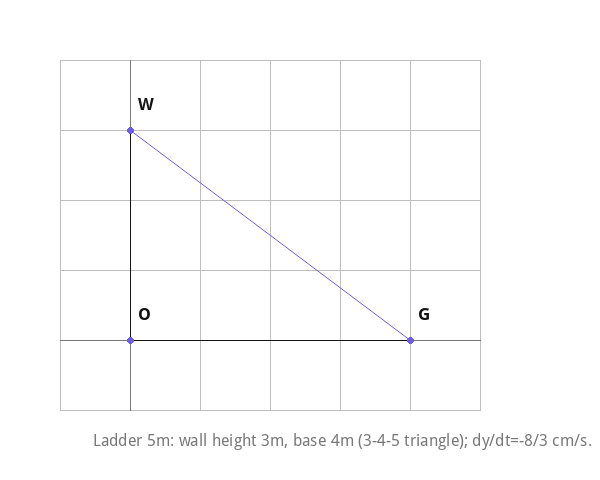
11. A particle moves along the curve 6y=x³+2. Find the points on the curve at which the y-coordinate is changing 8 times as fast as the x-coordinate.
Ans: Differentiating, 6(dy/dt)=3x²(dx/dt), so dy/dt=(x²/2)(dx/dt). Given dy/dt=8(dx/dt): x²/2=8, so x²=16, x=±4. At x=4: y=(64+2)/6=11, giving (4,11). At x=−4: y=(−64+2)/6=−31/3, giving (−4,−31/3).
12. The radius of an air bubble is increasing at the rate of ½cm/s. At what rate is the volume of the bubble increasing when the radius is 1cm?
Ans: V=(4/3)πr³, dV/dt=4πr²(dr/dt)=4π(1)(1/2)=2π cm³/s.
13. A balloon, which always remains spherical, has a variable diameter (3/2)(2x+1). Find the rate of change of its volume with respect to x.
Ans: Radius r=(3/4)(2x+1), so V=(4/3)πr³=(4/3)π(3/4)³(2x+1)³=(9/16)π(2x+1)³. dV/dx=(9/16)π·3(2x+1)²·2=(27/8)π(2x+1)².
14. Sand is pouring from a pipe at the rate of 12cm³/s. The falling sand forms a cone on the ground in such a way that the height of the cone is always one-sixth of the radius of the base. How fast is the height of the sand cone increasing when the height is 4cm?
Ans: h=r/6, so r=6h. V=(1/3)πr²h=(1/3)π(36h²)h=12πh³. dV/dt=36πh²(dh/dt)=12, so at h=4: dh/dt=12/(36π×16)=1/(48π) cm/s.
15. The total cost C(x) in Rupees associated with the production of x units of an item is given by C(x)=0.007x³−0.003x²+15x+4000. Find the marginal cost when 17 units are produced.
Ans: Marginal cost=dC/dx=0.021x²−0.006x+15. At x=17: 0.021(289)−0.006(17)+15=6.069−0.102+15=20.967. So the marginal cost is Rs 20.967.
16. The total revenue in Rupees received from the sale of x units of a product is given by R(x)=13x²+26x+15. Find the marginal revenue when x=7.
Ans: Marginal revenue=dR/dx=26x+26. At x=7: 26(7)+26=182+26=208. So the marginal revenue is Rs 208.
17. The rate of change of the area of a circle with respect to its radius r at r=6cm is (A) 10π (B) 12π (C) 8π (D) 11π.
Ans: dA/dr=2πr=2π(6)=12π. So the answer is (B) 12π.
18. The total revenue in Rupees received from the sale of x units of a product is given by R(x)=3x²+36x+5. The marginal revenue, when x=15 is (A) 116 (B) 96 (C) 90 (D) 126.
Ans: Marginal revenue=dR/dx=6x+36. At x=15: 6(15)+36=90+36=126. So the answer is (D) 126.
Exercise 6.2 Solutions (All 19 Questions)
1. Show that the function given by f(x)=3x+17 is increasing on R.
Ans: For any x₁<x₂ in R, f(x₂)−f(x₁)=3(x₂−x₁)>0, so f(x₁)<f(x₂). Also f′(x)=3>0 for all x∈R. Hence f is strictly increasing on R.
2. Show that the function given by f(x)=e²ˣ is increasing on R.
Ans: f′(x)=2e²ˣ. Since e²ˣ>0 for every real x, f′(x)>0 for all x∈R. Hence f is strictly increasing on R.
3. Show that the function given by f(x)=sin x is (a) increasing in (0,π/2) (b) decreasing in (π/2,π) (c) neither increasing nor decreasing in (0,π).
Ans: f′(x)=cos x. (a) On (0,π/2), cos x>0, so f is strictly increasing. (b) On (π/2,π), cos x<0, so f is strictly decreasing. (c) Since f is increasing on (0,π/2) and decreasing on (π/2,π), f is neither increasing nor decreasing on the whole interval (0,π).
4. Find the intervals in which the function f(x)=2x²−3x is (a) increasing (b) decreasing.
Ans: f′(x)=4x−3, which is zero at x=3/4. For x<3/4, f′(x)<0 (decreasing); for x>3/4, f′(x)>0 (increasing). So f is increasing on (3/4,∞) and decreasing on (−∞,3/4).
5. Find the intervals in which the function f(x)=2x³−3x²−36x+7 is (a) increasing (b) decreasing.
Ans: f′(x)=6x²−6x−36=6(x²−x−6)=6(x−3)(x+2), zero at x=−2,3. Testing signs: f′(x)>0 for x<−2 and x>3 (increasing); f′(x)<0 for −2<x<3 (decreasing). So f is increasing on (−∞,−2)∪(3,∞) and decreasing on (−2,3).
6. Find the intervals in which the following functions are strictly increasing or decreasing: (a) x²+2x−5 (b) 10−6x−2x² (c) −2x³−9x²−12x+1 (d) 6−9x−x² (e) (x+1)³(x−3)³
Ans: (a) f′(x)=2x+2, zero at x=−1. Increasing on (−1,∞), decreasing on (−∞,−1). (b) f′(x)=−6−4x, zero at x=−3/2. Increasing on (−∞,−3/2), decreasing on (−3/2,∞). (c) f′(x)=−6x²−18x−12=−6(x²+3x+2)=−6(x+1)(x+2), zero at x=−2,−1. Increasing on (−2,−1), decreasing on (−∞,−2)∪(−1,∞). (d) f′(x)=−9−2x, zero at x=−9/2. Increasing on (−∞,−9/2), decreasing on (−9/2,∞). (e) f′(x)=3(x+1)²(x−3)²(2x−2), zero at x=−1,1,3. Since (x+1)²(x−3)²≥0 always, the sign of f′(x) follows the sign of (2x−2): increasing on (1,∞), decreasing on (−∞,1).
7. Show that y=log(1+x)−2x/(2+x), x>−1, is an increasing function of x throughout its domain.
Ans: dy/dx=1/(1+x)−[2(2+x)−2x]/(2+x)²=1/(1+x)−4/(2+x)²=[(2+x)²−4(1+x)]/[(1+x)(2+x)²]=x²/[(1+x)(2+x)²]. For x>−1, (1+x)>0 and (2+x)²>0, and x²≥0, so dy/dx≥0 throughout the domain (equality only at x=0). Hence y is an increasing function of x throughout its domain.
8. Find the values of x for which y=[x(x−2)]² is an increasing function.
Ans: y=(x²−2x)², dy/dx=2(x²−2x)(2x−2)=4x(x−2)(x−1), zero at x=0,1,2. Testing signs across the four intervals shows dy/dx>0 on (0,1) and (2,∞), and dy/dx<0 on (−∞,0) and (1,2). So y is increasing for x∈(0,1)∪(2,∞).
9. Prove that y=4sinθ/(2+cosθ)−θ is an increasing function of θ in [0,π/2].
Ans: dy/dθ=[4cosθ(2+cosθ)+4sin²θ]/(2+cosθ)²−1=[8cosθ+4cos²θ+4sin²θ]/(2+cosθ)²−1=(8cosθ+4)/(2+cosθ)²−1=[8cosθ+4−(2+cosθ)²]/(2+cosθ)²=[4cosθ−cos²θ]/(2+cosθ)²=cosθ(4−cosθ)/(2+cosθ)². On [0,π/2], cosθ≥0 and (4−cosθ)>0, so dy/dθ≥0 throughout. Hence y is increasing on [0,π/2].
10. Prove that the logarithmic function is strictly increasing on (0,∞).
Ans: Let f(x)=log x. Then f′(x)=1/x, which is positive for every x>0. Hence f is strictly increasing on (0,∞).
11. Prove that the function f given by f(x)=x²−x+1 is neither strictly increasing nor strictly decreasing on (−1,1).
Ans: f′(x)=2x−1, which is zero at x=1/2∈(−1,1). For x<1/2, f′(x)<0 (f is decreasing) and for x>1/2, f′(x)>0 (f is increasing). Since f′ changes sign within (−1,1), f is neither strictly increasing nor strictly decreasing on the whole interval.
12. Which of the following functions are strictly decreasing on (0,π/2)? (A) cos x (B) cos 2x (C) cos 3x (D) tan x
Ans: (cos x)′=−sin x<0 throughout (0,π/2), so cos x is strictly decreasing. (cos 2x)′=−2sin 2x, and since 2x∈(0,π), sin 2x>0 throughout, so cos 2x is also strictly decreasing. (cos 3x)′=−3sin 3x changes sign on (0,π/2) since 3x ranges over (0,3π/2), so cos 3x is not strictly decreasing throughout. (tan x)′=sec²x>0, so tan x is increasing, not decreasing. So the strictly decreasing functions are (A) cos x and (B) cos 2x.
13. On which of the following intervals is the function f given by f(x)=x¹⁰⁰+sin x−1 strictly decreasing? (A) (0,1) (B) (π/2,π) (C) (0,π/2) (D) None of these
Ans: f′(x)=100x⁹⁹+cos x. On (0,1), 100x⁹⁹>0 and cos x>0, so f′(x)>0. On (0,π/2), similarly both terms keep f′(x)>0. On (π/2,π), cos x<0 but 100x⁹⁹ is very large and positive (since x>1), dominating cos x, so f′(x)>0 there too. Hence f′(x)>0 on all three given intervals, so f is increasing (not decreasing) on each. The answer is (D) None of these.
14. Find the least value of a such that the function f given by f(x)=x²+ax+1 is strictly increasing on (1,2).
Ans: f′(x)=2x+a. For f to be increasing on (1,2), we need f′(x)≥0 for all x∈(1,2), i.e. a≥−2x for all such x. Since −2x is largest (closest to 0) as x→1, we need a≥−2(1)=−2. So the least value of a is −2.
15. Let I be any interval disjoint from (−1,1). Prove that the function f given by f(x)=x+1/x is strictly increasing on I.
Ans: f′(x)=1−1/x²=(x²−1)/x². For any x in an interval disjoint from (−1,1), we have x²>1 (i.e. x<−1 or x>1), so x²−1>0, and since x²>0, f′(x)>0 throughout I. Hence f is strictly increasing on I.
16. Prove that the function f given by f(x)=log sin x is strictly increasing on (0,π/2) and strictly decreasing on (π/2,π).
Ans: f′(x)=cos x/sin x=cot x. On (0,π/2), both sin x and cos x are positive, so cot x>0 and f is strictly increasing. On (π/2,π), sin x>0 but cos x<0, so cot x<0 and f is strictly decreasing.
17. Prove that the function f given by f(x)=log cos x is strictly decreasing on (0,π/2) and strictly increasing on (π/2,π).
Ans: f′(x)=−sin x/cos x=−tan x. On (0,π/2), tan x>0, so f′(x)<0 and f is strictly decreasing. On (π/2,π), cos x<0 and sin x>0, so tan x<0, making f′(x)=−tan x>0, so f is strictly increasing.
18. Prove that the function given by f(x)=x³−3x²+3x−100 is increasing in R.
Ans: f′(x)=3x²−6x+3=3(x²−2x+1)=3(x−1)². Since (x−1)²≥0 for all real x, f′(x)≥0 for all x∈R (equality only at x=1). Hence f is increasing throughout R.
19. The interval in which y=x²e⁻ˣ is increasing is (A) (−∞,∞) (B) (−2,0) (C) (2,∞) (D) (0,2)
Ans: y′=2xe⁻ˣ−x²e⁻ˣ=x(2−x)e⁻ˣ. Since e⁻ˣ>0 always, the sign of y′ follows the sign of x(2−x), which is positive only for 0<x<2. So the answer is (D) (0,2).
Exercise 6.3 Solutions (All 29 Questions)
1. Find the maximum and minimum values, if any, of the following functions given by (i) f(x)=(2x−1)²+3 (ii) f(x)=9x²+12x+2 (iii) f(x)=−(x−1)²+10 (iv) g(x)=x³+1.
Ans: (i) Since (2x−1)²≥0, f(x)≥3 always, with equality at x=1/2. So the minimum value is 3, and there is no maximum (f→∞ as x→±∞). (ii) f(x)=9x²+12x+2=(3x+2)²−2≥−2, with equality at x=−2/3. So the minimum value is −2, and there is no maximum. (iii) Since −(x−1)²≤0, f(x)≤10 always, with equality at x=1. So the maximum value is 10, and there is no minimum. (iv) g(x)=x³+1 is a strictly increasing, unbounded function, so it has neither a maximum nor a minimum value.
2. Find the maximum and minimum values, if any, of the following functions given by (i) f(x)=|x+2|−1 (ii) g(x)=−|x+1|+3 (iii) h(x)=sin(2x)+5 (iv) f(x)=|sin 4x+3| (v) h(x)=x+1, x∈(−1,1).
Ans: (i) Since |x+2|≥0, f(x)≥−1, with equality at x=−2. Minimum value is −1; no maximum (unbounded above). (ii) Since −|x+1|≤0, g(x)≤3, with equality at x=−1. Maximum value is 3; no minimum (unbounded below). (iii) Since −1≤sin(2x)≤1, h(x) ranges from 4 to 6. Maximum value is 6, minimum value is 4. (iv) Since sin 4x+3 always lies between 2 and 4 (always positive), |sin 4x+3|=sin 4x+3, so the maximum value is 4 and the minimum value is 2. (v) On the open interval (−1,1), h(x)=x+1 is strictly increasing and never actually reaches its endpoint values 0 or 2, so it has neither a maximum nor a minimum value on this interval.
3. Find the local maxima and local minima, if any, of the following functions. Find also the local maximum and local minimum values: (i) f(x)=x² (ii) g(x)=x³−3x (iii) h(x)=sin x+cos x, 0<x<π/2 (iv) f(x)=sin x−cos x, 0<x<2π (v) f(x)=x³−6x²+9x+15 (vi) g(x)=x/2+2/x, x>0 (vii) g(x)=1/(x²+2) (viii) f(x)=x√(1−x), 0<x<1.
Ans: (i) f′(x)=2x=0 at x=0; f″(x)=2>0, so x=0 is a point of local minima, with local minimum value f(0)=0. (ii) g′(x)=3x²−3=0 at x=±1; g″(x)=6x. At x=−1, g″<0, so local maximum, value g(−1)=2. At x=1, g″>0, so local minimum, value g(1)=−2. (iii) h′(x)=cos x−sin x=0 at x=π/4; h″(x)=−sin x−cos x, which is negative at π/4, so this is a local maximum with value h(π/4)=√2. (iv) f′(x)=cos x+sin x=0 at x=3π/4 and x=7π/4. f″(x)=−sin x+cos x. At x=3π/4, f″<0, local maximum, value √2. At x=7π/4, f″>0, local minimum, value −√2. (v) f′(x)=3x²−12x+9=3(x−1)(x−3), zero at x=1,3. f″(x)=6x−12. At x=1, f″<0, local maximum, value f(1)=19. At x=3, f″>0, local minimum, value f(3)=15. (vi) g′(x)=1/2−2/x²=0 at x=2 (taking x>0); g″(x)=4/x³>0, so local minimum, value g(2)=2. (vii) g′(x)=−2x/(x²+2)²=0 at x=0; testing signs shows g′>0 for x<0 and g′<0 for x>0, so x=0 is a local maximum, value g(0)=1/2. (viii) f′(x)=√(1−x)−x/(2√(1−x))=(2(1−x)−x)/(2√(1−x))=(2−3x)/(2√(1−x)), zero at x=2/3. Testing signs confirms this is a local maximum, with value f(2/3)=2/(3√3).
4. Prove that the following functions do not have maxima or minima: (i) f(x)=eˣ (ii) g(x)=log x (iii) h(x)=x³+x²+x+1.
Ans: (i) f′(x)=eˣ, which is always positive and never zero, so f has no critical point and hence no local maximum or minimum. (ii) g′(x)=1/x, which is never zero for any x in the domain (x>0), so g has no maxima or minima. (iii) h′(x)=3x²+2x+1, whose discriminant is 4−12=−8<0, so h′(x) is always positive (never zero) and h has no maxima or minima.
5. Find the absolute maximum value and the absolute minimum value of the following functions in the given intervals: (i) f(x)=x³, x∈[−2,2] (ii) f(x)=sin x+cos x, x∈[0,π] (iii) f(x)=4x−(1/2)x², x∈[−2,9/2] (iv) f(x)=(x−1)²+3, x∈[−3,1].
Ans: (i) f′(x)=3x²≥0 always, so f is increasing; checking endpoints, f(−2)=−8 and f(2)=8. Absolute maximum is 8, absolute minimum is −8. (ii) f′(x)=cos x−sin x=0 at x=π/4. Comparing f(0)=1, f(π/4)=√2, f(π)=−1: absolute maximum is √2, absolute minimum is −1. (iii) f′(x)=4−x=0 at x=4. Comparing f(−2)=−10, f(4)=8, f(9/2)=7.875: absolute maximum is 8, absolute minimum is −10. (iv) f′(x)=2(x−1)=0 at x=1. Comparing f(−3)=19, f(1)=3: absolute maximum is 19, absolute minimum is 3.
6. Find the maximum profit that a company can make, if the profit function is given by p(x)=41−72x−18x².
Ans: p′(x)=−72−36x=0 gives x=−2. p″(x)=−36<0, so this is a maximum. p(−2)=41+144−72=113. So the maximum profit is 113.
7. Find both the maximum value and the minimum value of 3x⁴−8x³+12x²−48x+25 on the interval [0,3].
Ans: f′(x)=12x³−24x²+24x−48=12(x³−2x²+2x−4)=12[x²(x−2)+2(x−2)]=12(x−2)(x²+2). Since x²+2>0 always, the only critical point in [0,3] is x=2. Comparing f(0)=25, f(2)=−39, f(3)=16: the maximum value is 25 and the minimum value is −39.
8. At what points in the interval [0,2π] does the function sin 2x attain its maximum value?
Ans: sin 2x attains its maximum value 1 whenever 2x=π/2+2nπ, i.e. x=π/4+nπ. Within [0,2π], this gives x=π/4 and x=5π/4.
9. What is the maximum value of the function sin x+cos x?
Ans: sin x+cos x=√2 sin(x+π/4), whose maximum value is √2 (attained when x+π/4=π/2, i.e. x=π/4). So the maximum value is √2.
10. Find the maximum value of 2x³−24x+107 in the interval [1,3]. Find the maximum value of the same function in [−3,−1].
Ans: f′(x)=6x²−24=0 at x=±2. On [1,3]: comparing f(1)=85, f(2)=75, f(3)=89, the maximum value is 89 (at x=3). On [−3,−1]: comparing f(−3)=125, f(−2)=139, f(−1)=129, the maximum value is 139 (at x=−2).
11. It is given that at x=1, the function x⁴−62x²+ax+9 attains its maximum value, on the interval [0,2]. Find the value of a.
Ans: f′(x)=4x³−124x+a. Since x=1 is a maximum point, f′(1)=0: 4−124+a=0, giving a=120.
12. Find the maximum and minimum values of x+sin 2x on [0,2π].
Ans: f′(x)=1+2cos 2x=0 gives cos 2x=−1/2, so 2x=2π/3, 4π/3, 8π/3, 10π/3, i.e. x=π/3, 2π/3, 4π/3, 5π/3. Evaluating f at these points and at the endpoints: f(0)=0, f(π/3)≈1.91, f(2π/3)≈1.23, f(4π/3)≈5.05, f(5π/3)≈4.37, f(2π)=2π≈6.28. The maximum value is 2π (at x=2π) and the minimum value is 0 (at x=0).
13. Find two numbers whose sum is 24 and whose product is as large as possible.
Ans: Let the numbers be x and 24−x. Product P(x)=x(24−x)=24x−x². P′(x)=24−2x=0 gives x=12. P″(x)=−2<0, confirming a maximum. So the two numbers are 12 and 12, with maximum product 144.
14. Find two positive numbers x and y such that x+y=60 and xy³ is maximum.
Ans: Let y=60−x, so f(x)=x(60−x)³. f′(x)=(60−x)³−3x(60−x)²=(60−x)²[(60−x)−3x]=(60−x)²(60−4x), zero at x=15 or x=60. Testing confirms x=15 gives a maximum. So x=15 and y=45.
15. Find two positive numbers x and y such that their sum is 35 and the product x²y⁵ is a maximum.
Ans: Let y=35−x, so f(x)=x²(35−x)⁵. f′(x)=2x(35−x)⁵−5x²(35−x)⁴=x(35−x)⁴[2(35−x)−5x]=x(35−x)⁴(70−7x), zero at x=0, 35, or 10. Testing confirms x=10 gives a maximum. So x=10 and y=25.
16. Find two positive numbers whose sum is 16 and the sum of whose cubes is minimum.
Ans: Let the numbers be x and 16−x. f(x)=x³+(16−x)³. f′(x)=3x²−3(16−x)²=0 gives x²=(16−x)², so x=16−x (taking the positive case), i.e. x=8. f″(x)=6x+6(16−x)>0, confirming a minimum. So both numbers are 8.
17. A square piece of tin of side 18 cm is to be made into a box without a top by cutting a square from each corner and folding up the flaps to form the box. What should be the side of the square to be cut off so that the volume of the box is maximum?
Ans: If x is the side of the cut square, the box has volume V(x)=x(18−2x)². V′(x)=(18−2x)²−4x(18−2x)=(18−2x)(18−2x−4x)=(18−2x)(18−6x), zero at x=9 or x=3. Since x=9 is not feasible (it collapses the box), testing confirms x=3 gives the maximum volume. So the side of the square to be cut off is 3 cm, and the maximum volume is 432 cm³.
18. A rectangular sheet of tin 45 cm by 24 cm is to be made into a box without top, by cutting off square from each corner and folding up the flaps. What should be the side of the square to be cut off so that the volume of the box is maximum?
Ans: If x is the side of the cut square, V(x)=x(45−2x)(24−2x). Expanding and differentiating, V′(x)=12x²−552x+1080, zero at x=5 or x=18 (which is infeasible since it exceeds half of 24). Testing confirms x=5 gives the maximum volume, which is 2450 cm³.
19. Show that of all the rectangles inscribed in a given fixed circle, the square has the maximum area.
Ans: Let the rectangle have half-diagonal r (the circle’s radius) with sides 2x and 2y, so x²+y²=r². Area A=4xy=4x√(r²−x²). Differentiating and setting dA/dx=0 leads to r²−2x²=0, i.e. x=r/√2, and correspondingly y=r/√2=x. Since x=y, the rectangle of maximum area is a square (with side r√2), which proves the required result.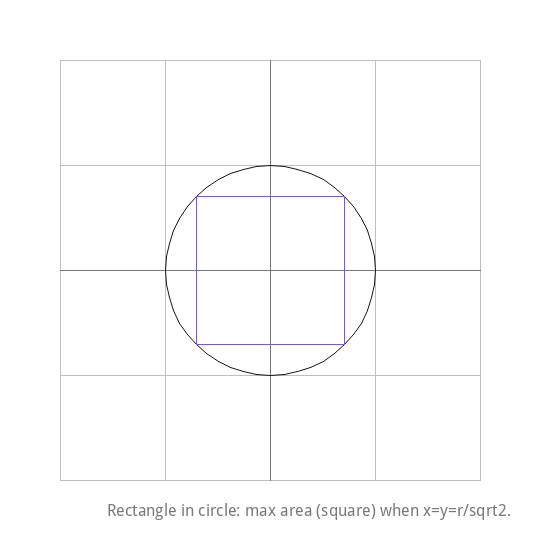
20. Show that the right circular cylinder of given surface and maximum volume is such that its height is equal to the diameter of the base.
Ans: Let the fixed surface area be S=2πr²+2πrh, so h=(S−2πr²)/(2πr). Volume V=πr²h=rS/2−πr³. Differentiating, dV/dr=S/2−3πr²=0 gives r²=S/(6π). Substituting back into h shows h=S/(3πr), and using S=6πr² at this critical point gives h=6πr²/(3πr)=2r. So the height equals the diameter of the base, as required.
21. Of all the closed cylindrical cans (right circular), of a given volume of 100 cubic centimetres, find the dimensions of the can which has the minimum surface area.
Ans: With V=πr²h=100, h=100/(πr²). Surface area S(r)=2πr²+2πrh=2πr²+200/r. S′(r)=4πr−200/r²=0 gives r³=50/π, so r=(50/π)1/3. Correspondingly h=2r. So the minimum surface area occurs when the radius is (50/π)1/3 cm and the height equals twice the radius.
22. A wire of length 28 m is to be cut into two pieces. One of the pieces is to be made into a square and the other into a circle. What should be the length of the two pieces so that the combined area of the square and the circle is minimum?
Ans: Let x be the length used for the square (so the side is x/4) and 28−x the length used for the circle (so the radius is (28−x)/(2π)). Combined area A(x)=x²/16+(28−x)²/(4π). A′(x)=x/8−(28−x)/(2π)=0 gives 2πx=8(28−x), so x(2π+8)=224, i.e. x=112/(π+4). So the piece bent into a square should have length 112/(π+4) m, and the piece bent into a circle should have length 28π/(π+4) m.
23. Prove that the volume of the largest cone that can be inscribed in a sphere of radius R is 8/27 of the volume of the sphere.
Ans: For a cone of height h inscribed in a sphere of radius R, the base radius satisfies r²=h(2R−h). Volume V(h)=(1/3)πr²h=(1/3)πh²(2R−h). V′(h)=(1/3)π(4Rh−3h²)=0 gives h=4R/3 (rejecting h=0). At this value, V=(1/3)π(4R/3)²(2R−4R/3)=(1/3)π(16R²/9)(2R/3)=32πR³/81. Since the volume of the sphere is (4/3)πR³, the ratio is (32πR³/81)/((4/3)πR³)=8/27, as required.
24. Show that the right circular cone of least curved surface and given volume has an altitude equal to √2 times the radius of the base.
Ans: With volume V=(1/3)πr²h fixed, h=3V/(πr²). The curved surface area is S=πrl=πr√(r²+h²). It is easier to minimize S²=π²r²(r²+h²)=π²(r⁴+r²h²). Substituting h=3V/(πr²) and differentiating with respect to r and setting the result to zero leads, after simplification, to h²=2r², i.e. h=√2·r. This proves the required result.
25. Show that the semi-vertical angle of the cone of the maximum volume and of given slant height is cos⁻¹(1/√3).
Ans: Let the slant height l be fixed and α the semi-vertical angle, so r=l sinα and h=l cosα. Volume V(α)=(1/3)πl²sin²α cosα. Differentiating with respect to α and setting dV/dα=0 leads to 2cos²α−sin²α=0, i.e. tan²α=2, so cos²α=1/3, giving α=cos⁻¹(1/√3), as required.
26. Show that semi-vertical angle of right circular cone of given surface area and maximum volume is sin⁻¹(1/3).
Ans: Let the total surface area S=πrl+πr² be fixed, with r=l sinα. This gives S=πl²sinα(1+sinα), so l²=S/[πsinα(1+sinα)]. Expressing the volume V in terms of α alone and differentiating with respect to α, setting dV/dα=0 leads, after simplification, to 2sin²α+sinα−1=0, i.e. (2sinα−1)(sinα+1)=0. Since sinα≠−1, sinα=1/3, so α=sin⁻¹(1/3), as required.
27. The point on the curve x²=2y which is nearest to the point (0,5) is (A) (2√2,4) (B) (2√2,0) (C) (0,0) (D) (2,2).
Ans: For a point (x,y) on the curve, y=x²/2, and the squared distance to (0,5) is D(x)=x²+(y−5)²=2y+(y−5)². Differentiating with respect to y: dD/dy=2+2(y−5)=0 gives y=4, so x²=8, x=±2√2. The nearest point is (2√2,4). The answer is (A).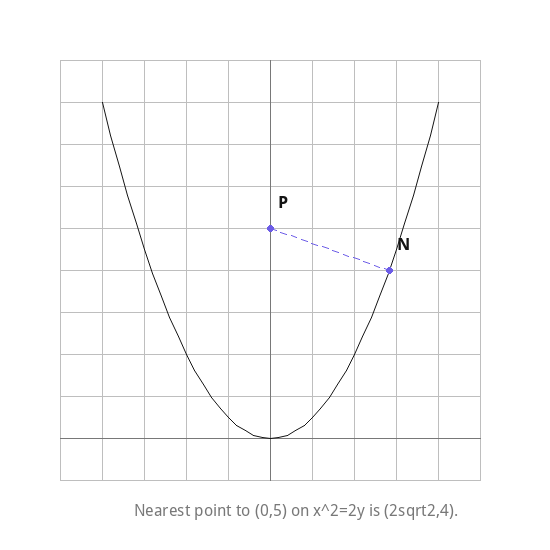
28. For all real values of x, the minimum value of (1−x+x²)/(1+x+x²) is (A) 0 (B) 1 (C) 3 (D) 1/3.
Ans: Let y=(1−x+x²)/(1+x+x²). Cross-multiplying and rearranging as a quadratic in x: (y−1)x²+(y+1)x+(y−1)=0. For real x, the discriminant must be non-negative: (y+1)²−4(y−1)²≥0, which simplifies to (3y−1)(y−3)≤0, i.e. 1/3≤y≤3. So the minimum value is 1/3. The answer is (D).
29. The maximum value of [x(x−1)+1]1/3, 0≤x≤1 is (A) (1/3)1/3 (B) 1/2 (C) 1 (D) 0.
Ans: Let g(x)=x(x−1)+1=x²−x+1. Since the cube root function is increasing, maximizing [g(x)]1/3 is equivalent to maximizing g(x) on [0,1]. g′(x)=2x−1=0 at x=1/2, which gives g(1/2)=3/4, a local minimum (since g″(x)=2>0). So the maximum of g on [0,1] occurs at an endpoint: g(0)=1 and g(1)=1. Hence the maximum value of g is 1, and the maximum value of [g(x)]1/3 is 11/3=1. The answer is (C).
Miscellaneous Exercise Solutions (All 16 Questions)
1. Show that the function given by f(x)=(log x)/x has maximum at x=e.
Ans: f′(x)=(1−log x)/x², which is zero when log x=1, i.e. x=e. For x<e, f′(x)>0, and for x>e, f′(x)<0, so x=e is a point of local maximum. The maximum value is f(e)=(log e)/e=1/e.
2. The two equal sides of an isosceles triangle with fixed base b are decreasing at the rate of 3 cm per second. How fast is the area decreasing when the two equal sides are equal to the base?
Ans: Let the equal sides have length a, with height h=√(a²−b²/4) (from the base). Area A=(1/2)bh=(b/2)√(a²−b²/4). Differentiating with respect to time: dA/dt=(b/2)·(a/h)·(da/dt). When a=b, h=(b√3)/2, and with da/dt=−3: dA/dt=(b/2)·(b/((b√3)/2))·(−3)=−√3·b. So the area is decreasing at the rate of √3·b cm²/s.
3. Find the intervals in which the function f given by f(x)=(4 sin x−2x−x cos x)/(2+cos x) is (i) increasing (ii) decreasing.
Ans: Differentiating using the quotient rule and simplifying (the domain here is 0≤x≤π): f′(x)=cos x(4−cos x)/(2+cos x)². Since (4−cos x)>0 and (2+cos x)²>0 always, the sign of f′(x) follows the sign of cos x. On (0,π/2), cos x>0, so f′(x)>0. On (π/2,π), cos x<0, so f′(x)<0. So f is increasing on (0,π/2) and decreasing on (π/2,π).
4. Find the intervals in which the function f given by f(x)=x³+1/x³, x≠0, is (i) increasing (ii) decreasing.
Ans: f′(x)=3x²−3/x⁴=3(x⁶−1)/x⁴, which is zero at x=±1. Testing signs across the intervals: f is increasing on (−∞,−1)∪(1,∞) and decreasing on (−1,0)∪(0,1).
5. Find the maximum area of an isosceles triangle inscribed in the ellipse x²/a²+y²/b²=1 with its vertex at one end of the major axis.
Ans: Using the parametrisation x=a cosθ, y=b sinθ, with the vertex at (a,0) and the base joining (a cosθ,b sinθ) and (a cosθ,−b sinθ), the area is A(θ)=b sinθ(a−a cosθ)=ab sinθ(1−cosθ). Differentiating and setting dA/dθ=0 leads to cosθ=−1/2, i.e. θ=2π/3. Substituting back, the maximum area is (3√3/4)ab.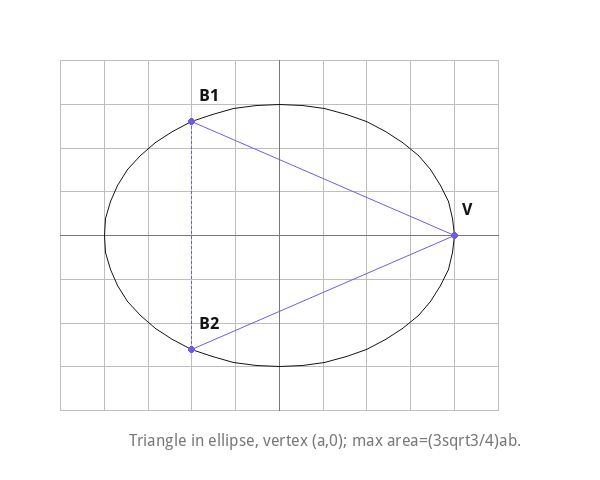
6. A tank with rectangular base and rectangular sides, open at the top, is to be constructed so that its depth is 2 m and volume is 8 m³. If building the tank costs Rs 70 per square metre for the base and Rs 45 per square metre for the sides, what is the cost of the least expensive tank?
Ans: Let the base have sides l and w, so lw·2=8, giving lw=4, i.e. w=4/l. Cost C(l)=70(lw)+45·2·2(l+w)=280+180(l+4/l). dC/dl=180(1−4/l²)=0 gives l²=4, so l=2, and correspondingly w=2 (a square base). The minimum cost is C=280+180(2+2)=280+720=1000. So the cost of the least expensive tank is Rs 1000.
7. The sum of the perimeter of a circle and a square is k, where k is some constant. Prove that the sum of their areas is least when the side of the square is double the radius of the circle.
Ans: Let the circle have radius r and the square have side x, so 2πr+4x=k, giving x=(k−2πr)/4. The combined area is A(r)=πr²+x². Differentiating and setting dA/dr=0 leads, after simplification, to x=2r. Checking the second derivative confirms this is a minimum, proving the required result.
8. A window is in the form of a rectangle surmounted by a semicircular opening. The total perimeter of the window is 10 m. Find the dimensions of the window to admit maximum light through the whole opening.
Ans: Let the rectangle have width 2r (equal to the semicircle’s diameter) and height y. The perimeter is 2y+2r+πr=10, so y=(10−2r−πr)/2. The total area (light admitted) is A(r)=2ry+(1/2)πr². Differentiating and setting dA/dr=0 leads to r=10/(π+4). Correspondingly, the rectangle’s height is also y=10/(π+4), so the window should have a rectangle of length 20/(π+4) m and breadth 10/(π+4) m, with a semicircle of the same radius on top, to admit maximum light.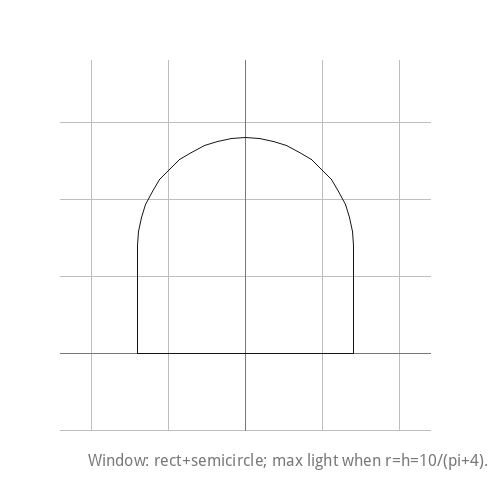
9. A point on the hypotenuse of a triangle is at distance a and b from the sides of the triangle. Show that the minimum length of the hypotenuse is (a2/3+b2/3)3/2.
Ans: Let the hypotenuse make angle θ with one leg. If the point is at perpendicular distances a and b from the two legs, the hypotenuse length is L(θ)=a/sinθ+b/cosθ. Differentiating: dL/dθ=−a cosθ/sin²θ+b sinθ/cos²θ. Setting this to zero gives b sin³θ=a cos³θ, i.e. tan³θ=a/b, so tanθ=(a/b)1/3. Substituting this back into L(θ) and simplifying using sin²θ+cos²θ=1 gives the minimum length L=(a2/3+b2/3)3/2, as required.
10. Find the points at which the function f given by f(x)=(x−2)⁴(x+1)³ has (i) local maxima (ii) local minima (iii) point of inflexion.
Ans: f′(x)=4(x−2)³(x+1)³+3(x−2)⁴(x+1)²=(x−2)³(x+1)²[4(x+1)+3(x−2)]=(x−2)³(x+1)²(7x−2), which is zero at x=−1, x=2/7, and x=2. Testing the sign of f′(x) across these points: at x=−1, the factor (x+1)² does not change sign, so f′(x) does not change sign there either — x=−1 is a point of inflexion. At x=2/7, f′(x) changes from positive to negative, so this is a point of local maximum. At x=2, f′(x) changes from negative to positive, so this is a point of local minimum.
11. Find the absolute maximum and minimum values of the function f given by f(x)=cos²x+sin x, x∈[0,π].
Ans: f′(x)=−2cos x sin x+cos x=cos x(1−2sin x), which is zero when cos x=0 (x=π/2) or sin x=1/2 (x=π/6 or 5π/6). Evaluating: f(0)=1, f(π/6)=3/4+1/2=5/4, f(π/2)=0+1=1, f(5π/6)=3/4+1/2=5/4, f(π)=1+0=1. The absolute maximum value is 5/4 (at x=π/6 and x=5π/6), and the absolute minimum value is 1 (at x=0, π/2, and π).
12. Show that the altitude of the right circular cone of maximum volume that can be inscribed in a sphere of radius r is 4r/3.
Ans: For a cone of height h inscribed in a sphere of radius r, the base radius satisfies R²=h(2r−h). Volume V(h)=(1/3)πR²h=(1/3)πh²(2r−h). Differentiating and setting dV/dh=0 gives 4rh−3h²=0, so h=4r/3 (rejecting h=0). The second derivative confirms this is a maximum, proving the required result.
13. Let f be a function defined on [a,b] such that f′(x)>0, for all x∈(a,b). Then prove that f is an increasing function on (a,b).
Ans: Let x₁,x₂∈(a,b) with x₁<x₂. By the Mean Value Theorem applied to f on [x₁,x₂], there exists c∈(x₁,x₂) such that f(x₂)−f(x₁)=f′(c)(x₂−x₁). Since f′(c)>0 (as c∈(a,b)) and x₂−x₁>0, it follows that f(x₂)−f(x₁)>0, i.e. f(x₁)<f(x₂). Since this holds for any x₁<x₂ in (a,b), f is increasing on (a,b).
14. Show that the height of the cylinder of maximum volume that can be inscribed in a sphere of radius R is 2R/√3. Also find the maximum volume.
Ans: For a cylinder of height h inscribed in a sphere of radius R, the base radius satisfies r²=R²−h²/4. Volume V(h)=πr²h=πh(R²−h²/4). Differentiating and setting dV/dh=0 gives R²−(3/4)h²=0, so h²=4R²/3, i.e. h=2R/√3. Substituting back, the maximum volume is V=4πR³/(3√3).
15. Show that the height of the cylinder of greatest volume which can be inscribed in a right circular cone of height h and semi-vertical angle α is one-third that of the cone, and the greatest volume of the cylinder is (4/27)πh³tan²α.
Ans: Let the cylinder have height y (measured from the base of the cone) and radius r. By similar triangles, r=(h−y)tanα. Volume V(y)=πr²y=π(h−y)²tan²α·y. Differentiating and setting dV/dy=0 gives (h−y)²−2y(h−y)=0, i.e. (h−y)(h−3y)=0, so y=h/3 (rejecting y=h). Substituting back, the maximum volume is V=πtan²α·(h−h/3)²·(h/3)=πtan²α·(4h²/9)·(h/3)=(4/27)πh³tan²α, as required.
16. A cylindrical tank of radius 10 m is being filled with wheat at the rate of 314 cubic metres per hour. Then the depth of the wheat is increasing at the rate of (A) 1 m/h (B) 0.1 m/h (C) 1.1 m/h (D) 0.5 m/h.
Ans: V=πr²h, so dV/dt=πr²(dh/dt). With r=10 and dV/dt=314: dh/dt=314/(π×100)=314/314.159≈1 (taking π≈3.14). So the depth is increasing at the rate of 1 m/h. The answer is (A) 1 m/h.
- Chapter 1: Relations and Functions – Free PDF Download
- Chapter 2: Inverse Trigonometric Functions – Free PDF Download
- Chapter 3: Matrices – Free PDF Download
- Chapter 4: Determinants – Free PDF Download
- Chapter 5: Continuity and Differentiability – Free PDF Download
- Chapter 7: Integrals – Free PDF Download
- Chapter 8: Applications of Integrals – Free PDF Download
- Chapter 9: Differential Equations – Free PDF Download
- Chapter 10: Vectors – Free PDF Download
- Chapter 11: Three-Dimensional Geometry – Free PDF Download
- Chapter 12: Linear Programming – Free PDF Download
- Chapter 13: Probability – Free PDF Download
Frequently Asked Questions
What is the second derivative test for local extrema?
If f′(c)=0 and f″(c)>0, c is a local minimum. If f″(c)<0, c is a local maximum. If f″(c)=0, the test is inconclusive.
What is the condition for a function to be increasing on an interval?
f′(x) ≥ 0 for all x in that interval (strictly increasing if f′(x)>0).
Chapter Quiz — Test Your Understanding
Class 12 Mathematics Chapter 6 – Notes and Extra Questions
Along with these NCERT Solutions, students can also use the Class 12 Mathematics Chapter 6 Extra Questions and Class 12 Mathematics Chapter 6 Revision Notes for quick revision and extra practice.
See also: Chapter 1 | Chapter 2 | Chapter 3 | Chapter 4 | Chapter 5
Practice more: Chapter 1 | Chapter 2 | Chapter 3 | Chapter 4 | Chapter 5
Quick revision: Chapter 1 | Chapter 2 | Chapter 3 | Chapter 4 | Chapter 5
Recommended: Buy the Printed NCERT Class 12 Maths Book
Contains Amazon affiliate links.
If you’d like a printed copy alongside the PDF, here’s a verified option:
4.3 out of 5 stars (899 ratings) · Rs. 94
Price and availability may change on Amazon. As an Amazon Associate, ncertbooks.org earns from qualifying purchases.



Pingback: Class 12 Maths Chapter 10 Vectors Revision Notes (2026-27)
Pingback: Class 12 Maths Chapter 6 Applications of Derivatives Extra Questions (2026-27)