
NCERT Class 11 Physics Chapter 12, Kinetic Theory, explains how the macroscopic behaviour of gases — pressure, temperature, and the ideal gas equation — emerges from the random motion of a very large number of molecules. Below are complete, independently worked solutions to all 10 exercise questions from the current (2023 rationalised) NCERT textbook, following the exact answers a CBSE examiner would expect, along with concise revision notes and a short FAQ on the chapter.
NCERT Exercise Solutions – Kinetic Theory (Chapter 12)
12.1 Fraction of molecular volume to actual volume of oxygen at STP
Question: Estimate the fraction of the molecular volume to the actual volume occupied by oxygen gas at STP. Take the diameter of an oxygen molecule to be 3 Å.
Last Updated: September 23, 2026
Solution: Radius of one O₂ molecule, r = 1.5 Å = 1.5 × 10⁻¹⁰ m.
Volume of one molecule, v = (4/3)πr³ = (4/3) × 3.1416 × (1.5 × 10-10)³ = 1.414 × 10⁻²⁹ m³.
At STP, 1 mole (6.022 × 10²³ molecules) occupies 22.4 L = 22.4 × 10⁻³ m³, so the actual volume available per molecule is
Vactual = (22.4 × 10⁻³)/(6.022 × 10²³) = 3.72 × 10⁻²⁶ m³.
Fraction = v/Vactual = (1.414 × 10⁻²⁹)/(3.72 × 10-26) ≈ 3.8 × 10⁻⁴. This very small ratio is why real gases at ordinary pressures behave close to ideal gases — molecules occupy a negligible fraction of the container’s volume.
12.2 Molar volume of an ideal gas at STP
Question: Molar volume is the volume occupied by 1 mol of any (ideal) gas at standard temperature and pressure (STP: 1 atmospheric pressure, 0°C). Show that it is 22.4 litres.
Solution: From the ideal gas equation, PV = nRT, so for n = 1 mol at STP (P = 1.013 × 10⁵ Pa, T = 273 K):
V = nRT/P = (1 × 8.314 × 273)/(1.013 × 10⁵) = 2269.7/101300 = 0.0224 m³ = 22.4 litres, as required.
12.3 PV/T versus P plot for oxygen
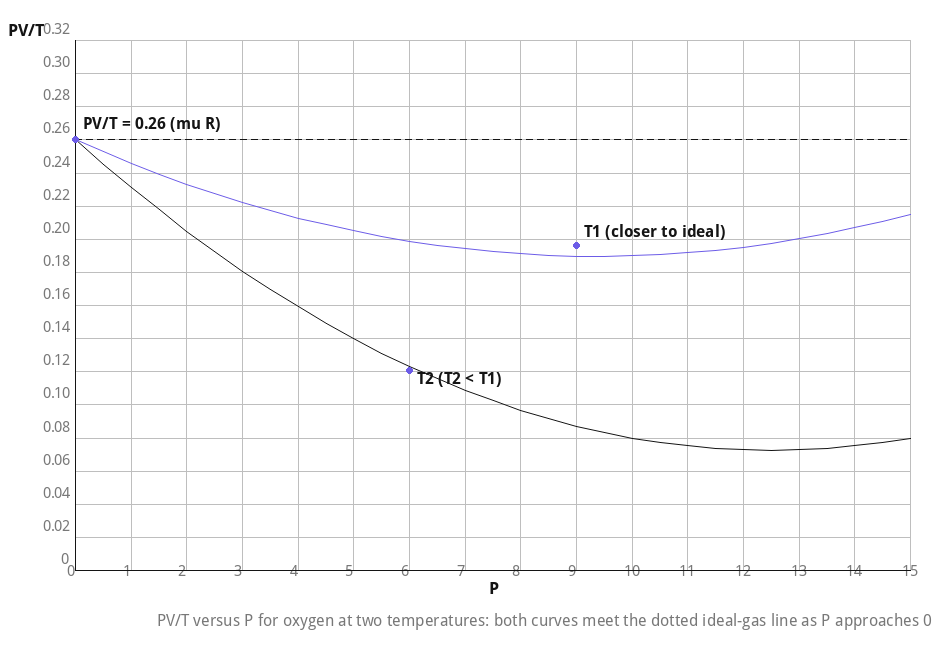
Question: Figure 12.8 (Fig. 13.8 in earlier editions) shows a plot of PV/T versus P for 1.00 × 10⁻³ kg of oxygen gas at two different temperatures.
(a) What does the dotted line signify?
(b) Which is true: T₁ > T₂ or T₁ < T₂?
(c) What is the value of PV/T where the curves meet on the y-axis?
(d) If we obtained similar plots for 1.00 × 10⁻³ kg of hydrogen, would we get the same value of PV/T at the point where the curves meet on the y-axis? If not, what mass of hydrogen yields the same value?
Solution:
(a) The dotted line represents the ideal gas behaviour, i.e., PV/T = μR = constant, independent of pressure. Real gases approach this line as P → 0.
(b) At any given pressure, the curve closer to the dotted (ideal) line deviates least from ideal behaviour. Since a gas behaves more ideally at higher temperature (molecules are farther apart on average relative to their size and interactions), the curve for T₁ lies closer to the dotted line, so T₁ > T₂.
(c) At the y-axis (P → 0), PV/T = μR, independent of temperature. Number of moles μ = mass/molar mass = (1.00 × 10⁻³ kg)/(32 × 10-3 kg/mol) = 0.03125 mol.
PV/T = μR = 0.03125 × 8.314 = 0.26 J K-1 (approximately).
(d) No. Since PV/T = μR depends on the number of moles μ, not on the mass alone, using the same mass (1.00 × 10⁻³ kg) of hydrogen (M = 2 g/mol) would give a different, larger μ and hence a different intercept. To get the same value of PV/T, hydrogen must have the same number of moles as the oxygen sample: mass of H₂ = μ × MH2 = 0.03125 × 2 × 10-3 kg = 6.25 × 10⁻⁵ kg (0.0625 g).
12.4 Mass of oxygen withdrawn from a cylinder
Question: An oxygen cylinder of volume 30 litres has an initial gauge pressure of 15 atm and a temperature of 27°C. After some oxygen is withdrawn, the gauge pressure drops to 11 atm and the temperature drops to 17°C. Estimate the mass of oxygen taken out of the cylinder. (R = 8.31 J mol-1 K-1, molecular mass of O₂ = 32 u.)
Solution: Using PV = nRT with R = 0.0821 L atm mol-1 K-1:
Initial moles: n₁ = P₁V/RT₁ = (15 × 30)/(0.0821 × 300) = 450/24.63 = 18.27 mol.
Final moles: n₂ = P₂V/RT₂ = (11 × 30)/(0.0821 × 290) = 330/23.81 = 13.86 mol.
Moles withdrawn, Δn = n₁ − n₂ = 18.27 − 13.86 = 4.41 mol.
Mass withdrawn = Δn × 32 g/mol = 4.41 × 32 ≈ 141 g.
12.5 Volume of a rising air bubble
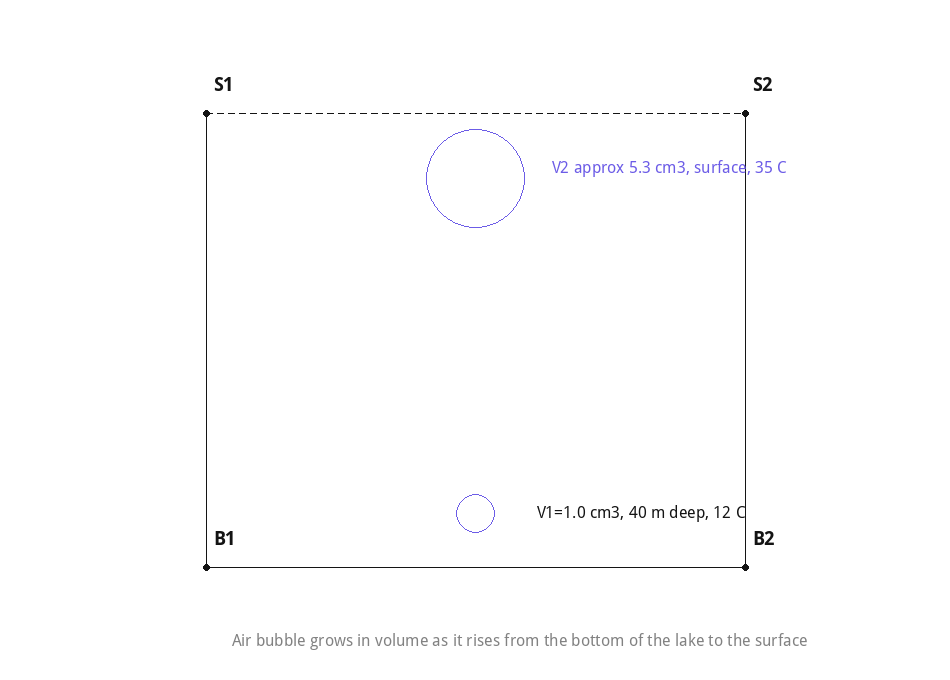
Question: An air bubble of volume 1.0 cm³ rises from the bottom of a lake 40 m deep at a temperature of 12°C. To what volume does it grow when it reaches the surface, which is at a temperature of 35°C? (1 atm = 1.01 × 10⁵ Pa, and density of water = 1000 kg m-3; g = 9.8 m s-2.)
Solution: Pressure at the bottom, P₁ = Patm + ρgh = 1.01 × 10⁵ + (1000 × 9.8 × 40) = 1.01 × 10⁵ + 3.92 × 10⁵ = 4.93 × 10⁵ Pa.
Pressure at the surface, P₂ = 1.01 × 10⁵ Pa.
T₁ = 285 K, T₂ = 308 K.
Using P₁V₁/T₁ = P₂V₂/T₂:
V₂ = V₁ × (P₁/P₂) × (T₂/T₁) = 1.0 × (4.93/1.01) × (308/285) = 1.0 × 4.881 × 1.081 ≈ 5.3 cm³.
12.6 Number of air molecules in a room
Question: Estimate the total number of air molecules (inclusive of oxygen, nitrogen, water vapour, and other constituents) in a room of capacity 25.0 m³ at a temperature of 27°C and 1 atm pressure.
Solution: n = PV/RT = (1.013 × 10⁵ × 25.0)/(8.314 × 300) = (2.5325 × 10⁶)/2494.2 = 1015.4 mol.
Number of molecules N = n × NA = 1015.4 × 6.022 × 10²³ ≈ 6.11 × 10²⁶ molecules.
12.7 Average thermal energy of a helium atom
Question: Estimate the average thermal energy of a helium atom at (i) room temperature (27°C), (ii) the temperature on the surface of the Sun (6000 K), and (iii) the temperature of 10 million kelvin (the core of a star).
Solution: Average thermal (translational kinetic) energy per molecule = (3/2)kBT, where kB = 1.38 × 10⁻²³ J/K.
(i) T = 300 K: E = 1.5 × 1.38 × 10-23 × 300 = 6.21 × 10⁻²¹ J.
(ii) T = 6000 K: E = 1.5 × 1.38 × 10-23 × 6000 = 1.24 × 10⁻¹⁹ J.
(iii) T = 1.0 × 10⁶ K: E = 1.5 × 1.38 × 10-23 × 1.0 × 10⁶ = 2.07 × 10⁻¹⁶ J.
12.8 Neon, chlorine and uranium hexafluoride in equal vessels
Question: Three vessels of equal capacity have gases at the same temperature and pressure. The first vessel contains neon (monatomic), the second contains chlorine (diatomic), and the third contains uranium hexafluoride (polyatomic). Do the vessels contain equal number of respective molecules? Is the root mean square speed of molecules the same in the three cases? If not, in which case is vrms the largest?
Solution: By Avogadro’s law, equal volumes of any gas at the same temperature and pressure contain an equal number of molecules, regardless of the gas’s atomicity or molar mass. So yes, all three vessels contain the same number of molecules.
However, vrms = √(3RT/M) depends on the molar mass M. Since T is the same for all three, vrms is not the same: it is inversely proportional to √M. Neon has the smallest molar mass (M ≈ 20.2 g/mol) compared to chlorine (M ≈ 71 g/mol) and uranium hexafluoride (M ≈ 352 g/mol), so neon has the largest vrms.
12.9 Temperature for equal rms speeds of argon and helium
Question: At what temperature is the root mean square speed of an atom in an argon gas cylinder equal to the rms speed of a helium gas atom at −20°C? (Atomic mass of Ar = 39.9 u, of He = 4.0 u.)
Solution: vrms = √(3RT/M). Setting vrms,Ar(T) = vrms,He(253 K):
3RT/MAr = 3R(253)/MHe
T = 253 × (MAr/MHe) = 253 × (39.9/4.0) = 253 × 9.975 ≈ 2523.7 K.
12.10 Mean free path and collision frequency of nitrogen
Question: Estimate the mean free path and collision frequency of a nitrogen molecule in a cylinder containing nitrogen at 2.0 atm and temperature 17°C. Take the radius of a nitrogen molecule to be roughly 1.0 Å. Compare the collision time with the time the molecule moves freely between two successive collisions (molecular mass of N₂ = 28.0 u).
Solution: Diameter d = 2.0 Å = 2.0 × 10⁻¹⁰ m; T = 290 K; P = 2.0 × 1.013 × 10⁵ Pa = 2.026 × 10⁵ Pa.
Number density, n = P/(kBT) = (2.026 × 10⁵)/(1.38 × 10-23 × 290) = 5.06 × 10²⁵ molecules/m³.
Mean free path, λ = 1/(√2 · πd² · n) = 1/(1.414 × 3.1416 × (2.0 × 10-10)² × 5.06 × 10²⁵)
= 1/(1.414 × 3.1416 × 4.0 × 10-20 × 5.06 × 10²⁵) ≈ 1.11 × 10⁻⁷ m.
vrms = √(3RT/M) = √(3 × 8.314 × 290/0.028) = √(258,330) ≈ 508 m/s.
Collision frequency = vrms/λ = 508/(1.11 × 10-7) ≈ 4.58 × 10⁹ collisions per second.
Collision time τ = d/vrms = (2.0 × 10⁻¹⁰)/508 ≈ 3.9 × 10⁻¹³ s. Free time between collisions T₂ = λ/vrms = (1.11 × 10⁻⁷)/508 ≈ 2.2 × 10⁻¹⁰ s. The ratio T₂/τ ≈ 560, i.e., a molecule spends far more time moving freely than colliding — this justifies treating molecular collisions as instantaneous point events in kinetic theory.
Notes and Extra Questions
Key formulas from the chapter:
Ideal gas equation: PV = nRT (or PV = μRT, where μ is the number of moles).
Pressure from kinetic theory: P = (1/3)ρv²rms = (1/3)(nm)v²rms, where n is number density and m is the mass of a molecule.
Average kinetic energy per molecule: (1/2)mv²rms = (3/2)kBT (this is independent of the nature of the gas — it depends only on temperature).
Root mean square speed: vrms = √(3RT/M) = √(3kBT/m).
Law of equipartition of energy: each degree of freedom (translational, rotational, or vibrational) contributes (1/2)kBT of energy per molecule on average. A vibrational mode contributes kBT (kinetic + potential) if fully active.
Degrees of freedom: monatomic gas — 3 (translational only); diatomic gas — 5 at moderate temperatures (3 translational + 2 rotational), rising to 7 at high temperatures if vibration is active; polyatomic (non-linear) gas — 6 (3 translational + 3 rotational), plus vibrational modes at higher temperatures.
Specific heats from degrees of freedom: Cv = (f/2)R and Cp = Cv + R, where f is the number of degrees of freedom; so γ = Cp/Cv = 1 + 2/f.
Mean free path: λ = 1/(√2 πd²n), the average distance a molecule travels between successive collisions, where d is the molecular diameter and n is the number density.
Concepts worth revising carefully: the distinction between vrms, average speed, and most probable speed (they are numerically different even though all three describe molecular speed distribution, per the Maxwell speed distribution introduced conceptually in this chapter); why gas pressure is independent of the nature of the gas at a given number density and temperature; why real gases deviate from the ideal gas law at high pressure and low temperature (finite molecular size and intermolecular attraction, addressed by the Van der Waals equation, mentioned qualitatively in the chapter); and the assumptions of the kinetic theory of gases (point-sized molecules in random motion, elastic collisions, no intermolecular forces except during collision, and Newtonian mechanics applying to each molecule).
Note on the current syllabus: as part of the CBSE/NCERT 2023 content rationalisation, the sub-topic “Specific Heat Capacity of Water” and the exercise questions that accompanied it (which dealt with the anomalous behaviour of water’s specific heat using the vibrational degrees of freedom of the H₂O molecule) have been removed from the current textbook. The exercise numbering above (12.1–12.10) reflects only the questions that remain in the current, examinable 2026-27 edition.
- Chapter 1: Units and Measurements (2026-27)
- Chapter 2: Motion in a Straight Line – Free PDF Download
- Chapter 3: Motion in a Plane – Free PDF Download
- Chapter 4: Laws of Motion – Free PDF Download
- Chapter 5: Work, Energy and Power – Free PDF Download
- Chapter 6: System of Particles and Rotational Motion – Free PDF Download
- Chapter 7: Gravitation – Free PDF Download
- Chapter 8: Mechanical Properties of Solids – Free PDF Download
- Chapter 9: Mechanical Properties of Fluids – Free PDF Download
- Chapter 10: Thermal Properties of Matter – Free PDF Download
- Chapter 11: Thermodynamics – Free PDF Download
- Chapter 13: Oscillations – Free PDF Download
- Chapter 14: Waves – Free PDF Download
FAQs on NCERT Class 11 Physics Chapter 12 – Kinetic Theory
Q1. How many questions are there in the Kinetic Theory chapter’s exercises in the current NCERT textbook?
The current (2023 rationalised, 2026-27 reprint) NCERT Class 11 Physics textbook has 10 exercise questions (numbered 12.1 to 12.10) at the end of the Kinetic Theory chapter. Four questions that were part of older editions (dealing with a horizontal mercury tube, gas diffusion via Graham’s law, sedimentation equilibrium, and estimating atomic sizes from density data) were dropped along with the “Specific Heat Capacity of Water” topic during rationalisation.
Q2. Why does gas pressure not depend on the type of gas, only on its number density and temperature?
From kinetic theory, P = (1/3)nmv²rms, and since (1/2)mv²rms = (3/2)kBT for every ideal gas regardless of molecular mass, substituting gives P = nkBT. This shows pressure depends only on the number of molecules per unit volume (n) and the absolute temperature (T) — not on the identity or mass of the gas molecules.
Q3. What is the difference between vrms, average speed, and most probable speed?
These are three different statistical measures of the same Maxwell-Boltzmann speed distribution of gas molecules. The most probable speed is the speed at which the distribution curve peaks; the average speed is the arithmetic mean of all molecular speeds; and vrms is the square root of the mean of the squares of the speeds. For any gas, vrms > average speed > most probable speed, though all three are proportional to √(T/M).
Q4. Why do diatomic and polyatomic gases have higher specific heats than monatomic gases?
By the law of equipartition of energy, every additional degree of freedom (rotational or vibrational, beyond the 3 translational ones common to all gases) adds (1/2)kBT of average energy per molecule. Diatomic gases have 2 extra rotational degrees of freedom (f = 5) and polyatomic gases have 3 (f = 6), sometimes more if vibration is active at higher temperatures. Since Cv = (f/2)R, a larger f directly means a larger molar specific heat compared to a monatomic gas (f = 3, Cv = 3R/2).
Frequently Asked Questions
What are the basic assumptions of the kinetic theory of gases?
Gas molecules are treated as point masses in constant random motion, undergoing perfectly elastic collisions with each other and the container walls, with negligible intermolecular forces except during collisions — these assumptions are what let the theory derive the ideal gas equation.
What is the difference between an ideal gas and a real gas?
An ideal gas exactly follows PV=nRT at all temperatures and pressures because its molecules are assumed to have no volume and no intermolecular forces; a real gas deviates from this, especially at high pressure and low temperature, because real molecules do occupy volume and do attract/repel each other.
Recommended: Buy the Printed NCERT Class 11 Physics Book Set
Contains Amazon affiliate links.
If you’d like a printed copy alongside the PDF, here’s a verified option:
Rs. 280
Price and availability may change on Amazon. As an Amazon Associate, ncertbooks.org earns from qualifying purchases.


