
Chapter 3 of Ganita Manjari, the NCERT Class 9 Mathematics textbook for the 2026-27 session, takes students on a journey through the history and structure of the number system. The World of Numbers opens with the story of ancient herders on the banks of the Sarasvatī river using pebbles to count cattle, travels through the Ishango and Lebombo bones, and celebrates Brahmagupta’s formalisation of zero and negative numbers before building up Natural Numbers, Integers, Rational Numbers, Irrational Numbers and finally the Real Number system, along with decimal expansions and cyclic numbers. This page provides complete NCERT solutions for Class 9 Maths Chapter 3 The World of Numbers, with detailed answers to every Exercise Set question from the Ganita Manjari textbook.
Last Updated: September 23, 2026
3.1 Natural Numbers — Exercise Set 3.1 (Page 41)
Q1. A merchant in the port city of Lothal is exchanging bags of spices for copper ingots. He receives 15 ingots for every 2 bags of spices. If he brings 12 bags of spices to the market, how many copper ingots will he leave with? — Answer: 2 bags of spices = 15 ingots, so 1 bag of spices = 15/2 ingots. For 12 bags of…
Answer: 2 bags of spices = 15 ingots, so 1 bag of spices = 15/2 ingots.
For 12 bags of spices = 12 × (15/2) = 6 × 15 = 90.
Therefore, the merchant will leave with 90 copper ingots.
Q2. Look at the sequence of numbers on one column of the Ishango bone: 11, 13, 17, 19. What do these numbers have in common? List the next three numbers that fit this pattern — Answer: The numbers 11, 13, 17, 19 are all prime numbers — each has exactly two…
Answer: The numbers 11, 13, 17, 19 are all prime numbers — each has exactly two factors, 1 and itself. The next three prime numbers after 19 are 23, 29 and 31.
Q3. We know that Natural Numbers are closed under addition (the sum of any two natural numbers is always a natural number). Are they closed under subtraction? Provide a couple of examples to justify your answer — Answer: Natural numbers are not closed under subtraction. Closure would require the…
Answer: Natural numbers are not closed under subtraction. Closure would require the result of subtracting any two natural numbers to always be a natural number, but this fails in general.
Example (i): 5 − 3 = 2, which is a natural number.
Example (ii): 3 − 5 = −2, which is not a natural number.
Since subtraction can produce a negative number, natural numbers are not closed under subtraction.
Q4. Ancient Indians used the joints of their fingers to count, a practice still seen today. Each finger has 3 joints, and the thumb is used to count them. How many can you count on one hand? How does this relate to the ancient base-12 counting systems? — Answer: Each of the four fingers (excluding the thumb) has 3 joints, so the total number…
Answer: Each of the four fingers (excluding the thumb) has 3 joints, so the total number of joints countable with the thumb is 4 × 3 = 12. This means one hand can count up to 12. Since counting naturally reaches 12 on one hand, it explains the historical origin of base-12 (duodecimal) counting systems used by ancient civilisations.
3.2 Integers — Exercise Set 3.2 (Page 44)
Q1. The temperature in the high-altitude desert of Ladakh is recorded as 4°C at noon. By midnight, it drops by 15°C. What is the midnight temperature? — Answer: Initial temperature = 4°C. Drop = 15°C. Midnight temperature = 4 − 15 =…
Answer: Initial temperature = 4°C. Drop = 15°C.
Midnight temperature = 4 − 15 = −11°C.
Therefore, the midnight temperature is −11°C.
Q2. A spice trader takes a loan (debt) of ₹850. The next day, he makes a profit (fortune) of ₹1,200. The following week, he incurs a loss of ₹450. Write this sequence as an equation using integers and calculate his final financial standing — Answer: Debt = −₹850, profit = +₹1200, loss = −₹450. Equation: −850 + 1200…
Answer: Debt = −₹850, profit = +₹1200, loss = −₹450.
Equation: −850 + 1200 − 450 = 350 − 450 = −100.
Therefore, his final financial standing is −₹100, that is, a net loss of ₹100.
Q3. Calculate the following using Brahmagupta's laws: (i) (−12) × 5 (ii) (−8) × (−7) (iii) 0 − (−14) (iv) (−20) ÷ 4 — Answer: By Brahmagupta's laws, debt is negative and fortune is positive. (i) Negative ×…
Answer: By Brahmagupta’s laws, debt is negative and fortune is positive.
(i) Negative × Positive = Negative (debt × fortune = debt), so (−12) × 5 = −60.
(ii) Negative × Negative = Positive (debt × debt = fortune), so (−8) × (−7) = 56.
(iii) Zero minus a debt is a fortune; subtracting a negative is the same as adding, so 0 − (−14) = 0 + 14 = 14.
(iv) Negative ÷ Positive = Negative (debt ÷ fortune = debt), so (−20) ÷ 4 = −5.
Q4. Explain, using a real-world example of debt, why subtracting a negative number is the same as adding a positive number (e.g., 10 − (−5) = 15) — Answer: Suppose you have ₹10, and a negative number represents a debt. So −₹5…
Answer: Suppose you have ₹10, and a negative number represents a debt. So −₹5 means you owe ₹5. Now, 10 − (−5) means removing (cancelling) a debt of ₹5. If a debt is removed, your money effectively increases by that amount. So 10 − (−5) = 10 + 5 = 15. Thus, subtracting a negative number has the same effect as adding the corresponding positive number.
3.3 Rational Numbers — Exercise Set 3.3 (Page 47)
Q1. Prove that the following rational numbers are equal: (i) 2/3 and 4/6 (ii) 5/4 and 10/8 (iii) −3/5 and −6/10 (iv) 9/3 and 3 — Answer: (i) 4/6 = 2/3 after dividing numerator and denominator by 2. So 2/3 = 4/6. (ii)…
Answer:
(i) 4/6 = 2/3 after dividing numerator and denominator by 2. So 2/3 = 4/6.
(ii) 10/8 = 5/4 after dividing numerator and denominator by 2. So 5/4 = 10/8.
(iii) −6/10 = −3/5 after dividing numerator and denominator by 2. So −3/5 = −6/10.
(iv) 9/3 = 3, so 9/3 and 3 are equal.
Q2. Find the sum: (i) 2/5 + 3/10 (ii) 7/12 + 5/8 (iii) −4/7 + 3/14 — Answer: (i) LCM of 5 and 10 is 10. 2/5 = 4/10, so 4/10 + 3/10 = 7/10. (ii) LCM of 12 and…
Answer:
(i) LCM of 5 and 10 is 10. 2/5 = 4/10, so 4/10 + 3/10 = 7/10.
(ii) LCM of 12 and 8 is 24. 7/12 = 14/24 and 5/8 = 15/24, so 14/24 + 15/24 = 29/24.
(iii) LCM of 7 and 14 is 14. −4/7 = −8/14, so −8/14 + 3/14 = −5/14.
Q3. Find the difference: (i) 5/6 − 1/4 (ii) 11/8 − 3/4 (iii) −7/9 − (−2/3) — Answer: (i) LCM of 6 and 4 is 12. 5/6 = 10/12 and 1/4 = 3/12, so 10/12 − 3/12 = 7/12.…
Answer:
(i) LCM of 6 and 4 is 12. 5/6 = 10/12 and 1/4 = 3/12, so 10/12 − 3/12 = 7/12.
(ii) LCM of 8 and 4 is 8. 3/4 = 6/8, so 11/8 − 6/8 = 5/8.
(iii) −7/9 − (−2/3) = −7/9 + 2/3. LCM of 9 and 3 is 9. 2/3 = 6/9, so −7/9 + 6/9 = −1/9.
Q4. Find the product: (i) 2/3 × 3/10 (ii) 7/11 × 5/8 (iii) −4/7 × 5/14 — Answer: (i) (2 × 3)/(3 × 10) = 6/30 = 1/5. (ii) (7 × 5)/(11 × 8) = 35/88. (iii)…
Answer:
(i) (2 × 3)/(3 × 10) = 6/30 = 1/5.
(ii) (7 × 5)/(11 × 8) = 35/88.
(iii) (−4 × 5)/(7 × 14) = −20/98 = −10/49.
Q5. Find the quotient: (i) 2/3 ÷ 3/10 (ii) 7/11 ÷ 5/8 (iii) −4/7 ÷ 5/14 — Answer: To divide fractions, multiply by the reciprocal of the divisor. (i) 2/3 × 10/3…
Answer: To divide fractions, multiply by the reciprocal of the divisor.
(i) 2/3 × 10/3 = 20/9.
(ii) 7/11 × 8/5 = 56/55.
(iii) −4/7 × 14/5 = −56/35 = −8/5.
Q6. Show that: (1/2 + 3/4) × 8/3 = 1/2 × 8/3 + 3/4 × 8/3 — Answer: LHS = (1/2 + 3/4) × 8/3 = (2/4 + 3/4) × 8/3 = (5/4) × (8/3) = 40/12 = 10/3.…
Answer: LHS = (1/2 + 3/4) × 8/3 = (2/4 + 3/4) × 8/3 = (5/4) × (8/3) = 40/12 = 10/3.
RHS = (1/2 × 8/3) + (3/4 × 8/3) = 8/6 + 24/12 = 4/3 + 2 = 10/3.
Since LHS = RHS = 10/3, the distributive property of multiplication over addition is verified for rational numbers.
Q7. Simplify the following using the distributive property: (7/9)(6/7 − 3/4) — Answer: 7/9 × (6/7 − 3/4) = (7/9 × 6/7) − (7/9 × 3/4) = 6/9 − 21/36 = 2/3 −…
Answer: 7/9 × (6/7 − 3/4) = (7/9 × 6/7) − (7/9 × 3/4) = 6/9 − 21/36 = 2/3 − 7/12.
LCM of 3 and 12 is 12: 2/3 = 8/12, so 8/12 − 7/12 = 1/12.
Therefore, 7/9(6/7 − 3/4) = 1/12.
Q8. Find the rational number x such that: (5/6)(x + 3/5) = (5/6)x + 1/2 — Answer: Expanding the left side using the distributive property: (5/6)x + (5/6 × 3/5) =…
Answer: Expanding the left side using the distributive property: (5/6)x + (5/6 × 3/5) = (5/6)x + 15/30 = (5/6)x + 1/2.
This is identical to the right side, (5/6)x + 1/2, for every value of x — the equation is an identity following directly from the distributive law. Therefore, x can be any rational number.
3.4 Representing Rational Numbers on the Number Line — Exercise Set 3.4 (Page 52)
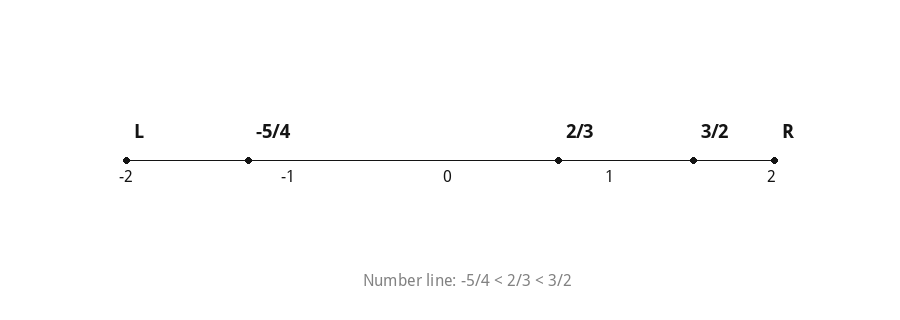
Q1. Represent the rational numbers 2/3, −5/4 and 1½ on a single number line — Answer: Converting to decimals for comparison: −5/4 = −1.25, 2/3 ≈ 0.67, and 1½ =…
Answer: Converting to decimals for comparison: −5/4 = −1.25, 2/3 ≈ 0.67, and 1½ = 3/2 = 1.5.
So −5/4 lies between −2 and −1; 2/3 lies between 0 and 1; and 3/2 lies between 1 and 2.
The order is −5/4 < 2/3 < 3/2, and these three points can be marked accordingly on a single number line drawn to scale.
Q2. Find three distinct rational numbers that lie strictly between −1/2 and 1/4 — Answer: Writing both numbers with a common denominator of 4: −1/2 = −2/4. So we need…
Answer: Writing both numbers with a common denominator of 4: −1/2 = −2/4. So we need numbers strictly between −2/4 and 1/4.
Three such rational numbers are −1/4, 0 and 1/8 (since −1/4 = −0.25, 0, and 1/8 = 0.125 all lie between −0.5 and 0.25). Note that infinitely many rational numbers exist between any two given rational numbers.
Q3. Simplify the expression: (−1/4) + (5/12) — Answer: LCM of 4 and 12 is 12. −1/4 = −3/12, so −3/12 + 5/12 = 2/12 = 1/6.
Answer: LCM of 4 and 12 is 12. −1/4 = −3/12, so −3/12 + 5/12 = 2/12 = 1/6.
Q4. A tailor has 15¾ metres of fine silk. If making one kurta requires 2¼ metres of silk, exactly how many kurtas can he make? — Answer: Converting to improper fractions: 15¾ = 63/4 and 2¼ = 9/4. Number of kurtas =…
Answer: Converting to improper fractions: 15¾ = 63/4 and 2¼ = 9/4.
Number of kurtas = (63/4) ÷ (9/4) = 63/4 × 4/9 = 63/9 = 7.
Therefore, the tailor can make exactly 7 kurtas.
Q5. Find three rational numbers between 3.1415 and 3.1416 — Answer: By inserting additional decimal places, we can find as many rational numbers as…
Answer: By inserting additional decimal places, we can find as many rational numbers as we like between the two given numbers: 3.1415 < 3.14151 < 3.14152 < 3.14153 < 3.1416. So three rational numbers between 3.1415 and 3.1416 are 3.14151, 3.14152 and 3.14153.
Q6. Can you think of other way(s) to find a rational number between any two rational numbers? — Answer: Yes, some other methods are: 1. Taking the average: If a and b are two rational…
Answer: Yes, some other methods are:
1. Taking the average: If a and b are two rational numbers with a < b, then (a + b)/2 always lies strictly between them.
2. Making a common denominator: convert both numbers to the same denominator and choose an integer numerator strictly in between.
3. Using decimal expansion: convert both numbers to decimals and insert extra decimal digits in between.
Since any of these methods can be repeated indefinitely, there are infinitely many rational numbers between any two distinct rational numbers.
3.5 Decimal Expansions and Real Numbers — Exercise Set 3.5 (Page 56)
Q1. Without performing long division, determine which of the following rational numbers will have terminating decimals and which will be repeating: 7/20, 4/15 and 13/250. Then check your answers by explicitly performing the long divisions and expressing these rational numbers as decimals — Answer: A rational number p/q in lowest form has a terminating decimal if and only if…
Answer: A rational number p/q in lowest form has a terminating decimal if and only if the only prime factors of q are 2 and/or 5; otherwise its decimal expansion repeats.
(i) 7/20: 20 = 2² × 5, so the decimal terminates. By long division, 7/20 = 0.35.
(ii) 4/15: 15 = 3 × 5, and 3 is a prime factor other than 2 or 5, so the decimal repeats. By long division, 4/15 = 0.2666… = 0.2̅3̅.
(iii) 13/250: 250 = 2 × 5³, so the decimal terminates. By long division, 13/250 = 0.052.
Q2. Perform the long division for 1/13. Identify the repeating block of digits. Does it show cyclic properties if you evaluate 2/13? Now compute 3/13, 4/13, etc. What do you notice? — Answer: 1/13 = 0.076923076923… — the repeating block is 076923. 2/13 =…
Answer: 1/13 = 0.076923076923… — the repeating block is 076923.
2/13 = 0.153846153846… (block: 153846)
3/13 = 0.230769230769… (block: 230769)
4/13 = 0.307692307692… (block: 307692)
5/13 = 0.384615384615… (block: 384615)
6/13 = 0.461538461538… (block: 461538)
Each of these decimals is repeating, and every repeating block is simply a cyclic rotation of the digits 076923. This confirms that the reciprocal of 13 shows cyclic behaviour, similar to the well-known cyclic number 142857 formed from 1/7.
Q3. Classify the following numbers as rational or irrational: (i) √81 (ii) √12 (iii) 0.33333… (iv) 0.123451234512345… (v) 1.01001000100001… (vi) 23.560185612239874790120 — Answer: (i) √81 = 9 = 9/1, which is rational. (ii) √12 = 2√3; since √3 is…
Answer:
(i) √81 = 9 = 9/1, which is rational.
(ii) √12 = 2√3; since √3 is irrational, √12 is irrational.
(iii) 0.33333… = 1/3, a repeating decimal, so it is rational.
(iv) 0.123451234512345… has a repeating block “12345” of length 5. Let x = 0.123451234512345…; then 100000x = 12345.123451234512345…, so 100000x − x = 12345, giving 99999x = 12345, so x = 12345/99999 = 4115/33333. This is rational.
(v) 1.01001000100001… is non-terminating and non-repeating — the number of zeros between successive 1s keeps increasing without forming a fixed repeating block — so it is irrational.
(vi) 23.560185612239874790120 is a terminating decimal, and every terminating decimal is rational, so it is rational (it can be written as 23560185612239874790120/10²¹).
Q4. The number 0.9̅ (which means 0.99999…) is a rational number. Using algebra (let x = 0.9̅, multiply by 10, and subtract), explain why 0.9̅ is exactly equal to 1 — Answer: Let x = 0.99999…. Multiplying both sides by 10: 10x = 9.99999…. Subtracting…
Answer: Let x = 0.99999…. Multiplying both sides by 10: 10x = 9.99999…. Subtracting the first equation from the second: 10x − x = 9.99999… − 0.99999…, so 9x = 9, giving x = 1. But x was defined as 0.99999…, so 0.99999… = 1 exactly — not merely “close to” 1.
Q5. We have seen that the repeating block of 1/7 is a cyclic number. Try to find more numbers (n) whose reciprocals (1/n) produce decimals with repeating blocks that are cyclic — Answer: Besides 7, other such numbers include 17 and 19: 1/7 = 0.142857142857… (cyclic…
Answer: Besides 7, other such numbers include 17 and 19:
1/7 = 0.142857142857… (cyclic block 142857)
1/17 = 0.0588235294117647… (repeats with a 16-digit cyclic block)
1/19 = 0.052631578947368421… (repeats with an 18-digit cyclic block)
These are examples of “full reptend primes” — primes n for which the decimal expansion of 1/n has the maximum possible repeating-block length of (n − 1) digits, and whose digit blocks rotate cyclically when multiplied by 1, 2, 3, … up to (n − 1).
End-of-Chapter Exercises (Page 60)
Q1. Convert the following rational numbers in the form of a terminating decimal or non-terminating and repeating decimal, whichever the case may be, by the process of long division: (i) 3/50 (ii) 2/9 — Answer: (i) 3/50 = 0.06, a terminating decimal. (ii) 2/9 = 0.2222… = 0.2̅, a…
Answer: (i) 3/50 = 0.06, a terminating decimal.
(ii) 2/9 = 0.2222… = 0.2̅, a non-terminating repeating decimal.
Q2. Prove that √5 is an irrational number — Answer: We use proof by contradiction. Suppose √5 is rational, so √5 = p/q, where p…
Answer: We use proof by contradiction. Suppose √5 is rational, so √5 = p/q, where p and q are integers, q ≠ 0, and p/q is in its lowest terms (p and q share no common factor other than 1).
Squaring both sides: 5 = p²/q², so p² = 5q². This means p² is divisible by 5, and therefore p itself must be divisible by 5. So let p = 5k for some integer k.
Substituting: (5k)² = 5q² ⇒ 25k² = 5q² ⇒ 5k² = q². This shows q² is divisible by 5, so q must also be divisible by 5.
But now both p and q are divisible by 5, contradicting the assumption that p/q was in lowest terms. Hence our original assumption is false, and √5 is irrational.
Q3. Convert the following decimal numbers into the form p/q: (i) 12.6 (ii) 0.0120 (iii) 3.05̅2̅ (iv) 1.23̅5̅ (v) 0.2̅3̅ (vi) 2.05̅ (vii) 2.125̅ (viii) 3.125̅ (ix) 2.1625̅ (repeating block "1625") — Answer: (i) 12.6 = 126/10 = 63/5. (ii) 0.0120 = 120/10000 = 3/250. (iii) Let x =…
Answer:
(i) 12.6 = 126/10 = 63/5.
(ii) 0.0120 = 120/10000 = 3/250.
(iii) Let x = 3.0525252…. Then 10x = 30.525252… and 1000x = 3052.525252…. Subtracting: 990x = 3022, so x = 3022/990 = 1511/495.
(iv) Let x = 1.2353535…. Then 10x = 12.353535… and 1000x = 1235.353535…. Subtracting: 990x = 1223, so x = 1223/990.
(v) Let x = 0.232323…. Then 100x = 23.232323…. Subtracting: 99x = 23, so x = 23/99.
(vi) Let x = 2.055555…. Then 10x = 20.5555… and 100x = 205.5555…. Subtracting: 90x = 185, so x = 185/90 = 37/18.
(vii) Let x = 2.1255555…. Then 100x = 212.5555… and 1000x = 2125.5555…. Subtracting: 900x = 1913, so x = 1913/900.
(viii) Let x = 3.1255555…. Then 100x = 312.5555… and 1000x = 3125.5555…. Subtracting: 900x = 2813, so x = 2813/900.
(ix) Let x = 2.162516251625…. Then 10000x = 21625.16251625…. Subtracting: 9999x = 21623, so x = 21623/9999.
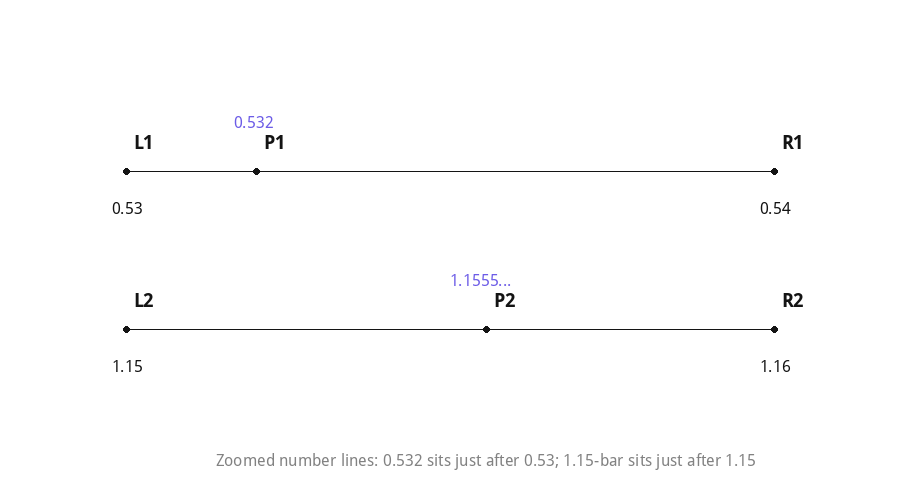
Q4. Locate the following rational numbers on the number line: (i) 0.532 (ii) 1.15̅ — Answer: (i) 0.532 = 532/1000 lies between 0 and 1, specifically between 0.53 and 0.54,…
Answer: (i) 0.532 = 532/1000 lies between 0 and 1, specifically between 0.53 and 0.54, marked slightly after 0.53.
(ii) 1.15̅ = 1.155555… lies between 1 and 2; more precisely, since 1.15 < 1.15555… < 1.16, it is marked between 1.15 and 1.16, slightly after 1.15.
Q5. Find 6 rational numbers between 3 and 4 — Answer: Writing 3 and 4 with a common denominator of 7: 3 = 21/7 and 4 = 28/7. Six…
Answer: Writing 3 and 4 with a common denominator of 7: 3 = 21/7 and 4 = 28/7. Six rational numbers between them are 22/7, 23/7, 24/7, 25/7, 26/7 and 27/7.
Q6. Find 5 rational numbers between 2/5 and 3/5 — Answer: Writing both with a common denominator of 50: 2/5 = 20/50 and 3/5 = 30/50. Five…
Answer: Writing both with a common denominator of 50: 2/5 = 20/50 and 3/5 = 30/50. Five rational numbers between them are 21/50, 22/50, 23/50, 24/50 and 25/50.
Q7. Find 5 rational numbers between 1/6 and 2/5 — Answer: Writing both with a common denominator of 30: 1/6 = 5/30 and 2/5 = 12/30. Five…
Answer: Writing both with a common denominator of 30: 1/6 = 5/30 and 2/5 = 12/30. Five rational numbers between them are 6/30, 7/30, 8/30, 9/30 and 10/30 — which simplify to 1/5, 7/30, 4/15, 3/10 and 1/3 respectively.
Q8. If x/3 + x/5 = 16/15, find the rational number x — Answer: Taking x common: x(1/3 + 1/5) = 16/15. Since 1/3 + 1/5 = 5/15 + 3/15 = 8/15, we…
Answer: Taking x common: x(1/3 + 1/5) = 16/15. Since 1/3 + 1/5 = 5/15 + 3/15 = 8/15, we get x × 8/15 = 16/15, so x = (16/15) ÷ (8/15) = 16/8 = 2.
Q9. Let a and b be two non-zero rational numbers such that a + 1/b = 0. Without assigning any numerical values, determine whether ab is positive or negative. Justify your answer — Answer: From a + 1/b = 0, we get a = −1/b. Multiplying both sides by b: ab = −1.…
Answer: From a + 1/b = 0, we get a = −1/b. Multiplying both sides by b: ab = −1. Since ab = −1, which is negative, ab must be negative for any valid non-zero rational a and b satisfying the given condition.
Q10. A rational number has a terminating decimal expansion whose last non-zero digit occurs in the 4th decimal place. Show that such a number can be written in the form p/10⁴, where p is an integer not divisible by 10. Is it necessary that the denominator of this rational number, when written in lowest form, is divisible by 2⁴ or 5⁴? Give reasons — Answer: If the last non-zero digit occurs in the 4th decimal place, the decimal has…
Answer: If the last non-zero digit occurs in the 4th decimal place, the decimal has exactly 4 places, so it can be written as p/10⁴ for some integer p. Since the last digit is non-zero, p cannot be divisible by 10 (otherwise the decimal would effectively end earlier).
Since 10⁴ = 2⁴ × 5⁴, when p/10⁴ is reduced to lowest terms, common factors between p and 10⁴ may cancel. Therefore it is not necessary that the denominator in lowest form is divisible by 2⁴ or 5⁴.
For example, 0.1250 = 1250/10000 = 1/8, where the reduced denominator 8 = 2³ is not divisible by 2⁴ or 5⁴.
Q11. Without performing division, determine whether the decimal expansion of 18/125 is terminating or non-terminating. If it terminates, state the number of decimal places — Answer: The denominator 125 = 5³ has only 5 as a prime factor, so the decimal expansion…
Answer: The denominator 125 = 5³ has only 5 as a prime factor, so the decimal expansion terminates. Making the denominator a power of 10: 125 × 8 = 1000, so 18/125 = 144/1000 = 0.144. The decimal expansion terminates with 3 decimal places.
Q12. A rational number in its lowest form has denominator 2³ × 5. How many decimal places will its decimal expansion have? Explain your answer — Answer: A denominator of the form 2ᵐ × 5ⁿ gives a terminating decimal with the…
Answer: A denominator of the form 2ᵐ × 5ⁿ gives a terminating decimal with the number of decimal places equal to the larger of the two exponents. Here the exponents are 3 and 1, so the number of decimal places is 3. For example, 1/40 = 0.025, which indeed has 3 decimal places.
Q13. Let a = 7/12 and b = 5/6. Express both a and b in the form k₁/m and k₂/m where k₁, k₂ and m are integers and k₂ − k₁ > 6. Using the same denominator m, write exactly five distinct rational numbers lying between a and b keeping an integer numerator. Explain why the condition k₂ − k₁ > n + 1 is necessary to find n such rational numbers between a and b using this method — Answer: Since 5/6 = 10/12, we first have a = 7/12 and b = 10/12, giving k₂ − k₁ =…
Answer: Since 5/6 = 10/12, we first have a = 7/12 and b = 10/12, giving k₂ − k₁ = 3, which is not greater than 6. Multiplying both fractions by 3: a = 21/36 and b = 30/36, so k₁ = 21, k₂ = 30, m = 36, and k₂ − k₁ = 9 > 6.
Five distinct rational numbers between a and b are 22/36, 23/36, 24/36, 25/36 and 26/36.
Regarding the condition: to obtain n rational numbers strictly between k₁/m and k₂/m using integer numerators, we need at least n integers strictly between k₁ and k₂. The count of integers strictly between k₁ and k₂ is (k₂ − k₁ − 1), so we require k₂ − k₁ − 1 ≥ n, i.e., k₂ − k₁ ≥ n + 1. The strict inequality k₂ − k₁ > n + 1 ensures there is comfortably enough room to pick n distinct integer numerators.
Q14. Three rational numbers x, y, z satisfy x + y + z = 0 and xy + yz + zx = 0. Show that all the rational numbers x, y, z must be simultaneously zero — Answer: Using the identity (x + y + z)² = x² + y² + z² + 2(xy + yz + zx): Since x +…
Answer: Using the identity (x + y + z)² = x² + y² + z² + 2(xy + yz + zx):
Since x + y + z = 0, the left side is 0² = 0. Since xy + yz + zx = 0, substituting gives 0 = x² + y² + z² + 2(0), so x² + y² + z² = 0.
Since x², y² and z² are each non-negative, their sum can equal 0 only if each term is individually 0. Hence x² = y² = z² = 0, which gives x = y = z = 0.
Q15. Show that the rational number (a + b)/2 lies between the rational numbers a and b — Answer: Assume without loss of generality that a < b. We show a < (a + b)/2 < b. Since a…
Answer: Assume without loss of generality that a < b. We show a < (a + b)/2 < b.
Since a < b, adding a to both sides gives 2a < a + b, so dividing by 2: a < (a + b)/2.
Since a < b, adding b to both sides gives a + b < 2b, so dividing by 2: (a + b)/2 < b.
Therefore a < (a + b)/2 < b, proving (a + b)/2 lies strictly between a and b. (If b < a instead, the same argument shows b < (a + b)/2 < a, so the result holds in either case.)
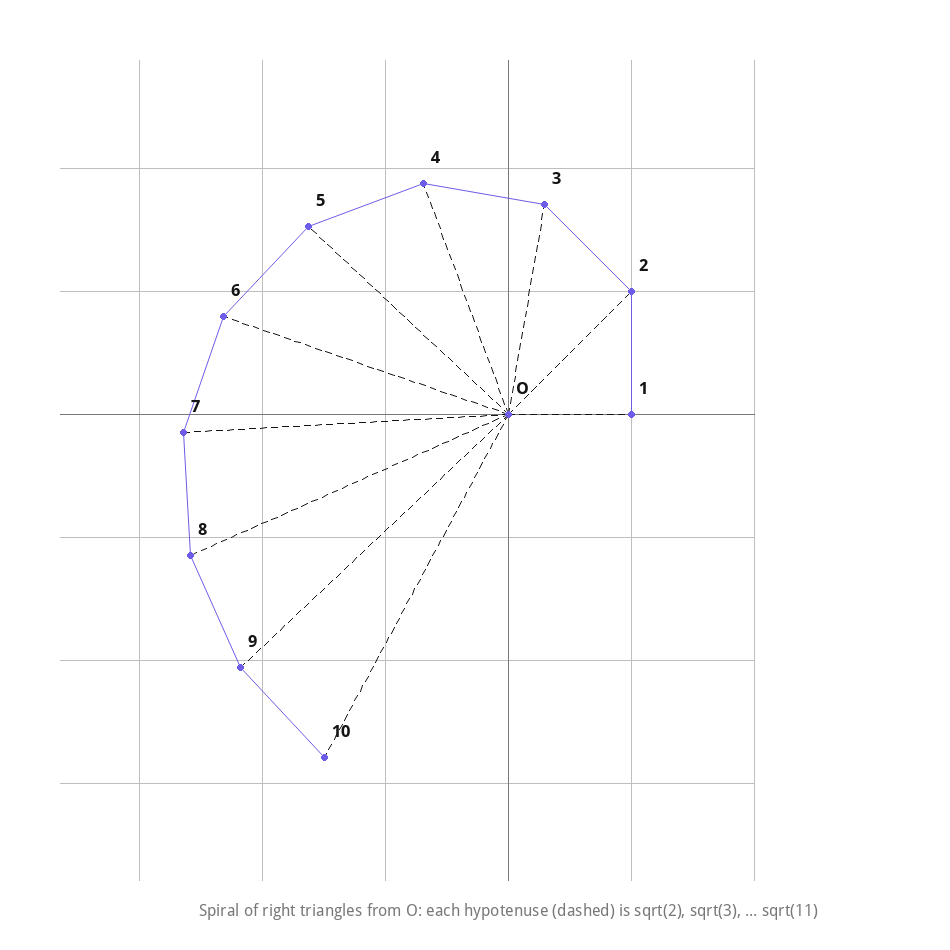
Q16. Find the lengths of the hypotenuses of all the right triangles in the square root spiral figure — Answer: In the square root spiral, each new right triangle is built with one leg of…
Answer: In the square root spiral, each new right triangle is built with one leg of length 1 unit and the other leg equal to the hypotenuse of the previous triangle, using the Pythagoras theorem repeatedly:
Triangle 1: legs 1, 1 → hypotenuse = √(1² + 1²) = √2
Triangle 2: legs √2, 1 → hypotenuse = √3
Triangle 3: legs √3, 1 → hypotenuse = √4 = 2
Triangle 4: legs 2, 1 → hypotenuse = √5
Triangle 5: legs √5, 1 → hypotenuse = √6
Triangle 6: legs √6, 1 → hypotenuse = √7
Triangle 7: legs √7, 1 → hypotenuse = √8 = 2√2
Triangle 8: legs 2√2, 1 → hypotenuse = √9 = 3
Triangle 9: legs 3, 1 → hypotenuse = √10
Triangle 10: legs √10, 1 → hypotenuse = √11
So the sequence of hypotenuse lengths is √2, √3, 2, √5, √6, √7, 2√2, 3, √10, √11, …, continuing this pattern for as many triangles as are drawn in the spiral.
Practice more: Extra Questions for Class 9 Mathematics Chapter 3
Quick revision: Revision Notes for Class 9 Mathematics Chapter 3
- Chapter 1: Orienting Yourself: The Use of Coordinates – Free PDF Download
- Chapter 2: Introduction to Linear Polynomials – Free PDF Download
- Chapter 4: Exploring Algebraic Identities – Free PDF Download
- Chapter 5: I'm Up and Down, and Round and Round – Free PDF Download
- Chapter 6: Measuring Space: Perimeter and Area – Free PDF Download
- Chapter 7: The Mathematics of Maybe: Introduction to Probability – Free PDF Download
- Chapter 8: Predicting What Comes Next?: Exploring Sequences and Progressions – Free PDF Download
Frequently Asked Questions
What is the difference between rational and irrational numbers?
A rational number can be expressed as a ratio p/q of two integers (q not zero) and has a terminating or repeating decimal expansion; an irrational number cannot be expressed this way and has a non-terminating, non-repeating decimal expansion (e.g. root 2, pi).
Why is the decimal expansion test useful for identifying rational vs irrational numbers?
Since every rational number decimal expansion either terminates or repeats in a pattern, and every irrational number does not, checking the decimal expansion gives a quick, reliable way to classify a given number without needing to prove it algebraically each time.
Chapter Quiz — Test Your Understanding
Class 9 Mathematics Chapter 3: The World of Numbers – Notes and Extra Questions
Along with these NCERT Solutions, students can also use the Class 9 Mathematics Chapter 3 Extra Questions and Class 9 Mathematics Chapter 3 Revision Notes for quick revision and extra practice.
Recommended: Buy the Printed NCERT Class 9 Maths Book
Contains Amazon affiliate links.
If you’d like a printed copy alongside the PDF, here’s a verified option:
4.0 out of 5 stars (1,313 ratings) · Rs. 106
Price and availability may change on Amazon. As an Amazon Associate, ncertbooks.org earns from qualifying purchases.



Pingback: Class 9 Maths Chapter 3 The World of Numbers Extra Questions (2026-27)