
Newton’s three laws of motion form the backbone of classical mechanics, and Chapter 4 builds them into practical tools—momentum conservation, impulse, static and kinetic friction, and the dynamics of circular motion (banking of roads, whirling stones, apparent weight in a lift). Every CBSE board paper draws at least 2-3 questions directly from this chapter’s numericals, so a clear, error-checked understanding here pays off across mechanics as a whole. Below are original, step-by-step solutions to all 23 in-chapter exercise questions (4.1-4.23) of the 2026-27 rationalised NCERT edition.
Last Updated: September 23, 2026
NCERT Solutions for Class 11 Physics Chapter 4: Laws of Motion
Q1. : Net Force in Everyday Situations — Give the magnitude and direction of the net force acting on (a) a drop of rain falling…
Give the magnitude and direction of the net force acting on (a) a drop of rain falling down with a constant speed, (b) a cork of mass 10 g floating on water, (c) a kite skilfully held stationary in the sky, (d) a car moving with a constant velocity of 30 km/h on a rough road, (e) a high-speed electron in space far from all material objects, and free of electric and magnetic fields.
(a) The raindrop falls with constant speed, so its acceleration is zero. By Newton’s second law (F = ma), the net force is zero.
(b) The cork floats in equilibrium: its weight acting downward is exactly balanced by the upward buoyant force (upthrust) of the water it displaces, so the net force is zero.
(c) The kite is stationary (at rest), so by Newton’s first law the net force on it is zero.
(d) Constant velocity means zero acceleration; the engine’s driving force exactly cancels friction and air drag, so the net force is zero.
(e) Far from all objects and fields, no force acts on the electron at all, so the net force is zero. (In every case here, the object’s velocity is constant, so Newton’s first/second law gives zero net force.)
Q2. : Net Force on a Vertically Thrown Pebble — A pebble of mass 0.05 kg is thrown vertically upwards. Give the direction and magnitude…
A pebble of mass 0.05 kg is thrown vertically upwards. Give the direction and magnitude of the net force on the pebble (a) during its upward motion, (b) during its downward motion, (c) at the highest point where it is momentarily at rest. Do your answers change if the pebble was thrown at an angle of 45° with the horizontal direction? Ignore air resistance.
Once released, the only force acting on the pebble (air resistance ignored) is gravity, F = mg, which always points vertically downward, regardless of the pebble’s own direction of motion.
(a) Upward motion: F = mg = 0.05 × 10 = 0.5 N, directed vertically downward.
(b) Downward motion: F = mg = 0.5 N, vertically downward (unchanged, since gravity doesn’t care which way the pebble is moving).
(c) At the highest point, the pebble’s velocity is momentarily zero, but its acceleration is not—gravity is still pulling on it. So the net force is still F = mg = 0.5 N, vertically downward.
If thrown at 45°, the pebble additionally has a constant horizontal velocity component, but since no horizontal force acts on it, this component doesn’t affect the net force calculation at all. So the answer does not change: the net force remains 0.5 N, vertically downward, in every case.
Q3. : Net Force on a Stone Dropped from a Moving Train — Neglecting air resistance, give the magnitude and direction of the net force acting on a…
Neglecting air resistance, give the magnitude and direction of the net force acting on a stone of mass 0.1 kg: (a) just after it is dropped from the window of a stationary train, (b) just after it is dropped from the window of a train running at a constant velocity of 36 km/h, (c) just after it is dropped from the window of a train accelerating with 1 ms-2, (d) lying on the floor of a train which is accelerating with 1 ms-2, the stone being at rest relative to the train.
(a) Stationary train: once released, only gravity acts. F = mg = 0.1 × 10 = 1 N, vertically downward.
(b) Constant-velocity train (36 km/h = 10 m/s): the train has zero acceleration, so it contributes no extra force to the stone even before release. After release, only gravity acts: F = mg = 1 N, vertically downward (same as case a).
(c) Accelerating train (a = 1 ms-2): the instant the stone is dropped, it stops sharing the train’s horizontal acceleration—force at any instant depends only on that instant’s situation, not on what happened a moment before. So the net force on the falling stone is again just gravity: F = mg = 1 N, vertically downward.
(d) Stone lying on the accelerating train’s floor, moving with the train (not dropped): here the stone shares the train’s horizontal acceleration of 1 ms-2, supplied by friction from the floor. F = ma = 0.1 × 1 = 0.1 N, horizontal, in the direction of the train’s motion.
Q4. : Centripetal Force on a String-and-Peg System (MCQ) — One end of a string of length l is connected to a particle of mass m and the other to a…
One end of a string of length l is connected to a particle of mass m and the other to a small peg on a smooth horizontal table. If the particle moves in a circle with speed v, the net force on the particle (directed towards the centre) is: (i) T, (ii) T − mv²/l, (iii) T + mv²/l, (iv) 0, where T is the tension in the string.
On a smooth (frictionless) table, the string’s tension T is the only horizontal force acting on the particle, and it points toward the centre—exactly what’s needed to keep the particle moving in a circle. So the net centripetal force simply equals the tension itself, with T = mv²/l automatically satisfied. The correct choice is (i) T.
Q5. : Time Taken to Stop Under a Retarding Force — A constant retarding force of 50 N is applied to a body of mass 20 kg moving initially…
A constant retarding force of 50 N is applied to a body of mass 20 kg moving initially with a speed of 15 ms-1. How long does the body take to stop?
Deceleration: a = F/m = 50/20 = 2.5 ms-2.
Using v = u − at, with v = 0, u = 15 ms-1: 0 = 15 − 2.5t, so t = 15/2.5 = 6 s.
Q6. : Force from Change in Speed Over Time — A constant force acting on a body of mass 3.0 kg changes its speed from 2.0 ms-1 to 3.5…
A constant force acting on a body of mass 3.0 kg changes its speed from 2.0 ms-1 to 3.5 ms-1 in 25 s. The direction of the motion of the body remains unchanged. What is the magnitude and direction of the force?
a = (v − u)/t = (3.5 − 2.0)/25 = 1.5/25 = 0.06 ms-2.
F = ma = 3.0 × 0.06 = 0.18 N, acting in the direction of motion (since the speed increases).
Q7. : Acceleration from Two Perpendicular Forces — A body of mass 5 kg is acted upon by two perpendicular forces 8 N and 6 N. Give the…
A body of mass 5 kg is acted upon by two perpendicular forces 8 N and 6 N. Give the magnitude and direction of the acceleration of the body.
Since the forces are perpendicular, the resultant force is F = √(8² + 6²) = √(64 + 36) = √100 = 10 N.
a = F/m = 10/5 = 2 ms-2.
Direction: tanθ = 6/8 = 0.75, so θ = 36.87° from the direction of the 8 N force (equivalently, 53.13° from the 6 N force). Final answer: 2 ms-2, at about 37° from the 8 N force.
Q8. : Retarding Force on a Braking Three-Wheeler — The driver of a three-wheeler moving with a speed of 36 km/h sees a child standing in…
The driver of a three-wheeler moving with a speed of 36 km/h sees a child standing in the middle of the road and brings his vehicle to rest in 4.0 s just in time to save the child. What is the average retarding force on the vehicle? The mass of the three-wheeler is 400 kg and the mass of the driver is 65 kg.
Total mass, m = 400 + 65 = 465 kg. u = 36 km/h = 10 ms-1, v = 0, t = 4.0 s.
a = (v − u)/t = (0 − 10)/4 = −2.5 ms-2.
F = ma = 465 × 2.5 = 1162.5 N, directed opposite to the vehicle’s motion (a retarding/backward force).
Q9. : Initial Thrust of a Rocket — A rocket with a lift-off mass 20,000 kg is blasted upwards with an initial acceleration…
A rocket with a lift-off mass 20,000 kg is blasted upwards with an initial acceleration of 5.0 ms-2. Calculate the initial thrust (force) of the blast.
The rocket’s engines must supply enough thrust to both overcome gravity and give the rocket its upward acceleration: F − mg = ma, so F = m(g + a).
F = 20,000 × (10 + 5) = 20,000 × 15 = 3.0 × 10⁵ N.
Q10. : Position of a Body Under a Reversing Force — A body of mass 0.40 kg moving initially with a constant speed of 10 ms-1 to the north is…
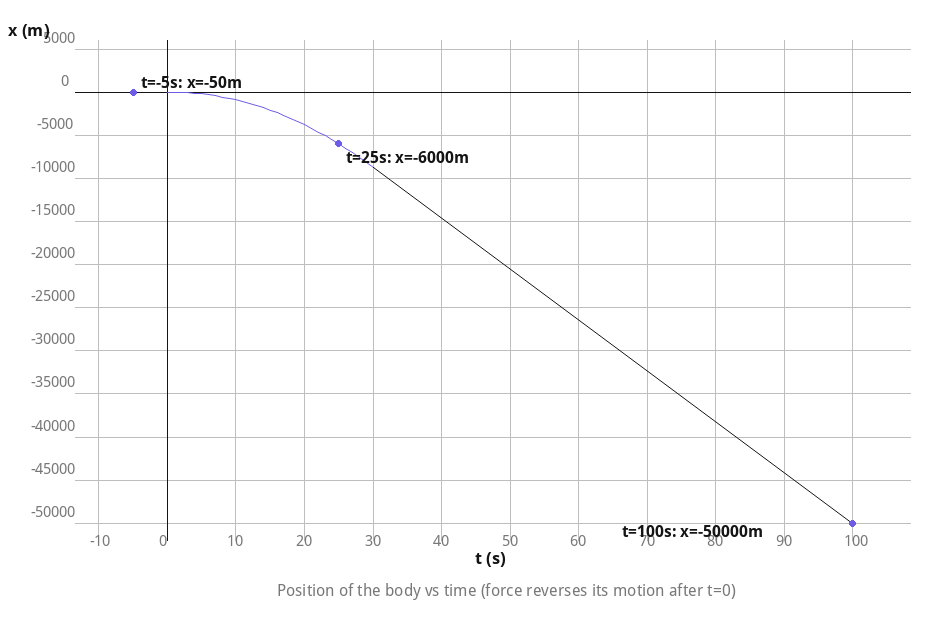
A body of mass 0.40 kg moving initially with a constant speed of 10 ms-1 to the north is subject to a constant force of 8.0 N directed towards the south for 30 s. Take the instant the force is applied to be t = 0, the position of the body at that time to be x = 0, and predict its position at t = −5 s, 25 s, 100 s.
Take north as positive. Acceleration while the force acts: a = F/m = 8.0/0.40 = 20 ms-2, directed south (i.e., a = −20 ms-2).
At t = −5 s (before the force is applied, motion is uniform at u = +10 ms-1): x = ut = 10 × (−5) = −50 m (50 m south of the origin).
At t = 25 s (still within the 30 s the force acts, so constant-acceleration kinematics apply throughout): x = ut + ½at² = 10(25) + ½(−20)(25)² = 250 − 6250 = −6000 m (6 km south).
At t = 100 s: the force only acts until t = 30 s. Position and velocity at t = 30 s: x₁ = 10(30) + ½(−20)(30)² = 300 − 9000 = −8700 m; v(30) = 10 − 20(30) = −590 ms-1. After t = 30 s the force is removed, so the body moves at this constant velocity for the remaining 70 s: x₂ = −590 × 70 = −41,300 m. Total position: x = −8700 − 41,300 = −50,000 m (50 km south).
Q11. : Velocity and Acceleration of a Stone Dropped from an Accelerating Truck — A truck starts from rest and accelerates uniformly at 2.0 ms-2. At t = 10 s, a stone is…
A truck starts from rest and accelerates uniformly at 2.0 ms-2. At t = 10 s, a stone is dropped by a person standing on the top of the truck (6 m high from the ground). What are the (a) velocity, and (b) acceleration of the stone at t = 11 s? (Neglect air resistance.)
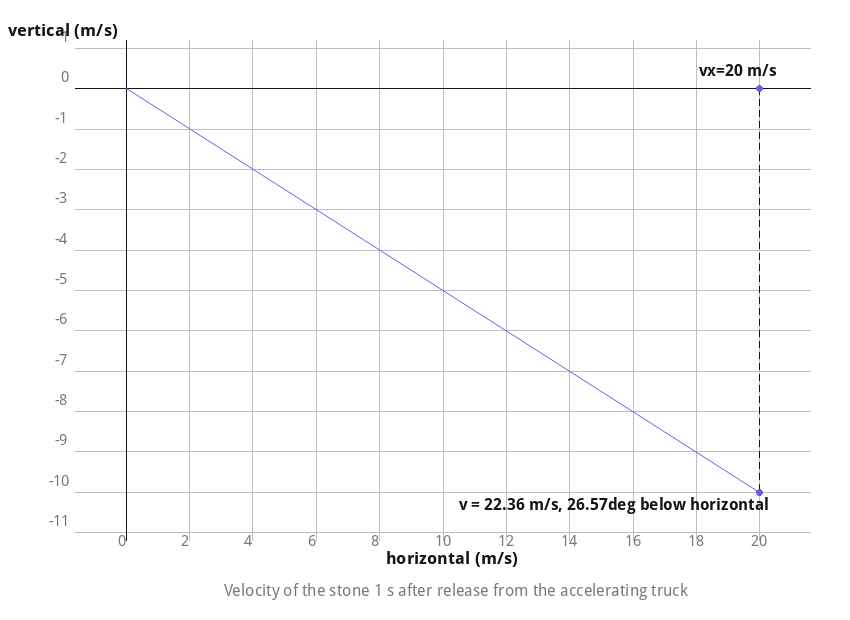
Truck’s (and stone’s) horizontal velocity at the moment of release (t = 10 s): v = u + at = 0 + 2 × 10 = 20 ms-1.
After release, the stone’s horizontal velocity stays constant at 20 ms-1 (no horizontal force acts once it leaves the truck), while it simultaneously falls freely under gravity, starting from zero vertical velocity at the instant of release.
(a) One second after release (t = 11 s): vertical velocity vy = g × 1 = 10 ms-1 downward. Resultant speed = √(20² + 10²) = √500 ≈ 22.36 ms-1, directed at tan-1(10/20) = 26.57° below the horizontal. (Check: in 1 s the stone falls ½(10)(1)² = 5 m, less than the 6 m height, so it is still airborne—consistent.)
(b) Once airborne, the only force on the stone is gravity, so its acceleration is simply g = 10 ms-2, vertically downward (the horizontal acceleration is zero).
Q12. : Trajectory of an Oscillating Bob After the String is Cut — A bob of mass 0.1 kg hung from the ceiling of a room by a string 2 m long is set into…
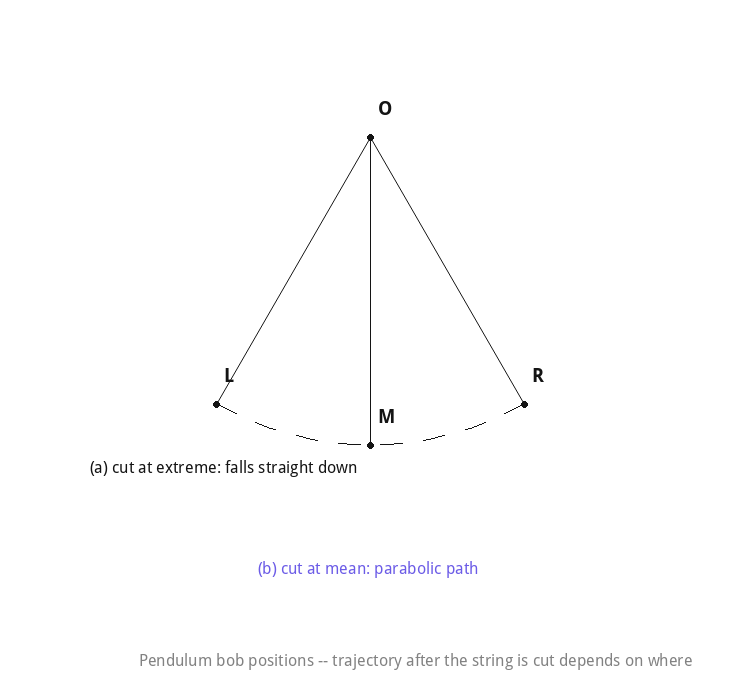
A bob of mass 0.1 kg hung from the ceiling of a room by a string 2 m long is set into oscillation. The speed of the bob at its mean position is 1 ms-1. What is the trajectory of the bob if the string is cut when the bob is (a) at one of its extreme positions, (b) at its mean position?
(a) At an extreme position, the bob is momentarily at rest (zero velocity). If the string is cut here, there is no horizontal velocity component to carry it sideways, so the bob simply falls vertically straight down under gravity.
(b) At the mean position, the bob has a horizontal speed of 1 ms-1. If the string is cut here, the bob becomes a projectile: it keeps its horizontal velocity of 1 ms-1 while simultaneously accelerating downward under gravity, so it follows a parabolic (projectile) path.
Q13. : Apparent Weight of a Man in an Accelerating Lift — A man of mass 70 kg stands on a weighing scale in a lift which is moving (a) upwards…
A man of mass 70 kg stands on a weighing scale in a lift which is moving (a) upwards with a uniform speed of 10 ms-1, (b) downwards with a uniform acceleration of 5 ms-2, (c) upwards with a uniform acceleration of 5 ms-2. What would be the readings on the scale in each case? (d) What would be the reading if the lift mechanism failed and it hurtled down freely under gravity?
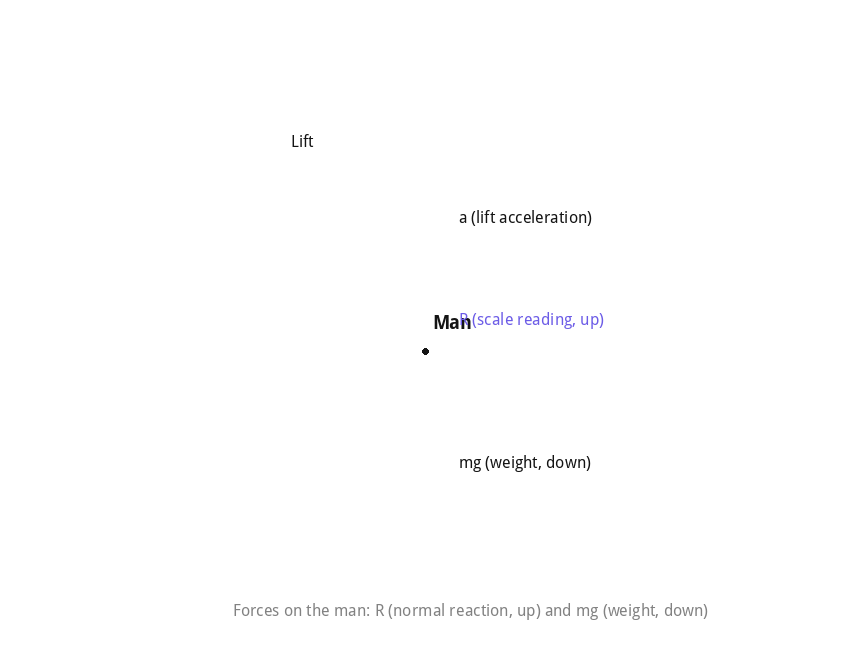
The scale reads the normal reaction R, i.e., the man’s apparent weight. Applying Newton’s second law to the man (taking upward as positive):
(a) Uniform speed ⇒ acceleration = 0, so R = mg = 70 × 10 = 700 N.
(b) Accelerating downward at 5 ms-2: mg − R = ma ⇒ R = m(g − a) = 70(10 − 5) = 350 N.
(c) Accelerating upward at 5 ms-2: R − mg = ma ⇒ R = m(g + a) = 70(10 + 5) = 1050 N.
(d) Free fall (a = g downward): R = m(g − g) = 0 N (the classic sensation of weightlessness).
Q14. : Force and Impulse from a Position-Time Graph — The position-time graph of a particle of mass 4 kg shows the particle at rest at x = 0…
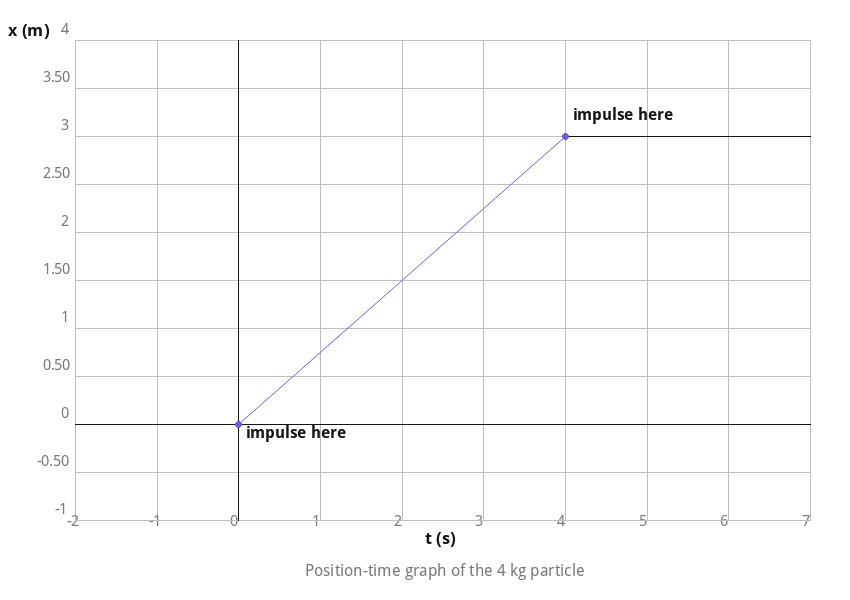
The position-time graph of a particle of mass 4 kg shows the particle at rest at x = 0 for t < 0; moving with a constant velocity from x = 0 to x = 3 m during 0 < t < 4 s; and at rest again at x = 3 m for t > 4 s. What is the force on the particle for t < 0, t > 4 s, 0 < t < 4 s? What is the impulse at t = 0 and t = 4 s?
Within each of the three intervals the particle’s velocity is constant (zero, then 3/4 = 0.75 ms-1, then zero again), so the acceleration—and hence the force—is zero in all three regions (t < 0, 0 < t < 4 s, and t > 4 s). The velocity changes abruptly only at the two instants t = 0 and t = 4 s, which is where the (impulsive) force acts for an infinitesimally short time.
Impulse at t = 0 (velocity jumps from 0 to 0.75 ms-1): Δp = mΔv = 4 × (0.75 − 0) = 3 kg ms-1 (in the direction of motion).
Impulse at t = 4 s (velocity drops from 0.75 ms-1 back to 0): Δp = 4 × (0 − 0.75) = −3 kg ms-1 (i.e., magnitude 3 kg ms-1, opposite to the direction of motion).
Q15. : Tension Between Two Connected Masses — Two bodies of masses 10 kg (A) and 20 kg (B), kept on a smooth horizontal surface, are…
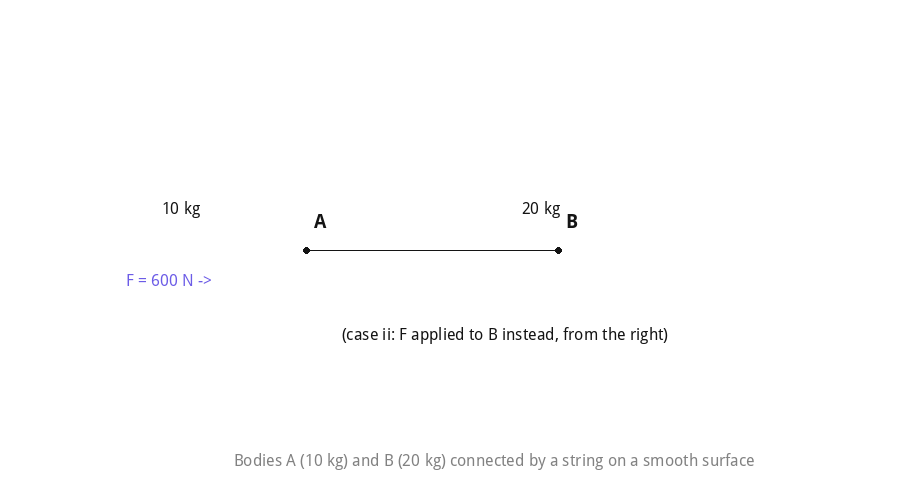
Two bodies of masses 10 kg (A) and 20 kg (B), kept on a smooth horizontal surface, are tied to the ends of a light string. A horizontal force F = 600 N is applied to (i) A, (ii) B, along the direction of the string. What is the tension in the string in each case?
Since the surface is smooth, both bodies always move together with the same acceleration: a = F/(mA + mB) = 600/30 = 20 ms-2.
(i) Force applied to A: the string must pull B along, so the tension supplies exactly the force needed to accelerate B alone: T = mB × a = 20 × 20 = 400 N.
(ii) Force applied to B: now the string pulls A along, so T = mA × a = 10 × 20 = 200 N.
Q16. : Acceleration and Tension in an Atwood Machine (Pulley System) — Two masses 8 kg and 12 kg are connected at the two ends of a light, inextensible string…
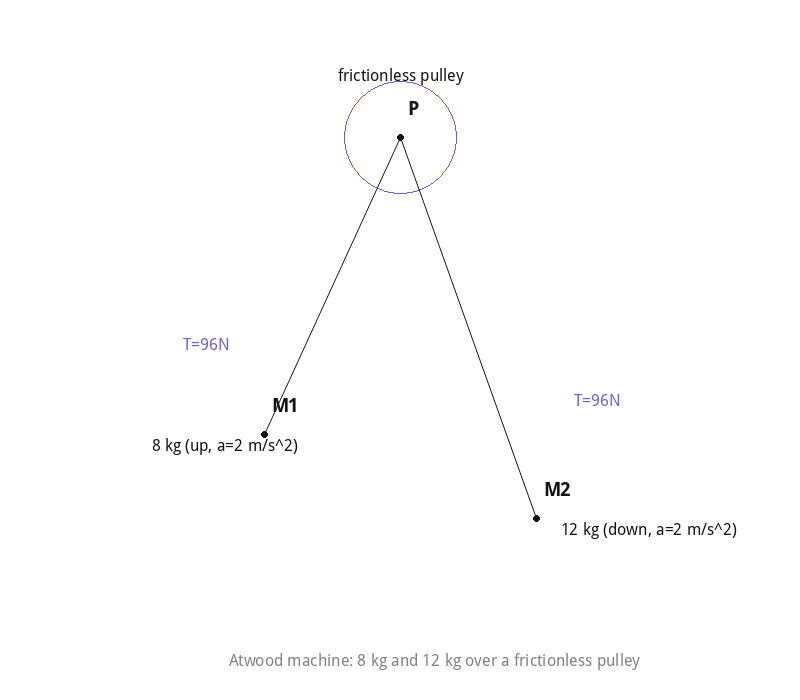
Two masses 8 kg and 12 kg are connected at the two ends of a light, inextensible string that goes over a frictionless pulley. Find the acceleration of the masses, and the tension in the string when the masses are released.
This is a standard Atwood machine. The heavier mass (12 kg) accelerates downward and the lighter one (8 kg) upward, with common magnitude:
a = (m₂ − m₁)g / (m₁ + m₂) = (12 − 8)(10) / 20 = 40/20 = 2 ms-2.
Tension (from the lighter mass): T − m₁g = m₁a ⇒ T = m₁(g + a) = 8(10 + 2) = 96 N. (Check via the heavier mass: T = m₂(g − a) = 12(10 − 2) = 96 N — consistent.)
Q17. : Conservation of Momentum in Nuclear Disintegration — A nucleus is at rest in the laboratory frame of reference. Show that if it disintegrates…
A nucleus is at rest in the laboratory frame of reference. Show that if it disintegrates into two smaller nuclei, the products must move in opposite directions.
Before disintegration, the nucleus is at rest, so its total momentum is zero. By the law of conservation of linear momentum, the total momentum after disintegration must also be zero. If the two product nuclei have masses m₁, m₂ and velocities v₁, v₂, then m₁v₁ + m₂v₂ = 0, which gives v₁ = −(m₂/m₁)v₂. The negative sign shows v₁ and v₂ must point in opposite directions—otherwise the vector sum could never be zero.
Q18. : Impulse on Colliding Billiard Balls — Two billiard balls, each of mass 0.05 kg, moving in opposite directions with speed 6…
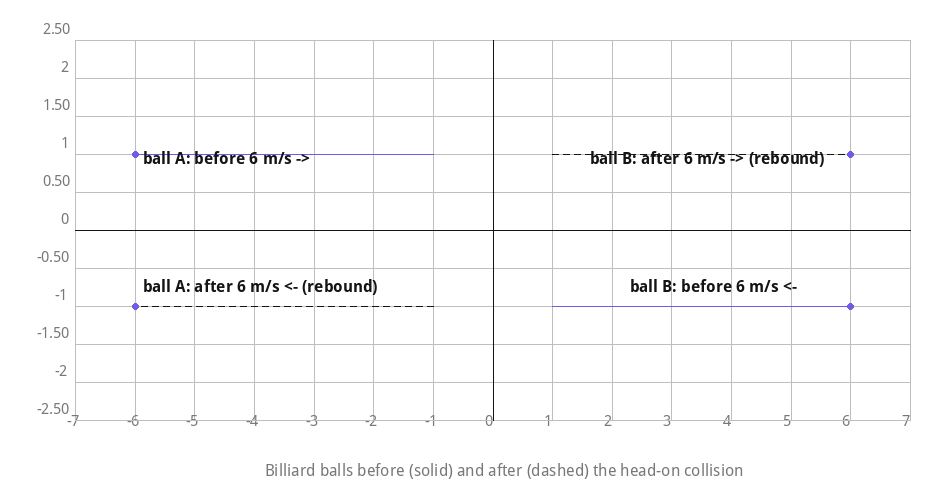
Two billiard balls, each of mass 0.05 kg, moving in opposite directions with speed 6 ms-1, collide and rebound with the same speed. What is the impulse imparted to each ball due to the other?
Taking one ball’s initial direction of motion as positive: its momentum before collision is pi = 0.05 × 6 = 0.3 kg ms-1. After it rebounds with the same speed, its momentum is pf = −0.3 kg ms-1.
Impulse on this ball = pf − pi = −0.3 − 0.3 = −0.6 kg ms-1. By identical reasoning (and Newton’s third law), the other ball receives an equal and opposite impulse. So the impulse on each ball has magnitude 0.6 kg ms-1, and the two impulses point in opposite directions (each opposite to that ball’s own original direction of motion).
Q19. : Recoil Speed of a Gun — A shell of mass 0.020 kg is fired by a gun of mass 100 kg. If the muzzle speed of the…
A shell of mass 0.020 kg is fired by a gun of mass 100 kg. If the muzzle speed of the shell is 80 ms-1, what is the recoil speed of the gun?
Before firing, total momentum = 0. By conservation of momentum: mshellvshell + MgunVgun = 0.
Vgun = −(0.020 × 80)/100 = −1.6/100 = −0.016 ms-1.
The recoil speed of the gun is 0.016 ms-1 (1.6 cm/s), directed opposite to the shell’s motion.
Q20. : Impulse on a Deflected Cricket Ball — A batsman deflects a ball by an angle of 45° without changing its initial speed, which…
A batsman deflects a ball by an angle of 45° without changing its initial speed, which is equal to 54 km/h. What is the impulse imparted to the ball? (Mass of the ball is 0.15 kg.)
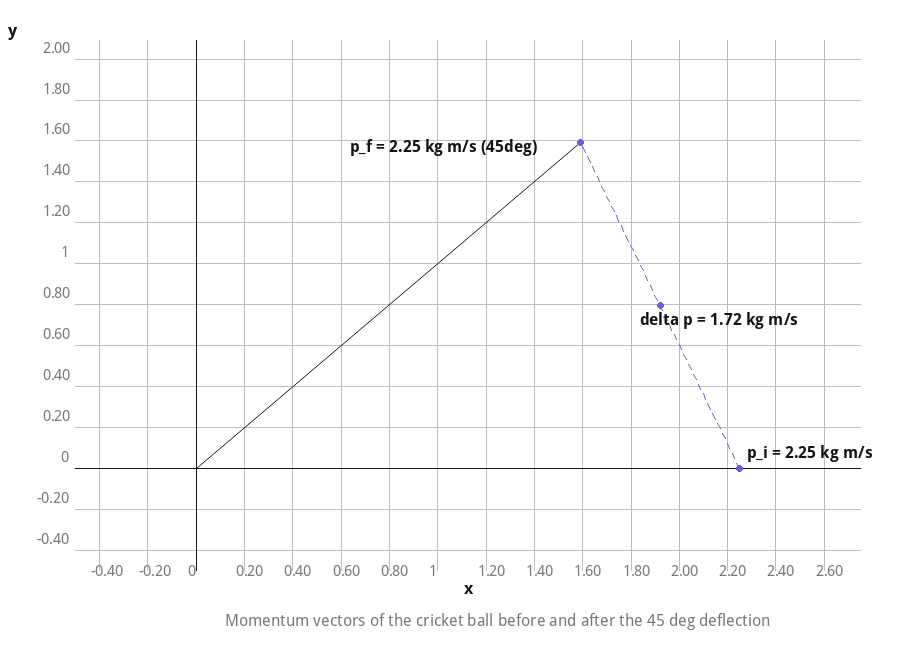
Speed, v = 54 km/h = 15 ms-1; mass, m = 0.15 kg. Since the ball’s speed is unchanged and only its direction turns through 45°, the initial and final momentum vectors have equal magnitude (mv = 2.25 kg ms-1) separated by an angle of 45°. For two equal-magnitude vectors separated by angle θ, the magnitude of their vector difference is a standard result: |Δp| = 2mv sin(θ/2).
|Δp| = 2 × 0.15 × 15 × sin(22.5°) = 4.5 × 0.3827 ≈ 1.72 kg ms-1, directed perpendicular to the bisector of the 45° angle turned by the ball (i.e., along the direction of the resultant change in momentum, roughly “into” the deflection).
Q21. : Tension and Maximum Speed of a Whirling Stone — A stone of mass 0.25 kg tied to the end of a string is whirled round in a circle of…
A stone of mass 0.25 kg tied to the end of a string is whirled round in a circle of radius 1.5 m with a speed of 40 rev/min in a horizontal plane. What is the tension in the string? What is the maximum speed with which the stone can be whirled around if the string can withstand a maximum tension of 200 N?
Convert to linear speed: v = 2πrN, where N = 40/60 rev/s. v = 2π × 1.5 × (40/60) = 2π × 1.0 ≈ 6.28 ms-1.
Tension supplies the centripetal force: T = mv²/r = 0.25 × (6.28)² / 1.5 = 0.25 × 39.48 / 1.5 ≈ 6.58 N.
Maximum speed before the string snaps: Tmax = mvmax²/r ⇒ vmax = √(Tmaxr/m) = √(200 × 1.5 / 0.25) = √1200 ≈ 34.64 ms-1.
Q22. : Trajectory of a Stone After the String Breaks (MCQ) — If the speed of the stone in the previous exercise is increased beyond the maximum…
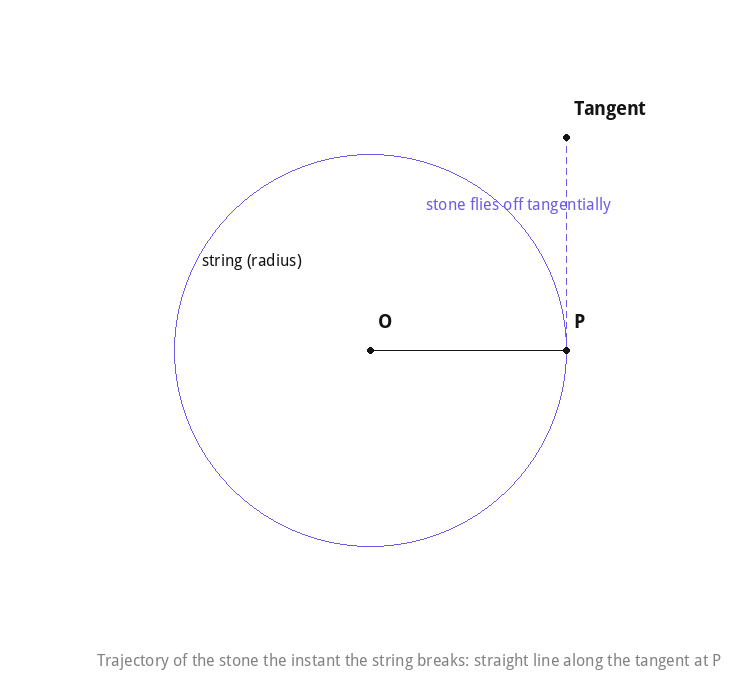
If the speed of the stone in the previous exercise is increased beyond the maximum permissible value, and the string breaks suddenly, which of the following correctly describes the trajectory of the stone after the string breaks: (a) the stone moves radially outwards, (b) the stone flies off tangentially from the instant the string breaks, (c) the stone flies off at an angle with the tangent whose magnitude depends on the speed of the particle?
At every point of circular motion, the stone’s velocity vector is directed along the tangent to the circle. Once the string (and hence the centripetal force) disappears, Newton’s first law takes over: with no net force, the stone continues in a straight line along whatever direction it was moving at that instant—the tangent. The correct answer is (b): the stone flies off tangentially the instant the string breaks.
Q23. : Explaining Everyday Inertia and Impulse Phenomena — Explain why (a) a horse cannot pull a cart and run in empty space, (b) passengers are…
Explain why (a) a horse cannot pull a cart and run in empty space, (b) passengers are thrown forward from their seats when a speeding bus stops suddenly, (c) it is easier to pull a lawn mower than to push it, (d) a cricketer moves his hands backwards while holding a catch.
(a) To pull the cart forward, the horse must push backward against the ground; by Newton’s third law, the ground pushes back on the horse’s feet, propelling it (and the cart) forward. In empty space there is no ground to push against, so there is no reaction force available, and the horse cannot move the cart.
(b) The passengers’ bodies are in motion along with the bus (Newton’s first law/inertia of motion). When the bus suddenly stops, the part of the body in contact with the seat stops with it, but the rest of the body tends to keep moving forward—so passengers are thrown forward.
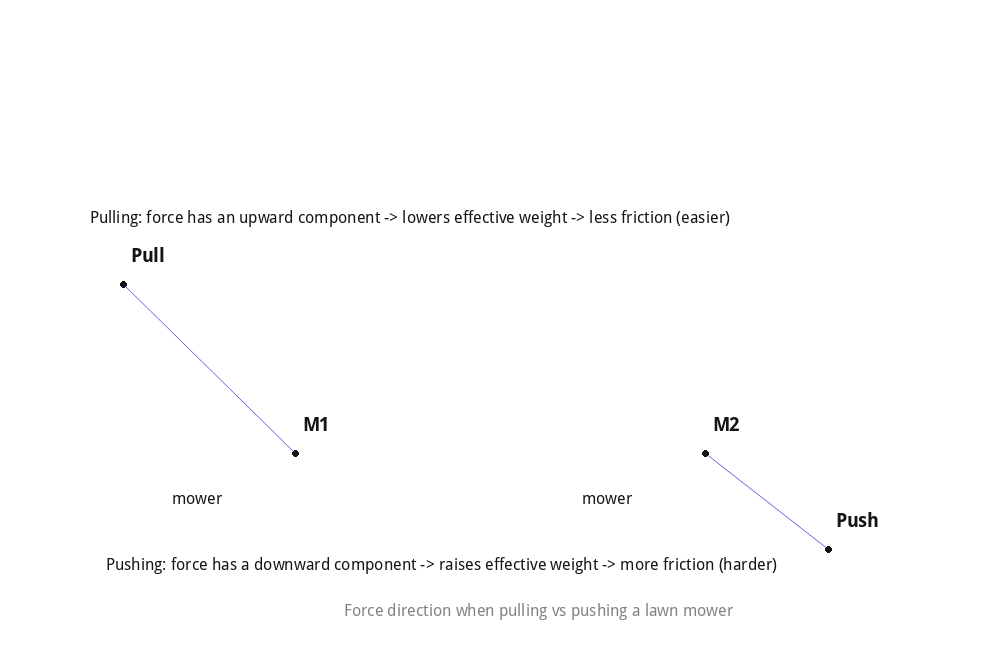
(c) When pulling, the applied force has an upward vertical component, which reduces the mower’s effective weight (and hence the normal reaction and friction) on the ground. When pushing, the vertical component of the force acts downward, increasing the effective weight and friction. Since friction is lower while pulling, pulling is easier.
(d) By Newton’s second law, F = Δp/Δt: for a given change in the ball’s momentum, a longer contact time Δt means a smaller force F. By drawing the hands backward as the ball arrives, the cricketer increases the time of impact, reducing the force on the hands and preventing injury.
Class 11 Physics Chapter 4 – Notes and Extra Questions
Along with these NCERT Solutions, students can also use the Class 11 Physics Chapter 4 Extra Questions and Class 11 Physics Chapter 4 Revision Notes for quick revision and extra practice.
- Chapter 1: Units and Measurements (2026-27)
- Chapter 2: Motion in a Straight Line – Free PDF Download
- Chapter 3: Motion in a Plane – Free PDF Download
- Chapter 5: Work, Energy and Power – Free PDF Download
- Chapter 6: System of Particles and Rotational Motion – Free PDF Download
- Chapter 7: Gravitation – Free PDF Download
- Chapter 8: Mechanical Properties of Solids – Free PDF Download
- Chapter 9: Mechanical Properties of Fluids – Free PDF Download
- Chapter 10: Thermal Properties of Matter – Free PDF Download
- Chapter 11: Thermodynamics – Free PDF Download
- Chapter 12: Kinetic Theory – Free PDF Download
- Chapter 13: Oscillations – Free PDF Download
- Chapter 14: Waves – Free PDF Download
Frequently Asked Questions
What are Newton’s three laws of motion?
Newton’s first law (the law of inertia) states that a body continues in its state of rest or uniform motion in a straight line unless acted upon by a net external force. The second law states that the rate of change of momentum of a body is directly proportional to the applied force and takes place in the direction of that force (F = ma for constant mass). The third law states that for every action there is an equal and opposite reaction, and that these action-reaction forces always act on two different bodies, never cancelling each other out for a single object.
What is the difference between mass and weight?
Mass is the quantity of matter in a body; it is a scalar, measured in kilograms, and stays the same everywhere in the universe. Weight is the gravitational force acting on that mass (W = mg); it is a vector, measured in newtons, and changes with the local value of g—for example, an astronaut’s mass is unchanged on the Moon, but their weight is roughly one-sixth of what it is on Earth.
What is the difference between static, kinetic, and rolling friction?
Static friction acts on a body at rest and opposes the tendency of relative motion; it adjusts itself up to a maximum value (limiting friction) given by fs(max) = μsN. Kinetic (or sliding) friction acts once the body is actually sliding, given by fk = μkN, and is generally slightly less than the maximum static friction (μk < μs). Rolling friction acts when a body rolls (like a wheel) instead of sliding, and is much smaller than both static and kinetic friction, which is why wheels and ball bearings are used to reduce resistance to motion.
How does banking of roads help vehicles take turns safely?
On a flat road, the entire centripetal force needed for a vehicle to turn must come from friction between the tyres and the road, which can fail at high speed or on a wet surface. Banking the road (tilting it at an angle θ to the horizontal) lets a component of the normal reaction also contribute to the centripetal force, reducing the vehicle’s dependence on friction. The optimum banking angle for a given speed v and radius r (ignoring friction) is given by tanθ = v²/rg, which is why sharper curves and highways designed for higher speeds are banked at steeper angles.
Recommended: Buy the Printed NCERT Class 11 Physics Book Set
Contains Amazon affiliate links.
If you’d like a printed copy alongside the PDF, here’s a verified option:
Rs. 280
Price and availability may change on Amazon. As an Amazon Associate, ncertbooks.org earns from qualifying purchases.


