
Chapter 5 of Class 9 Ganita Manjari, “I’m Up and Down, and Round and Round,” is the circle-geometry chapter of the new NCERT syllabus. It opens with the basic vocabulary of a circle — centre, radius, chord, diameter and the idea of a locus — and then builds twelve theorems from first principles using triangle congruence and symmetry, covering the circumcircle of a triangle, equal chords and the angles they subtend, perpendicular bisectors of chords, distance of chords from the centre, angles subtended by an arc, and concyclic points and cyclic quadrilaterals. This page provides complete NCERT solutions for Class 9 Maths Chapter 5 I’m Up and Down, and Round and Round, with detailed answers to every Exercise Set question from the Ganita Manjari textbook.
Last Updated: September 23, 2026
5.1 Definitions (Page 93)
This opening section defines a circle as the locus of points at a fixed distance (the radius) from a fixed point (the centre), and introduces the related terms chord, diameter and arc. It closes with a hands-on “Think and Reflect” activity about locating the centre of a circular sheet of paper by paper-folding.
Q1. Jamuna has a circular piece of paper and is trying to locate its centre. Amina gives her a suggestion, and it works. What could Amina have told her? — Answer: Amina's suggestion uses the fact that a fold through a circular sheet always…
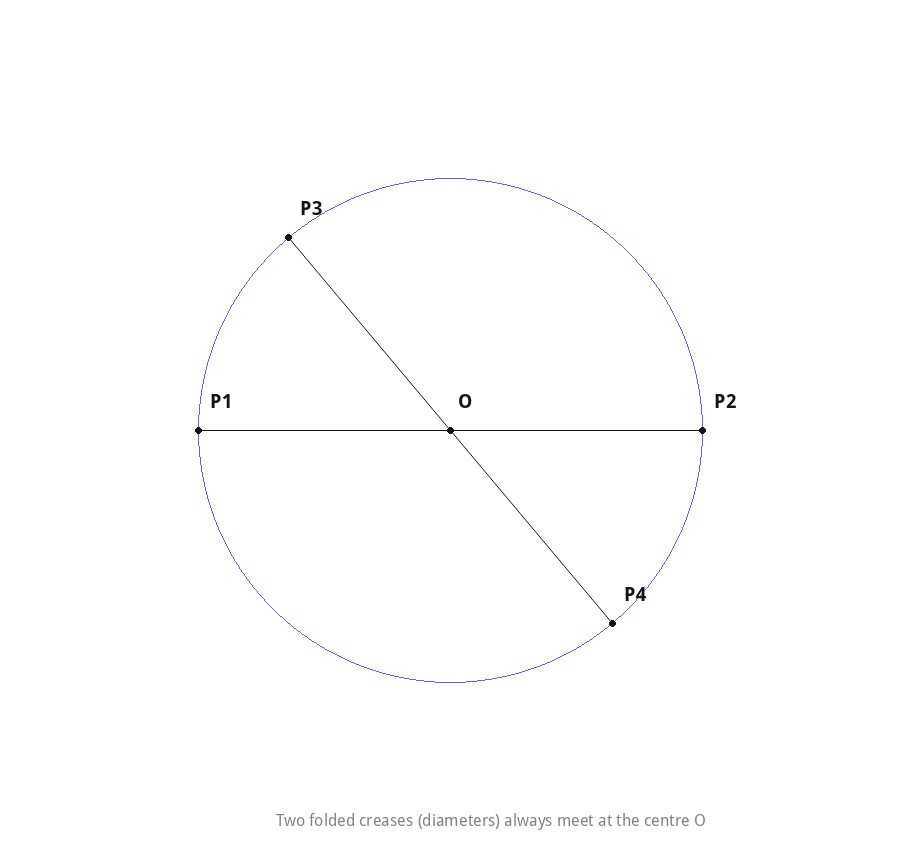
Answer: Amina’s suggestion uses the fact that a fold through a circular sheet always creates a diameter. The steps are:
1. Fold the circular paper exactly in half so the edges match, and press the crease flat. This crease is a diameter of the circle.
2. Unfold the paper, then fold it in half again in a different direction (not along the same crease), and press this second crease flat.
3. Unfold the paper. The two creases are both diameters, so they intersect at the centre of the circle.
This works because every diameter of a circle passes through the centre, so the point common to any two distinct diameters must be the centre itself.
5.2 Symmetries of a Circle (Page 94)
This section studies the rotational symmetry (a circle looks identical after a rotation through any angle about its centre) and reflection symmetry (every diameter is a line of symmetry) of a circle, contrasting it with the finite symmetry of regular polygons.
Q1. What are the rotational symmetries of a square? How many lines of reflection symmetry does it have? What about a regular pentagon and a regular hexagon? — Answer:
Answer:
Square: Rotational symmetry of order 4 — it looks unchanged after rotations of 90°, 180°, 270° and 360°. It has 4 lines of reflection symmetry: 2 through the midpoints of opposite sides, and 2 along the diagonals.
Regular pentagon: Rotational symmetry of order 5 — unchanged after rotations of 72°, 144°, 216°, 288° and 360° (each a multiple of 360°/5 = 72°). It has 5 lines of reflection symmetry, each passing through one vertex and the midpoint of the opposite side.
Regular hexagon: Rotational symmetry of order 6 — unchanged after rotations of 60°, 120°, 180°, 240°, 300° and 360°. It has 6 lines of reflection symmetry: 3 through pairs of opposite vertices and 3 through midpoints of opposite sides.
A circle is the limiting case: it has rotational symmetry of every angle (infinite order) and infinitely many lines of reflection symmetry, since every diameter is such a line.
Q2. What is the length of the longest chord in a circle of radius 5 units? Is there a smallest chord? — Answer: The longest chord of any circle is its diameter. Diameter = 2 × radius = 2 × 5…
Answer: The longest chord of any circle is its diameter. Diameter = 2 × radius = 2 × 5 = 10 units. There is no smallest chord — as the two endpoints of a chord are moved closer together along the circle, the chord’s length keeps decreasing towards (but never reaching) zero, so no minimum length exists.
Q3. The locus of points at a given distance from a given point is a circle. What can we say about the locus of points equidistant from two given points? — Answer: The locus is the perpendicular bisector of the segment joining the two points.
Answer: The locus is the perpendicular bisector of the segment joining the two points.
Given: A and B are two fixed points; P is any point with PA = PB, and PQ is the path traced by all such points P.
To prove: PQ is the perpendicular bisector of AB.
Proof: Join AB, and let PQ meet AB at O. In triangles PAO and PBO: PA = PB (given), AO = BO (O is a point of PQ, so it is equidistant from A and B by the same property), and PO = PO (common). So ∆PAO ≅ ∆PBO by SSS, which gives ∠POA = ∠POB (CPCT). Since AOB is a straight line, ∠POA + ∠POB = 180°, so each equals 90°. Also AO = BO, so O is the midpoint of AB. Hence PQ passes through the midpoint of AB and is perpendicular to it — PQ is the perpendicular bisector of AB.
5.3 How Many Circles? — Exercise Set 5.1 (Page 99)
This section shows that infinitely many circles pass through two given points, since the centre can be any point on the perpendicular bisector of the segment joining them. It then proves Theorem 1: there is a unique circle through any three non-collinear points (the circumcircle), obtained where the perpendicular bisectors of any two sides of the triangle meet — the circumcentre. It also studies how the position of the circumcentre (inside, on, or outside the triangle) depends on whether the triangle is acute, right, or obtuse.
Q1. How many circles pass through two points on a plane? — Answer: Infinitely many. The centre of any circle through the two points must lie on the…
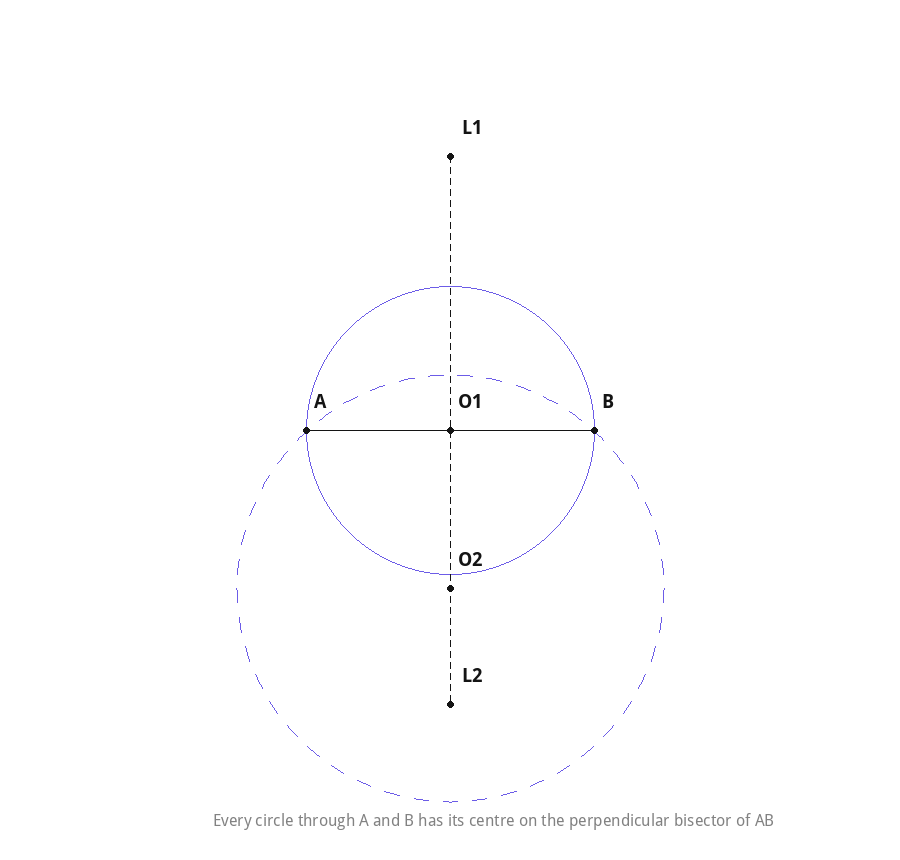
Answer: Infinitely many. The centre of any circle through the two points must lie on the perpendicular bisector of the segment joining them, and any point of that perpendicular bisector can serve as a centre — giving infinitely many circles, one for each choice of centre.
Q2. Are there circles of all possible radii passing through A and B? What is the radius of the smallest and the largest such circle? — Answer: No — not every radius is possible. The circle must be large enough to reach…
Answer: No — not every radius is possible. The circle must be large enough to reach from A to B, so the radius cannot be less than half of AB. The smallest circle occurs when the centre is exactly the midpoint of AB; its radius equals half of AB. As the centre is moved further away along the perpendicular bisector, the radius keeps increasing without any bound, so there is no largest circle — the radius can be made arbitrarily large (in the limit, the circle approaches a straight line).
Q3. As you move away from AB along its perpendicular bisector, do the radii of circles through A and B increase or decrease? — Answer: They increase. The radius equals the distance from the centre (on the…
Answer: They increase. The radius equals the distance from the centre (on the perpendicular bisector) to A (or B), and this distance grows the farther the centre is from the midpoint of AB.
Q4. As you go along the perpendicular bisector, does the circle through A and B appear more curved or less curved? — Answer: Less curved. A larger radius means a flatter arc near A and B, so the circle…
Answer: Less curved. A larger radius means a flatter arc near A and B, so the circle appears less curved as the centre moves farther away and the radius grows.
Q5. Given two points A and B, how many squares can be drawn with A and B on the boundary? How many with A and B as corners? — Answer:
Answer:
(a) A, B on the boundary: Infinitely many squares are possible, since A and B can lie anywhere along the four edges of a square of any size and orientation that happen to pass through both points.
(b) A, B as corners: Exactly 3 squares are possible — two squares with AB as a side (one square drawn on each side of AB), and one square with AB as a diagonal (its centre is the midpoint of AB).
Q6. Three collinear points A, B, C — can a point P exist with PA = PB = PC? What can you say about the perpendicular bisectors of AB and BC? Can a circle pass through three collinear points? — Answer: No such point P can exist. A point with PA = PB must lie on the perpendicular…
Answer: No such point P can exist. A point with PA = PB must lie on the perpendicular bisector of AB, and a point with PB = PC must lie on the perpendicular bisector of BC. Since A, B, C are collinear, both perpendicular bisectors are perpendicular to the same line (line ABC), so they are parallel to each other and never meet — hence no common point P exists. Consequently, no circle can pass through three collinear points, because the centre of such a circle would have to be this non-existent point P. (This also confirms that a straight line can intersect a circle in at most two points, never three.)
Q7. The circumcircle of a given ∆ABC is drawn. Can other triangles congruent to ∆ABC share the same circumcircle? — Answer: Yes. Since the circumcircle only fixes the set of points the vertices can occupy…
Answer: Yes. Since the circumcircle only fixes the set of points the vertices can occupy on its circumference (not their specific positions), rotating or reflecting ∆ABC about the circumcentre produces other triangles that are congruent to ∆ABC and still have exactly the same circumcircle.
Q1. (Exercise Set 5.1). Draw ∆ABC with AB = 5 cm, ∠A = 70°, ∠B = 60°. Draw its circumcircle. Is the centre inside or outside the triangle? — Answer: Construction: (i) Draw AB = 5 cm. (ii) At A, construct ∠A = 70°; at B,…
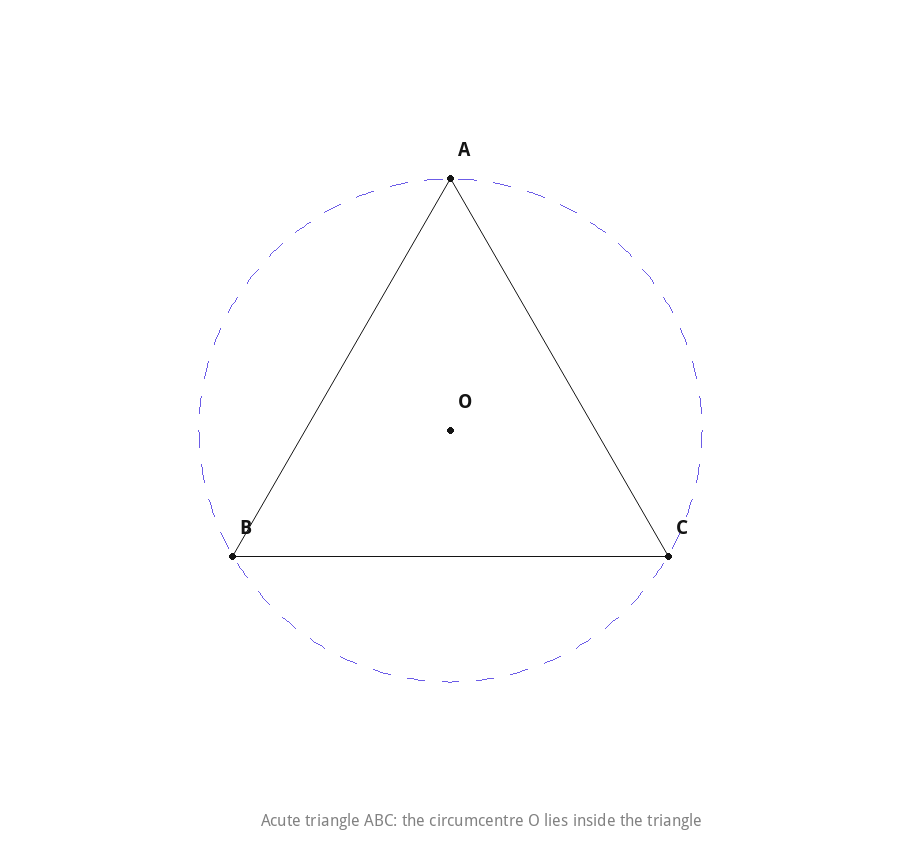
Answer: Construction: (i) Draw AB = 5 cm. (ii) At A, construct ∠A = 70°; at B, construct ∠B = 60°; let the two rays meet at C. (iii) Draw the perpendicular bisectors of any two sides, say AB and BC; their intersection is the circumcentre O. (iv) With O as centre and radius OA, draw the circumcircle — it will also pass through B and C.
Since ∠A + ∠B = 130°, ∠C = 50°, so all three angles are acute — the triangle is acute-angled, and the circumcentre O lies inside the triangle.
Q2. Draw ∆ABC with AB = 5 cm, ∠A = 100°, AC = 4 cm. Draw its circumcircle. Is the centre inside or outside? — Answer: Construction: (i) Draw AB = 5 cm. (ii) At A, construct ∠A = 100° and mark C…
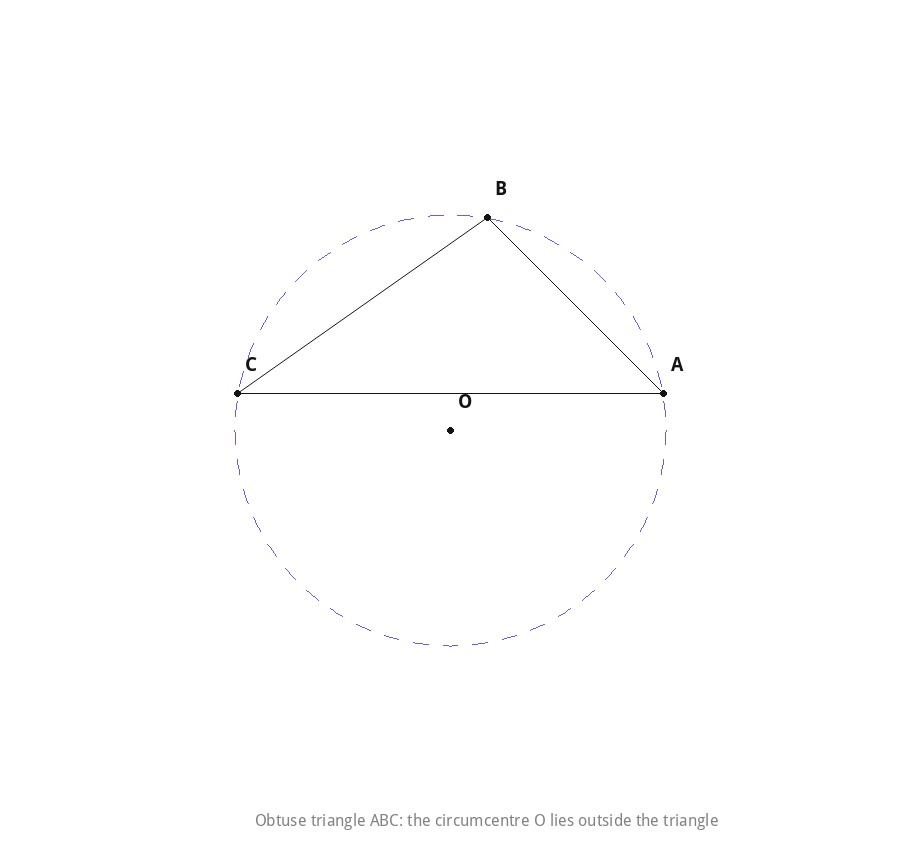
Answer: Construction: (i) Draw AB = 5 cm. (ii) At A, construct ∠A = 100° and mark C on this ray with AC = 4 cm. (iii) Join BC. (iv) Draw the perpendicular bisectors of two sides; their meeting point is the circumcentre O. (v) Draw the circle with centre O and radius OA.
Since ∠A = 100° is obtuse, the circumcentre O lies outside the triangle (on the far side of BC from A).
Q3. Draw ∆ABC with AB = 6 cm, BC = 7 cm, CA = 7 cm. Draw its circumcircle with circumcentre O. Measure OA, OB, OC — Answer: Construction: Draw AB = 6 cm. With A as centre and radius 7 cm, and B as centre…
Answer: Construction: Draw AB = 6 cm. With A as centre and radius 7 cm, and B as centre and radius 7 cm, draw arcs meeting at C. Join AC and BC. Draw the perpendicular bisectors of AB and BC to locate the circumcentre O, then draw the circle of radius OA.
Since O is equidistant from all three vertices by construction, OA = OB = OC ≈ 3.85 cm (this can be verified with a ruler after construction).
Q4. What is the least possible radius of a circle through two points A and B? — Answer: The smallest such circle occurs when AB itself is the diameter, so its radius is…
Answer: The smallest such circle occurs when AB itself is the diameter, so its radius is half the length of AB — this is the minimum radius among the infinitely many circles that pass through A and B.
5.4 Chords and the Angles They Subtend — Exercise Set 5.2 (Page 101)
This section proves Theorem 2 (equal chords of a circle subtend equal angles at the centre) and Theorem 3, its converse (chords subtending equal angles at the centre are equal), both using SSS/SAS congruence of the triangles formed by the chords and the centre.
Q1. Show that the triangle formed by a chord and the centre of the circle is isosceles — Answer: Given: A circle with centre O and chord AB, with A and B on the circle. To…
Answer: Given: A circle with centre O and chord AB, with A and B on the circle. To prove: ∆OAB is isosceles.
Proof: OA and OB are both radii of the same circle, so OA = OB. A triangle with two equal sides is isosceles, so ∆OAB is isosceles.
Q2. If two such isosceles triangles have equal base length, show they are congruent — Answer: Given: ∆OAB and ∆OCD are formed by chords AB and CD of the same circle…
Answer: Given: ∆OAB and ∆OCD are formed by chords AB and CD of the same circle (centre O), with AB = CD. To prove: ∆OAB ≅ ∆OCD.
Proof: OA = OC and OB = OD (all radii of the same circle are equal), and AB = CD (given). So by the SSS congruence rule, ∆OAB ≅ ∆OCD.
5.5 Midpoints and Perpendicular Bisectors of Chords — Exercise Set 5.3 (Page 103)
This section proves Theorem 4 (the line from the centre to the midpoint of a chord is perpendicular to the chord) and Theorem 5 (the perpendicular from the centre to a chord bisects the chord), which together are the key tools used throughout the rest of the chapter.
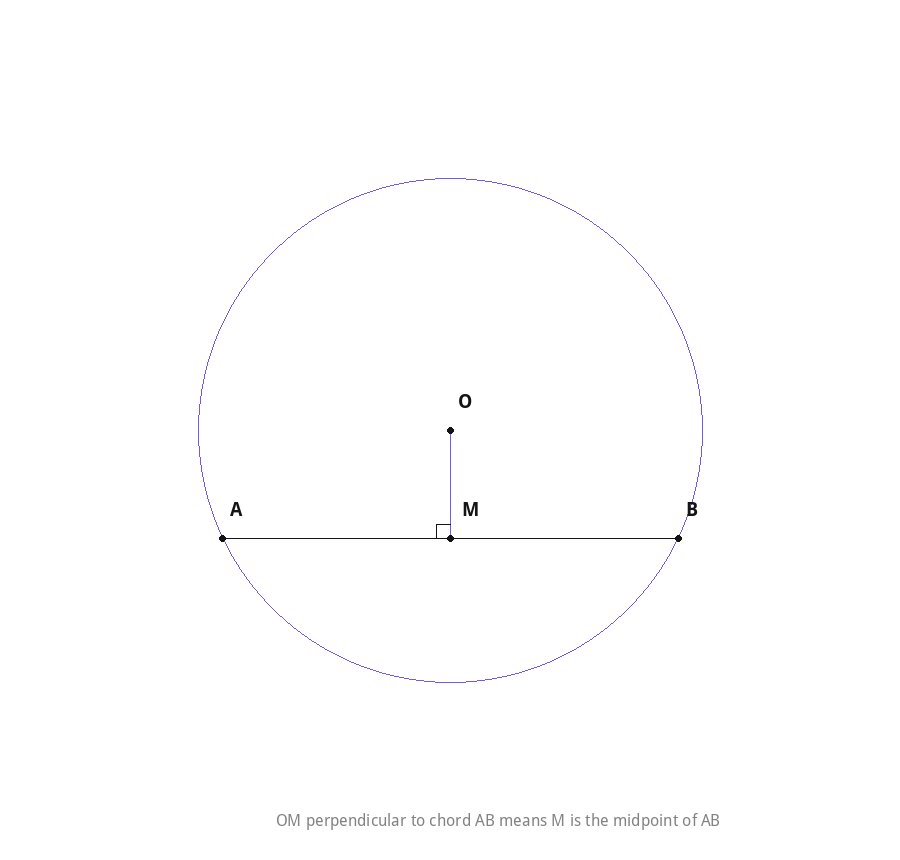
Q1. Why is the converse of Theorem 4 true — why does the perpendicular from the centre to a chord bisect the chord? (Given ∠CMA = ∠CMB = 90°, show AM = BM.) — Answer: Given: C is the centre, AB is a chord, and CM ⊥ AB with ∠CMA = ∠CMB =…
Answer: Given: C is the centre, AB is a chord, and CM ⊥ AB with ∠CMA = ∠CMB = 90°. To prove: AM = BM.
Proof: In ∆CMA and ∆CMB: CM = CM (common), CA = CB (radii of the same circle), and ∠CMA = ∠CMB = 90° (given). So ∆CMA ≅ ∆CMB by the RHS congruence rule, which gives AM = BM (CPCT).
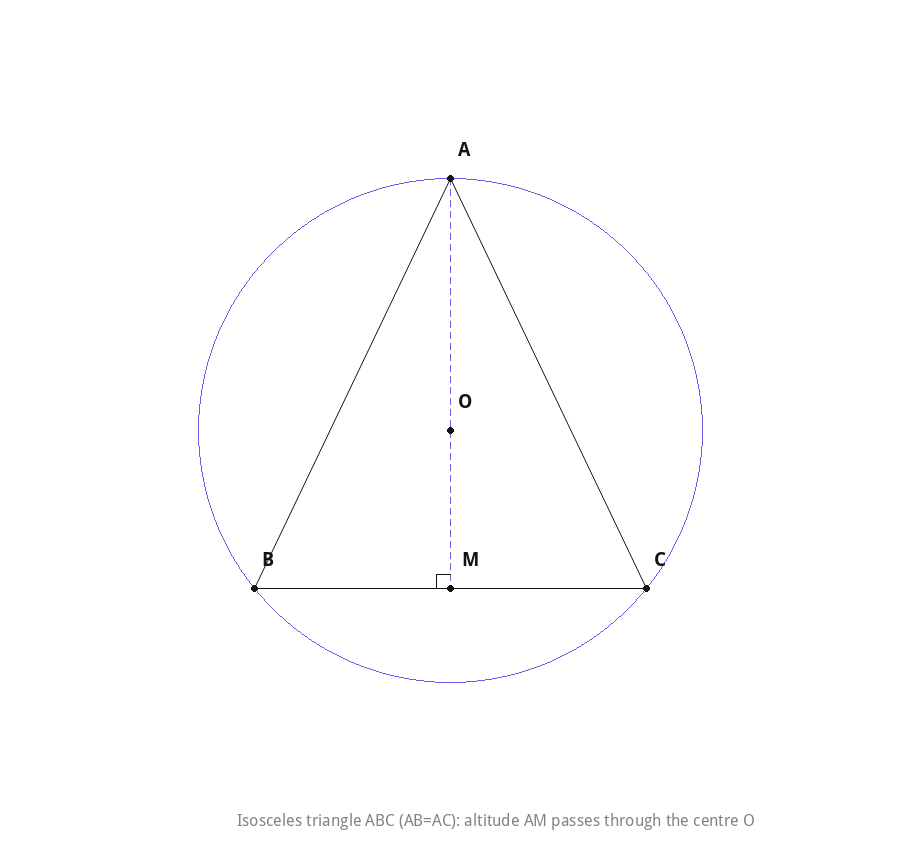
Q2. An isosceles triangle ABC is inscribed in a circle with AB = AC. Show that the altitude from A to BC passes through the centre — Answer: Given: ∆ABC inscribed in a circle with centre O, AB = AC, and AM is the…
Answer: Given: ∆ABC inscribed in a circle with centre O, AB = AC, and AM is the altitude from A to BC. To prove: A, O, M are collinear.
Proof: In ∆AMB and ∆AMC: AM = AM (common), AB = AC (given), and ∠AMB = ∠AMC = 90° (AM is the altitude). So ∆AMB ≅ ∆AMC by RHS, giving BM = CM (CPCT) — M is the midpoint of BC. By Theorem 4, the line from the centre O to the midpoint M of chord BC is perpendicular to BC, so OM ⊥ BC. Since AM is also perpendicular to BC at the same point M, and there is only one line through M perpendicular to BC, the lines AM and OM must coincide. Hence A, O, M lie on a single straight line — the altitude AM passes through the centre O.
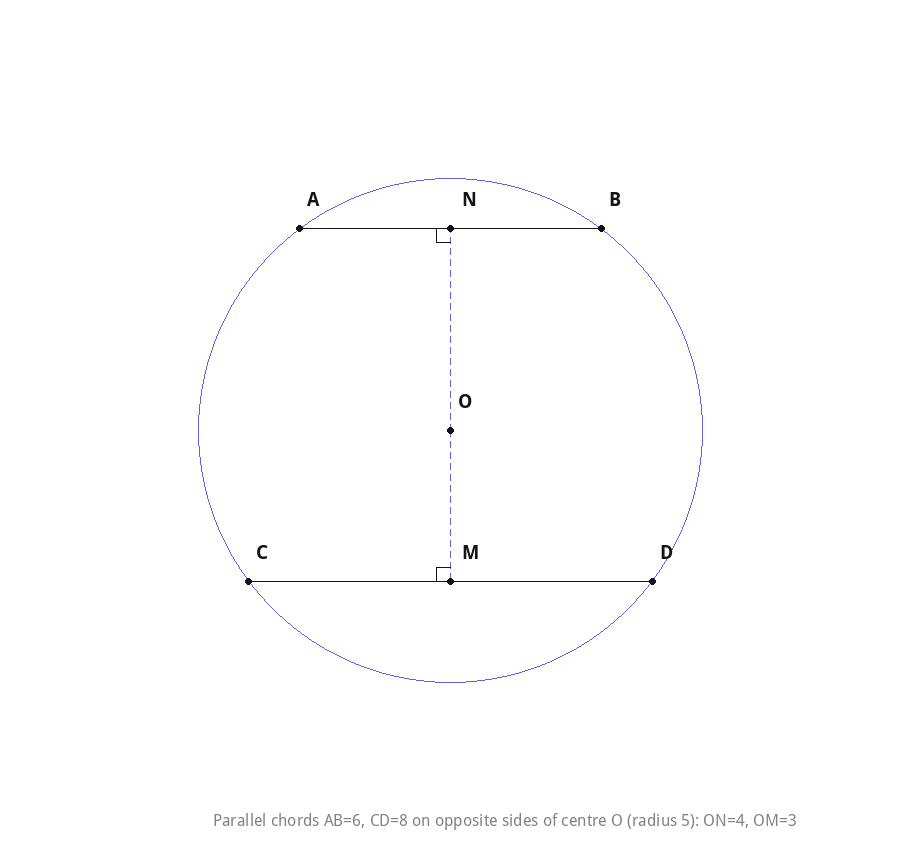
Q3. Two parallel chords of length 6 cm and 8 cm lie on opposite sides of the centre of a circle of radius 5 cm. Find the distance between their midpoints — Answer: Let N be the midpoint of the 6 cm chord AB, so AN = 3 cm. In right triangle ONA:…
Answer: Let N be the midpoint of the 6 cm chord AB, so AN = 3 cm. In right triangle ONA: ON² = OA² − AN² = 5² − 3² = 25 − 9 = 16, so ON = 4 cm.
Let M be the midpoint of the 8 cm chord CD, so CM = 4 cm. In right triangle OMC: OM² = OA² − CM² = 5² − 4² = 25 − 16 = 9, so OM = 3 cm.
Since the chords lie on opposite sides of the centre, the distance between the midpoints MN = ON + OM = 4 + 3 = 7 cm.
5.6 Distance of Chords from the Centre — Exercise Set 5.4 (Page 105)
This section proves Theorem 6 (chords of equal length are equidistant from the centre), using the Baudhāyana–Pythagoras theorem on the right triangles formed by the centre, a chord’s midpoint, and an endpoint of the chord.
Q1. Use the Baudhāyana–Pythagoras theorem to show why Theorem 6 must be true — Answer: Given: A circle with centre O; chords AB = CD; OP ⊥ AB and OQ ⊥ CD. To…
Answer: Given: A circle with centre O; chords AB = CD; OP ⊥ AB and OQ ⊥ CD. To prove: OP = OQ.
Proof: Since the perpendicular from the centre bisects a chord, AP = ½AB and CQ = ½CD. As AB = CD, we get AP = CQ. Let OA = OC = r (radii). In right triangle OPA: OP² + AP² = OA² = r² … (i). In right triangle OQC: OQ² + CQ² = OC² = r² … (ii). Comparing (i) and (ii): OP² + AP² = OQ² + CQ², and since AP = CQ, we get OP² = OQ², so OP = OQ. Hence equal chords are equidistant from the centre.
Q2. In Fig. 5.15, CE ⊥ AB, CH ⊥ GF, and CE = CH. Show that AB = GF — Answer: Given: Circle with centre C, CE ⊥ AB, CH ⊥ GF, and CE = CH. To prove: AB = GF.
Answer: Given: Circle with centre C, CE ⊥ AB, CH ⊥ GF, and CE = CH. To prove: AB = GF.
Proof: By Theorem 3, chords that subtend equal angles at the centre are equal, so it suffices to show ∠BCA = ∠GCF. Since CE = CH and CA = CF (radii), and CE, CH are altitudes from C in triangles that are mirror images by symmetry, ∠BCA = ∠GCF. In ∆BCA and ∆GCF: CB = CG, CA = CF (radii) and ∠BCA = ∠GCF, so ∆BCA ≅ ∆GCF by SAS, giving AB = GF (CPCT).
Q3. Solve the previous question using the Baudhāyana–Pythagoras theorem instead — Answer: Let the common radius be CA = CG = r and the common distance CE = CH = d. In…
Answer: Let the common radius be CA = CG = r and the common distance CE = CH = d. In right triangle CEA: EA² = CA² − CE² = r² − d² … (i). In right triangle CHG: GH² = CG² − CH² = r² − d² … (ii). From (i) and (ii), EA² = GH², so EA = GH. Since the perpendicular from the centre bisects a chord, AB = 2·EA and GF = 2·GH. As EA = GH, we conclude AB = GF.
5.6 Distance of Chords from the Centre (continued) — Exercise Set 5.5 (Page 106)
This continuation proves Theorem 7 (chords equidistant from the centre are equal — the converse of Theorem 6) and Theorem 8 (of two unequal chords, the longer one lies closer to the centre), and derives the general chord-length formula 2√(r² − d²).
Q1. Find the length of a chord of a circle of radius 7 cm whose perpendicular distance from the centre is 6 cm — Answer: Let AB be the chord, with OA = 7 cm (radius) and OP = 6 cm (perpendicular…
Answer: Let AB be the chord, with OA = 7 cm (radius) and OP = 6 cm (perpendicular distance), where P is the midpoint of AB. In right triangle OPA: AP² = OA² − OP² = 7² − 6² = 49 − 36 = 13, so AP = √13 cm. Since P bisects AB, AB = 2 × √13 ≈ 7.21 cm.
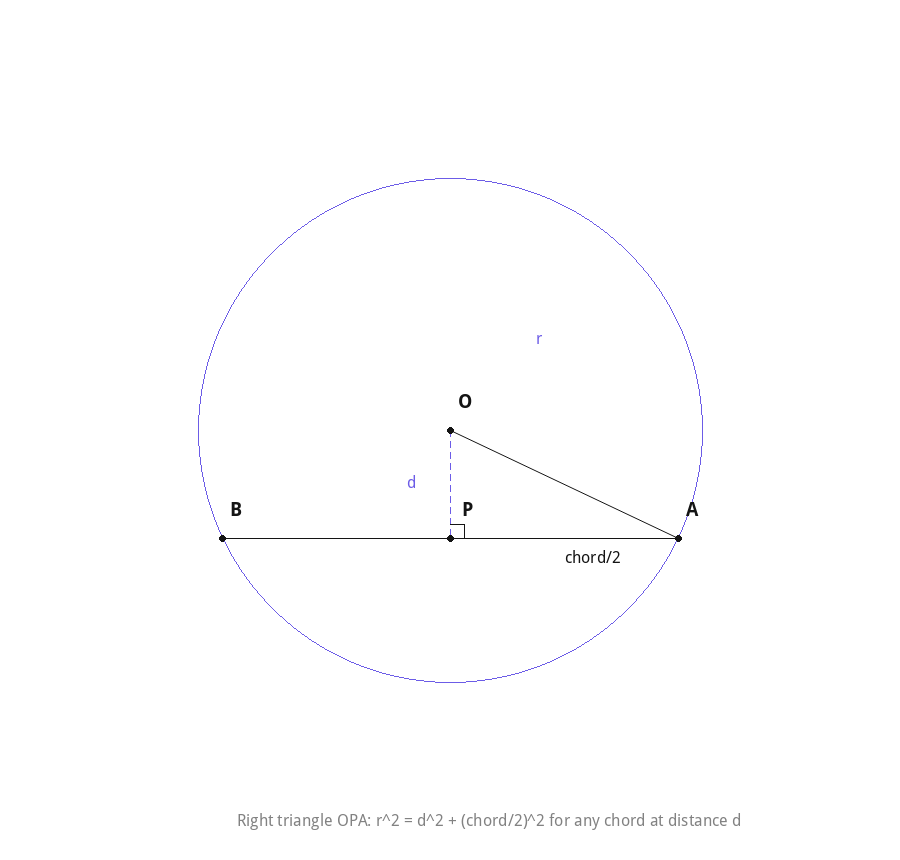
Q2. Explain why the chord length is 2√(r² − d²), where d is the perpendicular distance of the chord from the centre and r is the radius — Answer: Let AB be the chord with midpoint M, OA = r, OM = d. In right triangle OMA: OA²…
Answer: Let AB be the chord with midpoint M, OA = r, OM = d. In right triangle OMA: OA² = OM² + AM², so r² = d² + AM², giving AM² = r² − d², i.e. AM = √(r² − d²). Since the perpendicular from the centre bisects the chord, AB = 2 × AM = 2√(r² − d²).
Q3. If chord AB is twice as far from the centre as chord CD, can we conclude CD = 2AB? Explain — Answer: No. Let the distance of CD from the centre be x, so the distance of AB is 2x.…
Answer: No. Let the distance of CD from the centre be x, so the distance of AB is 2x. Using the chord-length formula with radius R: AB = 2√(R² − 4x²) and CD = 2√(R² − x²). Then CD/AB = √(R² − x²) / √(R² − 4x²), which is not a fixed ratio of 2 — it depends on R and x. So doubling the distance from the centre does not simply halve the chord length; the relationship is non-linear because of the square-root formula, and CD ≠ 2AB in general.
5.7 Angles Subtended by an Arc — Exercise Set 5.6 (Page 109)
This section defines minor and major arcs (an arc subtending less than 180° at the centre is minor; more than 180° is major) and proves Theorem 9: the angle an arc subtends at the centre is double the angle it subtends at any point on the remaining part of the circle. Its key corollary is that the angle in a semicircle is always 90°.
Q (in-text activity, Page 107). A circle with centre O has points A, B, C, D on it. Measure the angles subtended by arc AKB and arc CLD at O, and classify each as a minor or a major arc.
Answer: This is a hands-on measurement activity to be done with a protractor on the printed figure: if the angle measured at O for a given arc is less than 180°, that arc is a minor arc; if it is more than 180°, it is a major arc. (Students should find that arc AKB and arc CLD are supplementary in the sense that one of them is typically the minor arc and the other the corresponding major arc for the same chord, since the two arcs cut off by a chord together account for the full 360° at the centre.)
Q1. (Exercise Set 5.6). In a circle with centre O, ∠AOB = 60° and the radius is 12 cm. Find the length of chord AB — Answer: In ∆OAB, OA = OB = 12 cm (radii), so it is isosceles with ∠OAB = ∠OBA.…
Answer: In ∆OAB, OA = OB = 12 cm (radii), so it is isosceles with ∠OAB = ∠OBA. Since angles of a triangle sum to 180°: 2x + 60° = 180°, so x = 60°. All three angles of ∆OAB are 60°, so it is equilateral, and AB = OA = OB = 12 cm.
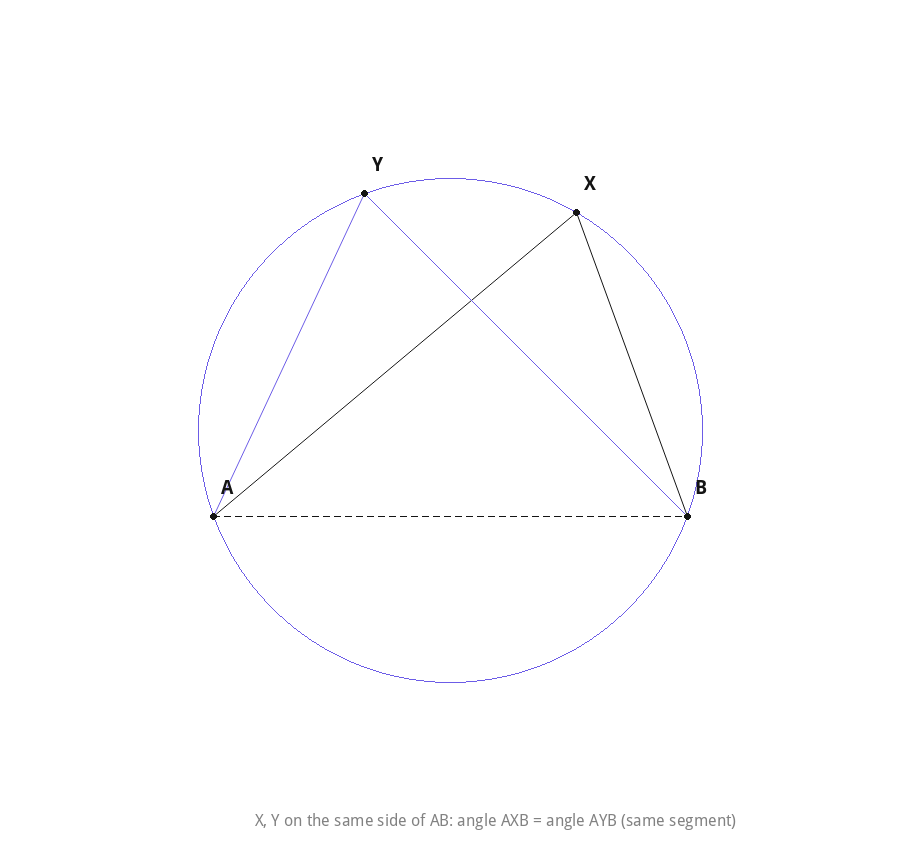
Q2. Let A, B be two points on a circle with centre O. (i) Can points X, Y on the same side of AB give different values of ∠AXB and ∠AYB? (ii) If ∠AXB = ∠AYB, must X, Y lie on the same side of AB? (iii) If ∠AXB = ∠AYB and X, Y are not on the circle, does the circle through A, B, X also pass through Y? — Answer:
Answer:
(i) No — all points on the same side of a chord AB see it at the same angle (angles in the same segment are equal), so ∠AXB and ∠AYB must be equal, never different.
(ii) No, not necessarily. If AB is a diameter, both angles could be 90° whether X and Y are on the same side or on opposite sides of AB, since the angle in a semicircle is 90° on either side.
(iii) Yes, provided X and Y are on the same side of AB — by Theorem 10, since AB subtends equal angles at X and Y on the same side, A, B, X, Y are concyclic, so the circle through A, B, X also passes through Y.
Q3. Find x in Fig. 5.26, given ∠ADC = 100° where ADC is on the reflex/major-arc side — Answer: ∠ADC = 100° is the inscribed angle for arc ABC, so the angle subtended by arc…
Answer: ∠ADC = 100° is the inscribed angle for arc ABC, so the angle subtended by arc ABC at the centre = 2 × 100° = 200°. Since the angles subtended by the major and minor arcs together make 360° at the centre, the angle subtended by arc ADC at the centre = 360° − 200° = 160°. Therefore x, the inscribed angle for arc ADC, is half of this: x = 160°/2 = 80°.
5.8 Concyclicity of Points (Page 111)
The final content section proves Theorem 10 (if a segment AB subtends equal angles at two points C, D on the same side, then A, B, C, D are concyclic), Theorem 11 (the opposite angles of a cyclic quadrilateral sum to 180°) and Theorem 12, its converse (if opposite angles of a quadrilateral sum to 180°, the quadrilateral is cyclic).
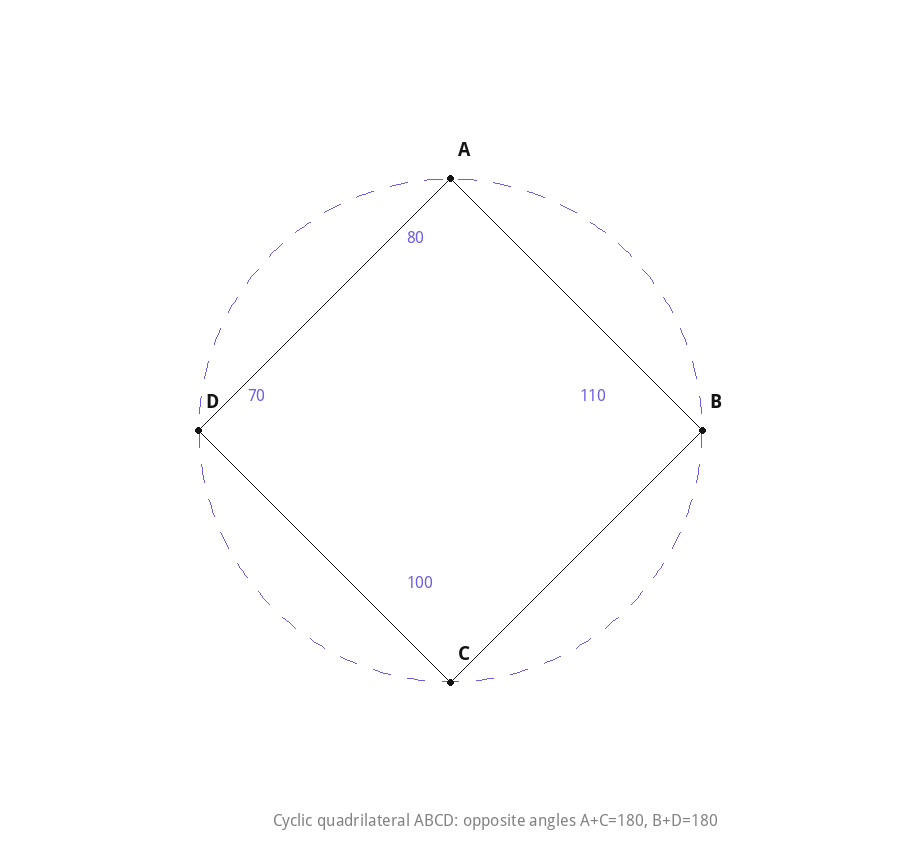
Q (in-text activity, Page 113). A cyclic quadrilateral ABCD has ∠A = 80°, ∠B = 110°, ∠C = 100°, ∠D = 70°. Can such a quadrilateral be drawn? Explain.
Answer: For a cyclic quadrilateral, opposite angles must be supplementary: ∠A + ∠C = 180° and ∠B + ∠D = 180°. Checking: ∠A + ∠C = 80° + 100° = 180° ✓, and ∠B + ∠D = 110° + 70° = 180° ✓. Both pairs of opposite angles are supplementary, so by the converse (Theorem 12), such a cyclic quadrilateral can indeed be drawn.
End-of-Chapter Exercises (Page 115)
Q1. In a circle, a chord is 5 cm away from the centre. If the radius is 13 cm, find the length of the chord — Answer: Let OA = 13 cm (radius), OP = 5 cm (distance to chord). In right triangle OPA:…
Answer: Let OA = 13 cm (radius), OP = 5 cm (distance to chord). In right triangle OPA: AP² = OA² − OP² = 169 − 25 = 144, so AP = 12 cm. Chord AB = 2 × AP = 24 cm.
Q2. An arc of a circle subtends an angle of 70° at the centre. What angle does it subtend at a point on the circle? — Answer: By Theorem 9, the angle at the centre is double the angle at the circumference…
Answer: By Theorem 9, the angle at the centre is double the angle at the circumference (for a point on the major arc): angle at circumference = 70°/2 = 35°. (If the point instead lies on the minor arc itself, the angle subtended is 180° − 35° = 145°, since ABPC forms a cyclic quadrilateral-like supplementary pair.)
Q3. The diameter of a circle is 26 cm. A chord of length 24 cm is drawn. Find the distance from the centre to the chord — Answer: Radius = 26/2 = 13 cm; half-chord AP = 24/2 = 12 cm. In right triangle OPA: OP²…
Answer: Radius = 26/2 = 13 cm; half-chord AP = 24/2 = 12 cm. In right triangle OPA: OP² = OA² − AP² = 169 − 144 = 25, so OP = 5 cm.
Q4. A circle has radius 15 cm. A chord is at a distance of 9 cm from the centre. Find the chord's length — Answer: AP² = OA² − OP² = 15² − 9² = 225 − 81 = 144, so AP = 12 cm. Chord AB…
Answer: AP² = OA² − OP² = 15² − 9² = 225 − 81 = 144, so AP = 12 cm. Chord AB = 2 × 12 = 24 cm.
Q5. Prove that the perpendicular bisector of a chord passes through the centre of the circle — Answer: Given: A circle with centre O; line L is the perpendicular bisector of chord AB,…
Answer: Given: A circle with centre O; line L is the perpendicular bisector of chord AB, meeting it at midpoint M. To prove: O lies on L.
Proof: In ∆AOM and ∆BOM: OM = OM (common), OA = OB (radii), AM = BM (M is the midpoint, given). So ∆AOM ≅ ∆BOM by SSS, giving ∠OMA = ∠OMB (CPCT). Since AMB is a straight line, ∠OMA + ∠OMB = 180°, so each is 90°. So OM ⊥ AB with M the midpoint of AB — meaning OM is itself the (unique) perpendicular bisector of AB. Since a line segment has only one perpendicular bisector, line L must coincide with OM, and therefore O lies on L.
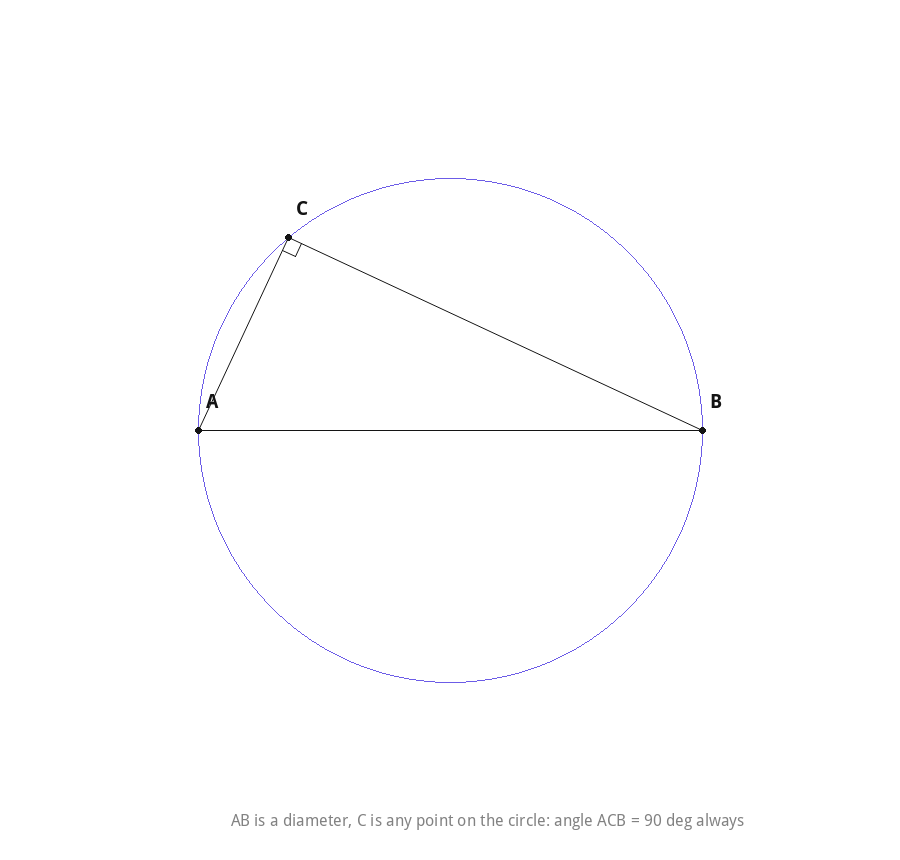
Q6. AB is the diameter of a circle, and C is a point on the circumference. What is ∠ACB? — Answer: By the corollary to Theorem 9, the angle subtended by a diameter at any point on…
Answer: By the corollary to Theorem 9, the angle subtended by a diameter at any point on the circle is always a right angle. So ∠ACB = 90°.
Q7. In cyclic quadrilateral ABCD, ∠A = 75° and ∠B = 110°. Find ∠C and ∠D — Answer: Opposite angles of a cyclic quadrilateral are supplementary. ∠C = 180° −…
Answer: Opposite angles of a cyclic quadrilateral are supplementary. ∠C = 180° − ∠A = 180° − 75° = 105°. ∠D = 180° − ∠B = 180° − 110° = 70°.
Q8. In cyclic quadrilateral PQRS, ∠P = (2x + 10)° and ∠R = (3x − 20)°. Find x, ∠P and ∠R — Answer: ∠P + ∠R = 180° (opposite angles of a cyclic quadrilateral): (2x + 10) + (3x…
Answer: ∠P + ∠R = 180° (opposite angles of a cyclic quadrilateral): (2x + 10) + (3x − 20) = 180 → 5x − 10 = 180 → 5x = 190 → x = 38. So ∠P = 2(38) + 10 = 86° and ∠R = 3(38) − 20 = 94°. (Check: 86 + 94 = 180 ✓)
Q9. The distance of a 16 cm chord from the centre is 6 cm. Find the radius — Answer: Half-chord AP = 16/2 = 8 cm. r² = OP² + AP² = 6² + 8² = 36 + 64 = 100, so r…
Answer: Half-chord AP = 16/2 = 8 cm. r² = OP² + AP² = 6² + 8² = 36 + 64 = 100, so r = 10 cm.
Q10. A cyclic quadrilateral has sides 5, 5, 12, 12 units. Find its area — Answer: Let ABCD have AB = BC = 5 and CD = DA = 12 — this is a kite shape. Join…
Answer: Let ABCD have AB = BC = 5 and CD = DA = 12 — this is a kite shape. Join diagonal BD. Since ∠ABD = ∠CBD (the kite’s line of symmetry), it follows that ∠BAD = ∠BCD. But in a cyclic quadrilateral opposite angles are supplementary, so ∠BAD + ∠BCD = 180°; combined with ∠BAD = ∠BCD, each must equal 90°.
So ∆ABD is right-angled at A with legs AB = 5, AD = 12 — a 5-12-13 right triangle, giving area = ½ × 5 × 12 = 30 square units. By the same reasoning ∆CBD (right-angled at C, legs 5 and 12) also has area 30 square units. Total area = 30 + 30 = 60 square units.
Q11. Without drawing the circumcircle of a cyclic quadrilateral, how can you tell whether its circumcentre lies inside or outside it? — Answer: For each side of the quadrilateral, look at the inscribed angle it makes at the…
Answer: For each side of the quadrilateral, look at the inscribed angle it makes at the opposite vertex. For side AB and opposite vertex C: the angle at the centre for chord AB is ∠AOB = 2∠ACB.
- If ∠ACB < 90°, then ∠AOB < 180°, so O is on the same side of AB as C (the interior side).
- If ∠ACB > 90°, then ∠AOB > 180° (reflex), so O is on the opposite side of AB from C.
- If ∠ACB = 90°, AB is a diameter, and O lies exactly on AB.
Repeat this test for all four sides (checking ∠ACB for side AB, ∠BDC for side BC, ∠CAD for side CD, and ∠DBA for side DA). If the centre falls on the interior side for every single side, the circumcentre lies inside the quadrilateral; if it falls on the exterior side for even one side, the circumcentre lies outside.
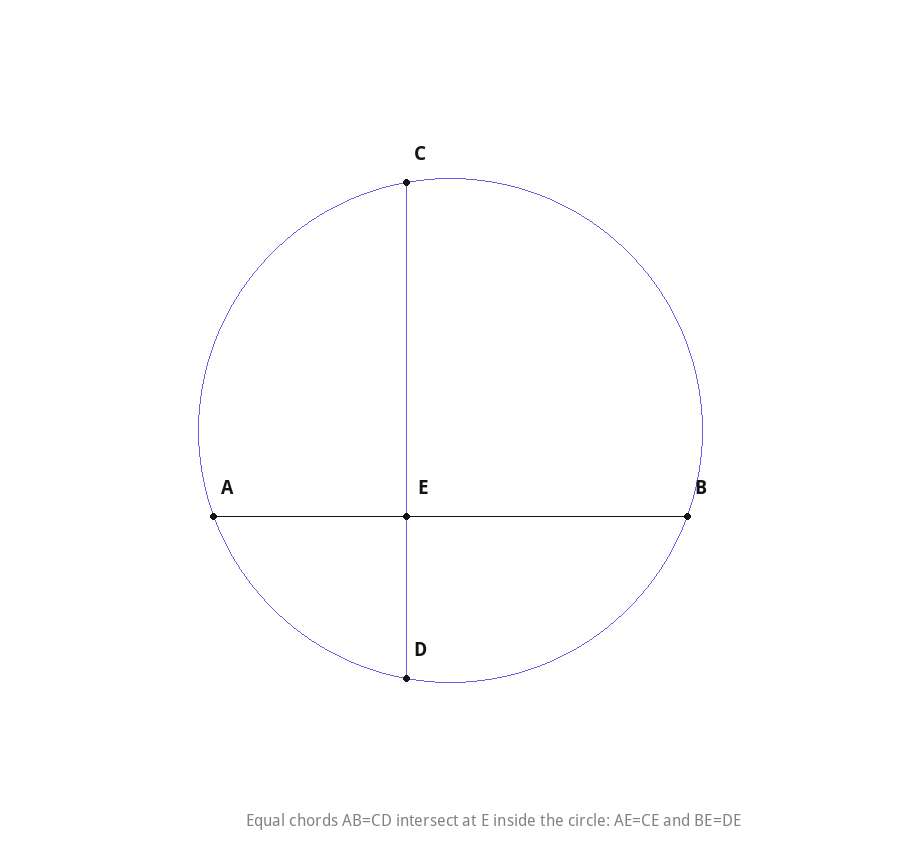
Q12. Two equal chords intersect inside a circle, each split into two segments. Show that the segments of one chord equal the corresponding segments of the other — Answer: Given: Chords AB = CD intersect at E inside a circle with centre O. Draw OM ⊥…
Answer: Given: Chords AB = CD intersect at E inside a circle with centre O. Draw OM ⊥ AB and ON ⊥ CD, and join OE. To prove: AE = CE and BE = DE.
Proof: Since AB = CD, by Theorem 6 they are equidistant from the centre: OM = ON. The perpendicular from the centre bisects each chord, so AM = MB and CN = ND. In right triangles OME and ONE: OM = ON, OE = OE (common), ∠OME = ∠ONE = 90°. So ∆OME ≅ ∆ONE by RHS, giving ME = NE (CPCT).
Now AE = AM + ME and CE = CN + NE. Since AM = CN and ME = NE, AE = CE. Similarly, BE = MB − ME and DE = ND − NE; since MB = ND and ME = NE, BE = DE.
Q13. Draw a circle in which a chord of 6 cm stands at a distance of 3 cm from the centre — Answer: Construction: Draw AB = 6 cm. Construct the perpendicular bisector of AB,…
Answer: Construction: Draw AB = 6 cm. Construct the perpendicular bisector of AB, meeting AB at its midpoint P. Since the centre of any circle through A and B must lie on this perpendicular bisector, mark a point O on it such that OP = 3 cm. With O as centre and radius OA (which, by the Baudhāyana-Pythagoras theorem, equals √(3² + 3²) = √18 = 3√2 cm since AP = 3 cm), draw the circle. This circle passes through A and B, and AB is exactly 3 cm from its centre, as required.
Q14. Show that a rectangle is the only kind of parallelogram that can be inscribed in a circle — Answer: Given: Parallelogram ABCD is inscribed in a circle. To prove: ABCD is a rectangle.
Answer: Given: Parallelogram ABCD is inscribed in a circle. To prove: ABCD is a rectangle.
Proof: Since ABCD is cyclic, opposite angles are supplementary: ∠A + ∠C = 180° and ∠B + ∠D = 180°. Since ABCD is also a parallelogram, opposite angles are equal: ∠A = ∠C and ∠B = ∠D. Combining ∠A = ∠C with ∠A + ∠C = 180° gives 2∠A = 180°, so ∠A = 90°. Since all angles of a parallelogram are determined once one is known (adjacent angles are supplementary), all four angles equal 90° — so ABCD is a rectangle.
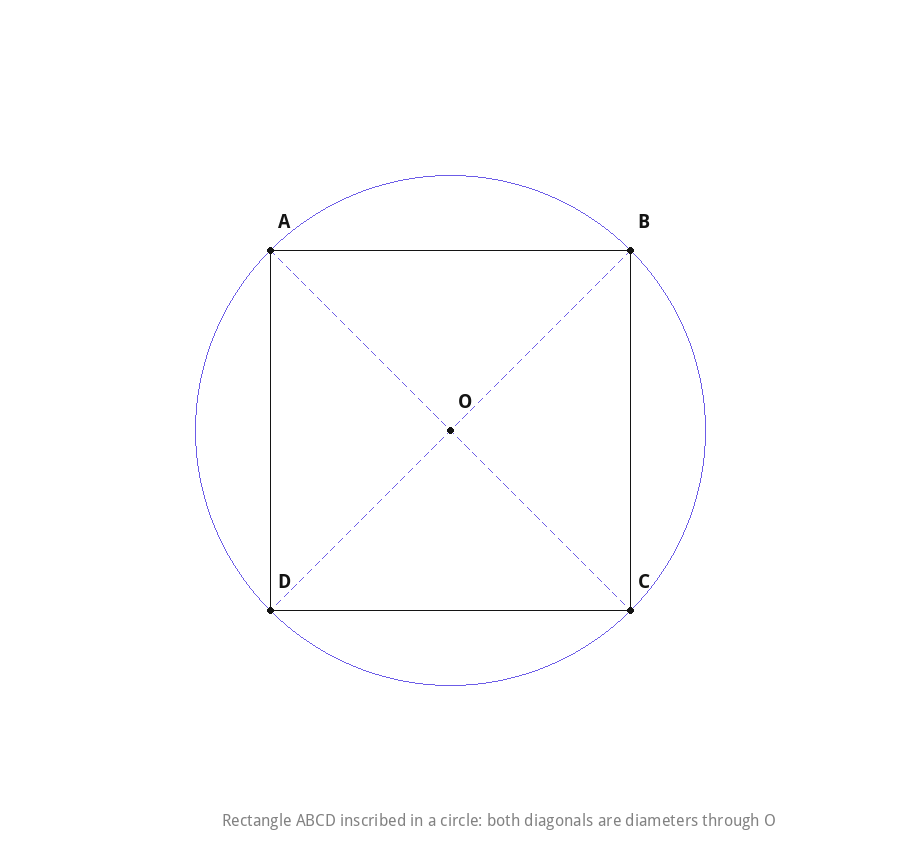
Q15. Show that if a rectangle is inscribed in a circle, the intersection of its diagonals is the centre of the circle — Answer: Given: Rectangle ABCD is inscribed in a circle, with diagonals AC and BD meeting…
Answer: Given: Rectangle ABCD is inscribed in a circle, with diagonals AC and BD meeting at O. To prove: O is the centre of the circle.
Proof: In a rectangle, ∠ABC = 90°, so chord AC subtends a right angle at B — by the converse of the semicircle-angle corollary, AC must be a diameter. Similarly, ∠BCD = 90° means BD is also a diameter. Since the diagonals of a rectangle bisect each other, AO = CO and BO = DO — but since AC and BD are both diameters (each passing through the true centre and having the same length, 2r), and they bisect each other at O, the point O must be their common midpoint, which is exactly the centre of the circle.
Q16. Consider all chords of a circle of a fixed length. What shape do their midpoints form? — Answer: All such midpoints lie at the same fixed distance d = √(r² − (chord/2)²)…
Answer: All such midpoints lie at the same fixed distance d = √(r² − (chord/2)²) from the centre (by the chord-length formula), so they trace out a smaller circle, concentric with the original circle (i.e., sharing the same centre).
Q17. In a circle with centre O, chords AB and AC are congruent. Explain why the centre lies on the angle bisector of ∠BAC — Answer: Given: AB = AC (equal chords from the same point A). To prove: AO bisects ∠BAC.
Answer: Given: AB = AC (equal chords from the same point A). To prove: AO bisects ∠BAC.
Proof: In ∆AOB and ∆AOC: OA = OA (common), OB = OC (radii), AB = AC (given). So ∆AOB ≅ ∆AOC by SSS, giving ∠OAB = ∠OAC (CPCT). This means line AO bisects ∠BAC, so the centre O lies on the angle bisector of ∠BAC.
Q18. Two parallel chords of length 10 cm and 24 cm lie on the same side of the centre, 7 cm apart. Find the radius — Answer: Let the distance from the centre to the 24 cm chord be x, so the distance to the…
Answer: Let the distance from the centre to the 24 cm chord be x, so the distance to the 10 cm chord is x + 7 (same side, farther out). Half-chords: 12 cm and 5 cm respectively.
r² = x² + 12² = x² + 144 … (i)
r² = (x + 7)² + 5² = x² + 14x + 49 + 25 = x² + 14x + 74 … (ii)
Equating: x² + 144 = x² + 14x + 74 → 144 − 74 = 14x → 70 = 14x → x = 5. Substituting into (i): r² = 25 + 144 = 169, so r = 13 cm.
Q19. A regular hexagon is inscribed in a circle of radius r. Find the side length and the distance of each side from the centre — Answer: Let ABCDEF be the regular hexagon. Since all sides are equal chords, they…
Answer: Let ABCDEF be the regular hexagon. Since all sides are equal chords, they subtend equal central angles: ∠AOB = ∠BOC = … = 360°/6 = 60°. In ∆AOB, OA = OB = r and the included angle is 60°, so the other two angles sum to 120° and (being equal by the isosceles property) are each 60°. All three angles of ∆AOB are 60°, so it is equilateral: AB = OA = OB = r — each side of the hexagon equals the radius.
For the distance from the centre: let M be the midpoint of AB, so AM = r/2. In right triangle OMA: d² = OA² − AM² = r² − (r/2)² = 3r²/4, so d = r√3/2.
Q20. Quadrilateral MNOP is inscribed in a circle with MN as a diameter. What can you say about ∠MOP and ∠MNP? — Answer: ∠MOP = ∠MNP, because both are inscribed angles standing on the same arc MP,…
Answer: ∠MOP = ∠MNP, because both are inscribed angles standing on the same arc MP, and by the theorem that angles in the same segment of a circle (subtended by the same arc) are equal, the two angles must be equal regardless of the fact that MN happens to be a diameter.
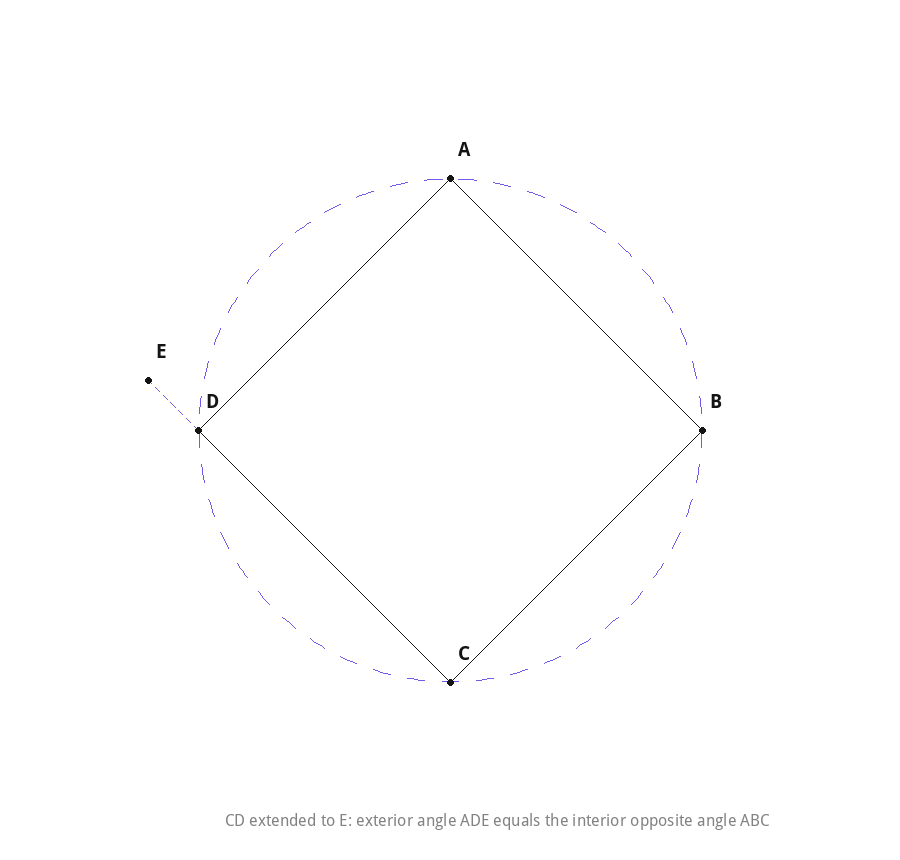
Q21. In cyclic quadrilateral ABCD, side CD is extended to point E. Show that the exterior angle ∠ADE equals the interior opposite angle ∠ABC — Answer: Given: CD is extended to E. To prove: ∠ADE = ∠ABC.
Answer: Given: CD is extended to E. To prove: ∠ADE = ∠ABC.
Proof: Since CDE is a straight line, ∠ADC + ∠ADE = 180° (linear pair). Since ABCD is cyclic, ∠ABC + ∠ADC = 180° (opposite angles supplementary). Comparing the two equations: ∠ADC + ∠ADE = ∠ABC + ∠ADC, and subtracting ∠ADC from both sides gives ∠ADE = ∠ABC.
Q22. "There is no chord of a circle longer than its diameter." Justify this — Answer: Let AB be any chord of a circle with centre O and radius r. In ∆OAB, by the…
Answer: Let AB be any chord of a circle with centre O and radius r. In ∆OAB, by the triangle inequality, the sum of two sides exceeds the third: OA + OB > AB. Since OA = OB = r, this gives 2r > AB. As 2r is precisely the length of the diameter, this shows the diameter is strictly greater than any chord that does not pass through the centre. A chord that does pass through the centre is itself a diameter of length exactly 2r. So no chord can ever exceed the diameter in length — the diameter is the longest possible chord.
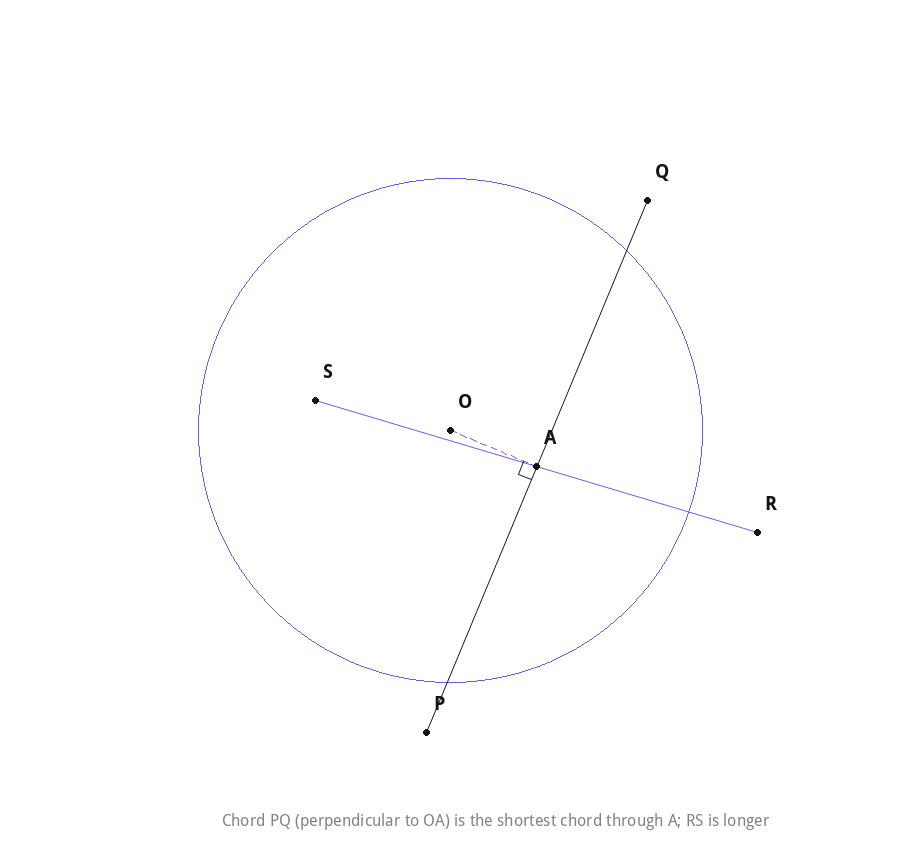
Q23. A is a point inside a circle with centre O. Show that the shortest chord through A is the one perpendicular to OA — Answer: Given: Chord PQ through A with OA ⊥ PQ; another chord RS through A, not…
Answer: Given: Chord PQ through A with OA ⊥ PQ; another chord RS through A, not perpendicular to OA, meeting OA-related perpendicular OM (M on RS) with OM ⊥ RS. To prove: PQ < RS.
Proof: In right triangle OMA (right-angled at M), the hypotenuse OA is longer than the leg OM: OA > OM. Now, the distance of chord PQ from the centre is OA (since OA itself is perpendicular to PQ), while the distance of chord RS from the centre is OM. Since OA > OM, chord PQ is farther from the centre than chord RS. By Theorem 8, the chord that is farther from the centre is shorter, so PQ < RS. This holds for every other chord through A, so the chord perpendicular to OA is the shortest possible chord through A.
Q24. How does the figure justify that the angle in a semicircle is 90°? — Answer: Given: A semicircle with centre O on diameter BC, and A a point on the…
Answer: Given: A semicircle with centre O on diameter BC, and A a point on the circumference, so OA = OB = OC (radii). To prove: ∠BAC = 90°.
Proof: In ∆OBA, OA = OB, so it is isosceles, giving ∠OAB = ∠OBA = a (say). In ∆OCA, OA = OC, so ∠OAC = ∠OCA = b (say). The angle at vertex A of the large triangle ABC is ∠BAC = a + b. The angles of ∆ABC sum to 180°: ∠ABC + ∠ACB + ∠BAC = a + b + (a + b) = 2a + 2b = 180°, so a + b = 90°. Therefore ∠BAC = a + b = 90° — the angle in a semicircle is always a right angle.
Q25. Chords CC' and DD' are drawn perpendicular to diameter AB. Prove that the segment MM' joining the midpoints of CD and C'D' is perpendicular to AB — Answer: Given: Diameter AB; chords CC' and DD' both perpendicular to AB; M, M' are the…
Answer: Given: Diameter AB; chords CC’ and DD’ both perpendicular to AB; M, M’ are the midpoints of CD and C’D’ respectively. To prove: MM’ ⊥ AB.
Proof: Since CC’ ⊥ AB and DD’ ⊥ AB, both CC’ and DD’ are perpendicular to the same line AB, so CC’ ∥ DD’. Quadrilateral CDD’C’ therefore has one pair of parallel sides (CC’ ∥ DD’), making it a trapezium. M and M’ are the midpoints of the non-parallel sides CD and C’D’ of this trapezium. By the midpoint theorem for a trapezium, the segment joining the midpoints of the non-parallel sides is parallel to the parallel sides, so MM’ ∥ CC’. Since CC’ ⊥ AB, and MM’ ∥ CC’, it follows that MM’ ⊥ AB as well.
Q26. How does the figure justify that the sum of opposite angles of a cyclic quadrilateral is 180°? — Answer: Join the centre O to each vertex A, B, C, D of the cyclic quadrilateral. Each…
Answer: Join the centre O to each vertex A, B, C, D of the cyclic quadrilateral. Each triangle formed (OAB, OBC, OCD, ODA) is isosceles since its two non-diagonal sides are radii, so the base angles of each are equal. Let ∠OAB = ∠OBA = p, ∠OBC = ∠OCB = q, ∠OCD = ∠ODC = u, and ∠ODA = ∠OAD = v.
Then the four angles of the quadrilateral are: ∠A = p + v, ∠B = p + q, ∠C = q + u, ∠D = u + v. Since the angles of any quadrilateral sum to 360°: (p+v) + (p+q) + (q+u) + (u+v) = 2p + 2q + 2u + 2v = 360°, so p + q + u + v = 180°.
Now, ∠A + ∠C = (p + v) + (q + u) = (p + q + u + v) = 180°, and ∠B + ∠D = (p + q) + (u + v) = (p + q + u + v) = 180°. So both pairs of opposite angles sum to 180°, proving the theorem.
Practice more: Extra Questions for Class 9 Mathematics Chapter 5
Quick revision: Revision Notes for Class 9 Mathematics Chapter 5
- Chapter 1: Orienting Yourself: The Use of Coordinates – Free PDF Download
- Chapter 2: Introduction to Linear Polynomials – Free PDF Download
- Chapter 3: The World of Numbers – Free PDF Download
- Chapter 4: Exploring Algebraic Identities – Free PDF Download
- Chapter 6: Measuring Space: Perimeter and Area – Free PDF Download
- Chapter 7: The Mathematics of Maybe: Introduction to Probability – Free PDF Download
- Chapter 8: Predicting What Comes Next?: Exploring Sequences and Progressions – Free PDF Download
Frequently Asked Questions
What is the difference between a linear and a quadratic equation in two variables?
A linear equation in two variables has the highest power of each variable equal to 1 (e.g. ax+by=c) and its graph is always a straight line; a quadratic equation involves a squared term and its graph is a curve (like a parabola), not a straight line.
Why must a linear equation in two variables have infinitely many solutions?
Because for any value you choose for one variable, the equation determines a corresponding value for the other — since there are infinitely many values you could choose for the first variable, there are infinitely many valid (x,y) solution pairs, which is why the solution set is represented as a line, not a single point.
Chapter Quiz — Test Your Understanding
Class 9 Mathematics Chapter 5: I’m Up and Down, and Round and Round – Notes and Extra Questions
Along with these NCERT Solutions, students can also use the Class 9 Mathematics Chapter 5 Extra Questions and Class 9 Mathematics Chapter 5 Revision Notes for quick revision and extra practice.
Recommended: Buy the Printed NCERT Class 9 Maths Book
Contains Amazon affiliate links.
If you’d like a printed copy alongside the PDF, here’s a verified option:
4.0 out of 5 stars (1,313 ratings) · Rs. 106
Price and availability may change on Amazon. As an Amazon Associate, ncertbooks.org earns from qualifying purchases.


