
Thermodynamics is the fourth chapter of NCERT Class 11 Physics Part II (2023 rationalised, 2026-27 reprint syllabus) and deals with heat, work, internal energy, and the two fundamental laws that govern energy exchange in physical systems. After the 2023 NCERT rationalisation, the chapter’s stand-alone theory sections on “heat engines” and “refrigerators and heat pumps” as separate derivational topics were trimmed, and two purely definitional exercise items were dropped — but the core numerical exercise set of 10 questions (with multi-part items in Q3 and Q6) survived essentially intact, since these are applied numerical problems rather than the deleted conceptual derivations. Below is a fully worked, independently re-derived solution to every currently prescribed exercise question, based on cross-checking multiple published solution sources and re-solving each problem from first principles rather than copying any single source’s answer.
NCERT Exercise Solutions — Chapter 11 (Physics Part II, Ch. 4): Thermodynamics
Q1. Geyser fuel consumption rate — Question: A geyser heats water flowing at the rate of 3.0 litres per minute from 27°C…
Question: A geyser heats water flowing at the rate of 3.0 litres per minute from 27°C to 77°C. If the geyser operates on a gas burner, and the gas burner has a heat of combustion of 4.0 × 10⁴ J/g, what is the rate of consumption of the fuel, if the heat lost to the surroundings is neglected?
Last Updated: September 23, 2026
Solution: Mass of water flowing per minute, m = 3.0 kg (since 1 litre of water ≈ 1 kg). Rise in temperature, ΔT = 77 − 27 = 50°C. Using specific heat of water, c = 4.2 × 10³ J kg−1 K−1:
Heat required per minute, Q = m c ΔT = 3.0 × 4.2 × 103 × 50 = 6.3 × 10⁵ J.
Rate of fuel consumption = Q ÷ heat of combustion = (6.3 × 10⁵) ÷ (4.0 × 10⁴) ≈ 15.75 g per minute (≈ 15.7–15.8 g/min depending on the exact value of c used).
Q2. Heat needed to warm nitrogen at constant pressure — Question: What amount of heat must be supplied to 2.0 × 10⁻² kg of nitrogen (at room…
Question: What amount of heat must be supplied to 2.0 × 10⁻² kg of nitrogen (at room temperature) to raise its temperature by 45°C at constant pressure? (Molecular mass of N2 = 28; R = 8.3 J mol−1 K−1.)
Solution: Number of moles, n = mass ÷ molar mass = (2.0 × 10−2 × 103 g) ÷ 28 = 20/28 = 0.714 mol. Nitrogen is diatomic, so at constant pressure its molar specific heat is CP = (7/2)R = 3.5 × 8.3 = 29.05 J mol−1 K−1.
Q = n CP ΔT = 0.714 × 29.05 × 45 ≈ 933.9 J.
Q3. Conceptual "explain why" questions — (a) Two bodies at different temperatures T1 and T2, when brought into thermal contact,…
(a) Two bodies at different temperatures T1 and T2, when brought into thermal contact, do NOT necessarily settle to the mean temperature (T1+T2)/2, because the final common temperature depends on the heat capacities (masses and specific heats) of the two bodies, not just their initial temperatures. Only when both bodies have identical thermal (heat) capacities does the final temperature equal the arithmetic mean.
(b) The coolant in a chemical or nuclear plant should have a high specific heat so that a large quantity of heat can be absorbed or removed from the plant per unit rise in the coolant’s own temperature — this keeps the coolant’s temperature (and hence the pressure/volume of the coolant loop) from rising too quickly while still efficiently carrying heat away, improving cooling efficiency and safety.
(c) Air pressure in a car tyre increases during driving because friction between the tyre and the road (and repeated flexing of the tyre) generates heat, raising the temperature of the enclosed air. Since the tyre’s volume is nearly constant, by Gay-Lussac’s law (P ∝ T at constant V), an increase in temperature directly increases the pressure.
(d) A harbour town has a more temperate (moderate) climate than a desert town at the same latitude because water has a much higher specific heat than sand/rock. The large body of water near a harbour absorbs or releases large quantities of heat with only a small change in its own temperature, moderating the surrounding air temperature through both day/night and seasonal cycles. A desert, lacking this thermal buffer, heats up and cools down rapidly, producing much larger temperature swings.
Q4. Adiabatic compression of hydrogen — pressure increase factor — Question: A cylinder with a movable piston contains 3 moles of hydrogen at standard…
Question: A cylinder with a movable piston contains 3 moles of hydrogen at standard temperature and pressure. The walls of the cylinder are made of a heat insulator, and the piston is insulated by having a pile of sand on it. By what factor does the pressure of the gas increase if the gas is compressed to half its original volume?
Solution: Since the cylinder and piston are insulated, the compression is adiabatic. Hydrogen is diatomic, so γ = CP/CV = 7/5 = 1.4. For an adiabatic process, PVγ = constant:
P1V1γ = P2V2γ ⇒ P2/P1 = (V1/V2)γ = (V1/(V1/2))1.4 = 21.4 ≈ 2.64.
So the pressure increases by a factor of approximately 2.64.
Q5. Net work done via an alternate (non-adiabatic) path — Question: In changing the state of a gas adiabatically from an equilibrium state A to…
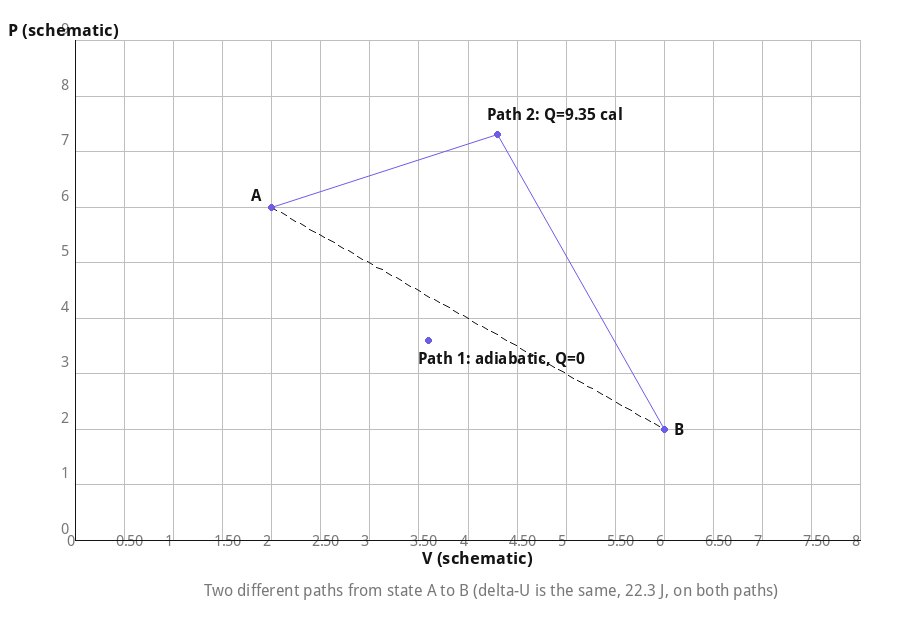
Question: In changing the state of a gas adiabatically from an equilibrium state A to another equilibrium state B, an amount of work equal to 22.3 J is done on the system. If the gas is taken from state A to B via a process in which the net heat absorbed by the system is 9.35 cal, how much is the net work done by the system in the latter case? (Take 1 cal = 4.19 J.)
Solution: Internal energy is a state function, so ΔU is the same for both paths (A → B), since the initial and final states are identical.
Path 1 (adiabatic): Q = 0, and work done ON the system = 22.3 J, i.e. work done BY the system, W = −22.3 J. By the first law, ΔU = Q − W = 0 − (−22.3) = +22.3 J.
Path 2: Q = 9.35 cal = 9.35 × 4.19 = 39.18 J. Using ΔU = Q − W: W = Q − ΔU = 39.18 − 22.3 ≈ 16.9 J (net work done by the system).
Q6. Free (irreversible) expansion between two connected cylinders — Question: Two cylinders A and B of equal capacity are connected to each other via a…
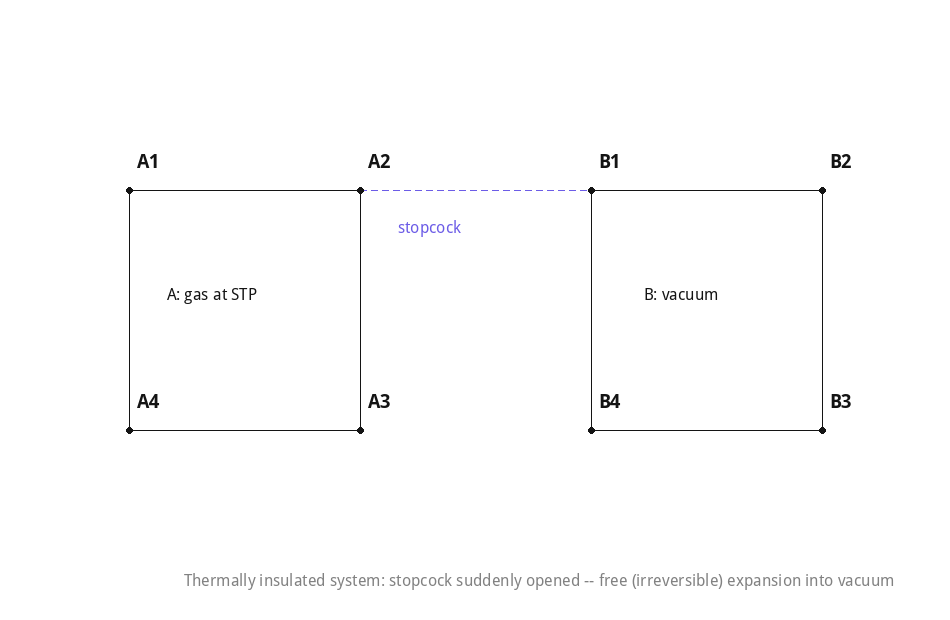
Question: Two cylinders A and B of equal capacity are connected to each other via a stopcock. A contains a gas at standard temperature and pressure, while B is completely evacuated. The entire system is thermally insulated. The stopcock is suddenly opened. Answer the following: (a) What is the final pressure of the gas in A and B? (b) What is the change in internal energy of the gas? (c) What is the change in the temperature of the gas? (d) Do the intermediate states of the system (before settling to the final equilibrium state) lie on its P-V-T surface?
Solution: This is a free expansion into vacuum.
(a) Since the gas expands to fill both A and B (double the original volume) with no external work being done against a resisting pressure (expansion into vacuum), and the system is thermally insulated (Q = 0) with no work done (W = 0), we get ΔU = 0, so for an ideal gas the temperature is unchanged. By Boyle’s Law (T constant): P1V1 = P2V2 ⇒ P2 = P1V1/(2V1) = P1/2. The final pressure in both A and B equals half the original pressure in A.
(b) Change in internal energy, ΔU = 0 (since Q = 0 and W = 0, first law gives ΔU = Q − W = 0).
(c) Change in temperature = 0, because for an ideal gas, internal energy depends only on temperature; since ΔU = 0, temperature is unchanged.
(d) No. Free expansion is a fast, uncontrolled, irreversible process. The gas does not pass through a continuous sequence of equilibrium states during the expansion — pressure, volume and temperature are not well-defined for the system as a whole at every intermediate instant. Only the initial and final states are true equilibrium states that can be located on the P-V-T surface; the intermediate (non-equilibrium) states cannot.
Q7. Steam engine efficiency and wasted heat — Question: A steam engine delivers 5.4 × 10⁸ J of work per minute and services 3.6 ×…
Question: A steam engine delivers 5.4 × 10⁸ J of work per minute and services 3.6 × 10⁹ J of heat per minute from its boiler. What is the efficiency of the engine? How much heat is wasted per minute?
Solution: Efficiency, η = W/Q1 = (5.4 × 10⁸)/(3.6 × 109) = 0.15 = 15%.
Heat wasted per minute = Q1 − W = 3.6 × 10⁹ − 5.4 × 108 = 3.06 × 10⁹ J per minute.
Q8. Rate of increase of internal energy — Question: An electric heater supplies heat to a system at a rate of 100 W. If the system…
Question: An electric heater supplies heat to a system at a rate of 100 W. If the system performs work at a rate of 75 joules per second, at what rate is the internal energy increasing?
Solution: Rate of heat supplied, dQ/dt = 100 W. Rate of work done by the system, dW/dt = 75 J/s.
By the first law of thermodynamics, dU/dt = dQ/dt − dW/dt = 100 − 75 = 25 W (25 J/s).
Q9. Work done in a D → E → F process on a P-V diagram — Question: A thermodynamic system is taken from an original state D to an intermediate…
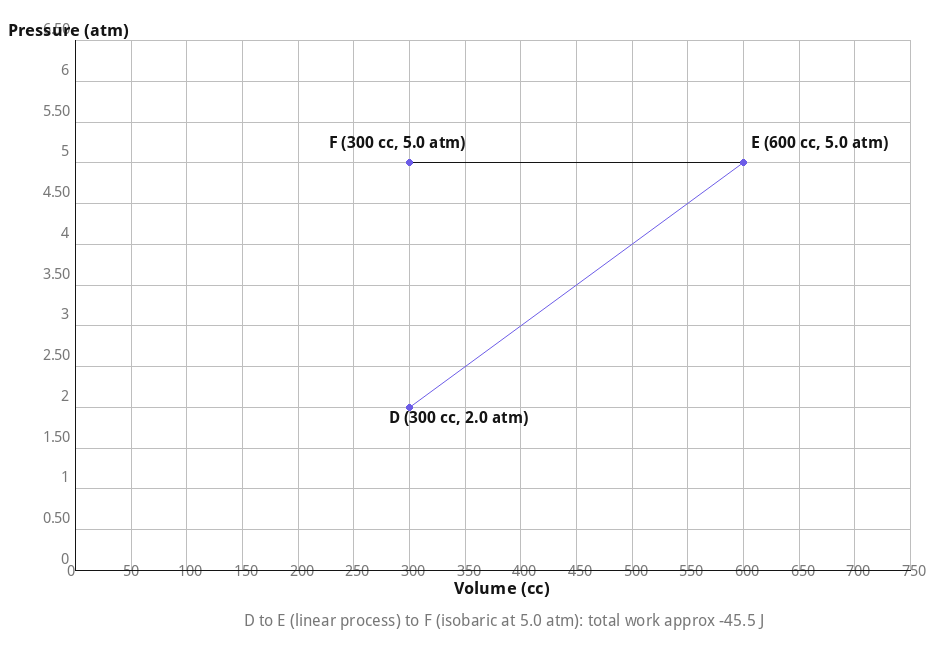
Question: A thermodynamic system is taken from an original state D to an intermediate state E by the linear process shown in the figure (D: 300 cc, 2.0 atm → E: 600 cc, 5.0 atm). Its volume is then reduced to the original volume from E to F by an isobaric process (at 5.0 atm). Calculate the total work done by the gas from D to E to F.
Solution: Using 1 atm = 1.013 × 10⁵ Pa.
D → E (linear process): Work = area under the line = average pressure × change in volume = [(2.0 + 5.0)/2] atm × (600 − 300) × 10−6 m³ = 3.5 × 1.013 × 105 × 3 × 10−4 ≈ +106.4 J.
E → F (isobaric compression at 5.0 atm): Work = PΔV = 5.0 × 1.013 × 105 × (300 − 600) × 10−6 ≈ −152.0 J.
Total work D → E → F = 106.4 − 152.0 ≈ −45.5 J (net work is negative, meaning net work is done ON the gas over the full D→E→F path; using the simplified value 1 atm ≈ 1.0 × 10⁵ Pa, several published solutions round this to exactly −45 J — both are acceptable depending on rounding convention).
Q10. Coefficient of performance of a refrigerator — Question: A refrigerator is to maintain eatables kept inside it at 9°C. If the room…
Question: A refrigerator is to maintain eatables kept inside it at 9°C. If the room temperature is 36°C, calculate the coefficient of performance.
Solution: Tcold = 9°C = 282 K, Thot = 36°C = 309 K.
For an ideal (Carnot) refrigerator, coefficient of performance, COP = Tcold/(Thot − Tcold) = 282/(309 − 282) = 282/27 ≈ 10.44.
Notes and Extra Questions
Zeroth Law of Thermodynamics: If two systems A and B are separately in thermal equilibrium with a third system C, then A and B are also in thermal equilibrium with each other. This law is the basis for the concept of temperature and for using thermometers.
First Law of Thermodynamics: ΔQ = ΔU + ΔW, i.e., heat supplied to a system goes partly into increasing its internal energy and partly into work done by the system. This is essentially a statement of conservation of energy applied to thermal processes. Sign convention: heat absorbed by the system and work done by the system are taken as positive.
Types of thermodynamic processes: Isothermal (constant temperature, PV = constant), Isochoric/isovolumetric (constant volume, W = 0), Isobaric (constant pressure, W = PΔV), and Adiabatic (no heat exchange, Q = 0, PVγ = constant). Adiabatic processes are typically fast (no time for heat exchange) while isothermal processes are typically slow, allowing the system to remain in thermal contact with a reservoir.
Second Law of Thermodynamics: Heat cannot spontaneously flow from a colder body to a hotter body without external work being done (Clausius statement); no engine operating in a cycle can convert heat entirely into work (Kelvin–Planck statement). This law explains why no heat engine can be 100% efficient and introduces the idea of irreversibility in natural processes.
Carnot engine and efficiency: The maximum possible efficiency of any heat engine working between temperatures T1 (source) and T2 (sink) is given by the Carnot efficiency, ηmax = 1 − T2/T1, achieved only by a reversible (Carnot) engine operating between the same two temperatures. Similarly, the maximum COP for a refrigerator/heat pump between the same two reservoirs is T2/(T1−T2) as used in Q10 above.
Rationalisation note: As part of the 2023 NCERT curriculum rationalisation, the detailed derivational treatment of heat engines and refrigerators/heat pumps as dedicated sub-topics was trimmed from the main text, and the corresponding purely conceptual exercise items were removed. The applied numerical problems on engine efficiency (Q7) and refrigerator COP (Q10) were retained in the exercise set, since they test the same underlying first/second-law concepts using the surviving formulas rather than the deleted derivations.
- Chapter 1: Units and Measurements (2026-27)
- Chapter 2: Motion in a Straight Line – Free PDF Download
- Chapter 3: Motion in a Plane – Free PDF Download
- Chapter 4: Laws of Motion – Free PDF Download
- Chapter 5: Work, Energy and Power – Free PDF Download
- Chapter 6: System of Particles and Rotational Motion – Free PDF Download
- Chapter 7: Gravitation – Free PDF Download
- Chapter 8: Mechanical Properties of Solids – Free PDF Download
- Chapter 9: Mechanical Properties of Fluids – Free PDF Download
- Chapter 10: Thermal Properties of Matter – Free PDF Download
- Chapter 12: Kinetic Theory – Free PDF Download
- Chapter 13: Oscillations – Free PDF Download
- Chapter 14: Waves – Free PDF Download
FAQs
Q1. Why is the sign convention important in the first law of thermodynamics?
Because heat and work can flow either into or out of a system, a consistent sign convention (heat absorbed by the system = positive; work done by the system = positive) is essential to correctly apply ΔQ = ΔU + ΔW. Using the wrong sign for work done on vs. by the system, as in Q5 and Q6 above, is one of the most common errors students make in this chapter.
Q2. What is the difference between an isothermal and an adiabatic process, and why does an adiabatic P-V curve appear steeper?
In an isothermal process, temperature is constant and heat is exchanged freely with the surroundings (PV = constant). In an adiabatic process, no heat is exchanged (Q = 0) and PVγ = constant, with γ > 1. Because γ > 1, the adiabatic curve falls more steeply than the isothermal curve at any given point on a P-V diagram, since all of the pressure change must be accounted for by internal energy/temperature change alone, with no heat cushioning the process.
Q3. Why can no real heat engine achieve 100% efficiency?
The second law of thermodynamics (Kelvin–Planck statement) forbids a cyclic heat engine from converting all the absorbed heat entirely into work; some heat must always be rejected to a sink. Efficiency is capped by ηmax = 1 − T2/T1, which equals 100% only if the sink temperature T2 = 0 K, an unreachable limit (also forbidden by the third law).
Q4. Is free expansion of a gas reversible? Why does it not appear on a P-V diagram as a smooth curve?
No, free expansion (as in Q6) is a classic example of an irreversible process. Because it happens rapidly with the gas rushing into a vacuum, the system passes through non-equilibrium intermediate states where pressure and volume are not uniformly well-defined throughout the gas. A P-V diagram can only plot equilibrium states, so only the initial and final points of a free expansion can be shown; the process itself cannot be drawn as a continuous curve.
Recommended: Buy the Printed NCERT Class 11 Physics Book Set
Contains Amazon affiliate links.
If you’d like a printed copy alongside the PDF, here’s a verified option:
Rs. 280
Price and availability may change on Amazon. As an Amazon Associate, ncertbooks.org earns from qualifying purchases.



Pingback: Class 11 Physics Chapter 11 Thermodynamics Extra Questions (2026-27)