
Complete NCERT Solutions for Class 7 Science Chapter 12 “Earth, Moon and the Sun” from the Curiosity textbook, covering the Earth’s rotation and revolution, day and night, the apparent motion of the Sun and stars, the tilt of Earth’s axis and seasons, and solar and lunar eclipses.
Last Updated: September 23, 2026
In-Text Questions
Q1. Why do we experience day and night on Earth?
Answer: The Earth spins on its own axis from west to east, taking about 24 hours to complete one full turn. At any moment, only the half of the Earth facing the Sun is lit up and experiences day, while the opposite half, turned away from the Sun, is in darkness and experiences night. As the Earth keeps spinning, every location gradually moves from the lit side to the dark side and back, giving the regular cycle of day and night.
Q2. If the Earth rotates from west to east, why does the Sun appear to rise in the east and move towards the west?
Answer: This is an example of apparent motion caused by our own movement. Because the Earth turns from west to east, a place on its surface is carried eastward towards the Sun’s rays — so, from our point of view standing on the ground, it looks as if the Sun itself is moving from east to west across the sky, even though it is really the Earth that is turning beneath it.
Q3. Do the stars also appear to move across the sky in the same way as the Sun?
Answer: Yes. Just like the Sun, the stars only seem to move from east to west during the night because of the Earth’s rotation — their actual positions relative to each other barely change. One star, the Pole Star, appears to stay almost fixed in the sky because it lies almost directly above Earth’s rotational axis (close to the line joining the North and South Poles), so the Earth’s spin does not carry it noticeably across the sky the way it does other stars.
Q4. Why do we see different groups of stars in the night sky at different times of the year?
Answer: This happens because of the Earth’s revolution around the Sun. As the Earth moves along its orbit through the year, the night side of the Earth faces a different direction in space each month, so we end up looking out towards a different part of the sky after sunset. Over a full year, as the Earth completes one revolution, we cycle through a full view of the different star patterns (constellations) that lie around the Sun.
Q5. How is the Earth’s revolution connected to the seasons we experience?
Answer: The Earth’s axis is not perfectly upright — it is tilted at about 23.5° to the plane of its orbit around the Sun. As the Earth revolves around the Sun over the year, this tilt means that sometimes the Northern Hemisphere leans towards the Sun and receives more direct, concentrated sunlight for longer hours (summer there), while the Southern Hemisphere leans away and receives slanting, weaker sunlight for shorter hours (winter there); six months later, the situation reverses. The seasons are caused by this changing tilt-related exposure to sunlight, not by the Earth moving closer to or farther from the Sun.
Q6. Why are the days longer in summer and shorter in winter?
Answer: When a hemisphere is tilted towards the Sun (its summer season), a larger portion of its area stays within the sunlit half of the Earth as the planet spins, so that region remains in daylight for a greater fraction of each rotation — giving longer days and shorter nights. When the same hemisphere is tilted away from the Sun (its winter season), a smaller portion of it stays in the sunlit half at any time, giving shorter days and longer nights.
Exercise Questions (Let Us Enhance Our Learning)
Q1. A diagram shows the North Pole tilted away from the Sun while the South Pole is tilted towards it. State how many hours of sunlight each pole receives in this position, and name the season at each pole.
Answer: In this configuration, the North Pole is tilted away from the Sun and lies entirely within Earth’s shadowed half, so it receives 0 hours of sunlight (continuous night) — this is winter at the North Pole. The South Pole is tilted towards the Sun and lies entirely within the sunlit half, so it receives 24 hours of sunlight (continuous day) — this is summer at the South Pole.
Q2. Fill in the blanks:
(i) Because of the Earth’s rotation from west to east, the Sun and stars appear to rise in the ______ and set in the ______.
(ii) The alternating cycle of day and night is caused by the Earth’s ______, while the cycle of seasons is caused mainly by the Earth’s ______ combined with the tilt of its axis.
(iii) When the Moon completely blocks out the Sun’s disc as seen from a place on Earth, it is called a ______ solar eclipse.
Answer: (i) east; west. (ii) rotation; revolution. (iii) total.
Q3. State whether the following statements are true or false:
(i) A lunar eclipse occurs when the Sun comes exactly between the Earth and the Moon.
(ii) Since the Earth rotates from west to east, places in the east see the Sun rise earlier than places further west in the same country.
(iii) Every place on Earth has its longest day of the year on exactly the same date, regardless of its distance from the equator.
(iv) It is safe to look directly at a solar eclipse with the unaided eye, as long as it only lasts a few minutes.
(v) The Earth’s revolution around the Sun is the direct cause of day and night.
Answer: (i) False — a lunar eclipse occurs when the Earth comes between the Sun and the Moon, not the Sun between the Earth and Moon. (ii) True — because the Earth spins west to east, eastern locations are carried into sunlight before locations to their west. (iii) False — the length of the longest day varies with latitude and hemisphere; it is not the same everywhere. (iv) False — looking directly at the Sun during a solar eclipse, even briefly, can permanently damage the eyes; special eclipse glasses or indirect viewing methods must always be used. (v) False — day and night are caused by the Earth’s rotation on its axis, not its revolution around the Sun.
Q4. Padma noted that a particular star group rose at 8:00 pm on a certain night. Roughly how many minutes earlier will the same star group rise the following night, and why does this happen?
Answer: The star group will rise roughly 4 minutes earlier the next night, at about 7:56 pm. This slight daily shift happens because, in addition to spinning on its axis once approximately every 24 hours, the Earth is also steadily moving along its orbit around the Sun. This small extra movement each day means the Earth has to rotate a little further than a full 360° turn for the Sun to return to the same position in the sky, but a distant star (not affected by this orbital shift in the same way) appears in the same position about 4 minutes sooner each day.
Q5. If a particular constellation is seen just after sunset on 21 June, roughly when would it appear in the same position after sunset again, and why?
Answer: It would appear in the same position after sunset again about 365 days later (roughly one year later) — once the Earth completes one full revolution around the Sun and returns to the same point in its orbit, the night sky returns to showing the same part of space in the same direction. Along the way, the same daily ~4-minute shift described above (Q4) adds up over the year to this full-cycle return.
Q6. When it is daytime in India, explain why it is night-time on the opposite side of the Earth, such as in parts of the USA.
Answer: At any given moment, only the half of the spinning Earth facing the Sun is lit (daytime), while the opposite half is in shadow (night-time). India and the USA lie roughly on opposite sides of the globe, so when India’s side of the Earth is turned to face the Sun (daytime there), the USA’s side is turned away from the Sun into Earth’s shadow (night-time there) — and several hours later, as the Earth keeps rotating, the situation reverses.
Q7. During a solar eclipse, a student watched the event directly with unprotected eyes because it “did not look too bright.” Explain what was wrong with this, and suggest two safe ways to observe a solar eclipse.
Answer: This was unsafe. Even when a large part of the Sun’s disc is covered by the Moon, the remaining sliver of sunlight is still intense enough to damage the retina, and because the overall brightness is reduced, the eye’s natural blink/pain reflex does not warn the viewer in time. Two safe methods are: (i) using certified solar eclipse viewing glasses (much darker than ordinary sunglasses) that block out harmful radiation; and (ii) using an indirect projection method, such as a pinhole projector, that casts an image of the eclipsed Sun onto a screen so it can be viewed without looking at the Sun at all.
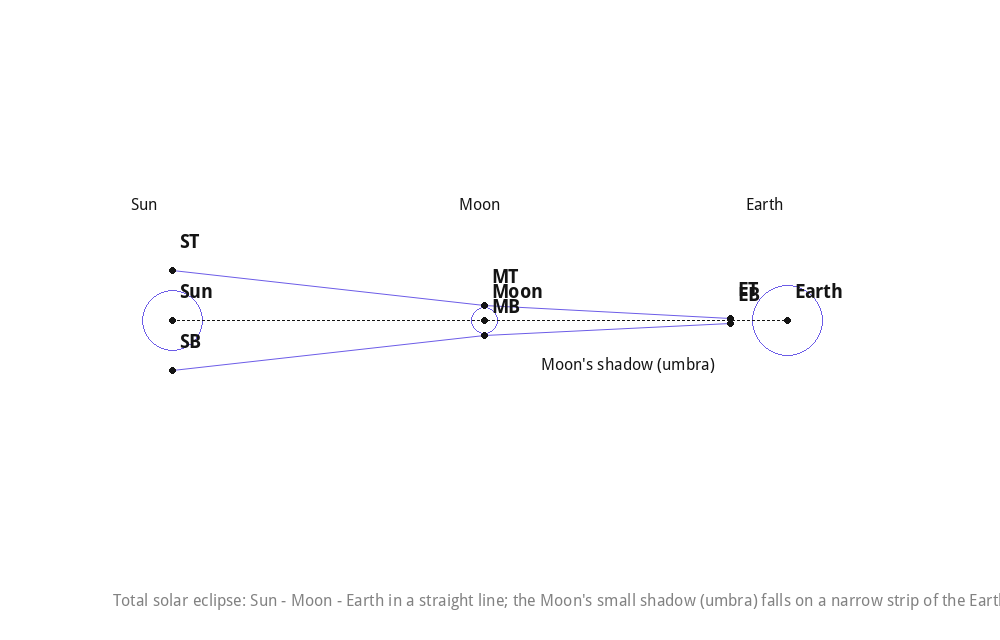
Q8. Draw and label a simple diagram showing the relative positions of the Sun, Earth and Moon during a total solar eclipse.
Answer: During a total solar eclipse, the three bodies line up in the order Sun – Moon – Earth, with the Moon positioned exactly between the Sun and the Earth. The Moon’s small, dark shadow (called the umbra) falls on a narrow strip of the Earth’s surface; only observers standing within that narrow shadow path see the Sun’s disc completely blocked out.
Q9. The Moon is much smaller than the Sun, yet during a total solar eclipse it appears to cover the Sun’s disc almost exactly. Explain why.
Answer: How large an object looks to us (its apparent size) depends on both its actual size and its distance from the observer — a nearby small object can look the same size as a much bigger but far-away object. The Sun’s diameter is enormously larger than the Moon’s, but the Sun is also enormously farther from Earth than the Moon is. By a striking coincidence, these two ratios (size and distance) are close enough to each other that the Sun and Moon end up appearing almost exactly the same size in Earth’s sky, which is why the much smaller Moon can neatly cover the much bigger Sun during a total solar eclipse.
Q10. An Indian cricket team travels to Australia to play a match in the last week of December. Should the players pack heavy woollens or light summer clothing? Explain your reasoning.
Answer: They should pack light summer clothing. December falls in winter in India (Northern Hemisphere) because the Northern Hemisphere is tilted away from the Sun at that time of year. Australia lies in the Southern Hemisphere, which is tilted towards the Sun during the same period — so while India experiences winter, Australia is in the middle of its summer season, with warm temperatures.
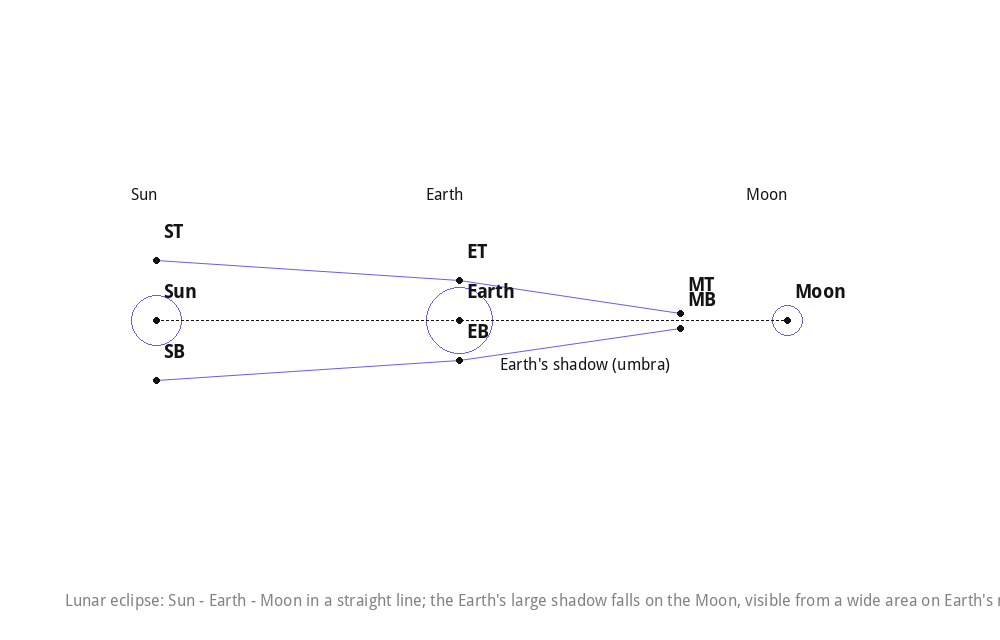
Q11. A lunar eclipse can usually be seen from a much larger part of the Earth than a total solar eclipse. Explain why, with reference to the sizes of the shadows involved.
Answer: During a lunar eclipse, it is the Earth’s shadow that falls on the Moon; since the Earth is much bigger than the Moon, its shadow at the Moon’s distance is also large, so the eclipse is visible simultaneously to everyone on the entire night-side half of the Earth that can see the Moon at that time — a very large area. During a total solar eclipse, it is the much smaller Moon’s shadow that falls on the Earth; because the Moon is small, its dark umbral shadow traces out only a narrow path a few hundred kilometres wide across the Earth’s surface, so totality is visible only to observers within that narrow strip, for at most a few minutes as the shadow sweeps past.
Q12. Suppose the Earth’s axis were not tilted at all, but stood perfectly upright relative to its orbit around the Sun. Would we still experience seasons? Explain.
Answer: No, there would be no seasons in that case. Seasonal change happens because the tilt causes different hemispheres to lean towards or away from the Sun at different times of the year, changing how directly sunlight falls on them and for how many hours. Without any tilt, every place on Earth would receive sunlight at the same angle and for the same number of daylight hours all through the year, so temperatures at any given place would stay roughly constant across the year, with no summer or winter.
Chapter Activities
Activity 12.1: Let Us Explore — Apparent motion on a spinning platform
Sit on a merry-go-round or a rotating chair and slowly spin around while looking outward at the surrounding objects, such as trees or buildings. Observation: the surroundings appear to move in the direction opposite to the spin, even though it is really the observer who is turning. Conclusion: this is the same idea behind why the Sun and stars appear to move across our sky — it is the Earth’s own rotation that creates this apparent motion of objects that are not actually moving relative to each other.
Activity 12.2: Let Us Experiment — Modelling day and night with a globe and a torch
Shine a torch (representing the Sun) on one side of a globe (representing the Earth) in an otherwise dark room, and slowly spin the globe on its axis. Observation: at any instant, only the half of the globe facing the torch is lit up, while the other half stays dark; as the globe turns, a fixed point marked on it moves from the lit side to the dark side and back again. Conclusion: this models exactly how the Earth’s rotation creates the repeating cycle of day and night.
Activity 12.3: Let Us Investigate — Tracking the apparent movement of stars
On a clear night, note the position of a bright star (or a small group of stars) against a fixed marker such as a windowsill or a tree branch, then check its position again after an hour or two. Observation: the star has visibly shifted position, moving in a general east-to-west direction across the sky, while a star close to the Pole Star’s position barely appears to move at all. Conclusion: stars appear to move across the night sky because of the Earth’s rotation, and the star nearest the Earth’s rotational axis (the Pole Star) shows the least apparent movement.
Activity 12.4: Let Us Explore — Apparent size and distance
Hold up a thumb at arm’s length and try to “cover” a distant object, such as a parked car or a tree, with it; then repeat while holding the thumb much closer to the eye. Observation: a small, nearby thumb can completely cover a much larger, but far-away, object. Conclusion: the apparent size of an object depends on both its true size and its distance from the observer — the same principle that allows the small, nearby Moon to cover the much larger, but far more distant, Sun during a total solar eclipse.
Practice more: Extra Questions for Class 7 Science Chapter 12
Quick revision: Revision Notes for Class 7 Science Chapter 12
For the full chapter list, see the Class 7 Science book page and the Class 7 Science Formulas Handbook.
- Chapter 1: The Ever-Evolving World of Science - Curiosity
- Chapter 2: Exploring Substances - Acidic, Basic and Neutral - Curiosity
- Chapter 3: Electricity - Circuits and their Components - Curiosity
- Chapter 4: The World of Metals and Non-metals - Curiosity
- Chapter 5: Changes Around Us - Physical and Chemical - Curiosity
- Chapter 6: Adolescence - A Stage of Growth and Change - Curiosity
- Chapter 7: Heat Transfer in Nature - Curiosity
- Chapter 8: Measurement of Time and Motion - Curiosity
- Chapter 9: Life Processes in Animals - Curiosity
- Chapter 10: Life Processes in Plants - Curiosity
- Chapter 11: Light: Shadows and Reflections - Curiosity
Frequently Asked Questions
Why does the Moon appear to change shape through the month?
This is due to the changing relative positions of the Earth, Moon and Sun — we see different amounts of the Moon’s sunlit half depending on its position in orbit, which is why the Moon goes through phases from new moon to full moon and back.
What causes day and night on Earth?
Earth’s rotation on its own axis (once approximately every 24 hours) causes different parts of the planet to face towards or away from the Sun at different times, creating the cycle of day and night.
Chapter Quiz — Test Your Understanding
Class 7 Science Chapter 12 – Notes and Extra Questions
Along with these NCERT Solutions, students can also use the Class 7 Science Chapter 12 Extra Questions and Class 7 Science Chapter 12 Revision Notes for quick revision and extra practice.
Recommended: Buy the Printed NCERT Class 7 Science Book
Contains Amazon affiliate links.
If you’d like a printed copy alongside the PDF, here’s a verified option:
Rs. 130
Price and availability may change on Amazon. As an Amazon Associate, ncertbooks.org earns from qualifying purchases.


