
Class 10 Science Chapter 9 – Light: Reflection and Refraction: NCERT Solutions
Chapter 9 of Class 10 Science covers spherical mirrors, refraction, lenses, and the mirror/lens formulas used to locate and characterise images. Several third-party sites still label this “Chapter 10” (the pre-2023 numbering) — in the current rationalised syllabus it is Chapter 9. This chapter is heavily numerical, with several questions depending on specific given values (object distance, focal length, radius of curvature). Below you will find both the chapter’s in-text “Questions” and the full end-of-chapter Exercise, including the ray-diagram-dependent questions. These Class 10 Science Chapter 9 solutions are also useful as quick revision notes before exams.
Why this chapter matters for boards
Ray-diagram and mirror/lens-formula numericals from this chapter are near-guaranteed in every CBSE board paper, often worth 3-5 marks with a diagram requirement.
NCERT In-Text Questions (Chapter 9)
- Q1. The radius of curvature of a spherical mirror is 20 cm. What is its focal length?
Answer: Focal length = half the radius of curvature. f = R/2 = 20/2 = 10 cm. - Q2. Light enters from air into glass having a refractive index of 1.50. What is the speed of light in glass? (Speed of light in vacuum = 3 × 10⁸ m/s.)
Answer: Refractive index n = speed in vacuum / speed in medium, so speed in glass = c/n = (3×10⁸)/1.50 = 2 × 10⁸ m/s. - Q3. A convex lens forms a real and inverted image of a needle at a distance of 50 cm from it, and the image is equal in size to the needle. Where is the needle placed, and what is the focal length?
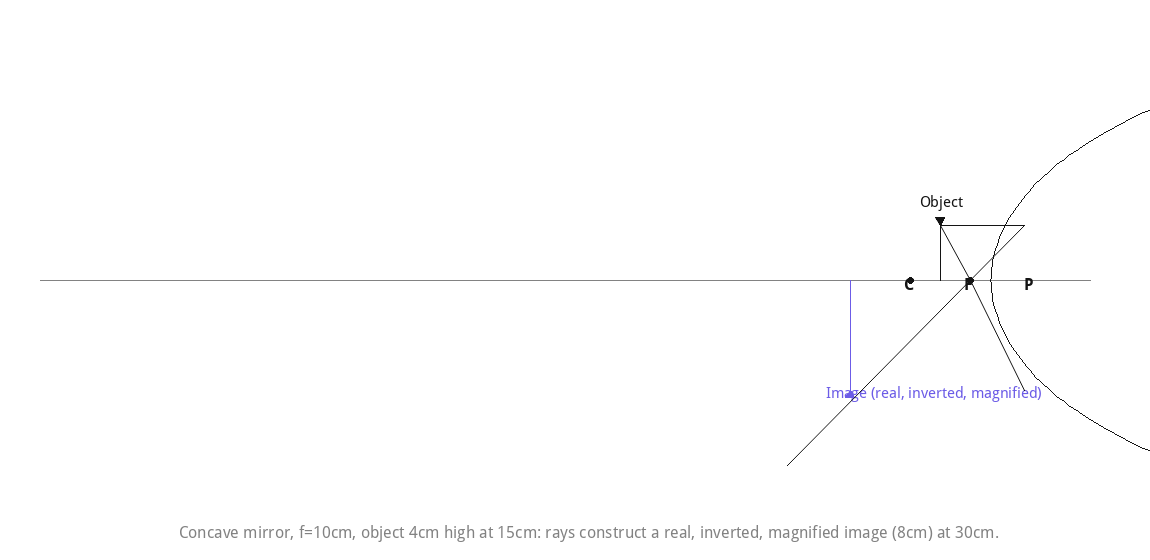
Answer: A real, inverted, equal-size image forms only when the object is at 2F (image also at 2F). Since the image distance is 50 cm, the needle must also be at 50 cm from the lens, and 2F = 50 cm, so F = 25 cm. - Q4. An object 4 cm high is placed at 15 cm in front of a concave mirror of focal length 10 cm. Find the position, size, and nature of the image.

Concave mirror, f=10cm, object 4cm high at 15cm: rays construct a real, inverted, magnified image (8cm) at 30cm.
Answer: Using the mirror formula 1/v + 1/u = 1/f with u=-15 cm, f=-10 cm: 1/v = 1/f – 1/u = -1/10 – (-1/15) = -1/10+1/15 = (-3+2)/30 = -1/30, so v = -30 cm. Magnification m = -v/u = -(-30)/(-15) = -2, so image height = m × object height = -2 × 4 = -8 cm. The image forms 30 cm in front of the mirror, is 8 cm tall, real, inverted, and magnified.
- Q5. Define the principal focus of a concave mirror.
Answer: The principal focus of a concave mirror is the point on its principal axis where all light rays travelling parallel to the principal axis converge after reflection from the mirror. - Q6. Name a mirror that can give an erect and enlarged image of an object.
Answer: A concave mirror, when the object is placed between the pole and the focus. - Q7. Why does a convex mirror always produce a virtual image?
Answer: The reflected rays from a convex mirror always diverge outward and never actually meet in front of the mirror; they only appear to meet behind the mirror when extended backward, which is the definition of a virtual image. - Q8. Define the power of a lens. What is its SI unit?
Answer: Power is the reciprocal of the focal length in metres (P = 1/f). Its SI unit is the dioptre (D). A convex (converging) lens has positive power; a concave (diverging) lens has negative power. - Q9. Find the power of a concave lens of focal length 2 m.
Answer: P = 1/f = 1/(-2) = -0.5 D (negative because it is a diverging lens).
The core numerical and conceptual questions above are drawn from the chapter’s in-text “Questions” boxes. The official end-of-chapter Exercise below is a separate, distinct question set in the NCERT textbook — covered here in full, including the ray-diagram-dependent questions.
NCERT Textbook Exercises (End of Chapter)
- 1. Which one of the following materials cannot be used to make a lens? (a) Water (b) Glass (c) Plastic (d) Clay
Answer: (d) Clay — it is opaque and cannot transmit light, so it cannot refract light the way a lens must. - 2. The image formed by a concave mirror is virtual, erect and larger than the object. Where is the object placed? (a) Between the principal focus and centre of curvature (b) At the centre of curvature (c) Beyond the centre of curvature (d) Between the pole and the principal focus
Answer: (d) Between the pole and the principal focus — this is the only object position for a concave mirror that produces a virtual, erect, magnified image. - 3. Where should an object be placed in front of a convex lens to get a real image of the size of the object? (a) At the principal focus of the lens (b) At twice the focal length (c) At infinity (d) Between the optical centre of the lens and its principal focus
Answer: (b) At twice the focal length (2F) — a convex lens forms a real, inverted, same-size image only when the object is placed at 2F (the image also forms at 2F on the other side). - 4. A spherical mirror and a thin spherical lens have each a focal length of –15 cm. The mirror and the lens are likely to be (a) both concave (b) both convex (c) the mirror is concave and the lens is convex (d) the mirror is convex, but the lens is concave
Answer: (a) Both concave — by convention a negative focal length means a converging (concave) mirror and a diverging (concave) lens. - 5. No matter how far you stand from a mirror, your image appears erect. The mirror is likely to be (a) plane (b) concave (c) convex (d) either plane or convex
Answer: (d) Either plane or convex — both always give an erect image regardless of object distance; a concave mirror only does this when the object is within its focal length. - 6. Which of the following lenses would you prefer to use while reading small letters found in a dictionary? (a) A convex lens of focal length 50 cm (b) A concave lens of focal length 50 cm (c) A convex lens of focal length 5 cm (d) A concave lens of focal length 5 cm
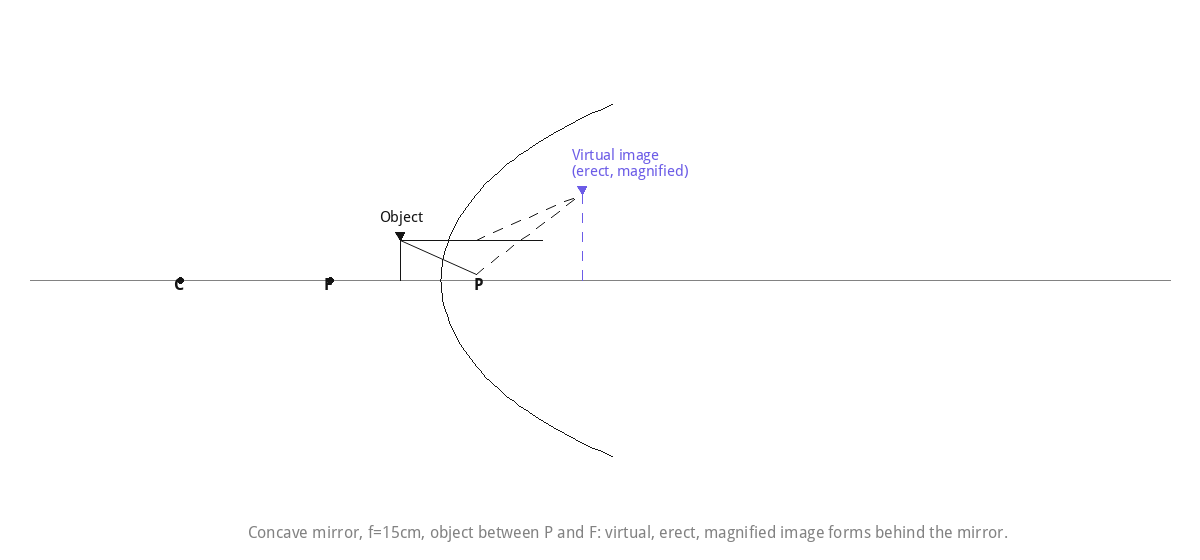
Answer: (c) A convex lens of focal length 5 cm — a short-focal-length convex lens gives the strongest magnifying power for reading small print. - 7. We wish to obtain an erect image of an object using a concave mirror of focal length 15 cm. What should be the range of distance of the object from the mirror? What is the nature of the image? Is the image larger or smaller than the object? Draw a ray diagram to show the image formation in this case.

Concave mirror, f=15cm, object between P and F: virtual, erect, magnified image forms behind the mirror.
Answer: The object must be placed between the pole and the focus, i.e. anywhere from 0 to 15 cm from the mirror. The image formed is virtual, erect, and larger (magnified) than the object.
- 8. Name the type of mirror used in the following situations: (a) Headlights of a car (b) Side/rear-view mirror of a vehicle (c) Solar furnace. Support your answer with reason.
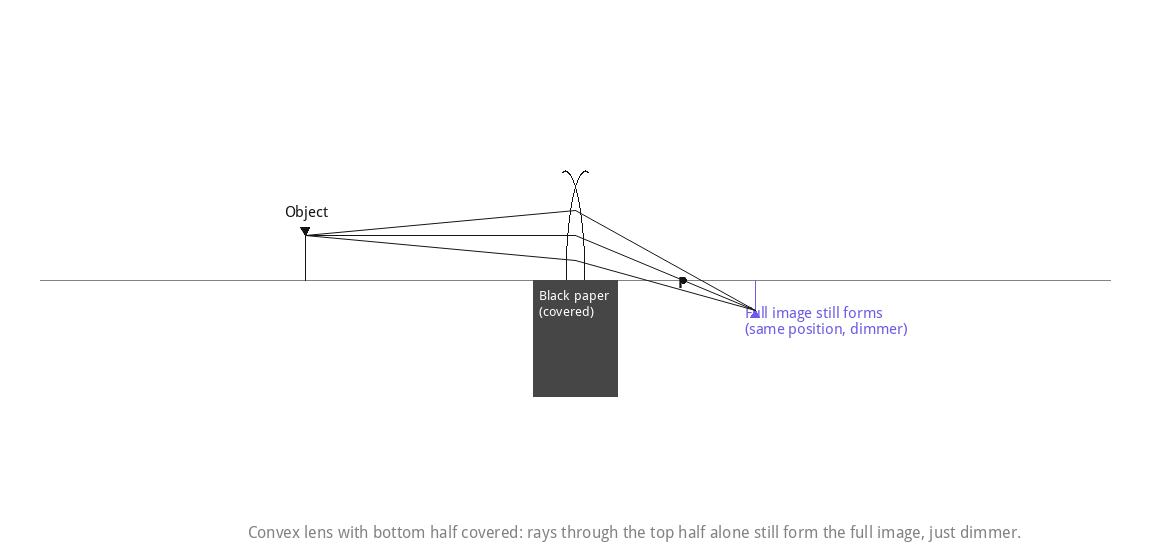
Answer: (a) Concave mirror — placed with the bulb at its focus, it reflects light as a strong parallel beam. (b) Convex mirror — it always gives an erect, diminished image and has a wider field of view, letting the driver see more of the traffic behind. (c) Concave mirror — parallel rays from the sun converge at the focus, concentrating heat there. - 9. One-half of a convex lens is covered with a black paper. Will this lens produce a complete image of the object? Verify your answer experimentally. Explain your observations.
Convex lens with bottom half covered: rays through the top half alone still form the full image, just dimmer.
Answer: Yes, the lens still produces a complete image of the object, just dimmer. Every point on the object sends out rays in all directions, and rays from the uncovered half of the lens alone are still enough to converge and form the full image — covering half the lens only blocks half the rays (reducing brightness), it does not block half the image.
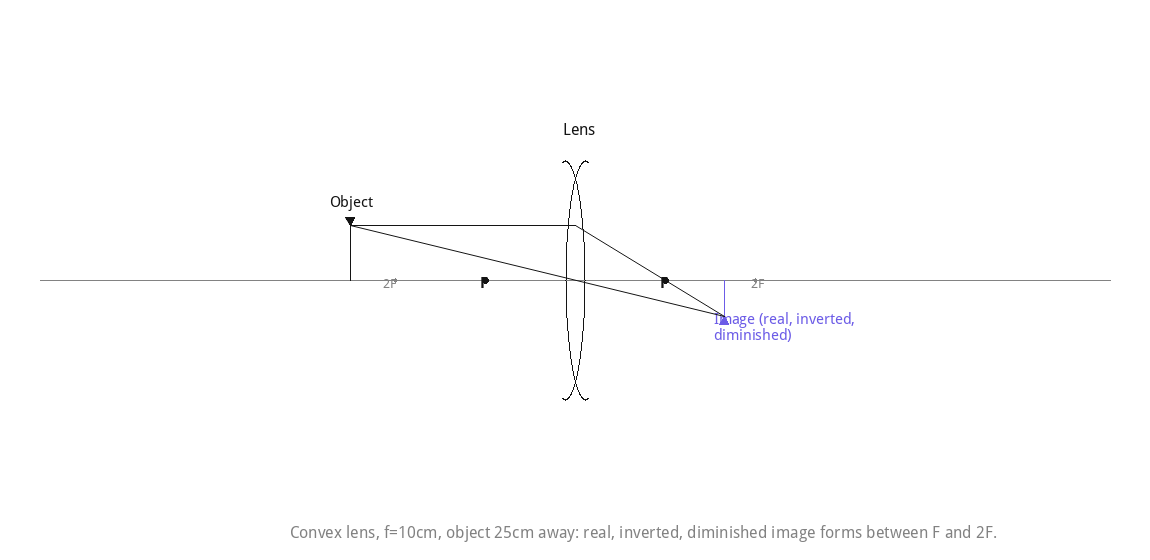
- 10. An object 5 cm in length is held 25 cm away from a converging lens of focal length 10 cm. Draw the ray diagram and find the position, size and the nature of the image formed.
Convex lens, f=10cm, object 25cm away: real, inverted, diminished image forms between F and 2F.
Answer: Using the lens formula 1/v − 1/u = 1/f with u = −25 cm, f = +10 cm: 1/v = 1/10 + 1/(−25) = 1/10 − 1/25 = (5−2)/50 = 3/50, so v ≈ 16.7 cm. Magnification m = v/u = 16.7/(−25) ≈ −0.67, so image height = 0.67 × 5 ≈ 3.3 cm. The image forms about 16.7 cm from the lens (on the far side), is about 3.3 cm tall, real, inverted, and diminished.
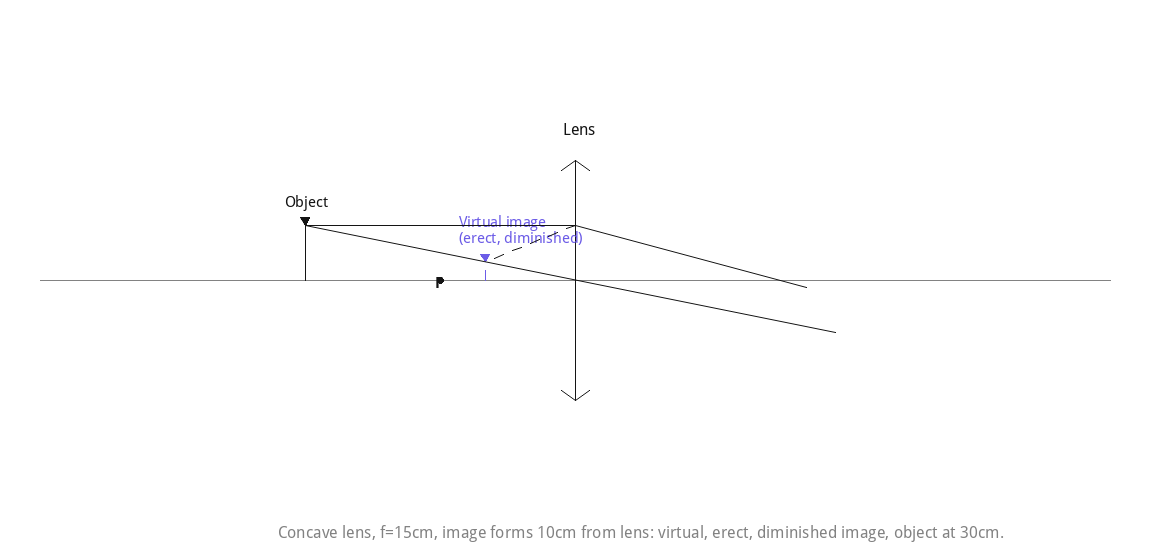
- 11. A concave lens of focal length 15 cm forms an image 10 cm from the lens. How far is the object placed from the lens? Draw the ray diagram.
Concave lens, f=15cm, image forms 10cm from lens: virtual, erect, diminished image, object at 30cm.
Answer: Using the lens formula 1/v − 1/u = 1/f with v = −10 cm (virtual image, same side as object), f = −15 cm: 1/u = 1/v − 1/f = 1/(−10) − 1/(−15) = −1/10 + 1/15 = (−3+2)/30 = −1/30, so u = −30 cm. The object is placed 30 cm from the lens.
- 12. An object is placed at a distance of 10 cm from a convex mirror of focal length 15 cm. Find the position and nature of the image.
Answer: Using 1/v + 1/u = 1/f with u = −10 cm, f = +15 cm: 1/v = 1/15 − 1/(−10) = 1/15 + 1/10 = (2+3)/30 = 5/30, so v = +6 cm. The image forms 6 cm behind the mirror; it is virtual, erect, and diminished (m = −v/u = −0.6). - 13. The magnification produced by a plane mirror is +1. What does this mean?
Answer: The “+” sign means the image is virtual and erect (same orientation as the object), and the magnitude “1” means the image is exactly the same size as the object. - 14. An object 5.0 cm in length is placed at a distance of 20 cm in front of a convex mirror of radius of curvature 30 cm. Find the position of the image, its nature and size.
Answer: f = R/2 = 15 cm. Using 1/v + 1/u = 1/f with u = −20 cm: 1/v = 1/15 − 1/(−20) = 1/15 + 1/20 = (4+3)/60 = 7/60, so v ≈ 8.6 cm. m = −v/u ≈ 0.43, image height ≈ 0.43 × 5 ≈ 2.1 cm. The image forms about 8.6 cm behind the mirror; it is virtual, erect, and diminished (about 2.1 cm tall). - 15. An object of size 7.0 cm is placed at 27 cm in front of a concave mirror of focal length 18 cm. At what distance from the mirror should a screen be placed to obtain a sharp image? Find the size and nature of the image.
Answer: Using 1/v + 1/u = 1/f with u = −27 cm, f = −18 cm: 1/v = −1/18 − 1/(−27) = −1/18 + 1/27 = (−3+2)/54 = −1/54, so v = −54 cm. The screen should be placed 54 cm from the mirror. m = −v/u = −54/−27 = −2, so image height = −2 × 7 = −14 cm. The image is real, inverted, and magnified (14 cm tall). - 16. Find the focal length of a lens of power −2.0 D. What type of lens is this?
Answer: f = 1/P = 1/(−2.0) = −0.5 m = −50 cm. Since the focal length is negative, this is a concave (diverging) lens. - 17. A doctor has prescribed a corrective lens of power +1.5 D. Find the focal length of the lens. Is the prescribed lens diverging or converging?
Answer: f = 1/P = 1/1.5 ≈ +0.67 m. Since the focal length and power are positive, this is a converging (convex) lens.
CBSE Exam Weightage
This chapter falls under Unit III: Natural Phenomena in the CBSE Class 10 Science board exam syllabus. This unit typically carries around 12 marks (15%) of the 80-mark theory paper, based on CBSE’s published unit-wise weightage (Question Paper Design). CBSE sets weightage at the unit level rather than chapter-by-chapter, so the exact share from this specific chapter can vary a little between years and sample papers.
Class 10 Science Chapter 9 – Notes and Extra Questions
Along with these NCERT Solutions, students can also use the Class 10 Science Chapter 9 Extra Questions and Class 10 Science Chapter 9 Revision Notes for quick revision and extra practice.
Related
- Chapter 1: Chemical Reactions and Equations – Free PDF Download
- Chapter 2: Acids, Bases and Salts – Free PDF Download
- Chapter 3: Metals and Non-metals – Free PDF Download
- Chapter 4: Carbon and its Compounds – Free PDF Download
- Chapter 5: NCERT Solutions for Class 10 Science: Periodic Classification of Elements (Supplementary — Not in Current CBSE Syllabus) – Free PDF Download
- Chapter 6: Life Processes – Free PDF Download
- Chapter 7: Control and Coordination – Free PDF Download
- Chapter 8: How do Organisms Reproduce? (2026-27) – Free PDF Download
- Chapter 9: Heredity – Free PDF Download
- Chapter 11: The Human Eye and the Colourful World (2026-27) – Free PDF Download
- Chapter 12: Electricity (2026-27) – Free PDF Download
- Chapter 13: Magnetic Effects of Electric Current (2026-27)
FAQs
Q: What is the relationship between focal length and radius of curvature?
f = R/2 for spherical mirrors.
Q: What is the SI unit of power of a lens?
The dioptre (D).


