
NCERT Solutions for Class 11 Physics Chapter 10, Thermal Properties of Matter, cover temperature scales, thermal expansion, calorimetry, change of state, and heat transfer (conduction, convection and radiation) exactly as they appear in the current (2023 rationalised) NCERT Physics Part II textbook used for the 2026-27 session. Every question below is solved from first principles with complete step-by-step working, using the exact data values given in the textbook, so you can verify each numerical answer rather than just copy it.
NCERT Exercise Solutions – Chapter 10 Thermal Properties of Matter
10.1 Triple points of neon and carbon dioxide in Celsius and Fahrenheit
Question: The triple points of neon and carbon dioxide are 24.57 K and 216.55 K respectively. Express these temperatures on the Celsius and Fahrenheit scales.
Last Updated: September 23, 2026
Solution: Using T(°C) = T(K) − 273.15 and T(°F) = (9/5)T(°C) + 32:
Neon: T(°C) = 24.57 − 273.15 = −248.58°C.
T(°F) = (9/5)(−248.58) + 32 = −447.44 + 32 = −415.44°F.
Carbon dioxide: T(°C) = 216.55 − 273.15 = −56.60°C.
T(°F) = (9/5)(−56.60) + 32 = −101.88 + 32 = −69.88°F.
10.2 Relation between two absolute temperature scales A and B
Question: Two absolute scales A and B have triple points of water defined as 200 A and 350 B. What is the relation between TA and TB?
Solution: The triple point of water is 273.16 K on the Kelvin scale. Since both A and B are absolute (start at true zero), each degree is a fixed fraction of a kelvin:
1°A = 273.16/200 K, so TA = (200/273.16) TK.
1°B = 273.16/350 K, so TB = (350/273.16) TK.
Dividing the two relations eliminates TK: TA/TB = 200/350 = 4/7.
TA = (4/7) TB
10.3 Platinum resistance thermometer
Question: A resistance thermometer gives resistance R = R0[1 + α(T − T0)]. Its resistance is 101.6 Ω at the triple point of water (273.16 K) and 165.5 Ω at the normal melting point of lead (600.5 K). What is the temperature when the resistance is 123.4 Ω?
Solution: Take T0 = 273.16 K, R0 = 101.6 Ω.
165.5 = 101.6[1 + α(600.5 − 273.16)]
1.6289 = 1 + α(327.34)
α = 0.6289/327.34 = 1.921 × 10⁻³ K−1
Now for R = 123.4 Ω:
123.4 = 101.6[1 + α(T − 273.16)]
1.2146 − 1 = 1.921 × 10⁻³(T − 273.16)
T − 273.16 = 111.72
T ≈ 384.8 K
10.4 Conceptual questions on temperature scales
Question: (a) Why is the triple point of water preferred over its ice and steam points as a standard fixed point? (b) What is the other fixed point on the Kelvin absolute scale? (c) Why does the Celsius scale use 273.15 rather than 273.16 in the conversion T = TC + 273.15? (d) What is the triple-point temperature of water on an absolute scale whose unit interval is the same size as the Fahrenheit degree?
Solution:
(a) Unlike the ice point or steam point, which vary slightly with pressure, the triple point occurs at one unique, precisely defined pressure and temperature (4.58 mm Hg, 0.01°C). This makes it an extremely reproducible standard fixed point.
(b) The other fixed point of the Kelvin scale is absolute zero (0 K) itself — the Kelvin scale needs only one arbitrary fixed point (the triple point) because its zero is fixed by nature.
(c) 0°C (the ice point at 1 atm) is 0.01°C below the triple point of water, so 0°C corresponds to 273.15 K while the triple point corresponds to 273.16 K.
(d) A Fahrenheit-sized absolute degree is 5/9 the size of a kelvin, so the same physical interval needs (9/5) times as many degrees: 273.16 × 9/5 = 491.69 on this scale (analogous to the Rankine scale).
10.5 Oxygen and hydrogen gas thermometers
Question: The absolute temperature of the normal melting point of sulphur as read by an oxygen gas thermometer is 373.16 K and by a hydrogen gas thermometer is a slightly different value. Explain this discrepancy. What is the way out?
Solution: No real gas is perfectly ideal, so different gases show slightly different readings for the same temperature because their deviations from ideal-gas behaviour differ. The discrepancy is reduced as the pressure of the gas in the bulb is lowered further and further; in the limit of vanishing pressure, all gas thermometers converge to the same (ideal-gas) temperature. So the way out is to use very low-pressure gas and extrapolate readings to zero pressure.
10.6 Steel measuring tape
Question: A steel tape 1 m long is correctly calibrated at 27°C. The length of a steel rod measured by this tape is found to be 63.0 cm at 45°C. What is the actual length of the rod at 45°C? What is the actual length at 27°C? (αsteel = 1.20 × 10⁻⁵ K−1)
Solution: At 45°C every 1 cm marking on the tape has itself expanded to 1(1 + αΔT) cm, so the true length is larger than the reading:
L(45°C) = 63.0 × [1 + 1.20 × 10−5 × (45 − 27)] = 63.0 × 1.000216 = 63.0136 cm
Since the rod is also made of steel with the same α, cooling it back to 27°C (the tape’s calibration temperature) restores exact agreement between rod and tape, so the length at 27°C is simply 63.0 cm (the tiny correction cancels because both rod and tape contract identically).
10.7 Steel shaft and wheel fitting
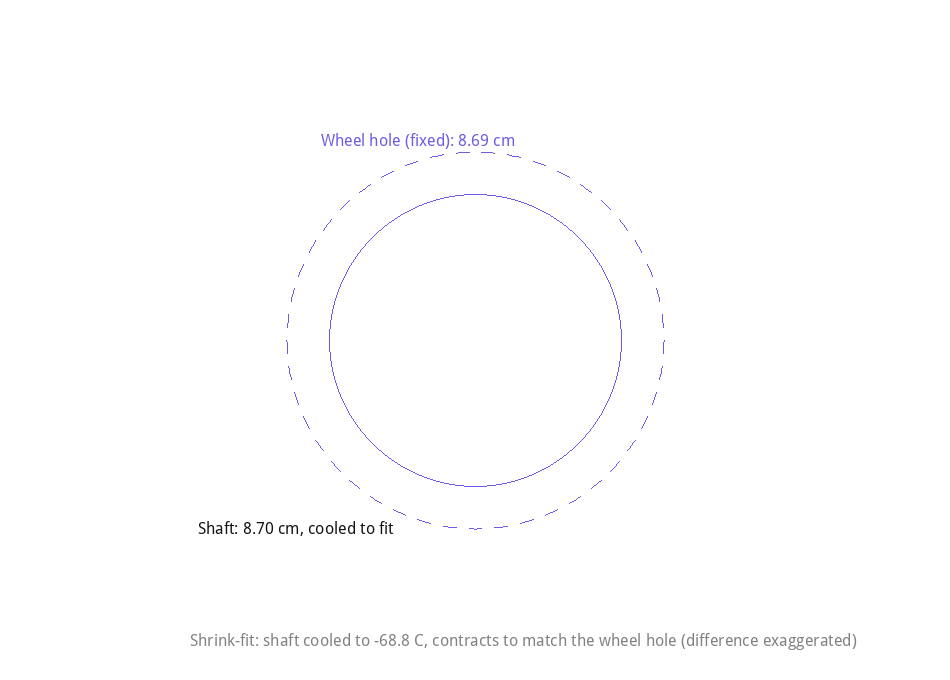
Question: A large steel wheel has a hole of diameter 8.69 cm at 27°C, into which a steel shaft of diameter 8.70 cm must be fitted by cooling. To what temperature should the shaft be cooled? (αsteel = 1.20 × 10⁻⁵ K−1)
Solution: Required fractional contraction: ΔD/D = (8.69 − 8.70)/8.70 = −1.149 × 10⁻³.
ΔT = ΔD / (Dα) = −1.149 × 10⁻³ / (1.20 × 10⁻⁵) = −95.8 K
T = 27 − 95.8 = −68.8°C (the shaft must be cooled to about −69°C).
10.8 Hole in a heated copper sheet
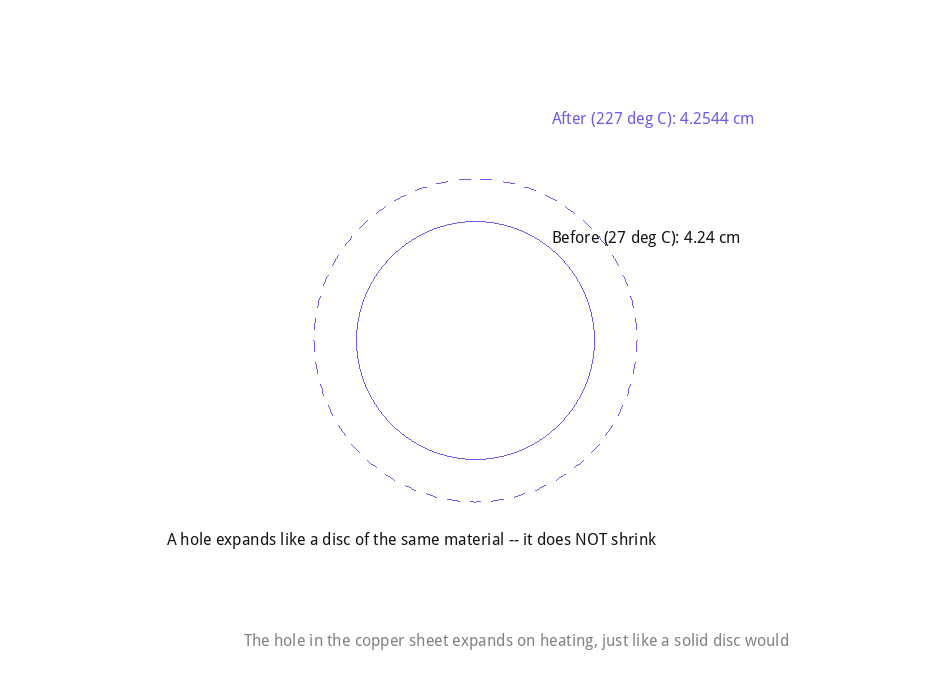
Question: A hole is drilled in a copper sheet, its diameter being 4.24 cm at 27.0°C. What is the change in the diameter of the hole when the sheet is heated to 227°C? (αcopper = 1.70 × 10⁻⁵ K−1)
Solution: A hole expands exactly like a disc of the same material (thermal expansion is isotropic):
Δd = dαΔT = 4.24 × 1.70 × 10−5 × (227 − 27) = 4.24 × 1.70 × 10−5 × 200 = 0.0144 cm (diameter increases to about 4.2544 cm).
10.9 Tension in a cooled brass wire
Question: A brass wire 1.8 m long at 27°C is held taut with negligible tension between two rigid supports. If the wire is cooled to a temperature of −39°C, what is the tension developed in the wire, if its diameter is 2.0 mm? (αbrass = 2.0 × 10⁻⁵ K−1, Ybrass = 0.91 × 10¹¹ Pa)
Solution: Since the supports are rigid, the wire cannot contract; the thermal strain it “would have” undergone shows up entirely as tensile strain.
Thermal strain = αΔT = 2.0 × 10−5 × (27 − (−39)) = 2.0 × 10−5 × 66 = 1.32 × 10⁻³
Stress = Y × strain = 0.91 × 1011 × 1.32 × 10−3 = 1.201 × 10⁸ Pa
Area = πr² = π(1.0 × 10⁻³)² = 3.1416 × 10⁻⁶ m²
Tension = Stress × Area = 1.201 × 108 × 3.1416 × 10−6 ≈ 377 N
10.10 Combined brass-steel rod
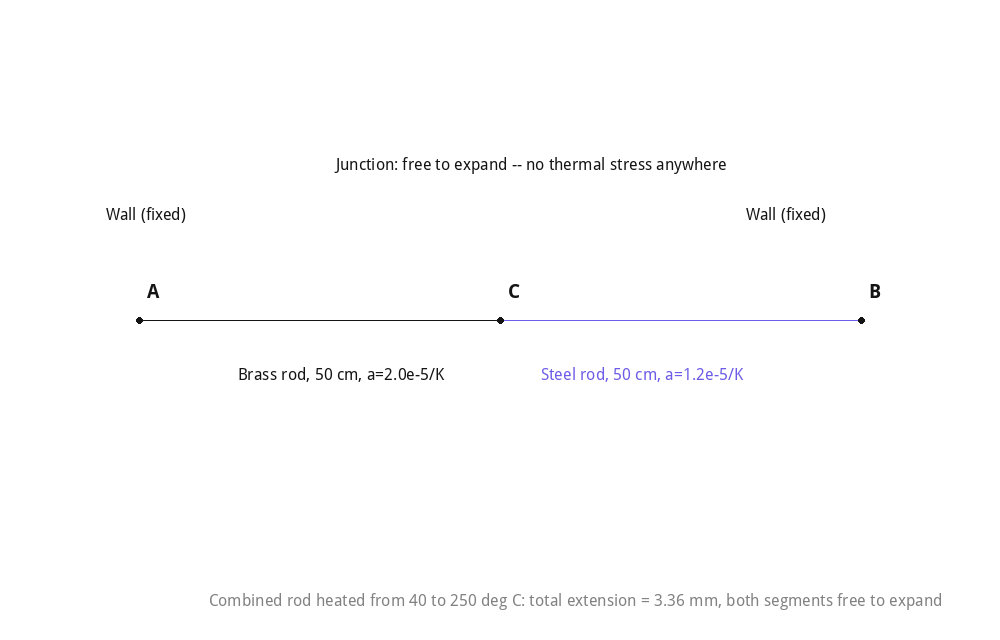
Question: A brass rod and a steel rod, each of length 50 cm and diameter 3.0 mm, are joined end to end with their free ends secured rigidly to two walls, but free to expand at the junction (i.e. the combined rod as a whole is free to expand). What is the change in length of the combined rod when heated from 40.0°C to 250°C? Is thermal stress developed at the junction? (αbrass = 2.0 × 10⁻⁵ K−1, αsteel = 1.2 × 10⁻⁵ K−1)
Solution: ΔT = 250 − 40 = 210°C.
ΔLbrass = 0.50 × 2.0 × 10−5 × 210 = 2.10 × 10⁻³ m
ΔLsteel = 0.50 × 1.2 × 10−5 × 210 = 1.26 × 10⁻³ m
Total ΔL = 2.10 + 1.26 = 3.36 mm.
Since the ends of the combined rod are free to expand (not clamped at fixed separation), no thermal stress develops anywhere in the rod — each segment simply expands by its own natural amount.
10.11 Fractional change in density of glycerine
Question: The coefficient of volume expansion of glycerine is 49 × 10−5 K−1. What is the fractional change in its density for a 30°C rise in temperature?
Solution: Since mass is constant, ρ = m/V, so Δρ/ρ = −ΔV/V = −γΔT.
Δρ/ρ = −49 × 10−5 × 30 = −1.47 × 10⁻²
The density decreases by about 1.47%.
10.12 Heating by a drilling machine
Question: A 10 kW drilling machine is used to drill a bore in a small aluminium block of mass 8.0 kg. How much is the rise in temperature of the block in 2.5 minutes, assuming 50% of the power is lost to the surroundings? (saluminium = 0.91 J g−1 K−1)
Solution: Total energy supplied = Pt = 10,000 W × 150 s = 1.5 × 10⁶ J.
Energy absorbed by block (50%) = 7.5 × 10⁵ J.
Heat capacity of block = 8000 g × 0.91 J g−1 K−1 = 7280 J/K.
ΔT = 7.5 × 10⁵ / 7280 ≈ 103°C
10.13 Ice melted by a hot copper block
Question: A copper block of mass 2.5 kg is heated in a furnace to a temperature of 500°C and then placed on a large ice block. What is the maximum amount of ice that can melt? (scopper = 0.39 J g−1 K−1, Lf of ice = 335 J g−1)
Solution: Heat released as the copper cools from 500°C to 0°C:
Q = mcΔT = 2500 g × 0.39 J g−1K−1 × 500 = 4.875 × 10⁵ J
Mass of ice melted = Q/Lf = 4.875 × 10⁵/335 ≈ 1455 g ≈ 1.5 kg (this is the maximum/upper-limit value assuming all heat goes into melting ice; the actual amount melted will be somewhat less due to unavoidable heat loss to surroundings).
10.14 Specific heat of a metal by the method of mixtures
Question: In an experiment on the specific heat of a metal, a 0.20 kg block of the metal at 150°C is dropped in a copper calorimeter (water equivalent 0.025 kg) containing 150 g of water at 27°C. The final temperature is 40°C. Compute the specific heat of the metal. If heat losses to the surroundings are not negligible, is the specific heat calculated by this method greater or smaller than the actual value?
Solution: Heat gained by water + calorimeter (using swater = 1 cal g−1°C−1):
Qgained = (150 + 25) g × 1 × (40 − 27) = 175 × 13 = 2275 cal
Heat lost by metal: Qlost = 200 g × s × (150 − 40) = 200 × s × 110
Equating: 22000s = 2275 ⇒ s = 0.1034 cal g−1°C−1 = 0.1034 × 4.186 J g−1K−1 ≈ 0.433 J g−1 K−1.
If heat is lost to the surroundings, the water receives less heat than the metal actually gave up, so the value of s computed from the water’s temperature rise underestimates the true specific heat — the actual specific heat of the metal is somewhat greater than 0.433 J g−1 K−1.
10.15 Molar specific heats of gases
Question: Given below are observed values of molar specific heats of some common gases at room temperature and atmospheric pressure. Explain why the value for chlorine is largely different from the predicted value based on the theoretical value of Cv for a rigid diatomic molecule.
Solution: For a rigid diatomic gas (only translational and rotational degrees of freedom active, i.e. 5 degrees of freedom), the theoretical prediction is Cv = (5/2)R, close to what is observed for light diatomics like H2, N2, and O2. Chlorine (Cl2) is a heavier molecule with a much lower vibrational frequency than these gases, so at room temperature its vibrational mode is not “frozen out” — it is thermally active and contributes an extra ~R to the molar specific heat. This additional vibrational contribution is why chlorine’s observed molar specific heat is noticeably higher than the simple rigid-rotor prediction.
10.16 Extra sweat evaporation during fever
Question: A child running a temperature of 101°F is given an antipyrin (a medicine that increases the rate of evaporation of sweat from the skin) which causes the temperature to drop to 98°F in 20 minutes. If the mass of the child is 30 kg, how much extra evaporation, on average, does the antipyrin cause per minute? (Latent heat of evaporation of water at that temperature ≈ 580 cal g−1; specific heat of the human body ≈ that of water = 1000 cal kg−1 K−1)
Solution: Temperature drop: 101°F − 98°F = 3°F = 3 × 5/9 °C = 5/3 °C.
Heat lost by body: Q = msΔT = 30 kg × 1000 cal kg−1K−1 × 5/3 = 50,000 cal.
Mass of water evaporated = Q/L = 50,000/580 ≈ 86.2 g over 20 minutes.
Average extra evaporation rate = 86.2/20 ≈ 4.31 g per minute.
10.17 Ice remaining in a thermacole icebox
Question: A cubical icebox of thermacole with sides 30 cm and thickness 5.0 cm contains 4.0 kg of ice. The outside temperature is 45°C. Calculate the total ice remaining after 6 hours. (Kthermacole = 0.01 J s−1 m−1 K−1, Lf = 335 × 103 J kg−1; take the inside temperature to remain at 0°C)
Solution: Total surface area of the cube = 6 × (0.30)² = 0.54 m².
Rate of heat conduction: P = KAΔT/d = (0.01 × 0.54 × 45)/0.05 = 4.86 W
Heat entering in 6 hours (21,600 s): Q = 4.86 × 21,600 ≈ 1.050 × 10⁵ J
Mass of ice melted = Q/Lf = 1.050 × 10⁵/(335 × 103) ≈ 0.313 kg
Ice remaining = 4.0 − 0.313 ≈ 3.69 kg (i.e. roughly 92% of the ice survives 6 hours, confirming the icebox is a good insulator).
10.18 Flame temperature under a brass boiler
Question: A brass boiler has a base area of 0.15 m² and thickness 1.0 cm. It boils water at the rate of 6.0 kg/min when placed on a gas stove. Estimate the temperature of the part of the flame in contact with the boiler. (Kbrass = 109 J s−1 m−1 K−1, Lv of water = 2256 × 103 J kg−1; inner boiler surface stays at 100°C, the boiling point)
Solution: Rate of vaporisation = 6.0 kg/min = 0.1 kg/s.
Power required: P = 0.1 × 2256 × 103 = 2.256 × 10⁵ W
Using P = KAΔT/d: ΔT = Pd/(KA) = (2.256 × 105 × 0.01)/(109 × 0.15) = 2256/16.35 ≈ 138.0°C
Flame-side temperature = 100 + 138 = ≈ 238°C
10.19 Conceptual questions on heat transfer and radiation
Question: Explain briefly: (a) why bodies with large reflectivity are poor emitters; (b) why a brass tumbler feels much colder than a wooden tray on a chilly day, even though both are at room temperature; (c) why an optical pyrometer, calibrated for an ideal blackbody radiation, gives too low a value for the temperature of a red-hot iron piece kept in a furnace, compared to its true temperature; (d) why the earth without its atmosphere would be inhospitably cold; (e) why a heating system based on the circulation of steam is more efficient than one based on circulating hot water.
Solution:
(a) By Kirchhoff’s law, good absorbers of radiation are also good emitters at the same wavelength. A body with high reflectivity absorbs very little incident radiation, so it must also be a poor emitter.
(b) Brass is a much better conductor of heat than wood. Touching brass rapidly conducts heat away from your (warmer) hand, so it feels cold, while wood, a poor conductor, barely draws heat away and feels comparatively warm even though both objects are at the same room temperature.
(c) Inside the furnace, the iron piece is surrounded by other hot, radiating surfaces; some of this surrounding radiation is reflected off the iron piece and adds to what the pyrometer detects, but a pyrometer calibrated only for a perfect blackbody underestimates the true temperature of a real (non-black) object, so its reading is lower than the actual furnace temperature of the iron piece.
(d) Without an atmosphere there would be no absorption/re-radiation (greenhouse-type) blanket effect, so the earth’s surface would lose heat very rapidly by radiation at night and heat up very fast during the day, producing extreme day-night temperature swings that would make it inhospitable.
(e) Steam carries not just its sensible heat but also a large latent heat of vaporisation. When steam condenses in a radiator it releases this large amount of latent heat in addition to cooling down, so per kilogram of fluid circulated, steam delivers far more heat than hot water at the same temperature, making steam heating more efficient.
10.20 Newton’s law of cooling
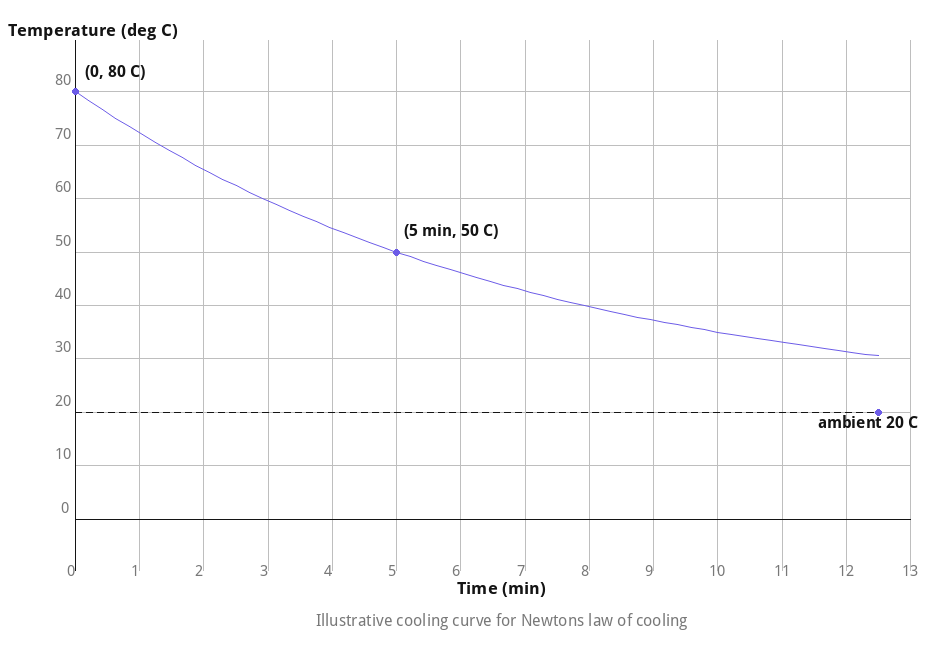
Question: A body cools from 80°C to 50°C in 5 minutes. Calculate the time it takes to cool from 60°C to 30°C. The temperature of the surroundings is 20°C.
Solution: Using the approximate (finite-difference) form of Newton’s law of cooling, (T1 − T2)/t = k[(T1+T2)/2 − T0]:
First interval: (80 − 50)/5 = k[(80+50)/2 − 20] ⇒ 6 = k(65 − 20) = 45k ⇒ k = 0.1333 min−1
Second interval: (60 − 30)/t = k[(60+30)/2 − 20] = 0.1333 × (45 − 20) = 0.1333 × 25 = 3.333
t = 30/3.333 = 9 minutes
Notes and Extra Questions
Key ideas to revise from this chapter: the difference between heat and temperature; the Celsius, Fahrenheit and Kelvin scales and their conversion formulas; linear, area and volume thermal expansion coefficients and the relation β ≈ 2α, γ ≈ 3α for isotropic solids; the anomalous expansion of water near 4°C; specific heat capacity and molar specific heat, including why Cp > Cv for gases; calorimetry and the principle of conservation of heat in the method of mixtures; latent heat of fusion and vaporisation and the flat regions on a temperature-vs-heat graph during a phase change; the three modes of heat transfer — conduction (Fourier’s law, thermal conductivity K), convection, and radiation (Stefan-Boltzmann law, Kirchhoff’s law, Wien’s displacement law); and Newton’s law of cooling and its approximate linear form used in numericals.
Note on the current (2023 rationalised) syllabus: the two “Additional Exercises” based on the P–T phase diagram of CO2 (old questions 11.21 and 11.22) have been removed from this chapter in the rationalisation, along with the “Greenhouse Effect” sub-topic. Students preparing from the current NCERT textbook only need questions 10.1 to 10.20 covered above; older solution sets online that include CO2 phase-diagram questions numbered 11.21/11.22 are based on the pre-2023 edition and are no longer part of the examinable syllabus.
Useful extra practice questions: (1) Derive the relation between the coefficients of linear and volume expansion for an isotropic solid. (2) Two rods of different materials having the same length are joined end to end and clamped at both ends — find the thermal stress in each if heated. (3) Explain, using Kirchhoff’s law, why a black surface is a better emitter than a shiny/polished surface of the same material and temperature. (4) A metal sphere cools according to Newton’s law of cooling — sketch and explain the temperature-vs-time graph. (5) State Wien’s displacement law and use it to compare the peak emission wavelengths of two stars of different surface temperatures.
- Chapter 1: Units and Measurements (2026-27)
- Chapter 2: Motion in a Straight Line – Free PDF Download
- Chapter 3: Motion in a Plane – Free PDF Download
- Chapter 4: Laws of Motion – Free PDF Download
- Chapter 5: Work, Energy and Power – Free PDF Download
- Chapter 6: System of Particles and Rotational Motion – Free PDF Download
- Chapter 7: Gravitation – Free PDF Download
- Chapter 8: Mechanical Properties of Solids – Free PDF Download
- Chapter 9: Mechanical Properties of Fluids – Free PDF Download
- Chapter 11: Thermodynamics – Free PDF Download
- Chapter 12: Kinetic Theory – Free PDF Download
- Chapter 13: Oscillations – Free PDF Download
- Chapter 14: Waves – Free PDF Download
FAQs on NCERT Solutions Class 11 Physics Chapter 10
Q1: How many exercise questions are there in the current NCERT Class 11 Physics Chapter 10, Thermal Properties of Matter?
The current (2023 rationalised) NCERT textbook has 20 exercise questions in this chapter, numbered 10.1 to 10.20. The two additional CO2 phase-diagram questions found in older (pre-2023) editions, then numbered 11.21 and 11.22, have been dropped from the syllabus.
Q2: Why is the triple point of water used to define the Kelvin scale instead of the ice point or steam point?
The ice point (0°C) and steam point (100°C) both depend on atmospheric pressure and are not perfectly reproducible across locations and conditions. The triple point of water occurs at one exact, unique combination of pressure and temperature (4.58 mm Hg, 273.16 K) where ice, water and water vapour coexist in equilibrium, making it a far more precise and universally reproducible reference.
Q3: What is the difference between heat capacity, specific heat capacity, and molar specific heat capacity?
Heat capacity is the amount of heat needed to raise the temperature of an entire given object by 1 K (units J/K). Specific heat capacity is heat capacity per unit mass (units J kg−1 K−1 or J g−1 K−1), a property of the material. Molar specific heat capacity is heat capacity per mole of substance (units J mol−1 K−1), commonly used for gases where Cp and Cv are distinguished.
Q4: Why does a body cool faster when the temperature difference with its surroundings is larger?
This follows from Newton’s law of cooling, which states that the rate of loss of heat of a body is directly proportional to the temperature difference between the body and its surroundings (for small temperature differences). A larger temperature difference means a proportionally faster initial rate of heat loss, which is why the cooling curve is steepest at the start and flattens out as the body approaches the surrounding temperature.
Frequently Asked Questions
What is the difference between heat and temperature?
Temperature is a measure of the average kinetic energy of a substance particles (a state variable); heat is the energy transferred between two bodies due to a temperature difference — heat flows from higher to lower temperature until thermal equilibrium is reached.
What is the difference between conduction, convection and radiation?
Conduction transfers heat through direct particle collisions within a medium (no bulk movement); convection transfers heat via the actual bulk movement of a fluid (liquid/gas); radiation transfers heat via electromagnetic waves and needs no medium at all, which is how heat reaches us from the Sun.
Recommended: Buy the Printed NCERT Class 11 Physics Book Set
Contains Amazon affiliate links.
If you’d like a printed copy alongside the PDF, here’s a verified option:
Rs. 280
Price and availability may change on Amazon. As an Amazon Associate, ncertbooks.org earns from qualifying purchases.



Pingback: Class 11 Physics Chapter 10 Thermal Properties of Matter Revision Notes (2026-27)
Pingback: Class 11 Physics Chapter 14 Waves Revision Notes (2026-27)