
Class 11 Physics Chapter 8, “Mechanical Properties of Solids,” is the opening chapter of NCERT Physics Part II and introduces stress, strain, Hooke’s law, and the elastic moduli (Young’s, shear, and bulk) that describe how solids deform under load. The solutions below correspond to the genuine, current (2023 rationalised, 2026-27 reprint) NCERT in-text exercise questions 8.1 to 8.16 as they appear in the official textbook, with every numerical answer worked out independently from first principles.
NCERT Exercise Solutions: Mechanical Properties of Solids
8.1 Young’s modulus ratio of steel to copper wires
Question: A steel wire of length 4.7 m and cross-sectional area 3.0 × 10⁻⁵ m2 stretches by the same amount as a copper wire of length 3.5 m and cross-sectional area 4.0 × 10⁻⁵ m2 under a given load. What is the ratio of the Young’s modulus of steel to that of copper?
Last Updated: September 23, 2026
Solution: Since both wires carry the same load F and undergo the same elongation ΔL, using Y = FL/(A·ΔL):
Ysteel/Ycopper = (L1/A1) ÷ (L2/A2) = (L1 × A2)/(L2 × A1) = (4.7 × 4.0 × 10-5)/(3.5 × 3.0 × 10-5) = 18.8/10.5 ≈ 1.79
So the Young’s modulus of steel is about 1.79 times that of copper.
8.2 Young’s modulus and yield strength from a stress-strain graph
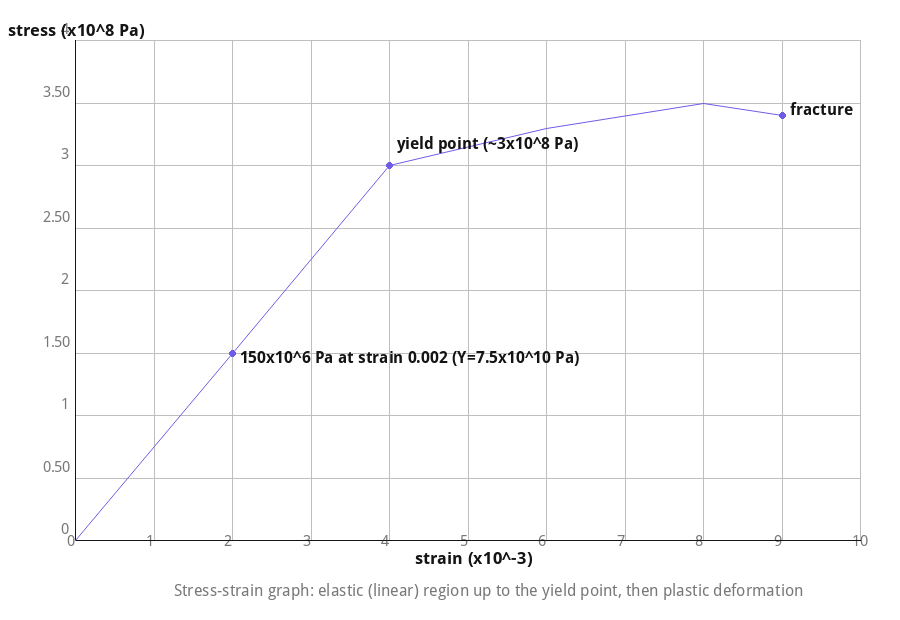
Question: Read the following data off the given strain-stress graph for a given material: (a) What is the Young’s modulus? (b) What is the approximate yield strength for this material?
Solution (a): From the linear (elastic) portion of the graph, a stress of 150 × 106 Pa corresponds to a strain of 0.002. Since Y = stress/strain:
Y = (150 × 106)/0.002 = 7.5 × 10¹⁰ Pa (75 GPa)
Solution (b): The graph departs from linearity (the “knee” of the curve, beyond which permanent deformation begins) at a stress of about 3 × 10⁸ Pa, which is the approximate yield strength.
8.3 Comparing two stress-strain graphs (materials A and B)
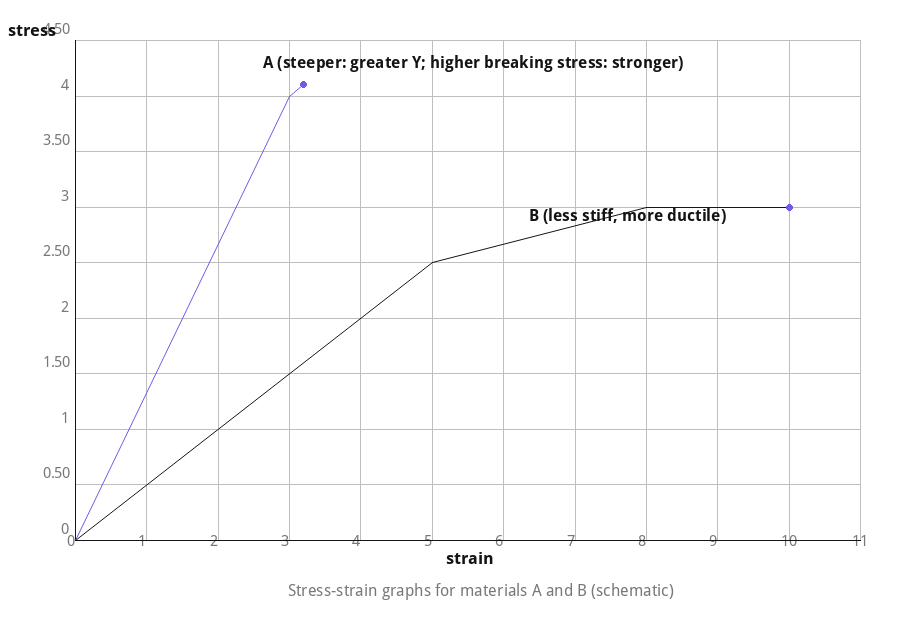
Question: The stress-strain graphs for materials A and B are shown schematically. (a) Which material has greater Young’s modulus? (b) Which material is stronger?
Solution (a): Young’s modulus is the slope of the initial linear (elastic) part of the stress-strain curve. The material whose elastic region is steeper has the greater Young’s modulus — that is material A.
Solution (b): Strength is judged by the stress the material can withstand before it fractures (the ultimate tensile stress at the end of the curve). The material that sustains the higher stress before breaking is the stronger one — again material A, since it reaches a higher breaking stress than B, even though B may be more ductile (stretches further before fracture).
8.4 True or false: rubber vs steel, and shear in a spring
Question: (a) The Young’s modulus of rubber is greater than that of steel. (b) The stretching of a coil is determined by its shear modulus. State whether these statements are true or false.
Solution (a): False. For the same tensile stress, rubber stretches (strains) far more than steel, which means rubber’s Young’s modulus is much smaller than steel’s, not greater.
Solution (b): True. When a helical spring/coil is stretched, the wire of the coil is twisted rather than uniformly elongated along its own length, so the restoring force and the extension are governed mainly by the shear modulus of the wire material.
8.5 Elongation of steel and brass wires
Question: Two wires of diameter 0.25 cm, one made of steel and the other of brass, are loaded as shown (joined end to end and hung vertically): a 4.0 kg mass hangs at the joint between the steel wire above and the brass wire below, and a further 6.0 kg mass hangs at the bottom of the brass wire. The unloaded length of the steel wire is 1.5 m and of the brass wire is 1.0 m. Compute the elongations of the steel and brass wires. (Ysteel = 2.0 × 10¹¹ Pa, Ybrass = 0.91 × 10¹¹ Pa)
Solution: Radius r = 0.125 cm = 1.25 × 10⁻³ m, so cross-sectional area A = πr2 = 4.91 × 10⁻⁶ m2 for both wires.
Tension in the steel wire supports both masses: Fsteel = (4.0 + 6.0) × 9.8 = 98 N. Tension in the brass wire supports only the lower mass: Fbrass = 6.0 × 9.8 = 58.8 N.
ΔLsteel = FsteelLsteel/(A·Ysteel) = (98 × 1.5)/(4.91 × 10-6 × 2.0 × 1011) ≈ 1.49 × 10⁻⁴ m
ΔLbrass = FbrassLbrass/(A·Ybrass) = (58.8 × 1.0)/(4.91 × 10-6 × 0.91 × 1011) ≈ 1.30 × 10⁻⁴ m
8.6 Shear deflection of an aluminium cube face
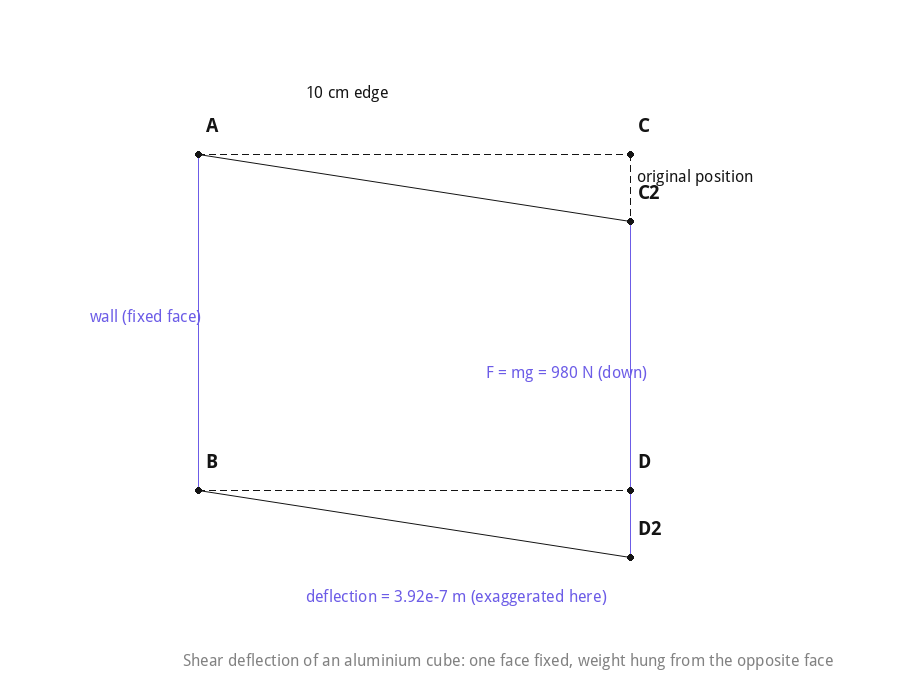
Question: The edge of an aluminium cube is 10 cm long. One face of the cube is firmly fixed to a vertical wall, and a mass of 100 kg is attached to the opposite face. Find the vertical deflection of this face. (Shear modulus of aluminium = 25 GPa)
Solution: Shearing force F = mg = 100 × 9.8 = 980 N. Area of the face A = (0.1)2 = 0.01 m2.
Using η = (F/A)/(ΔL/L), so ΔL = FL/(Aη) = (980 × 0.1)/(0.01 × 25 × 109) = 98/(2.5 × 108) ≈ 3.92 × 10⁻⁷ m
8.7 Compressional strain in hollow steel columns
Question: Four identical hollow cylindrical steel columns support a big structure of mass 50,000 kg. The inner and outer radii of each column are 30 cm and 60 cm respectively. Assuming the load is distributed equally, calculate the compressional strain of each column. (Ysteel = 2.0 × 10¹¹ Pa)
Solution: Cross-sectional area of one hollow column: A = π(R2 – r2) = π(0.62 – 0.32) = π(0.27) ≈ 0.848 m2.
Total weight = 50,000 × 9.8 = 4.9 × 10⁵ N, shared equally by 4 columns: F = 1.225 × 10⁵ N per column.
Strain = stress/Y = (F/A)/Y = (1.225 × 10⁵/0.848)/(2.0 × 1011) ≈ 7.22 × 10⁻⁷ (no units, since strain is dimensionless)
8.8 Strain in a copper piece under tension
Question: A piece of copper having a rectangular cross-section of 15.2 mm × 19.1 mm is pulled in tension with 44,500 N force, producing only elastic deformation. Calculate the resulting strain. (Ycopper = 1.2 × 10¹¹ Pa)
Solution: Area A = 15.2 × 10-3 × 19.1 × 10-3 = 2.903 × 10⁻⁴ m2.
Stress = F/A = 44,500/(2.903 × 10-4) ≈ 1.533 × 10⁸ Pa. Strain = stress/Y = (1.533 × 10⁸)/(1.2 × 1011) ≈ 1.28 × 10⁻³
8.9 Maximum load on a steel cable
Question: A steel cable with a radius of 1.5 cm supports a chairlift at a ski area. If the maximum stress is not to exceed 108 N/m2, what is the maximum load the cable can support?
Solution: Area A = πr2 = π(0.015)2 ≈ 7.07 × 10⁻⁴ m2.
Maximum load = maximum stress × A = 108 × 7.07 × 10-4 ≈ 7.07 × 10⁴ N (about 7,210 kgf)
8.10 Diameter ratio of copper and iron wires under equal tension
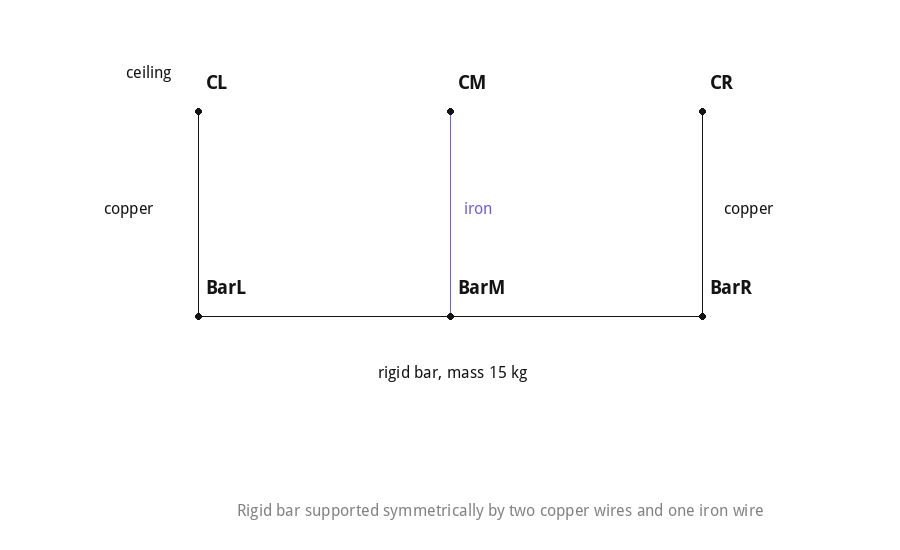
Question: A rigid bar of mass 15 kg is supported symmetrically by three wires, each 2.0 m long. The two end wires are copper and the middle one is iron. Determine the ratio of their diameters if each wire is to have the same tension. (Yiron = 190 × 109 Pa, Ycopper = 120 × 109 Pa)
Solution: Because the bar is rigid and symmetrically loaded, it stays horizontal, so all three wires (equal original length) stretch by the same ΔL. Tension T = YA(ΔL/L), and since ΔL/L and L are common to all three wires, equal tension requires:
YcopperAcopper = YironAiron ⇒ dcopper2/diron2 = Yiron/Ycopper = 190/120
dcopper/diron = √(190/120) ≈ 1.26, i.e. dcopper : diron ≈ 1.26 : 1 — the copper wires must be thicker than the iron wire, since copper is less stiff (lower Y) and needs a larger area to carry the same tension at the same strain.
8.11 Elongation of a whirling steel wire
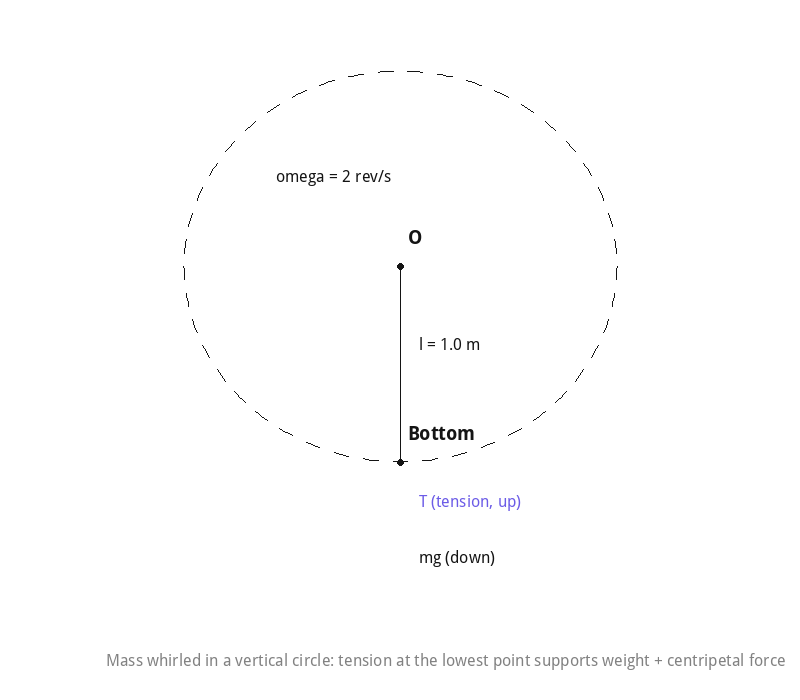
Question: A 14.5 kg mass, fastened to the end of a steel wire of unstretched length 1.0 m, is whirled in a vertical circle with an angular velocity of 2 rev/s at the bottom of the circle. The cross-sectional area of the wire is 0.065 cm2. Calculate the elongation of the wire when the mass is at the lowest point of its path. (Ysteel = 2.0 × 10¹¹ Pa)
Solution: ω = 2 rev/s = 4π rad/s ≈ 12.57 rad/s. At the lowest point, tension must support the weight and provide the centripetal force:
T = m(g + ω2l) = 14.5 × (9.8 + (12.57)2 × 1.0) = 14.5 × (9.8 + 158.0) ≈ 2432 N
A = 0.065 × 10⁻⁴ m2 = 6.5 × 10⁻⁶ m2. ΔL = Tl/(AY) = 2432/(6.5 × 10-6 × 2.0 × 1011) ≈ 1.87 × 10⁻³ m
8.12 Bulk modulus of water
Question: Compute the bulk modulus of water from the following data: initial volume = 100.0 litre, pressure increase = 100.0 atm (1 atm = 1.013 × 10⁵ Pa), final volume = 100.5 litre. Compare the bulk modulus of water with that of air (bulk modulus of air ≈ 1.0 × 10⁵ Pa) and explain why the ratio is so large.
Solution: ΔP = 100 × 1.013 × 105 = 1.013 × 10⁷ Pa, ΔV/V = 0.5/100.0 = 5.0 × 10⁻³.
B = ΔP/(ΔV/V) = (1.013 × 10⁷)/(5.0 × 10-3) ≈ 2.03 × 10⁹ Pa
Ratio Bwater/Bair ≈ (2.03 × 10⁹)/(1.0 × 105) ≈ 2.03 × 10⁴. This huge ratio reflects the fact that a gas like air is highly compressible (molecules are far apart and easily pushed closer), while liquid water molecules are already packed close together and strongly resist further compression.
8.13 Density of water at depth
Question: What is the density of water at a depth where the pressure is 80.0 atm, given that its density at the surface is 1.03 × 10³ kg/m3? (Bwater = 2.2 × 10⁹ Pa)
Solution: ΔP = 80 × 1.013 × 105 ≈ 8.10 × 10⁶ Pa. Fractional volume change ΔV/V = ΔP/B = (8.10 × 10⁶)/(2.2 × 109) ≈ 3.69 × 10⁻³.
Since mass is conserved while volume shrinks slightly, density increases: ρ2 ≈ ρ1(1 + ΔV/V) = 1.03 × 103 × 1.00369 ≈ 1.034 × 10³ kg/m3
8.14 Fractional volume change of a glass slab
Question: Compute the fractional change in volume of a glass slab when subjected to a hydraulic pressure of 10 atm. (Bglass = 37 × 109 Pa)
Solution: ΔP = 10 × 1.013 × 105 = 1.013 × 10⁶ Pa.
ΔV/V = ΔP/B = (1.013 × 10⁶)/(37 × 109) ≈ 2.74 × 10⁻⁵
8.15 Volume contraction of a copper cube
Question: Determine the volume contraction of a solid copper cube, 10 cm on an edge, when subjected to a hydraulic pressure of 7.0 × 10⁶ Pa. (Bcopper = 140 × 109 Pa)
Solution: V = (0.1)3 = 1.0 × 10⁻³ m3.
ΔV = V × ΔP/B = (1.0 × 10-3) × (7.0 × 106)/(140 × 109) ≈ 5.0 × 10⁻⁸ m3 (equal to 0.05 cm3)
8.16 Pressure needed to compress water by 0.10%
Question: How much should the pressure on a litre of water be changed to compress it by 0.10%? (Bwater = 2.2 × 10⁹ Pa)
Solution: ΔV/V = 0.10% = 1.0 × 10⁻³.
ΔP = B × (ΔV/V) = 2.2 × 109 × 1.0 × 10-3 ≈ 2.2 × 10⁶ Pa (about 21.7 atm)
Notes and Extra Questions
Elasticity questions in this chapter almost always reduce to three formulas: Young’s modulus Y = (F/A)/(ΔL/L) for stretching/compressing along a length, shear modulus η = (F/A)/(Δx/L) for a sideways (tangential) deformation, and bulk modulus B = ΔP/(ΔV/V) for a uniform pressure squeezing a volume. Always identify which of these three applies before substituting numbers.
Keep a mental table of typical values: Ysteel ≈ 2.0 × 10¹¹ Pa, Ycopper ≈ 1.1-1.2 × 10¹¹ Pa, Yiron ≈ 1.9 × 10¹¹ Pa, Yaluminium ≈ 0.7 × 10¹¹ Pa, and Bwater ≈ 2.1-2.2 × 10⁹ Pa. Metals have Y of order 1011 Pa while rubber-like materials are 103-104 times smaller.
For circular-motion tension problems (like 8.11), always add the centripetal-force term to the weight when the mass is at the lowest point of a vertical circle, and subtract it (T = mω2l – mg) if it were at the top — a very common source of sign mistakes.
When two wires are joined in series and share a common load path, remember that the wire nearer the ground carries only the mass below it, while a wire higher up carries the combined weight of everything hanging beneath it (as in question 8.5).
- Chapter 1: Units and Measurements (2026-27)
- Chapter 2: Motion in a Straight Line – Free PDF Download
- Chapter 3: Motion in a Plane – Free PDF Download
- Chapter 4: Laws of Motion – Free PDF Download
- Chapter 5: Work, Energy and Power – Free PDF Download
- Chapter 6: System of Particles and Rotational Motion – Free PDF Download
- Chapter 7: Gravitation – Free PDF Download
- Chapter 9: Mechanical Properties of Fluids – Free PDF Download
- Chapter 10: Thermal Properties of Matter – Free PDF Download
- Chapter 11: Thermodynamics – Free PDF Download
- Chapter 12: Kinetic Theory – Free PDF Download
- Chapter 13: Oscillations – Free PDF Download
- Chapter 14: Waves – Free PDF Download
FAQs
Q1. Why is Chapter 8, Mechanical Properties of Solids, the first chapter of Part II rather than continuing the numbering from Part I?
After the 2023 NCERT rationalisation, several chapters and topics from the original Class 11 Physics syllabus were dropped or merged, which shifted the overall chapter count. “Mechanical Properties of Solids” is the first chapter of the Physics Part II textbook, and in the renumbered, rationalised edition it now falls as the book’s overall Chapter 8.
Q2. Which topics were removed from this chapter during rationalisation?
The sub-topic on the detailed elastic behaviour discussion and the experimental method for determining the Young’s modulus of the material of a wire, along with several of the chapter’s later numerical exercises, were trimmed. As a result the exercise set now runs only from 8.1 to 8.16, compared to a longer list in the pre-2023 edition.
Q3. What is the key difference between elasticity and plasticity that this chapter tests?
Elasticity is the property by which a body regains its original shape and size once the deforming force is removed, provided the applied stress stays within the elastic limit. Plasticity is when the deformation is permanent because the material has been stressed beyond that elastic limit (as illustrated by the yield-strength point in question 8.2).
Q4. Do students need to memorise the values of Young’s, shear, and bulk modulus for different materials?
For NCERT exercises, the necessary numerical constants (Young’s modulus, shear modulus, or bulk modulus) are always supplied either directly in the question or via the standard reference table in the chapter, so rote memorisation is not required — the important skill is knowing which modulus formula to apply and being careful with the unit conversions (especially atm to pascal, and cm to m).
Recommended: Buy the Printed NCERT Class 11 Physics Book Set
Contains Amazon affiliate links.
If you’d like a printed copy alongside the PDF, here’s a verified option:
Rs. 280
Price and availability may change on Amazon. As an Amazon Associate, ncertbooks.org earns from qualifying purchases.



Pingback: Class 11 Physics Chapter 8 Mechanical Properties of Solids Extra Questions (2026-27)