
Chapter 5 of the new NCERT Exploration textbook for Class 9 Science, Exploring Mixtures and their Separation, teaches students how to classify mixtures as solutions, suspensions and colloids, how to express concentration using the % m/m, % m/v and % v/v formulas, and how to pick the right separation technique — crystallisation, distillation, paper chromatography, sublimation, centrifugation, coagulation and the separating funnel — for a given mixture. The solutions below were cross-checked against Tiwari Academy, Vedantu and Boundless Maths, covering every question from the chapter’s formal exercise as well as its in-text features (Think It Over, Pause and Ponder, Think as a Scientist, What if…, the Journey Beyond reflections and all nine Activities); one factual error found in a source answer has been corrected and is flagged below.
Last Updated: September 23, 2026
NCERT Solutions for Class 9 Science Chapter 5: Exploring Mixtures and their Separation
Revise, Reflect, Refine (NCERT Textbook, Page No. 90)
1. Which of the following mixtures are correctly classified as homogeneous (Hm) and heterogeneous (Ht)? Choose the correct option.
(i) Air — Hm, Milk — Ht, Sugar solution — Hm, Smoke — Hm
(ii) Brass — Ht, Fog — Ht, Vinegar — Ht, Muddy water — Hm
(iii) Copper sulphate solution — Hm, Salt solution — Hm, Milk — Hm, Bronze — Hm
(iv) Muddy water — Ht, Milk — Ht, Blood — Ht, Brass — Hm
Answer: (iv) Muddy water — Ht, Milk — Ht, Blood — Ht, Brass — Hm.
Muddy water is heterogeneous because mud particles are visible and settle out. Milk and blood are colloids, which are treated as heterogeneous mixtures because the dispersed phase and dispersion medium remain as two distinct phases even though the mixture looks uniform. Brass is a homogeneous mixture (a solid solution/alloy of copper and zinc).
2. Choose the correct option and explain the reason for the correct and incorrect options. Which among the following mixtures show the Tyndall Effect? A mixture of: (a) air and dust particles (b) copper sulphate and water (c) starch and water (d) acetone and water
(i) a and b (ii) b and d (iii) a and c (iv) c and d
Answer: (iii) a and c.
The Tyndall effect (scattering of light) is shown only by colloids and suspensions, not by true solutions. Air with dust particles and starch with water are colloids, so they scatter light and show the Tyndall effect. Copper sulphate solution and acetone-water are true solutions with particles smaller than 1 nm, so they do not scatter light.
3. A mixture can be categorised as a solution, a suspension, or a colloid, each possessing distinct properties. Utilise the words or phrases provided in the box to fill in Table 5.2 (words/phrases may be used more than once): Large-sized particles; Particles remain evenly distributed; Small-sized particles (less than 1 nm diameter); Moderate-sized particles (1–1000 nm); Settles down when left undisturbed (more than 1000 nm in diameter); Does not settle down; Scatters light; Separates by filtration; Transparent; Salt solution; Milk; Sand in water; Smoke; Heterogeneous mixture; Cannot be separated by filtration; Mud; Butter; Brass.
Answer:
| Property | Solution | Suspension | Colloid |
|---|---|---|---|
| Particle size | Small-sized particles (less than 1 nm diameter) | Large-sized particles; settles down when left undisturbed (more than 1000 nm in diameter) | Moderate-sized particles (1–1000 nm) |
| Appearance | Transparent | Heterogeneous mixture, particles often visible | Particles remain evenly distributed; appears uniform but is a heterogeneous mixture |
| Settling | Does not settle down | Settles down when left undisturbed | Does not settle down |
| Filtration | Cannot be separated by filtration | Separates by filtration | Cannot be separated by filtration |
| Effect on light | Does not scatter light | Scatters light | Scatters light |
| Examples | Salt solution, Brass | Sand in water, Mud | Milk, Smoke, Butter |
4. Solve the following problems: (i) A cake recipe uses dry ingredients, namely 75 g of sugar for 420 g of all-purpose flour and 5 g of sodium hydrogencarbonate. Express the concentration of each component in the mixture using an appropriate method. (ii) A brass alloy contains 70% copper by mass. Calculate the quantities of copper and zinc present in 120 g of brass.
Answer: (i) Total mass of the mixture = 75 + 420 + 5 = 500 g.
Mass % of sugar = (75/500) × 100 = 15%
Mass % of flour = (420/500) × 100 = 84%
Mass % of sodium hydrogencarbonate = (5/500) × 100 = 1%
(ii) Mass of copper = 70% of 120 g = (70/100) × 120 = 84 g. Mass of zinc = 120 − 84 = 36 g.
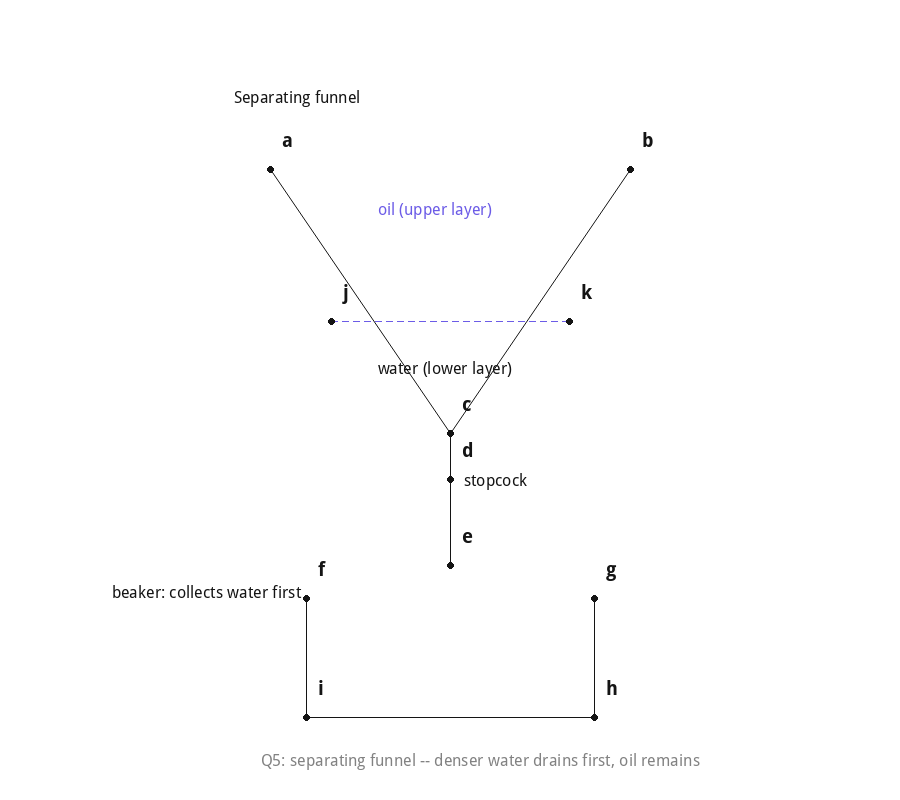
5. The label on a cooking oil pack says one litre (910 g). If this oil is mixed with water, will it form a separate layer? If so, which substance will be on top? How will you separate the two layers? Also, draw the diagram of the apparatus used.
Answer: Yes, cooking oil and water form two separate layers because they are immiscible liquids that do not dissolve in each other. Oil (910 g per litre, i.e., density about 0.91 g/mL) is less dense than water, so oil forms the upper layer and water the lower layer. The two layers are separated using a separating funnel: the mixture is poured in and left undisturbed until the layers form, the stopcock is opened to drain out the denser lower layer (water) first, and the oil is retained and collected separately. (Apparatus: separating funnel fitted with a stopcock, clamped on a stand, with a beaker placed below to collect the lower layer.)
6. Assertion (A): Solutions do not exhibit the Tyndall effect. Reason (R): The particles in solutions are larger than 100 nm, so they cannot scatter light. Choose the correct option:
(i) Both A and R are true, and R is the correct explanation of A.
(ii) Both A and R are true, but R is not the correct explanation of A.
(iii) A is true, but R is false.
(iv) A is false, but R is true.
Answer: (iii) A is true, but R is false.
The assertion is correct — true solutions do not show the Tyndall effect. The reason is incorrect — particles in a true solution are actually very small, less than 1 nm in size (not larger than 100 nm), and it is precisely because they are so small that they cannot scatter light.
7. How would you separate the mixtures given in Table 5.3? Mention the reason for choosing your method. If a mixture cannot be separated, explain why. (Mud from muddy water; Plasma from other components in a blood sample; Naphthalene and sand; Chalk powder and common salt; Common salt and water; Oil from water; Pigments of a flower.)
Answer:
| Mixture | Method of separation | Reason |
|---|---|---|
| Mud from muddy water | Sedimentation followed by filtration (or decantation) | Mud particles are insoluble, heavier and larger; they settle on standing and are retained by filter paper. |
| Plasma from other components of blood | Centrifugation | Blood cells are denser than plasma; spinning at high speed forces the heavier cells outward/downward, leaving plasma above. |
| Naphthalene and sand | Sublimation | Naphthalene changes directly from solid to vapour on heating; sand does not sublime and is left behind. |
| Chalk powder and common salt | Dissolve in water, then filter, then evaporate the filtrate | Salt dissolves in water but chalk powder does not; chalk is removed as residue by filtration and salt is recovered from the filtrate by evaporation. |
| Common salt and water | Evaporation (or distillation if water is also needed) | Water evaporates on heating, leaving solid salt behind; distillation additionally allows the water to be collected as a pure distillate. |
| Oil from water | Separating funnel | Oil and water are immiscible with different densities, so they form two separate layers that can be run off separately. |
| Pigments of a flower | Paper chromatography | Different pigments have different solubilities in the solvent and different attractions to the paper, so they travel different distances and separate. |
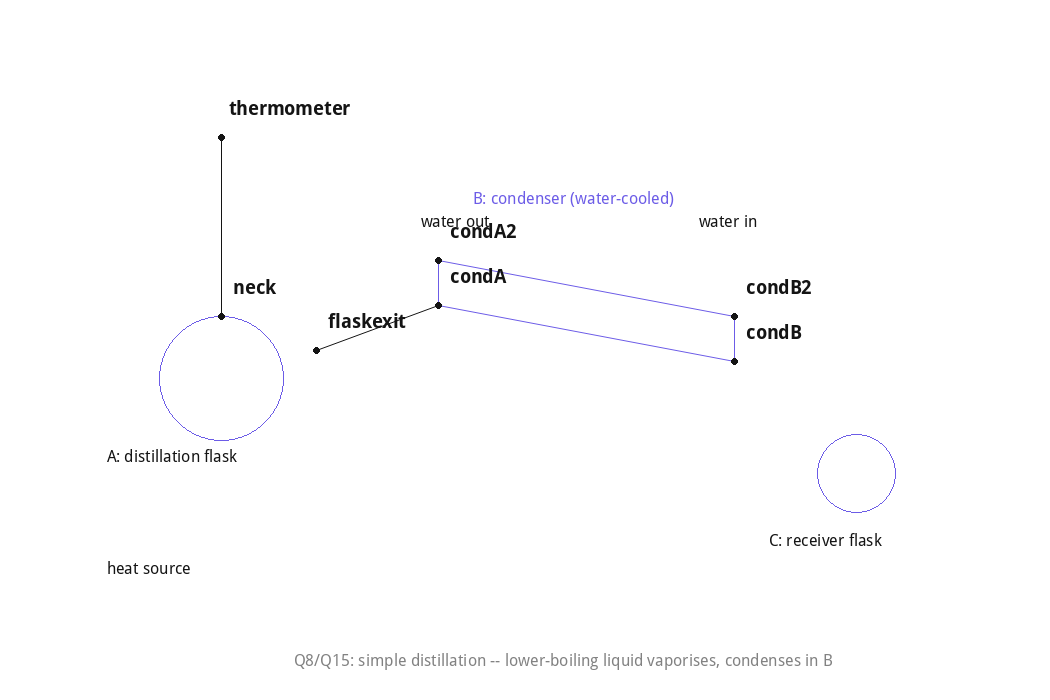
8. Two miscible liquids, A and B, are present in a mixture. The boiling point of A is 60°C and the boiling point of B is 90°C. Suggest a method to separate them. Also, draw a labelled diagram of the method suggested.
Answer: Simple distillation. The two boiling points differ by 30°C, which is large enough (more than 25°C) for simple distillation to work. On heating the mixture, liquid A (lower boiling point, 60°C) vaporises first; its vapour passes into the condenser, is cooled back to liquid, and is collected in the receiver flask. Liquid B (boiling point 90°C) remains behind in the distillation flask. (Apparatus: distillation flask with thermometer, fitted to a condenser, leading to a receiver flask, over a heat source.)
9. Compare evaporation, crystallization and distillation. In which situation would you prefer each of these over the others?
Answer: Evaporation removes the solvent by heating so that the dissolved solid is left behind as residue; it is quick and simple but the solvent is lost and the solid obtained is not very pure — it is preferred when only the solute is wanted and purity is not critical, e.g., recovering common salt from salt water. Crystallisation cools a hot saturated solution slowly so that pure, well-shaped crystals of the solute separate out; it is preferred when a pure solid product is required, e.g., preparing pure copper sulphate crystals. Distillation heats a liquid until it vaporises and then condenses the vapour separately; it is preferred when the solvent itself must be recovered, or when two miscible liquids with sufficiently different boiling points must be separated, e.g., separating water and acetone.
10. Blood is an example of a colloidal mixture. (i) What would happen if blood behaved like a true suspension inside the body? (ii) In a blood sample, identify the dispersed phase and the dispersion medium.
Answer: (i) If blood behaved like a true suspension, its heavier particles (blood cells) would settle down under gravity instead of staying dispersed. This could cause blood cells to collect and clog blood vessels, disrupting circulation and the transport of oxygen, nutrients, hormones and waste — which would be life-threatening. (ii) Dispersed phase: blood cells (red blood cells, white blood cells, platelets). Dispersion medium: plasma.
11. You are given a mixture of sand, common salt and naphthalene. A figure depicts various steps used to separate the components of this mixture. Identify and write down the correct sequence of separation techniques.
Answer: Step 1 — Sublimation: gentle heating removes naphthalene, which sublimes directly to vapour and is collected as solid on a cool surface, leaving sand and salt behind. Step 2 — Dissolution and filtration: water is added to dissolve the salt; sand, being insoluble, is removed as residue by filtration, while salt solution passes through as the filtrate. Step 3 — Evaporation: the filtrate is heated to evaporate the water, leaving pure common salt behind. Correct sequence: Sublimation → Dissolution and filtration → Evaporation.
12. Why is distillation an effective method for separating a mixture of water and acetone?
Answer: Water and acetone are miscible liquids with sufficiently different boiling points — acetone boils at about 56°C and water at 100°C, a difference of 44°C. On heating the mixture, acetone (the lower-boiling liquid) vaporises first; its vapour is cooled and condensed in the condenser and collected separately, while water remains behind in the flask because of its much higher boiling point. This large difference in boiling points is exactly what simple distillation exploits, making it an effective separation method here.
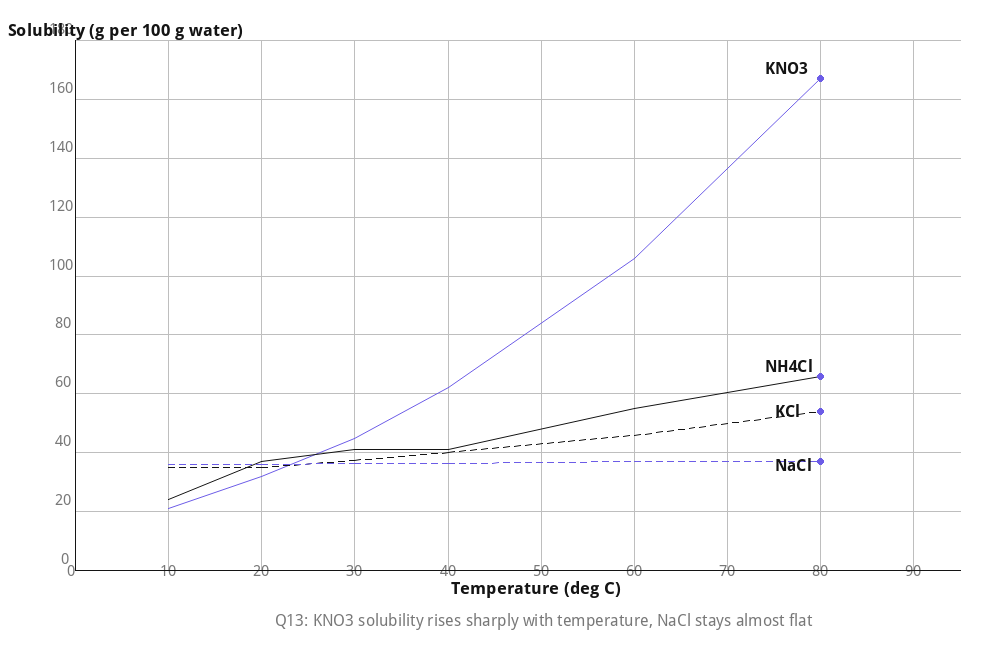
13. Answer the following questions with the help of the data given in Table 5.4 (solubility, in g per 100 g of water): Potassium nitrate — 21 (10°C), 32 (20°C), 45 (30°C), 62 (40°C), 106 (60°C), 167 (80°C); Sodium chloride — 36, 36, 36.3, 36.5, 37, 37; Potassium chloride — 35, 35, 37.4, 40, 46, 54; Ammonium chloride — 24, 37, 41, 41, 55, 66.
(i) What mass of potassium nitrate would be needed to prepare its saturated solution in 50 g of water at 40°C?
(ii) A student makes a saturated solution of potassium chloride in water at 80°C and leaves the solution to cool at room temperature (25°C). What would she observe as the solution cools? Explain.
(iii) What is the effect of a change in temperature on the solubility of salts? Also, compare the changes in the solubility of the four given salts with increasing temperature from 10°C to 80°C.
Answer: (i) Solubility of potassium nitrate at 40°C = 62 g per 100 g water. For 50 g water: mass needed = (62/100) × 50 = 31 g.
(ii) As the solution cools from 80°C to 25°C, the solubility of potassium chloride falls (from 54 g to well below 35 g per 100 g water), so the solution can no longer hold all the dissolved salt. The excess potassium chloride separates out and crystallises — the student would observe solid crystals forming as the solution cools.
(iii) In general, the solubility of solid salts in water increases as temperature rises, though the extent of increase differs from salt to salt. Potassium nitrate shows the sharpest rise (21 g to 167 g, an eight-fold increase), ammonium chloride shows a considerable rise (24 g to 66 g), potassium chloride shows a moderate rise (35 g to 54 g), while sodium chloride shows almost no change (36 g to 37 g) across the same temperature range.
14. Three students, A, B and C, are preparing sugar solutions for an experiment. Student A dissolves 20 g of sugar in 80 g of water. Student B dissolves 20 g of sugar in 100 g of water. Student C dissolves 30 g of sugar in 80 g of water.
(i) Calculate the mass percentage (% m/m) concentration of sugar in each student’s solution.
(ii) Whose solution is the most concentrated? Explain why.
Answer: (i) % m/m = (mass of solute / mass of solution) × 100.
Student A: total mass = 20 + 80 = 100 g; % m/m = (20/100) × 100 = 20%.
Student B: total mass = 20 + 100 = 120 g; % m/m = (20/120) × 100 ≈ 16.67%.
Student C: total mass = 30 + 80 = 110 g; % m/m = (30/110) × 100 ≈ 27.27%.
(ii) Student C’s solution is the most concentrated (≈27.27% m/m) because it has the highest mass of sugar dissolved per unit mass of total solution — a higher mass percentage means more solute per given amount of solution.
15. Examine a figure showing a distillation setup marked ‘S’. (i) Identify the separation technique marked as ‘S’. (ii) Label the apparatus A, B and C. (iii) Which of the following mixtures can be separated by the technique identified above? Use the boiling-point data given in Table 5.5 (Water 100°C, Acetone 56°C, Alcohol 78°C, Chloroform 61°C, Benzene 80°C): (a) water–acetone (b) water–salt (c) acetone–alcohol (d) sand–salt (e) alcohol–chloroform (f) alcohol–benzene.
Answer: (i) The technique marked ‘S’ is simple distillation. (ii) A = distillation flask, B = condenser, C = receiver flask.
(iii) Simple distillation works for a liquid with a dissolved non-volatile solid, or for miscible liquids whose boiling points differ by more than about 25°C. Checking each pair: (a) water–acetone, difference = 44°C — can be separated by simple distillation. (b) water–salt, salt has no boiling point/is non-volatile — water can be distilled off leaving salt behind, so this can be separated by simple distillation. (c) acetone–alcohol, difference = 22°C — too close; needs fractional distillation. (d) sand–salt, both solids with no liquid present — cannot be separated by distillation at all; needs dissolution, filtration and evaporation. (e) alcohol–chloroform, difference = only 17°C — too close for simple distillation; needs fractional distillation. (f) alcohol–benzene, difference = only 2°C — needs fractional distillation.
So the mixtures separable by the technique identified (simple distillation) are (a) water–acetone and (b) water–salt.
Correction note: one source (Tiwari Academy) answered this part as “(a) and (e)”, i.e. including alcohol–chloroform and excluding water–salt. That is incorrect: alcohol (78°C) and chloroform (61°C) differ by only 17°C, well below the ~25°C gap simple distillation needs, so this pair actually requires fractional distillation. Water–salt, on the other hand, is a textbook example of simple distillation (it is how distilled water is obtained from a saline solution), so it belongs in the “can be separated” list. This page uses the corrected answer, which matches Vedantu’s independently-verified working.
In-Text Questions (Think It Over, Pause and Ponder, Think as a Scientist, What if…, The Journey Beyond, and Activities 5.1–5.9)
Why do suspended particles settle in muddy water over time but not in milk? (Think It Over, NCERT Textbook Page No. 72)
Muddy water is a suspension — its particles are large (over 1000 nm) and heavy, so gravity pulls them down and they settle when left undisturbed. Milk is a colloid; its particles are much smaller (1–1000 nm) and remain uniformly dispersed, so milk does not separate into layers on standing.
How is evaporation different from boiling? (Think It Over, NCERT Textbook Page No. 72)
Evaporation happens only from the surface of a liquid, occurs slowly at any temperature, and produces no bubbles. Boiling happens throughout the liquid at one fixed temperature (the boiling point), is much faster, and is marked by bubble formation.
Why do you see bright rays of sunlight when it passes through small gaps between the leaves of a dense tree? (Think It Over, NCERT Textbook Page No. 72)
Tiny dust particles, water droplets and smoke suspended in the air scatter the sunlight passing through the gaps. This scattering of light by colloidal-sized particles is the Tyndall effect, and it is what makes the beam of light visible.
A common talcum powder contains 4% m/m zinc oxide, which acts as an antiseptic. How much zinc oxide is present in 300 g of the talcum powder? (Pause and Ponder, NCERT Textbook Page No. 76)
4% m/m means 4 g of zinc oxide per 100 g of powder. For 300 g: mass of zinc oxide = (4/100) × 300 = 12 g.
Your mother asks you to mix two tablespoons of orange juice concentrate (15 mL each) with water to make 150 mL of juice per person. What is the % v/v of concentrate in the prepared mixture? (Pause and Ponder, NCERT Textbook Page No. 76)
Volume of concentrate = 2 × 15 = 30 mL. Total volume of juice = 150 mL. % v/v = (30/150) × 100 = 20%.
Vinegar contains 5% v/v acetic acid, while glacial acetic acid is 100% acetic acid. How would you prepare vinegar from glacial acetic acid? (Pause and Ponder, NCERT Textbook Page No. 76)
5% v/v means 5 mL of acetic acid is needed per 100 mL of final solution. Measure 5 mL of glacial acetic acid and add water gradually, with careful mixing, until the total volume reaches 100 mL. Because glacial acetic acid is concentrated and corrosive, it must be handled carefully and diluted slowly (acid added to water, not the reverse, and with care).
Refer to the solubility curves of compounds A and B (Activity 5.2). If equal masses of hot, saturated solutions of A and B are cooled from 80°C to 60°C, which solution deposits more solid? (Pause and Ponder, NCERT Textbook Page No. 79)
Compound B deposits more solid. Its solubility curve falls more sharply between 80°C and 60°C than compound A’s, and since the excess solute that a cooling solution can no longer hold separates out as crystals, the sharper the drop in solubility, the more solid crystallises out.
Will there be any change in the size of common salt crystals if the rate of evaporation is increased or decreased? Explain. (Pause and Ponder, NCERT Textbook Page No. 79)
Yes. Fast evaporation gives particles very little time to arrange themselves, producing small, poorly formed crystals. Slow evaporation allows particles more time to arrange in an orderly pattern, producing larger, well-shaped crystals.
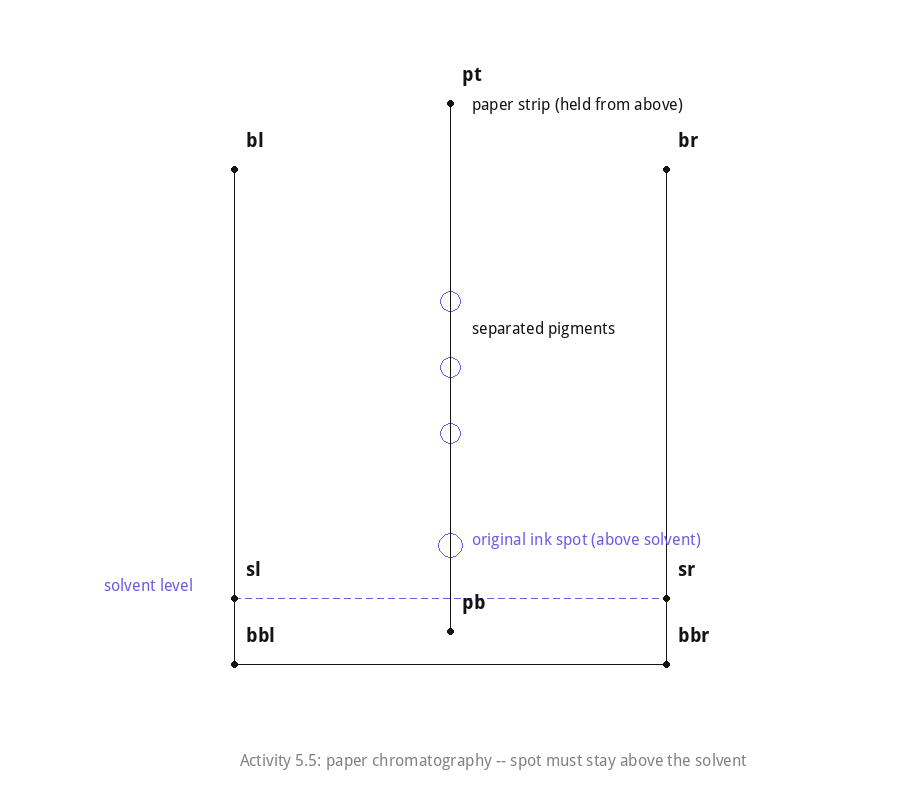
State whether the following are True or False, and correct the false ones: (i) Salt can be separated from a salt solution by evaporation or distillation. (ii) Distillation can separate two liquids even when they have the same boiling point. (iii) In paper chromatography, the solvent level should be above the sample spot at the start. (iv) Evaporation and crystallisation are the same process. (Pause and Ponder, NCERT Textbook Page No. 82)
(i) True — evaporation gives the salt directly, and distillation additionally recovers the water. (ii) False — distillation only works when the liquids have different boiling points; it cannot separate two liquids with the same boiling point. (iii) False — the solvent level should be below the sample spot; if the spot itself is submerged, the sample dissolves straight into the solvent instead of rising up the paper. (iv) False — evaporation removes the solvent to leave the solute behind (often impure), while crystallisation is the slow cooling of a saturated solution to obtain pure, well-formed solid crystals.
Why do immiscible liquids form two separate layers in a separating funnel? (Pause and Ponder, NCERT Textbook Page No. 84)
Immiscible liquids do not dissolve into one another, and they usually have different densities. The denser liquid sinks to the bottom and the lighter liquid floats above, so the two remain as distinct layers that can be drained off separately.
Is sublimation different from evaporation? Justify. (Pause and Ponder, NCERT Textbook Page No. 84)
Yes. Sublimation is a solid changing directly into vapour without passing through the liquid state (e.g., camphor, naphthalene). Evaporation is a liquid changing into vapour from its surface. The starting states are different — solid versus liquid — even though both end in a vapour.
Clouds are made of tiny water droplets or ice crystals floating in air. What type of mixture are clouds, and why? (Pause and Ponder, NCERT Textbook Page No. 88)
Clouds are colloids. The water droplets/ice crystals (1–1000 nm range) form the dispersed phase and air is the dispersion medium; the particles remain suspended without settling quickly and scatter light, which is why clouds are visible.
Why do cities with a lot of smoke and dust in the air often look hazy? (Pause and Ponder, NCERT Textbook Page No. 88)
Smoke and dust particles in the air are colloidal in size and scatter light passing through them — the Tyndall effect. With enough particles present, this scattering reduces visibility and gives the air a hazy, cloudy appearance.
If a hot, saturated copper sulfate solution is cooled rapidly in ice-cold water, smaller and less well-formed crystals will form than if it is cooled slowly at room temperature. How would you design an experiment to test this? (Think as a Scientist, NCERT Textbook Page No. 79)
Prepare a hot saturated copper sulfate solution and filter it to remove impurities. Divide it into two equal parts. Cool one part rapidly in an ice-cold water bath and let the other part cool slowly, undisturbed, at room temperature. Compare the crystals formed in each: the rapidly cooled part is expected to yield smaller, less regular crystals, while the slowly cooled part is expected to yield larger, well-shaped crystals — because slow cooling gives particles more time to arrange into an orderly crystal lattice, while rapid cooling does not.
Two immiscible liquids of the same density are mixed in a separating funnel. How will the layers form? (What if…, NCERT Textbook Page No. 83)
If both liquids have the same density, neither will clearly sink below or float above the other, so a separating funnel cannot cleanly split them into two distinct layers. They may stay mixed as a cloudy dispersion or an unstable emulsion, making this method of separation ineffective — a different property (such as boiling point, for distillation) would need to be used instead.
The Deg-Bhapka method (Kannauj) — what principle of separation does it use, and why is it significant? (The Journey Beyond — India’s Scientific Contributions)
It uses steam distillation (hydro-distillation). Flowers or plant material are placed with water in a copper still called a Deg; on heating, steam carries the volatile fragrance (essential oil) molecules through a bamboo pipe into a cooled receiver pot called the Bhapka, where the vapour condenses and the perfume (ittar) separates out. This centuries-old traditional distillation technique from Kannauj, Uttar Pradesh, is significant because it still produces fragrances — such as Mitti ka Ittar, the earthy scent of rain-soaked soil — with a complexity that synthetic chemistry has not been able to fully replicate.
The Paperfuge — what physical principle does it use, and why is it important for healthcare? (The Journey Beyond — Bridging Science and Society)
It uses centrifugation, driven by centrifugal force. Pulling the strings attached to the paper disc makes it spin at very high speed; this force pushes the heavier red blood cells outward to the tip of the sample tube, separating them from the lighter plasma and platelets — the same principle used in a laboratory centrifuge, including for diagnosing malaria from a blood sample. It matters for healthcare because a standard centrifuge needs electricity, which is unavailable in many remote or low-resource areas, whereas the paperfuge costs only a few cents, needs no electricity, and can still separate blood components for diagnosis in the field.
Can we create artificial blood that works just as well as real blood for all patients? (The Journey Beyond)
This is an active area of research, and current substitutes fall short of real blood in several ways. Blood is a complex colloid containing living cells (red blood cells, white blood cells, platelets) and over a hundred different plasma proteins, all performing different jobs. Researchers have developed haemoglobin-based oxygen carriers (HBOCs) and perfluorocarbon-based oxygen carriers (PFBOCs) that can transport oxygen, but these cannot yet replicate every function of real blood (immune defence, clotting, universal compatibility) without triggering immune reactions. So while partial substitutes exist, a true universal artificial blood is still a work in progress.
Activity 5.1 — Let Us Experiment (Group Activity): Identify whether given mixtures are a true solution, a suspension, or a colloid. (NCERT Textbook Page No. 73)
Salt + water: clear and transparent, no visible particles, laser beam path not visible, no settling, no residue on filtration — a true solution. Chalk powder + water: cloudy, particles may be visible, laser beam path visible (scattering), particles settle on standing, residue left on filtration — a suspension. Milk + water: uniform but slightly cloudy, particles not visible to the naked eye, laser beam path visible (Tyndall effect), does not settle, no residue on ordinary filter paper — a colloid.
Activity 5.2 — Let Us Represent Solubility Graphically: solubility curves of compounds A and B. (NCERT Textbook Page No. 77)
Compound B dissolves more than compound A at the same temperature because B’s solubility curve lies above A’s. The solubility of A at 20°C is less than at 60°C, and the solubility of B at 20°C is also less than at 60°C — solubility of solids generally rises with temperature. Compound B’s solubility increases more than A’s as temperature rises. If a saturated solution is prepared hot and cooled slowly, the solubility falls and the excess solute separates as crystals — slow cooling gives larger, better-shaped crystals.
Activity 5.3 — Let Us Prepare: obtain crystals of copper sulfate from its solution. (NCERT Textbook Page No. 78)
When a hot saturated copper sulfate solution is cooled, blue crystals of copper sulfate form; they are shiny and well-shaped if cooling happens slowly. This confirms that crystallisation — based on the fact that solubility changes with temperature — can be used to obtain pure solid crystals from a saturated solution.
Activity 5.4 — Let Us Describe a Process: how salt crystals are obtained from seawater by evaporation. (NCERT Textbook Page No. 79)
Seawater is collected in large, shallow evaporation ponds where solar heat and wind evaporate the water slowly. As water leaves, the salt solution becomes more concentrated until it is saturated, after which salt begins to crystallise and settle at the bottom of the pond. The crystals are then collected, washed and dried. This shows how solar evaporation and crystallisation are used together on an industrial scale to obtain salt.
Activity 5.5 — Let Us Investigate: separate the coloured components of black ink using paper chromatography. (NCERT Textbook Page No. 82)
As water rises up the chromatography paper by capillary action, it carries the ink spot with it, and the black ink separates into different coloured spots at different heights. This shows that black ink is a mixture of different dyes, each with a different solubility in the solvent and a different attraction to the paper — which is why they separate and travel to different distances.
Activity 5.6 — Let Us Separate: separate two immiscible liquids (mustard oil and water) using a separating funnel. (NCERT Textbook Page No. 83)
When mustard oil and water are poured into a separating funnel and left undisturbed, two layers form — mustard oil on top (lower density) and water at the bottom (higher density). Opening the stopcock lets the denser water drain out first, leaving the oil behind to be collected separately. This confirms that a separating funnel separates immiscible liquids using their density difference.
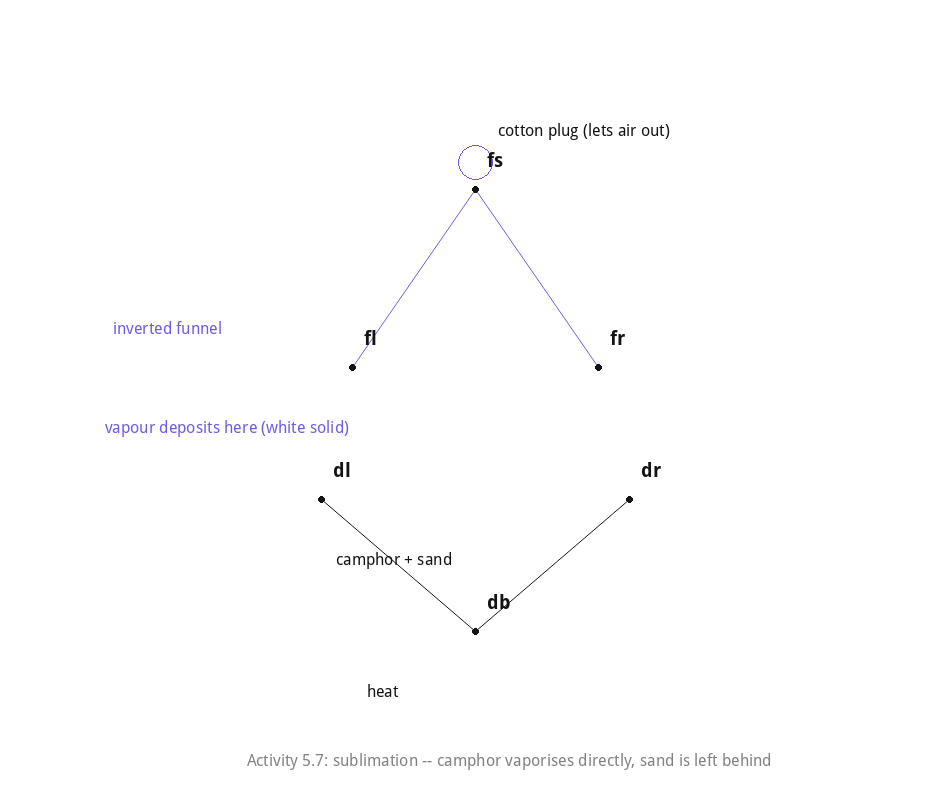
Activity 5.7 — Let Us Explore: separate camphor from sand by sublimation. (NCERT Textbook Page No. 84)
On heating the mixture, camphor changes directly from solid to vapour; the vapour rises and deposits as a white solid on the cool surface of an inverted funnel placed above, while sand — which does not sublime — remains behind in the dish. This shows sublimation can separate a sublimable substance from one that does not sublime.
Activity 5.8 — Let Us Make a Model: build a simple centrifuge model using a cardboard disc and thread. (NCERT Textbook Page No. 86)
When the cardboard disc is spun rapidly by pulling the threads, the mixture attached to it moves outward under the spinning force; heavier particles move farther out than the lighter liquid. This models how centrifugation separates particles of different densities — heavier components move outward and settle faster than lighter ones — the same principle used in laboratory and blood-sample centrifuges.
Activity 5.9 — Complete Table 5.1 and review what you have learnt about solutions, suspensions and colloids. (NCERT Textbook Page No. 88)
Answer:
| Property | Solution | Suspension | Colloid |
|---|---|---|---|
| Nature | Homogeneous | Heterogeneous | Heterogeneous |
| Particle size | Less than 1 nm | More than 1000 nm | 1–1000 nm |
| Visibility | Not visible to the naked eye | Visible to the naked eye | Not visible to the naked eye |
| Separation by filtration | No | Yes | No |
| Settling | No | Yes | No |
| Tyndall effect | No | Yes | Yes |
Why This Chapter Matters
Exploring Mixtures and their Separation carries the chemistry thread of Class 9 Science forward from the atomic and molecular ideas built up in earlier chapters into something students can see, measure and separate with their own hands — the same skills of classifying matter and reading solubility data return with sharper mathematical tools in later chapters on atomic structure and chemical reactions, while the concentration formulas introduced here (% m/m, % m/v, % v/v) resurface in numericals throughout Class 9 and Class 10 Chemistry. Because nearly every idea in this chapter — from filtering tea leaves to separating blood in a diagnostic lab — has an everyday or medical example attached to it, it is also one of the more scoring, application-based chapters for board-style questions, making a solid grasp of it useful well beyond this one chapter.
Extra Questions | Revision Notes | Formulas Handbook
Chapter Quiz — Test Your Understanding
Class 9 Science Chapter 5 – Notes and Extra Questions
Along with these NCERT Solutions, students can also use the Class 9 Science Chapter 5 Extra Questions and Class 9 Science Chapter 5 Revision Notes for quick revision and extra practice.
- Chapter 1: Entering the World of Secondary Science – Free PDF Download
- Chapter 2: Cell: The Building Block of Life – Free PDF Download
- Chapter 3: Tissues in Action – Free PDF Download
- Chapter 4: Describing Motion Around Us – Free PDF Download
- Chapter 6: How Forces Affect Motion – Free PDF Download
- Chapter 7: Work, Energy and Simple Machines – Free PDF Download
- Chapter 8: Journey Inside the Atom – Free PDF Download
- Chapter 9: Atomic Foundations of Matter – Free PDF Download
- Chapter 10: Sound Waves: Characteristics and Applications – Free PDF Download
- Chapter 11: Reproduction: How Life Continues – Free PDF Download
- Chapter 12: Patterns in Life: Diversity and Classification – Free PDF Download
- Chapter 13: Earth as a System: Energy, Matter and Life – Free PDF Download
Frequently Asked Questions
What is the official name of the exercise at the end of Class 9 Science Chapter 5?
It is called Revise, Reflect, Refine and appears on page 90 of the NCERT Exploration textbook. It contains 15 questions covering classification of mixtures, the Tyndall effect, concentration numericals, separation techniques and solubility-curve data, in formats ranging from MCQs and assertion-reason to table-based and diagram-based questions.
How many concentration formulas does this chapter introduce, and when should each be used?
Three: mass by mass percentage (% m/m = mass of solute ÷ mass of solution × 100), used when both solute and solvent are measured by mass, such as on food labels; mass by volume percentage (% m/v = mass of solute ÷ volume of solution × 100), used when a solid or liquid solute’s mass is dissolved to make a known volume, such as medicines and IV drips; and volume by volume percentage (% v/v = volume of solute ÷ volume of solution × 100), used when both solute and solution are liquids, such as vinegar and perfumes. The most common mistake is using only the solvent’s mass instead of the total solution’s mass in the denominator of % m/m.
How is a solution different from a suspension and a colloid?
The three are distinguished mainly by particle size and behaviour. A solution has particles smaller than 1 nm, does not settle, cannot be filtered out, and does not scatter light. A suspension has particles larger than 1000 nm, settles on standing, can be separated by filtration, and scatters light (visible Tyndall effect, with particles often visible to the eye). A colloid falls in between (1–1000 nm) — it does not settle and cannot be filtered with ordinary paper like a solution, but it does scatter light like a suspension, which is the key test (the Tyndall effect) used to tell a colloid apart from a true solution.
When should distillation be used instead of simple evaporation, and when is fractional distillation needed instead of simple distillation?
Evaporation only recovers the solute (as the solvent is lost as vapour), so it is used when just the dissolved solid is needed. Distillation recovers both the solute and the solvent (or separates two miscible liquids), so it is used when the liquid must also be collected — for example, to obtain pure/distilled water from a salt solution. Simple distillation only works well when two miscible liquids have boiling points that differ by more than about 25°C; if the difference is smaller (as with alcohol and chloroform, which differ by only 17°C, or acetone and alcohol, which differ by 22°C), fractional distillation using a fractionating column is required instead.
What are the main separation techniques in this chapter, and what property does each one exploit?
Crystallisation and evaporation exploit the fact that solid solubility changes with temperature; distillation exploits differences in boiling point; paper chromatography exploits differences in solubility and attraction to the paper; sublimation exploits the fact that some solids vaporise directly without melting; the separating funnel exploits density differences between immiscible liquids; and centrifugation and coagulation exploit density/particle-size differences to separate suspended or colloidal particles, such as blood cells from plasma or fine mud particles clumped together with alum.
Recommended: Buy the Printed NCERT Class 9 Science Book
Contains Amazon affiliate links.
If you’d like a printed copy alongside the PDF, here’s a verified option:
3.8 out of 5 stars (931 ratings) · Rs. 187
Price and availability may change on Amazon. As an Amazon Associate, ncertbooks.org earns from qualifying purchases.


