
Chapter 10, Conic Sections, introduces the curves obtained by intersecting a right circular cone with a plane — the circle, parabola, ellipse, and hyperbola. Students learn to derive and apply the standard equations of each conic, and to find key features such as centre, radius, focus, directrix, vertices, eccentricity, and latus rectum.
Last Updated: September 23, 2026
Exercise 10.1
Q1. Find the equation of the circle with centre (0,2) and radius 2 — The equation of a circle with centre (h, k) and radius r is (x − h)² + (y − k)² =…
The equation of a circle with centre (h, k) and radius r is (x − h)² + (y − k)² = r².
Here h = 0, k = 2, r = 2.
So the equation is (x − 0)² + (y − 2)² = 2², i.e., x² + (y − 2)² = 4.
Q2. Find the equation of the circle with centre (−2,3) and radius 4 — Here h = −2, k = 3, r = 4. (x − (−2))² + (y − 3)² = 4², i.e., (x + 2)² + (y…
Here h = −2, k = 3, r = 4.
(x − (−2))² + (y − 3)² = 4², i.e., (x + 2)² + (y − 3)² = 16.
Q3. Find the equation of the circle with centre (1/2, 1/4) and radius 1/12 — (x − 1/2)² + (y − 1/4)² = (1/12)², i.e., (x − 1/2)² + (y − 1/4)² = 1/144.
(x − 1/2)² + (y − 1/4)² = (1/12)², i.e., (x − 1/2)² + (y − 1/4)² = 1/144.
Q4. Find the equation of the circle with centre (1,1) and radius √2 — (x − 1)² + (y − 1)² = (√2)², i.e., (x − 1)² + (y − 1)² = 2.
(x − 1)² + (y − 1)² = (√2)², i.e., (x − 1)² + (y − 1)² = 2.
Q5. Find the equation of the circle with centre (−a, −b) and radius √(a² − b²) — (x − (−a))² + (y − (−b))² = (√(a² − b²))², i.e., (x + a)² + (y + b)²…
(x − (−a))² + (y − (−b))² = (√(a² − b²))², i.e., (x + a)² + (y + b)² = a² − b².
Q6. Find the centre and radius of the circle (x + 5)² + (y − 3)² = 36 — Comparing with (x − h)² + (y − k)² = r², we get h = −5, k = 3, r² = 36. Centre…
Comparing with (x − h)² + (y − k)² = r², we get h = −5, k = 3, r² = 36.
Centre = (−5, 3), radius = 6.
Q7. Find the centre and radius of the circle x² + y² − 4x − 8y − 45 = 0 — x² − 4x + y² − 8y = 45 (x² − 4x + 4) + (y² − 8y + 16) = 45 + 4 + 16 (x −…
x² − 4x + y² − 8y = 45
(x² − 4x + 4) + (y² − 8y + 16) = 45 + 4 + 16
(x − 2)² + (y − 4)² = 65
Centre = (2, 4), radius = √65.
Q8. Find the centre and radius of the circle x² + y² − 8x + 10y − 12 = 0 — (x² − 8x + 16) + (y² + 10y + 25) = 12 + 16 + 25 (x − 4)² + (y + 5)² = 53 Centre…
(x² − 8x + 16) + (y² + 10y + 25) = 12 + 16 + 25
(x − 4)² + (y + 5)² = 53
Centre = (4, −5), radius = √53.
Q9. Find the centre and radius of the circle 2x² + 2y² − x = 0 — Dividing by 2: x² + y² − x/2 = 0 (x² − x/2 + 1/16) + y² = 1/16 (x − 1/4)² +…
Dividing by 2: x² + y² − x/2 = 0
(x² − x/2 + 1/16) + y² = 1/16
(x − 1/4)² + y² = (1/4)²
Centre = (1/4, 0), radius = 1/4.
Q10. Find the equation of the circle passing through the points (4,1) and (6,5) and whose centre is on the line 4x + y = 16 — Let the circle be (x − h)² + (y − k)² = r². Since it passes through (4,1) and…
Let the circle be (x − h)² + (y − k)² = r².
Since it passes through (4,1) and (6,5):
(4 − h)² + (1 − k)² = (6 − h)² + (5 − k)²
Expanding and simplifying: 4h + 8k = 44, i.e., h + 2k = 11.
Also 4h + k = 16 (centre lies on the given line).
Solving these two equations: h = 3, k = 4.
r² = (4 − 3)² + (1 − 4)² = 1 + 9 = 10.
Equation: (x − 3)² + (y − 4)² = 10.
Q11. Find the equation of the circle passing through the points (2,3) and (−1,1) and whose centre is on the line x − 3y − 11 = 0 — Let centre be (h, k). (2 − h)² + (3 − k)² = (−1 − h)² + (1 − k)² Expanding…
Let centre be (h, k).
(2 − h)² + (3 − k)² = (−1 − h)² + (1 − k)²
Expanding and simplifying: 6h + 4k = 11.
Also h − 3k = 11, i.e., h = 11 + 3k.
Substituting: 6(11 + 3k) + 4k = 11 ⇒ 66 + 22k = 11 ⇒ k = −55/22 = −5/2.
h = 11 + 3(−5/2) = 7/2.
r² = (2 − 7/2)² + (3 + 5/2)² = 9/4 + 121/4 = 130/4 = 65/2.
Equation: (x − 7/2)² + (y + 5/2)² = 65/2.
Q12. Find the equation of the circle with radius 5 whose centre lies on x-axis and passes through the point (2,3) — Since the centre lies on the x-axis, let it be (h, 0). (2 − h)² + 9 = 25 ⇒ (2 −…
Since the centre lies on the x-axis, let it be (h, 0).
(2 − h)² + 9 = 25 ⇒ (2 − h)² = 16 ⇒ 2 − h = ±4 ⇒ h = −2 or h = 6.
Equation: (x + 2)² + y² = 25 or (x − 6)² + y² = 25.
Q13. Find the equation of the circle passing through (0,0) and making intercepts a and b on the coordinate axes — The circle passes through (0,0), (a,0) and (0,b). Let the equation be x² + y² + 2gx +…
The circle passes through (0,0), (a,0) and (0,b).
Let the equation be x² + y² + 2gx + 2fy + c = 0.
Since it passes through (0,0): c = 0.
Since it passes through (a,0): a² + 2ga = 0 ⇒ g = −a/2.
Since it passes through (0,b): b² + 2fb = 0 ⇒ f = −b/2.
Equation: x² + y² − ax − by = 0.
Q14. Find the equation of a circle with centre (2,2) and passes through the point (4,5) — r² = (4 − 2)² + (5 − 2)² = 4 + 9 = 13. Equation: (x − 2)² + (y − 2)² = 13.
r² = (4 − 2)² + (5 − 2)² = 4 + 9 = 13.
Equation: (x − 2)² + (y − 2)² = 13.
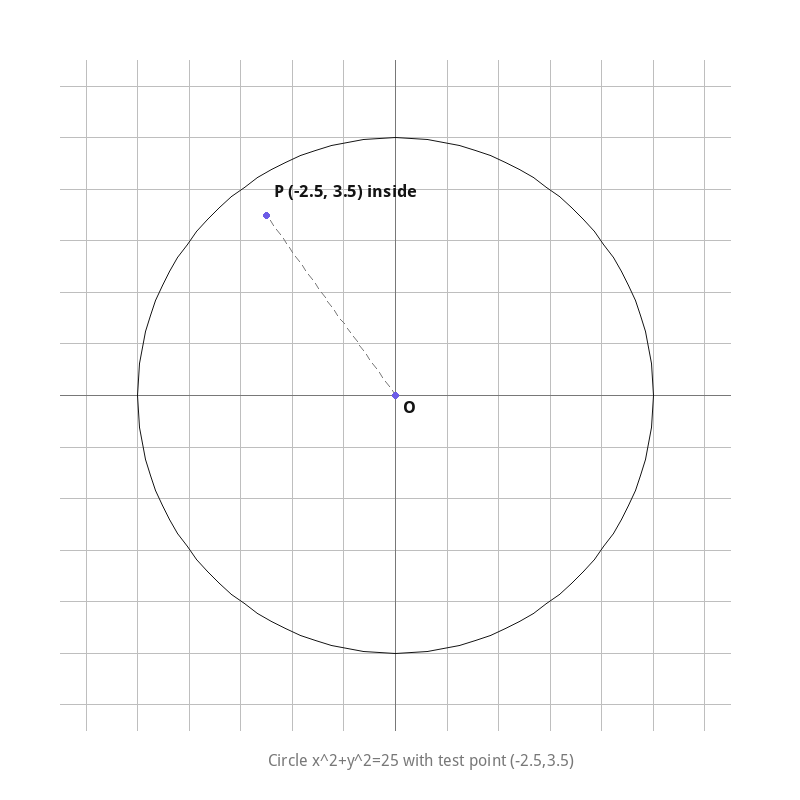
Q15. Does the point (−2.5, 3.5) lie inside, outside or on the circle x² + y² = 25? — Distance of the point from the centre (0,0): d² = (−2.5)² + (3.5)² = 6.25 + 12.25 =…
Distance of the point from the centre (0,0):
d² = (−2.5)² + (3.5)² = 6.25 + 12.25 = 18.5
Radius² = 25.
Since d² (18.5) < r² (25), the point lies inside the circle.
Exercise 10.2
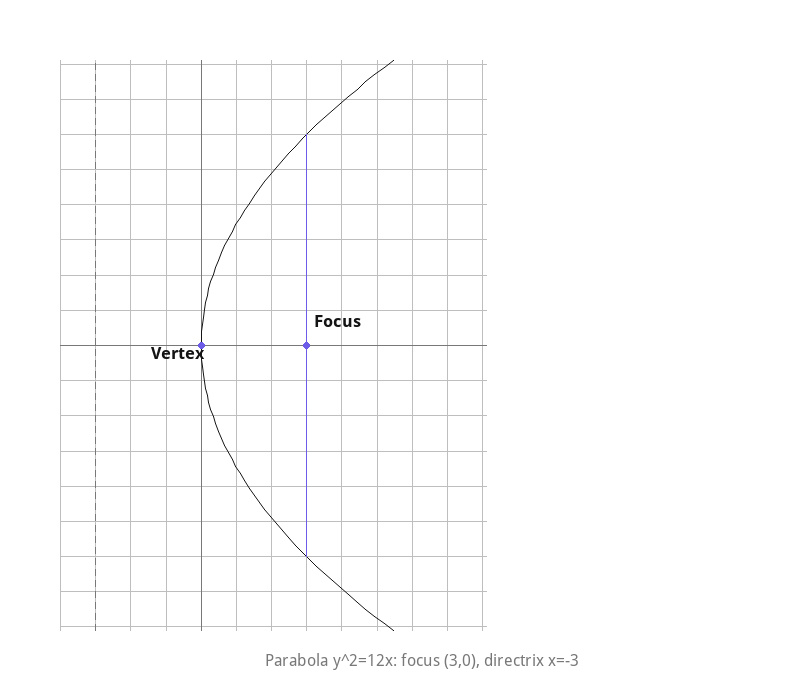
Q1. y² = 12x — find the coordinates of the focus, axis, equation of directrix and length of latus rectum — Comparing with y² = 4ax: 4a = 12 ⇒ a = 3. Focus = (3, 0); Axis = x-axis (y = 0);…
Comparing with y² = 4ax: 4a = 12 ⇒ a = 3.
Focus = (3, 0); Axis = x-axis (y = 0); Directrix: x = −3; Length of latus rectum = 12.
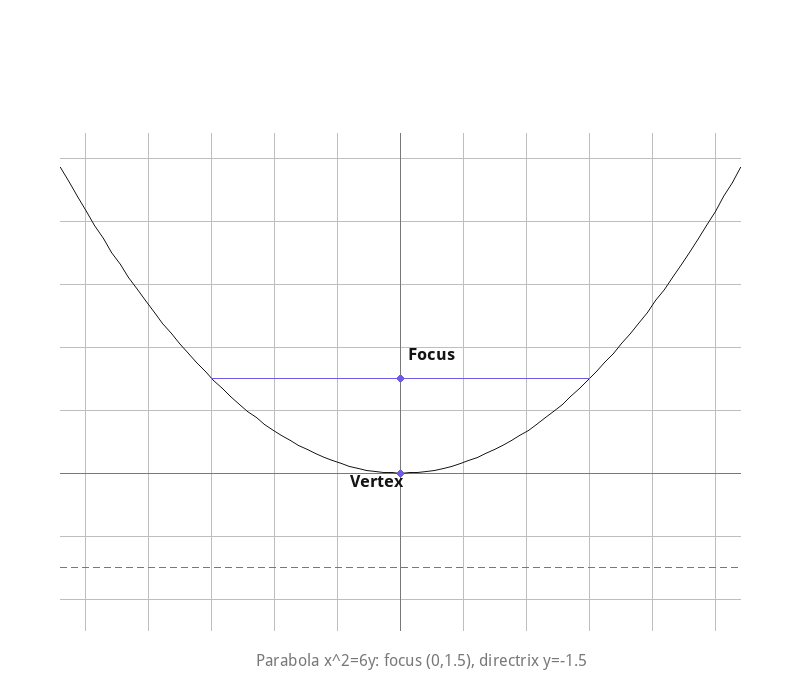
Q2. x² = 6y — Comparing with x² = 4ay: 4a = 6 ⇒ a = 3/2. Focus = (0, 3/2); Axis = y-axis (x = 0);…
Comparing with x² = 4ay: 4a = 6 ⇒ a = 3/2.
Focus = (0, 3/2); Axis = y-axis (x = 0); Directrix: y = −3/2; Length of latus rectum = 6.
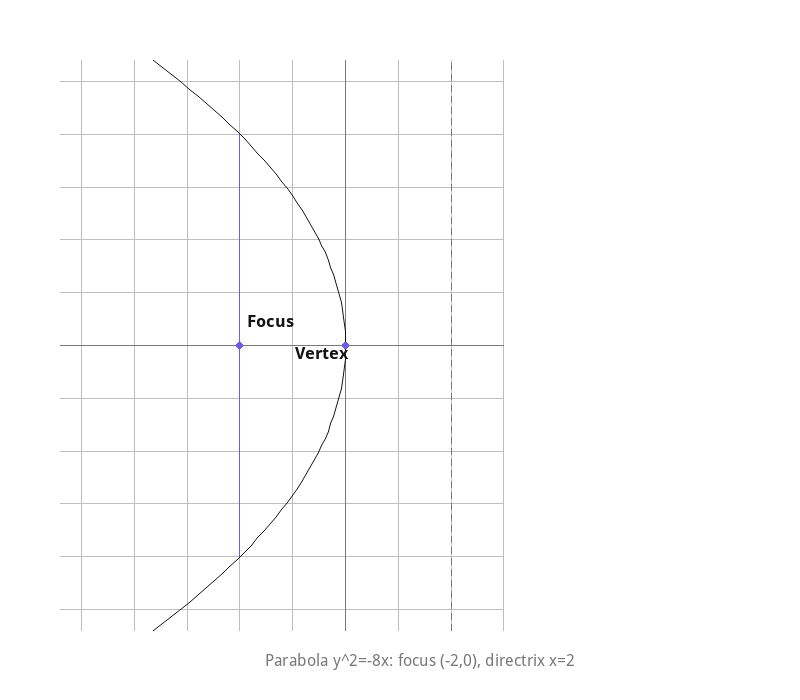
Q3. y² = −8x — Comparing with y² = −4ax: 4a = 8 ⇒ a = 2. Focus = (−2, 0); Axis = x-axis (y = 0);…
Comparing with y² = −4ax: 4a = 8 ⇒ a = 2.
Focus = (−2, 0); Axis = x-axis (y = 0); Directrix: x = 2; Length of latus rectum = 8.
Q4. x² = −16y — Comparing with x² = −4ay: 4a = 16 ⇒ a = 4. Focus = (0, −4); Axis = y-axis (x =…
Comparing with x² = −4ay: 4a = 16 ⇒ a = 4.
Focus = (0, −4); Axis = y-axis (x = 0); Directrix: y = 4; Length of latus rectum = 16.
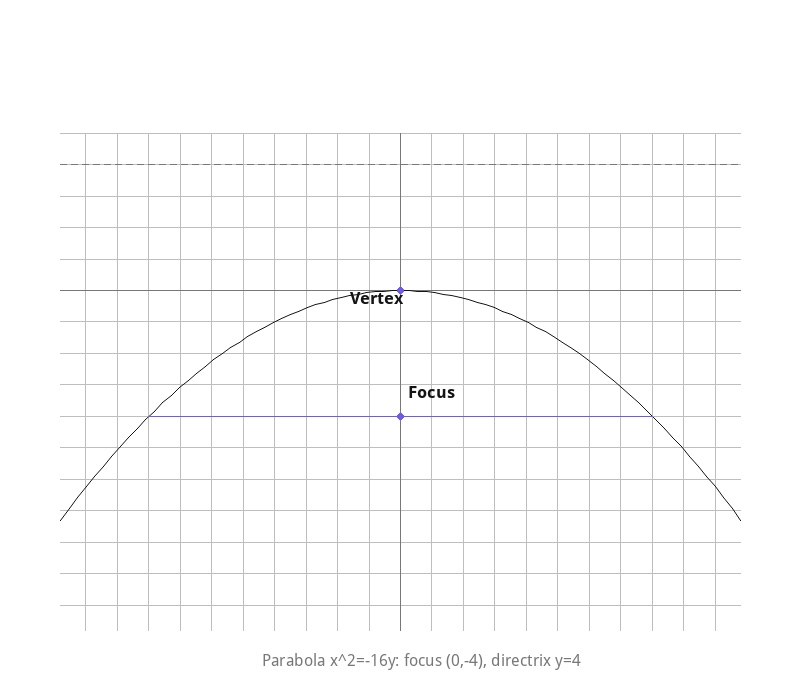
Q5. y² = 10x — 4a = 10 ⇒ a = 5/2. Focus = (5/2, 0); Axis = x-axis (y = 0); Directrix: x = −5/2;…
4a = 10 ⇒ a = 5/2.
Focus = (5/2, 0); Axis = x-axis (y = 0); Directrix: x = −5/2; Length of latus rectum = 10.
Q6. x² = −9y — 4a = 9 ⇒ a = 9/4. Focus = (0, −9/4); Axis = y-axis (x = 0); Directrix: y = 9/4;…
4a = 9 ⇒ a = 9/4.
Focus = (0, −9/4); Axis = y-axis (x = 0); Directrix: y = 9/4; Length of latus rectum = 9.
Q7. Find the equation of the parabola that satisfies: Focus (6,0); directrix x = −6 — Since the focus is on the positive x-axis and the directrix is x = −a with a = 6, the…
Since the focus is on the positive x-axis and the directrix is x = −a with a = 6, the parabola opens to the right: y² = 4ax.
Equation: y² = 24x.
Q8. Focus (0,−3); directrix y = 3 — The focus is below the origin, so the parabola opens downward: x² = −4ay with a = 3.…
The focus is below the origin, so the parabola opens downward: x² = −4ay with a = 3.
Equation: x² = −12y.
Q9. Vertex (0,0); focus (3,0) — Focus is on the positive x-axis with a = 3, so parabola opens right: y² = 4ax.…
Focus is on the positive x-axis with a = 3, so parabola opens right: y² = 4ax.
Equation: y² = 12x.
Q10. Vertex (0,0); focus (−2,0) — Focus is on the negative x-axis with a = 2, so parabola opens left: y² = −8ax.…
Focus is on the negative x-axis with a = 2, so parabola opens left: y² = −8ax.
Equation: y² = −8x.
Q11. Vertex (0,0) passing through (2,3) and axis is along x-axis — Equation: y² = 4ax. Since it passes through (2,3): 9 = 4a(2) = 8a ⇒ a = 9/8.…
Equation: y² = 4ax.
Since it passes through (2,3): 9 = 4a(2) = 8a ⇒ a = 9/8.
Equation: y² = (9/2)x.
Q12. Vertex (0,0), passing through (5,2) and symmetric with respect to y-axis — Since the parabola is symmetric about the y-axis and passes through a point with…
Since the parabola is symmetric about the y-axis and passes through a point with positive y-coordinate, it opens upward: x² = 4ay.
25 = 4a(2) = 8a ⇒ a = 25/8.
Equation: x² = (25/2)y.
Exercise 10.3
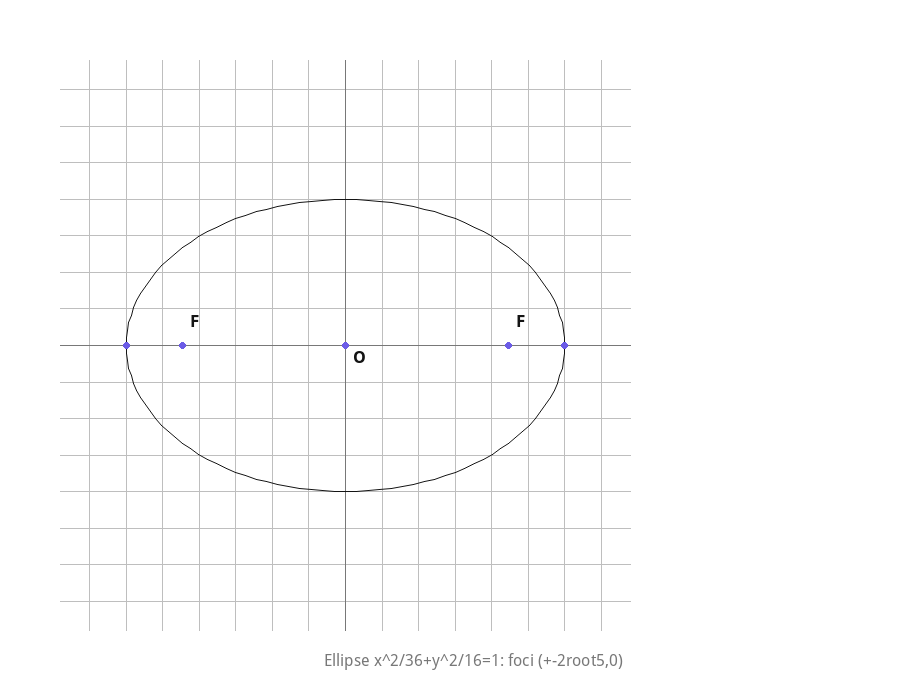
Q1. x²/36 + y²/16 = 1 — find the coordinates of the foci, vertices, length of major axis, minor axis, eccentricity and latus rectum — Here a² = 36, b² = 16 with a² > b², so the major axis is along the x-axis. a = 6, b…
Here a² = 36, b² = 16 with a² > b², so the major axis is along the x-axis. a = 6, b = 4.
c² = a² − b² = 36 − 16 = 20 ⇒ c = 2√5.
Foci = (±2√5, 0); Vertices = (±6, 0); Length of major axis = 12; Length of minor axis = 8; Eccentricity e = c/a = √5/3; Length of latus rectum = 2b²/a = 16/3.
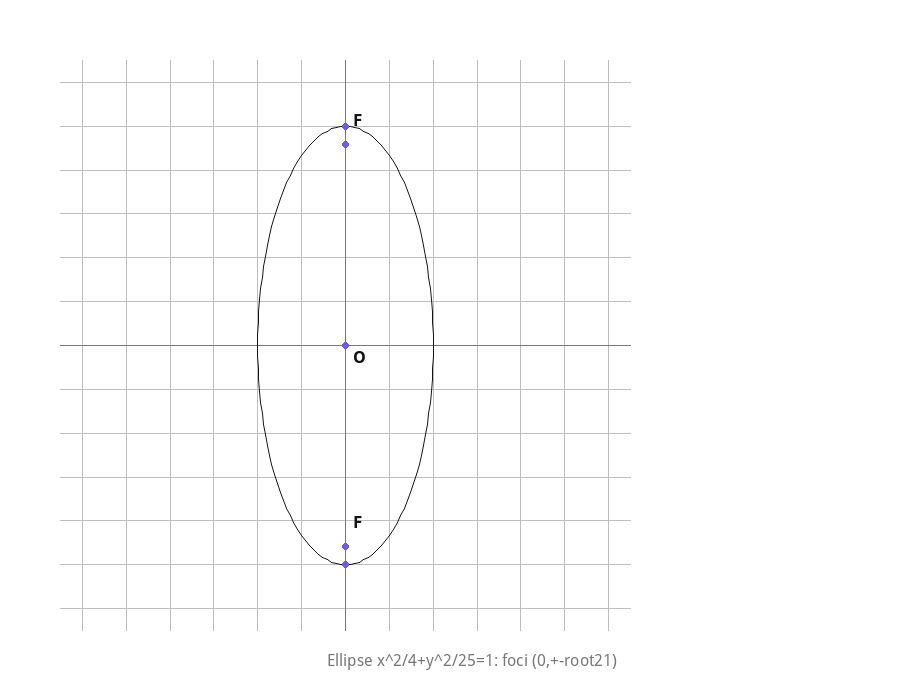
Q2. x²/4 + y²/25 = 1 — Here the denominator under y² (25) is larger, so the major axis is along the y-axis,…
Here the denominator under y² (25) is larger, so the major axis is along the y-axis, with a = 5, b = 2.
c² = a² − b² = 25 − 4 = 21 ⇒ c = √21.
Foci = (0, ±√21); Vertices = (0, ±5); Length of major axis = 10; Length of minor axis = 4; Eccentricity e = √21/5; Length of latus rectum = 2b²/a = 8/5.
Q3. x²/16 + y²/9 = 1 — Major axis along x-axis; a = 4, b = 3. c² = 16 − 9 = 7 ⇒ c = √7. Foci = (±√7,…
Major axis along x-axis; a = 4, b = 3.
c² = 16 − 9 = 7 ⇒ c = √7.
Foci = (±√7, 0); Vertices = (±4, 0); Length of major axis = 8; Length of minor axis = 6; Eccentricity e = √7/4; Length of latus rectum = 9/2.
Q4. x²/25 + y²/100 = 1 — Major axis along y-axis; a = 10, b = 5. c² = 100 − 25 = 75 ⇒ c = 5√3. Foci = (0,…
Major axis along y-axis; a = 10, b = 5.
c² = 100 − 25 = 75 ⇒ c = 5√3.
Foci = (0, ±5√3); Vertices = (0, ±10); Length of major axis = 20; Length of minor axis = 10; Eccentricity e = √3/2; Length of latus rectum = 5.
Q5. x²/49 + y²/36 = 1 — Major axis along x-axis; a = 7, b = 6. c² = 49 − 36 = 13 ⇒ c = √13. Foci =…
Major axis along x-axis; a = 7, b = 6.
c² = 49 − 36 = 13 ⇒ c = √13.
Foci = (±√13, 0); Vertices = (±7, 0); Length of major axis = 14; Length of minor axis = 12; Eccentricity e = √13/7; Length of latus rectum = 72/7.
Q6. x²/100 + y²/400 = 1 — Major axis along y-axis; a = 20, b = 10. c² = 400 − 100 = 300 ⇒ c = 10√3. Foci =…
Major axis along y-axis; a = 20, b = 10.
c² = 400 − 100 = 300 ⇒ c = 10√3.
Foci = (0, ±10√3); Vertices = (0, ±20); Length of major axis = 40; Length of minor axis = 20; Eccentricity e = √3/2; Length of latus rectum = 10.
Q7. 36x² + 4y² = 144 — Dividing by 144: x²/4 + y²/36 = 1. Major axis along y-axis; a = 6, b = 2. c² = 36 −…
Dividing by 144: x²/4 + y²/36 = 1.
Major axis along y-axis; a = 6, b = 2.
c² = 36 − 4 = 32 ⇒ c = 4√2.
Foci = (0, ±4√2); Vertices = (0, ±6); Length of major axis = 12; Length of minor axis = 4; Eccentricity e = 2√2/3; Length of latus rectum = 4/3.
Q8. 16x² + y² = 16 — Dividing by 16: x²/1 + y²/16 = 1. Major axis along y-axis; a = 4, b = 1. c² = 16 −…
Dividing by 16: x²/1 + y²/16 = 1.
Major axis along y-axis; a = 4, b = 1.
c² = 16 − 1 = 15 ⇒ c = √15.
Foci = (0, ±√15); Vertices = (0, ±4); Length of major axis = 8; Length of minor axis = 2; Eccentricity e = √15/4; Length of latus rectum = 1/2.
Q9. 4x² + 9y² = 36 — Dividing by 36: x²/9 + y²/4 = 1. Major axis along x-axis; a = 3, b = 2. c² = 9 − 4…
Dividing by 36: x²/9 + y²/4 = 1.
Major axis along x-axis; a = 3, b = 2.
c² = 9 − 4 = 5 ⇒ c = √5.
Foci = (±√5, 0); Vertices = (±3, 0); Length of major axis = 6; Length of minor axis = 4; Eccentricity e = √5/3; Length of latus rectum = 8/3.
Q10. Find the equation for the ellipse that satisfies: Vertices (±5,0), foci (±4,0) — a = 5, c = 4. b² = a² − c² = 25 − 16 = 9. Equation: x²/25 + y²/9 = 1.
a = 5, c = 4. b² = a² − c² = 25 − 16 = 9.
Equation: x²/25 + y²/9 = 1.
Q11. Vertices (0, ±13), foci (0, ±5) — a = 13, c = 5. b² = 169 − 25 = 144. Equation: x²/144 + y²/169 = 1.
a = 13, c = 5. b² = 169 − 25 = 144.
Equation: x²/144 + y²/169 = 1.
Q12. Vertices (±6, 0), foci (±4, 0) — a = 6, c = 4. b² = 36 − 16 = 20. Equation: x²/36 + y²/20 = 1.
a = 6, c = 4. b² = 36 − 16 = 20.
Equation: x²/36 + y²/20 = 1.
Q13. Ends of major axis (±3, 0), ends of minor axis (0, ±2) — a = 3, b = 2. Equation: x²/9 + y²/4 = 1.
a = 3, b = 2.
Equation: x²/9 + y²/4 = 1.
Q14. Ends of major axis (0, ±√5), ends of minor axis (±1, 0) — Major axis is along the y-axis; a = √5, b = 1. Equation: x²/1 + y²/5 = 1.
Major axis is along the y-axis; a = √5, b = 1.
Equation: x²/1 + y²/5 = 1.
Q15. Length of major axis 26, foci (±5, 0) — 2a = 26 ⇒ a = 13; c = 5. b² = 169 − 25 = 144. Equation: x²/169 + y²/144 = 1.
2a = 26 ⇒ a = 13; c = 5. b² = 169 − 25 = 144.
Equation: x²/169 + y²/144 = 1.
Q16. Length of minor axis 16, foci (0, ±6) — 2b = 16 ⇒ b = 8; c = 6. Since the foci are on the y-axis, a² = b² + c² = 64 + 36 =…
2b = 16 ⇒ b = 8; c = 6. Since the foci are on the y-axis, a² = b² + c² = 64 + 36 = 100.
Equation: x²/64 + y²/100 = 1.
Q17. Foci (±3, 0), a = 4 — c = 3, a = 4. b² = 16 − 9 = 7. Equation: x²/16 + y²/7 = 1.
c = 3, a = 4. b² = 16 − 9 = 7.
Equation: x²/16 + y²/7 = 1.
Q18. b = 3, c = 4, centre at the origin; foci on the x-axis — Since foci are on the x-axis, a² = b² + c² = 9 + 16 = 25. Equation: x²/25 + y²/9 = 1.
Since foci are on the x-axis, a² = b² + c² = 9 + 16 = 25.
Equation: x²/25 + y²/9 = 1.
Q19. Centre at (0,0), major axis on the y-axis and passes through the points (3, 2) and (1, 6) — Let the equation be x²/b² + y²/a² = 1. Passing through (3,2): 9/b² + 4/a² = 1…
Let the equation be x²/b² + y²/a² = 1.
Passing through (3,2): 9/b² + 4/a² = 1
Passing through (1,6): 1/b² + 36/a² = 1
Let u = 1/b², v = 1/a². Then 9u + 4v = 1 and u + 36v = 1.
From the second equation, u = 1 − 36v. Substituting: 9(1 − 36v) + 4v = 1 ⇒ 9 − 320v = 1 ⇒ v = 1/40.
u = 1 − 36/40 = 1/10.
So b² = 10, a² = 40.
Equation: x²/10 + y²/40 = 1.
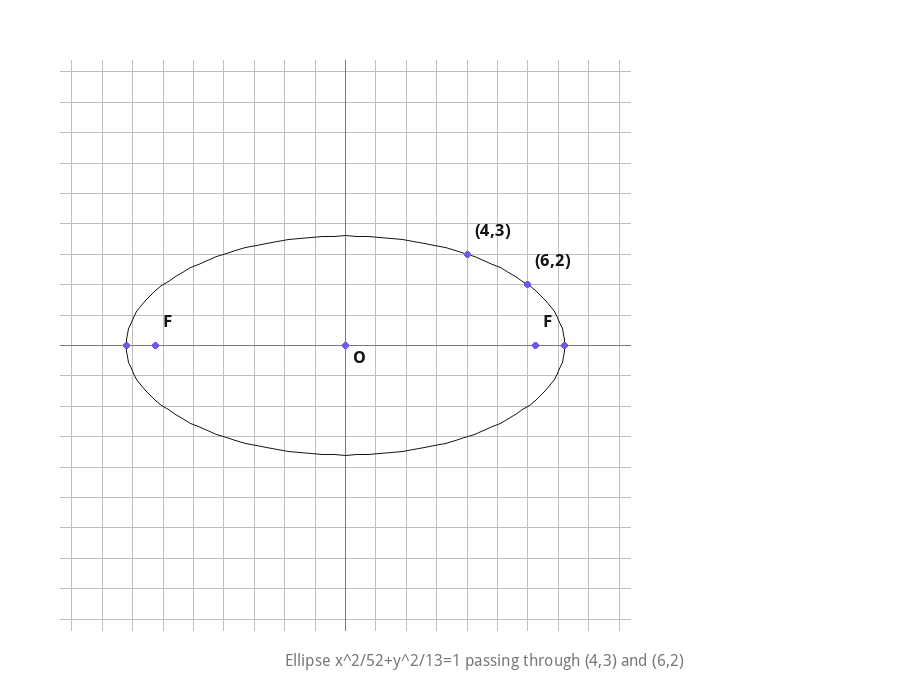
Q20. Major axis on the x-axis and passes through the points (4, 3) and (6, 2) — Let the equation be x²/a² + y²/b² = 1. Passing through (4,3): 16/a² + 9/b² = 1…
Let the equation be x²/a² + y²/b² = 1.
Passing through (4,3): 16/a² + 9/b² = 1
Passing through (6,2): 36/a² + 4/b² = 1
Let u = 1/a², v = 1/b². Then 16u + 9v = 1 and 36u + 4v = 1.
Multiplying the first by 4 and second by 9: 64u + 36v = 4 and 324u + 36v = 9.
Subtracting: 260u = 5 ⇒ u = 1/52 ⇒ a² = 52.
From 16u + 9v = 1: 16/52 + 9v = 1 ⇒ 9v = 9/13 ⇒ v = 1/13 ⇒ b² = 13.
Equation: x²/52 + y²/13 = 1.
Exercise 10.4
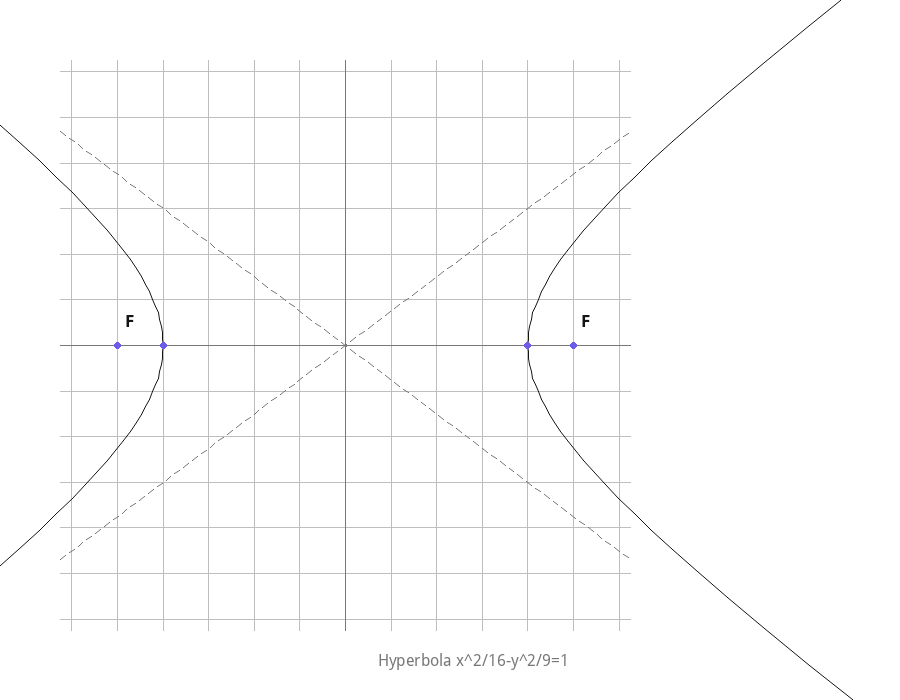
Q1. x²/16 − y²/9 = 1 — find the coordinates of the foci and the vertices, the eccentricity and the length of the latus rectum of the hyperbola — a² = 16, b² = 9. c² = a² + b² = 16 + 9 = 25 ⇒ c = 5. Foci = (±5, 0); Vertices =…
a² = 16, b² = 9. c² = a² + b² = 16 + 9 = 25 ⇒ c = 5.
Foci = (±5, 0); Vertices = (±4, 0); Eccentricity e = c/a = 5/4; Length of latus rectum = 2b²/a = 9/2.
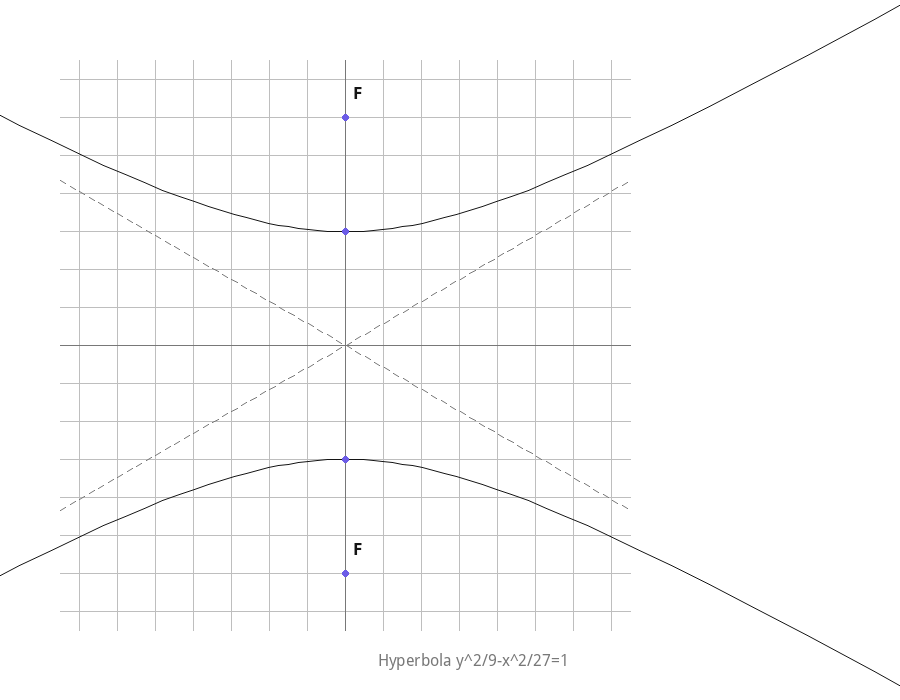
Q2. y²/9 − x²/27 = 1 — a² = 9, b² = 27. c² = 9 + 27 = 36 ⇒ c = 6. Foci = (0, ±6); Vertices = (0, ±3);…
a² = 9, b² = 27. c² = 9 + 27 = 36 ⇒ c = 6.
Foci = (0, ±6); Vertices = (0, ±3); Eccentricity e = c/a = 2; Length of latus rectum = 2b²/a = 18.
Q3. 9y² − 4x² = 36 — Dividing by 36: y²/4 − x²/9 = 1. a² = 4, b² = 9. c² = 4 + 9 = 13 ⇒ c = √13.…
Dividing by 36: y²/4 − x²/9 = 1.
a² = 4, b² = 9. c² = 4 + 9 = 13 ⇒ c = √13.
Foci = (0, ±√13); Vertices = (0, ±2); Eccentricity e = √13/2; Length of latus rectum = 2b²/a = 9.
Q4. 16x² − 9y² = 576 — Dividing by 576: x²/36 − y²/64 = 1. a² = 36, b² = 64. c² = 36 + 64 = 100 ⇒ c =…
Dividing by 576: x²/36 − y²/64 = 1.
a² = 36, b² = 64. c² = 36 + 64 = 100 ⇒ c = 10.
Foci = (±10, 0); Vertices = (±6, 0); Eccentricity e = 10/6 = 5/3; Length of latus rectum = 2b²/a = 64/3.
Q5. 5y² − 9x² = 36 — Dividing by 36: y²/(36/5) − x²/4 = 1. a² = 36/5, b² = 4. c² = 36/5 + 4 = 56/5.…
Dividing by 36: y²/(36/5) − x²/4 = 1.
a² = 36/5, b² = 4. c² = 36/5 + 4 = 56/5.
Foci = (0, ±√(56/5)); Vertices = (0, ±6/√5); Eccentricity e = √14/3; Length of latus rectum = 2b²/a = 4√5/3.
Q6. 49y² − 16x² = 784 — Dividing by 784: y²/16 − x²/49 = 1. a² = 16, b² = 49. c² = 16 + 49 = 65 ⇒ c =…
Dividing by 784: y²/16 − x²/49 = 1.
a² = 16, b² = 49. c² = 16 + 49 = 65 ⇒ c = √65.
Foci = (0, ±√65); Vertices = (0, ±4); Eccentricity e = √65/4; Length of latus rectum = 2b²/a = 49/2.
Q7. Find the equation of the hyperbola satisfying: Vertices (±2,0), foci (±3,0) — a = 2, c = 3. b² = c² − a² = 9 − 4 = 5. Equation: x²/4 − y²/5 = 1.
a = 2, c = 3. b² = c² − a² = 9 − 4 = 5.
Equation: x²/4 − y²/5 = 1.
Q8. Vertices (0, ±5), foci (0, ±8) — a = 5, c = 8. b² = 64 − 25 = 39. Equation: y²/25 − x²/39 = 1.
a = 5, c = 8. b² = 64 − 25 = 39.
Equation: y²/25 − x²/39 = 1.
Q9. Vertices (0, ±3), foci (0, ±5) — a = 3, c = 5. b² = 25 − 9 = 16. Equation: y²/9 − x²/16 = 1.
a = 3, c = 5. b² = 25 − 9 = 16.
Equation: y²/9 − x²/16 = 1.
Q10. Foci (±5, 0), the transverse axis is of length 8 — 2a = 8 ⇒ a = 4; c = 5. b² = 25 − 16 = 9. Equation: x²/16 − y²/9 = 1.
2a = 8 ⇒ a = 4; c = 5. b² = 25 − 16 = 9.
Equation: x²/16 − y²/9 = 1.
Q11. Foci (0, ±13), the conjugate axis is of length 24 — 2b = 24 ⇒ b = 12; c = 13. a² = c² − b² = 169 − 144 = 25. Equation: y²/25 −…
2b = 24 ⇒ b = 12; c = 13. a² = c² − b² = 169 − 144 = 25.
Equation: y²/25 − x²/144 = 1.
Q12. Foci (±3√5, 0), the latus rectum is of length 8 — c² = 45. Latus rectum = 2b²/a = 8 ⇒ b² = 4a. Since c² = a² + b²: a² + 4a = 45…
c² = 45. Latus rectum = 2b²/a = 8 ⇒ b² = 4a.
Since c² = a² + b²: a² + 4a = 45 ⇒ a² + 4a − 45 = 0 ⇒ (a − 5)(a + 9) = 0 ⇒ a = 5 (taking the positive value).
b² = 4(5) = 20.
Equation: x²/25 − y²/20 = 1.
Q13. Foci (±4, 0), the latus rectum is of length 12 — c² = 16. Latus rectum = 2b²/a = 12 ⇒ b² = 6a. a² + 6a = 16 ⇒ a² + 6a − 16 = 0…
c² = 16. Latus rectum = 2b²/a = 12 ⇒ b² = 6a.
a² + 6a = 16 ⇒ a² + 6a − 16 = 0 ⇒ (a − 2)(a + 8) = 0 ⇒ a = 2.
b² = 6(2) = 12.
Equation: x²/4 − y²/12 = 1.
Q14. Vertices (±7,0), e = 4/3 — a = 7, e = 4/3 ⇒ c = ae = 28/3. b² = c² − a² = (28/3)² − 49 = 784/9 − 441/9…
a = 7, e = 4/3 ⇒ c = ae = 28/3.
b² = c² − a² = (28/3)² − 49 = 784/9 − 441/9 = 343/9.
Equation: x²/49 − y²/(343/9) = 1, i.e., x²/49 − 9y²/343 = 1.
Q15. Foci (0, ±√10), passing through (2,3) — Let the equation be y²/a² − x²/b² = 1, with c² = a² + b² = 10, so b² = 10 −…
Let the equation be y²/a² − x²/b² = 1, with c² = a² + b² = 10, so b² = 10 − a².
Since the hyperbola passes through (2,3): 9/a² − 4/(10 − a²) = 1.
Let A = a². Then 9(10 − A) − 4A = A(10 − A) ⇒ 90 − 13A = 10A − A² ⇒ A² − 23A + 90 = 0.
Solving: A = (23 ± √(529 − 360))/2 = (23 ± 13)/2 ⇒ A = 18 or A = 5.
Since b² = 10 − A must be positive, A = 18 is rejected; A = 5, so b² = 10 − 5 = 5.
Equation: y²/5 − x²/5 = 1.
Miscellaneous Exercise
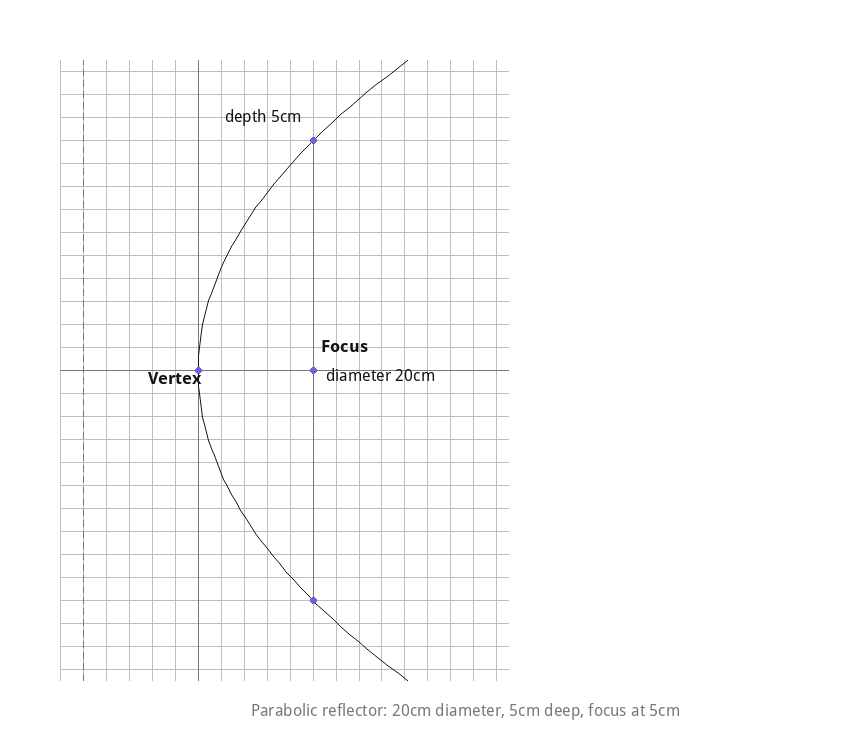
Q1. If a parabolic reflector is 20 cm in diameter and 5 cm deep, find the focus — Set the vertex at the origin with the axis of the parabola along the positive x-axis:…
Set the vertex at the origin with the axis of the parabola along the positive x-axis: y² = 4ax.
Since the reflector is 20 cm in diameter, the point on the rim has y = 10 (half of the diameter) when x = 5 (the depth).
10² = 4a(5) ⇒ 100 = 20a ⇒ a = 5.
The focus is at a distance of 5 cm from the vertex.
Q2. An arch is in the form of a parabola with its axis vertical. The arch is 10 m high and 5 m wide at the base. How wide is it 2 m from the vertex of the parabola? — Take the vertex at the origin with the parabola opening downward: x² = −4ay. At the…
Take the vertex at the origin with the parabola opening downward: x² = −4ay.
At the base (10 m below the vertex), the width is 5 m, so x = 2.5 when y = −10.
(2.5)² = −4a(−10) ⇒ 6.25 = 40a ⇒ a = 0.15625, so 4a = 0.625.
At 2 m from the vertex, y = −2: x² = 4a(2) = 0.625 × 2 = 1.25 ⇒ x = √1.25 = √5/2.
Width = 2x = √5 ≈ 2.24 m.
The width 2 m from the vertex is √5 m ≈ 2.24 m.
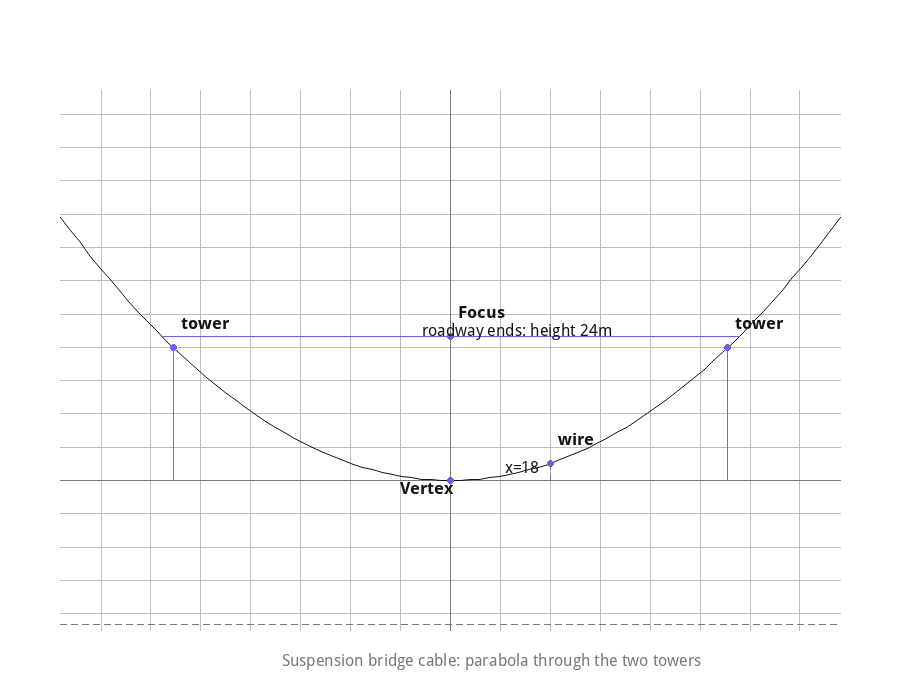
Q3. The cable of a uniformly loaded suspension bridge hangs in the form of a parabola. The roadway which is horizontal and 100 m long is supported by vertical wires attached to the cable, the longest wire being 30 m and the shortest being 6 m. Find the length of a supporting wire attached to the roadway 18 m from the middle — Take the origin at the lowest point of the cable, with the parabola x² = 4ay. At the…
Take the origin at the lowest point of the cable, with the parabola x² = 4ay.
At the towers (x = 50, the ends of the 100 m roadway), the height above the lowest point is 30 − 6 = 24 m.
(50)² = 4a(24) ⇒ 2500 = 96a ⇒ 4a = 2500/24 = 625/6.
At x = 18 m from the middle: y = x²/4a = 324 ÷ (625/6) = 324 × 6/625 = 1944/625 = 3.1104 m.
Length of the wire = shortest wire + y = 6 + 3.1104 = 9.1104 m.
The length of the supporting wire 18 m from the middle is 9.1104 m (≈ 9.11 m).
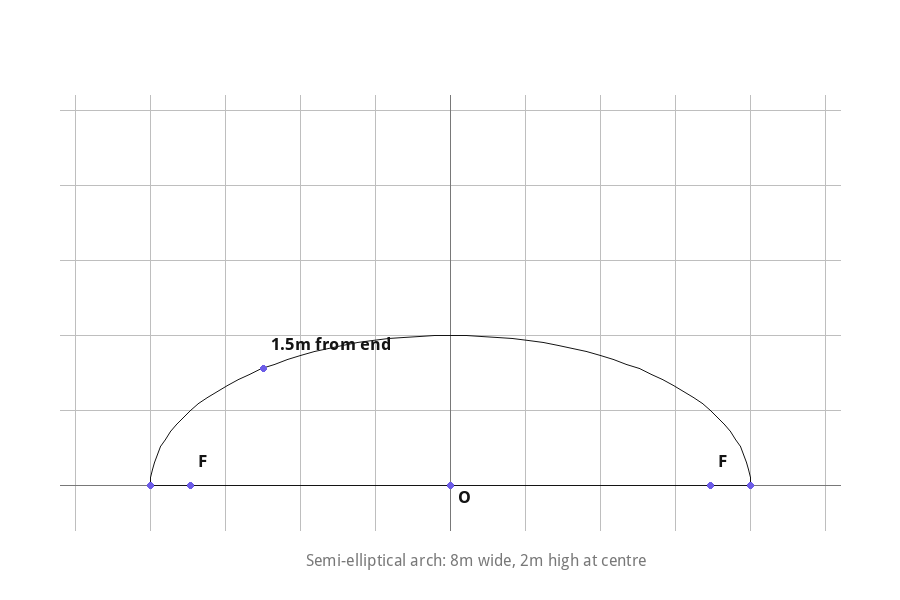
Q4. An arch is in the form of a semi-ellipse. It is 8 m wide and 2 m high at the centre. Find the height of the arch at a point 1.5 m from one end — Since the arch is 8 m wide, semi-major axis a = 4; since it is 2 m high at the centre,…
Since the arch is 8 m wide, semi-major axis a = 4; since it is 2 m high at the centre, semi-minor axis b = 2.
Equation: x²/16 + y²/4 = 1.
A point 1.5 m from one end (taking the end at x = −4) is at x = −4 + 1.5 = −2.5, so |x| = 2.5.
y² = 4(1 − x²/16) = 4 − x²/4 = 4 − 6.25/4 = 4 − 1.5625 = 2.4375 = 39/16.
y = √39/4 ≈ 1.56 m.
The height of the arch at that point is √39/4 m ≈ 1.56 m.
Q5. A rod of length 12 cm moves with its ends always touching the coordinate axes. Determine the equation of the locus of a point P on the rod, which is 3 cm from the end in contact with the x-axis — Let the rod AB have A = (a, 0) on the x-axis and B = (0, b) on the y-axis, with AB = 12,…
Let the rod AB have A = (a, 0) on the x-axis and B = (0, b) on the y-axis, with AB = 12, so a² + b² = 144.
P is 3 cm from A, so AP = 3 and PB = 9, i.e., P divides AB in the ratio AP : PB = 1 : 3 from A.
Using the section formula: x = (1·0 + 3·a)/4 = 3a/4 ⇒ a = 4x/3
y = (1·b + 3·0)/4 = b/4 ⇒ b = 4y
Substituting into a² + b² = 144: (4x/3)² + (4y)² = 144 ⇒ 16x²/9 + 16y² = 144.
Dividing by 16: x²/9 + y² = 9, i.e., x²/81 + y²/9 = 1 (an ellipse).
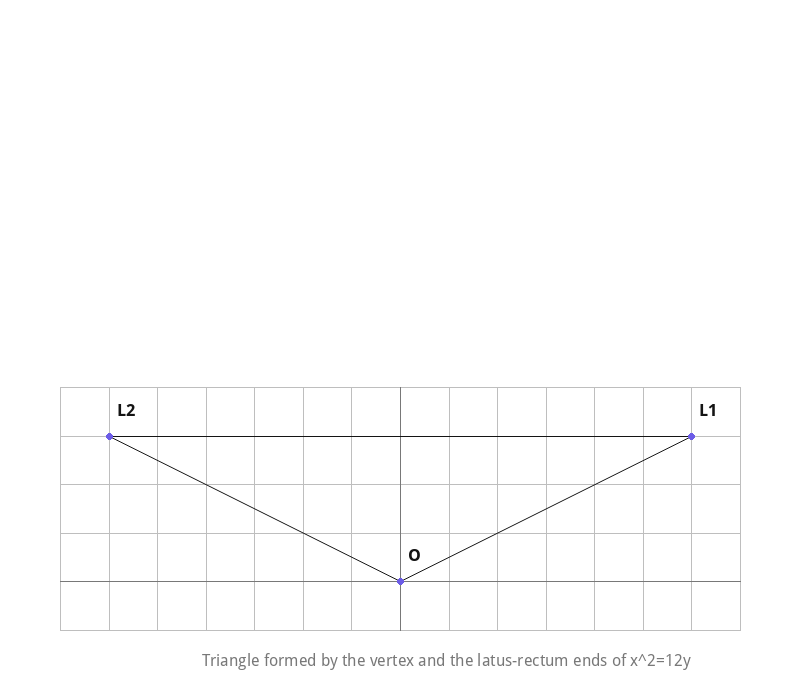
Q6. Find the area of the triangle formed by the lines joining the vertex of the parabola x² = 12y to the ends of its latus rectum — Comparing x² = 12y with x² = 4ay: 4a = 12 ⇒ a = 3. The ends of the latus rectum are…
Comparing x² = 12y with x² = 4ay: 4a = 12 ⇒ a = 3.
The ends of the latus rectum are (2a, a) and (−2a, a), i.e., (6, 3) and (−6, 3). The vertex is (0, 0).
Area = 1/2 × base × height = 1/2 × (length of latus rectum) × (distance from vertex to the latus rectum)
= 1/2 × 12 × 3 = 18.
The area of the triangle is 18 square units.
Q7. A man running a racecourse notes that the sum of the distances from the two flag posts from him is always 10 m and the distance between the flag posts is 8 m. Find the equation of the posts traced by the man — The path traced is an ellipse with the flag posts as foci. Sum of distances = 2a = 10…
The path traced is an ellipse with the flag posts as foci.
Sum of distances = 2a = 10 ⇒ a = 5.
Distance between foci = 2c = 8 ⇒ c = 4.
b² = a² − c² = 25 − 16 = 9.
Equation: x²/25 + y²/9 = 1.
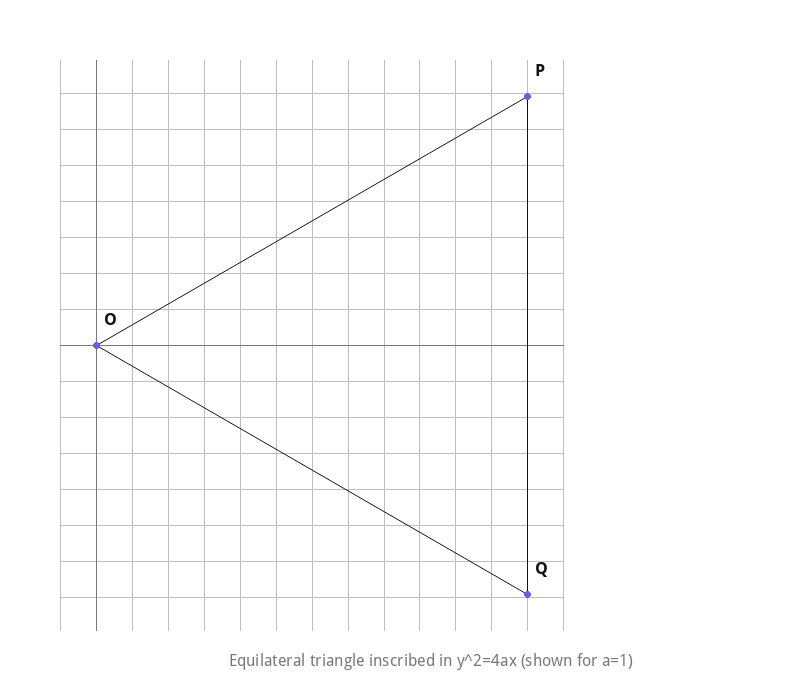
Q8. An equilateral triangle is inscribed in the parabola y² = 4ax, where one vertex is at the vertex of the parabola. Find the length of the side of the triangle — Let O = (0,0) be the vertex, and let the other two vertices be symmetric about the…
Let O = (0,0) be the vertex, and let the other two vertices be symmetric about the x-axis: P(x₁, y₁) and Q(x₁, −y₁), both on the parabola so y₁² = 4ax₁.
Since the triangle is equilateral, OP makes an angle of 30° with the x-axis: y₁/x₁ = tan 30° = 1/√3, so x₁ = y₁√3.
Substituting into y₁² = 4ax₁: y₁² = 4a(y₁√3) ⇒ y₁ = 4√3 a.
Then x₁ = y₁√3 = 4√3a × √3 = 12a.
Side length = OP = √(x₁² + y₁²) = √((12a)² + (4√3a)²) = √(144a² + 48a²) = √(192a²) = 8√3 a.
The length of the side of the triangle is 8√3 a units.
Class 11 Maths Chapter 10 – Notes and Extra Questions
- Circle: The equation of a circle with centre (h, k) and radius r is (x − h)² + (y − k)² = r². A circle centred at the origin has equation x² + y² = r².
- General equation of a circle: x² + y² + 2gx + 2fy + c = 0 has centre (−g, −f) and radius √(g² + f² − c).
- Parabola (four standard forms): y² = 4ax (opens right), y² = −4ax (opens left), x² = 4ay (opens up), x² = −4ay (opens down). In each case the vertex is at the origin and a is the distance from the vertex to the focus.
- Latus rectum of a parabola: A line segment through the focus, perpendicular to the axis, with both endpoints on the parabola; its length is 4a.
- Ellipse: Standard equation x²/a² + y²/b² = 1. If a > b, the major axis is along the x-axis with foci (±c, 0), where c² = a² − b². If b > a, the major axis is along the y-axis.
- Eccentricity of an ellipse: e = c/a, always between 0 and 1. Length of latus rectum = 2b²/a.
- Hyperbola: Standard equation x²/a² − y²/b² = 1 (transverse axis along x-axis) or y²/a² − x²/b² = 1 (transverse axis along y-axis), with c² = a² + b² and foci (±c, 0) or (0, ±c) respectively.
- Eccentricity of a hyperbola: e = c/a, always greater than 1. Length of latus rectum = 2b²/a.
- Degenerate conics: When the intersecting plane passes through the vertex of the cone, the resulting section may be a point, a straight line, or a pair of intersecting straight lines, depending on the angle of intersection.
- Chapter 1: Sets (2026-27)
- Chapter 2: Relations and Functions – Free PDF Download
- Chapter 3: Trigonometric Functions – Free PDF Download
- Chapter 4: Complex Numbers and Quadratic Equations – Free PDF Download
- Chapter 5: Linear Inequalities – Free PDF Download
- Chapter 6: Permutations and Combinations – Free PDF Download
- Chapter 7: Binomial Theorem – Free PDF Download
- Chapter 8: Sequences and Series – Free PDF Download
- Chapter 9: Straight Lines – Free PDF Download
- Chapter 11: Introduction to Three Dimensional Geometry – Free PDF Download
- Chapter 12: Limits and Derivatives – Free PDF Download
- Chapter 13: Statistics – Free PDF Download
- Chapter 14: Probability – Free PDF Download
Frequently Asked Questions
How many exercises are there in Class 11 Maths Chapter 10, Conic Sections?
The current NCERT textbook (2026-27 edition) has four exercises in this chapter — Exercise 10.1 (Circle), Exercise 10.2 (Parabola), Exercise 10.3 (Ellipse), and Exercise 10.4 (Hyperbola) — followed by a Miscellaneous Exercise that combines concepts from all four sections.
What are the four types of conic sections covered in this chapter?
The chapter covers the circle, the parabola, the ellipse, and the hyperbola — all obtained by intersecting a plane with a double-napped right circular cone at different angles.
What is the difference between the eccentricity of an ellipse and a hyperbola?
For an ellipse, the eccentricity e = c/a is always less than 1 (0 < e < 1), since c < a. For a hyperbola, the eccentricity is always greater than 1 (e > 1), since c > a. A parabola has eccentricity exactly equal to 1.
How do you find the length of the latus rectum of a parabola, ellipse, or hyperbola?
For a parabola y² = 4ax, the length of the latus rectum is 4a. For an ellipse x²/a² + y²/b² = 1 and for a hyperbola x²/a² − y²/b² = 1, the length of the latus rectum is 2b²/a in both cases.
Recommended: Buy the Printed NCERT Class 11 Maths Book
Contains Amazon affiliate links.
If you’d like a printed copy alongside the PDF, here’s a verified option:
4.2 out of 5 stars (953 ratings) · Rs. 170
Price and availability may change on Amazon. As an Amazon Associate, ncertbooks.org earns from qualifying purchases.



Pingback: Class 11 Maths Chapter 10 Conic Sections Extra Questions (2026-27)