
Class 11 Maths Chapter 2, Relations and Functions, builds the language that the rest of the Maths syllabus – and much of Class 12 Calculus – is written in: ordered pairs, the Cartesian product of sets, relations between two sets, and functions as a special type of relation with a unique image for every input. Below you will find complete, step-by-step NCERT solutions for every exercise of this chapter – Exercise 2.1, Exercise 2.2, Exercise 2.3, and the Miscellaneous Exercise – exactly as they appear in the current rationalised (2023) NCERT textbook used for the 2026-27 session.
Last Updated: September 23, 2026
How to Approach This Chapter
n
Start by getting completely comfortable distinguishing relations from functions using the vertical-line-style reasoning (one input, one output) before attempting domain/range questions — most solution errors in this chapter trace back to a shaky grip on this distinction. Work through the standard real functions systematically, sketching each one, since visualizing the graph makes domain and range questions far faster to solve than working them out algebraically every time.
n
Exercise 2.1
Q1. If (x/3 + 1, y − 2/3) = (5/3, 1/3), find the values of x and y — Two ordered pairs are equal only when their corresponding first elements are equal and…
Two ordered pairs are equal only when their corresponding first elements are equal and their corresponding second elements are equal. So we equate the first components and the second components separately.
First components: x/3 + 1 = 5/3. Subtracting 1 from both sides, x/3 = 5/3 − 1 = 5/3 − 3/3 = 2/3. Multiplying both sides by 3, x = 2.
Second components: y − 2/3 = 1/3. Adding 2/3 to both sides, y = 1/3 + 2/3 = 3/3 = 1.
Answer: x = 2 and y = 1.
Q2. If set A has 3 elements and set B = {3, 4, 5}, then find the number of elements in (A × B) — For any two finite sets P and Q, the number of elements in their Cartesian product is…
For any two finite sets P and Q, the number of elements in their Cartesian product is n(P × Q) = n(P) × n(Q), because every element of P can be paired with every element of Q exactly once.
Here n(A) = 3 and n(B) = 3 (since B = {3, 4, 5} has 3 elements). So n(A × B) = 3 × 3 = 9.
Answer: A × B has 9 elements.
Q3. If G = {7, 8} and H = {5, 4, 2}, find G × H and H × G — By definition, P × Q = {(p, q) : p ∈ P, q ∈ Q}. To form G × H, pair every element…
By definition, P × Q = {(p, q) : p ∈ P, q ∈ Q}. To form G × H, pair every element of G with every element of H, keeping the element of G first.
G × H = {(7, 5), (7, 4), (7, 2), (8, 5), (8, 4), (8, 2)}
To form H × G, pair every element of H with every element of G, keeping the element of H first.
H × G = {(5, 7), (5, 8), (4, 7), (4, 8), (2, 7), (2, 8)}
Note that G × H ≠ H × G, which shows the Cartesian product is not commutative.
Q4. State whether each of the following statements is true or false. If the statement is false, rewrite the given statement correctly.
- If P = {m, n} and Q = {n, m}, then P × Q = {(m, n), (n, m)}.
This is False. As sets, order does not matter, so P = {m, n} and Q = {n, m} are actually the same set, {m, n}. Therefore P × Q must contain every ordered pair formed by taking the first element from P and the second from Q, which includes pairing m with m and n with n as well.
Correct statement: If P = {m, n} and Q = {n, m}, then P × Q = {(m, m), (m, n), (n, m), (n, n)}. - If A and B are non-empty sets, then A × B is a non-empty set of ordered pairs (x, y) such that x ∈ A and y ∈ B.
This is True – it is exactly the definition of the Cartesian product of two non-empty sets. - If A = {1, 2}, B = {3, 4}, then A × (B ∩ ∅) = ∅.
This is True. The intersection of any set with the empty set is the empty set, so B ∩ ∅ = ∅. Then A × ∅ is also empty, because there is no element of ∅ to pair with elements of A.
Q5. If A = {−1, 1}, find A × A × A — For a set A, A × A × A is the set of all ordered triples (a, b, c) with a, b, c ∈ A.…
For a set A, A × A × A is the set of all ordered triples (a, b, c) with a, b, c ∈ A. Since A has 2 elements, A × A × A has 2³ = 8 elements. Listing every possible combination of −1 and 1 in three positions:
A × A × A = {(−1, −1, −1), (−1, −1, 1), (−1, 1, −1), (−1, 1, 1), (1, −1, −1), (1, −1, 1), (1, 1, −1), (1, 1, 1)}
Q6. If A × B = {(a, x), (a, y), (b, x), (b, y)}. Find A and B — In a Cartesian product A × B, the set A is precisely the set of all distinct first…
In a Cartesian product A × B, the set A is precisely the set of all distinct first elements appearing in the ordered pairs, and B is the set of all distinct second elements. Scanning the given set, the first elements that occur are a and b, and the second elements that occur are x and y.
Answer: A = {a, b} and B = {x, y}.
Q7. Let A = {1, 2}, B = {1, 2, 3, 4}, C = {5, 6} and D = {5, 6, 7, 8}. Verify that
- A × (B ∩ C) = (A × B) ∩ (A × C)
First find B ∩ C: B = {1, 2, 3, 4} and C = {5, 6} have no elements in common, so B ∩ C = ∅. Hence the left side, A × (B ∩ C) = A × ∅ = ∅.
Now compute the right side. A × B = {(1, 1), (1, 2), (1, 3), (1, 4), (2, 1), (2, 2), (2, 3), (2, 4)} and A × C = {(1, 5), (1, 6), (2, 5), (2, 6)}. Every pair in A × B has second element in {1, 2, 3, 4}, while every pair in A × C has second element in {5, 6} – these sets of pairs share nothing in common, so (A × B) ∩ (A × C) = ∅.
Since both sides equal ∅, LHS = RHS. Hence verified. - A × C is a subset of B × D
A × C = {(1, 5), (1, 6), (2, 5), (2, 6)}. Since A = {1, 2} ⊆ {1, 2, 3, 4} = B and C = {5, 6} ⊆ {5, 6, 7, 8} = D, every pair (a, c) with a ∈ A and c ∈ C automatically satisfies a ∈ B and c ∈ D, so it is also a member of B × D. Checking directly, all four pairs (1, 5), (1, 6), (2, 5), (2, 6) do appear among the elements of B × D.
Therefore A × C ⊆ B × D. Hence verified.
Q8. Let A = {1, 2} and B = {3, 4}. Write A × B. How many subsets will A × B have? List them — A × B = {(1, 3), (1, 4), (2, 3), (2, 4)}, so n(A × B) = 4.
A × B = {(1, 3), (1, 4), (2, 3), (2, 4)}, so n(A × B) = 4.
A set with n elements has 2n subsets (this follows because each element can independently be included or excluded from a subset). With n = 4, the number of subsets of A × B is 2⁴ = 16.
The 16 subsets are: ∅, {(1, 3)}, {(1, 4)}, {(2, 3)}, {(2, 4)}, {(1, 3), (1, 4)}, {(1, 3), (2, 3)}, {(1, 3), (2, 4)}, {(1, 4), (2, 3)}, {(1, 4), (2, 4)}, {(2, 3), (2, 4)}, {(1, 3), (1, 4), (2, 3)}, {(1, 3), (1, 4), (2, 4)}, {(1, 3), (2, 3), (2, 4)}, {(1, 4), (2, 3), (2, 4)}, and {(1, 3), (1, 4), (2, 3), (2, 4)}.
Q9. Let A and B be two sets such that n(A) = 3 and n(B) = 2. If (x, 1), (y, 2), (z, 1) are in A × B, find A and B, where x, y and z are distinct elements — Since (x, 1), (y, 2), (z, 1) ∈ A × B, the first elements x, y, z must all belong to…
Since (x, 1), (y, 2), (z, 1) ∈ A × B, the first elements x, y, z must all belong to A, and the second elements 1 and 2 must belong to B. As x, y and z are distinct and n(A) = 3, these three elements are precisely all of A. Since only the values 1 and 2 appear as second components and n(B) = 2, these are precisely all of B.
Answer: A = {x, y, z} and B = {1, 2}.
Q10. The Cartesian product A × A has 9 elements, among which are found (−1, 0) and (0, 1). Find the set A and the remaining elements of A × A — For any finite set A, n(A × A) = [n(A)]². We are told n(A × A) = 9, so [n(A)]² = 9,…
For any finite set A, n(A × A) = [n(A)]². We are told n(A × A) = 9, so [n(A)]² = 9, giving n(A) = 3.
Every element of A × A is of the form (a, a′) where a and a′ both come from A. Since (−1, 0) ∈ A × A, both −1 and 0 must belong to A; since (0, 1) ∈ A × A, both 0 and 1 must belong to A. So A contains at least {−1, 0, 1}, which already has 3 elements – and since n(A) = 3, this must be exactly A.
A = {−1, 0, 1}.
All 9 elements of A × A are: (−1, −1), (−1, 0), (−1, 1), (0, −1), (0, 0), (0, 1), (1, −1), (1, 0), (1, 1). Removing the two given pairs, (−1, 0) and (0, 1), the remaining 7 elements are:
(−1, −1), (−1, 1), (0, −1), (0, 0), (1, −1), (1, 0), (1, 1)
Exercise 2.2
Q1. Let A = {1, 2, 3, …, 14}. Define a relation R from A to A by R = {(x, y): 3x − y = 0, where x, y ∈ A}. Write down its domain, codomain and range — The condition 3x − y = 0 means y = 3x. Substitute each value of x from A and keep only…
The condition 3x − y = 0 means y = 3x. Substitute each value of x from A and keep only those pairs where y also lies in A (that is, y ≤ 14):
x = 1 → y = 3; x = 2 → y = 6; x = 3 → y = 9; x = 4 → y = 12; x = 5 → y = 15, which is not in A, so we stop here.
R = {(1, 3), (2, 6), (3, 9), (4, 12)}
Domain (set of all first elements) = {1, 2, 3, 4}. Codomain is the whole set A = {1, 2, 3, …, 14}. Range (set of all second elements actually appearing) = {3, 6, 9, 12}.
Q2. Define a relation R on the set N of natural numbers by R = {(x, y): y = x + 5, x is a natural number less than 4; x, y ∈ N}. Depict this relationship using roster form. Write down the domain and the range — The natural numbers less than 4 are 1, 2, and 3. Substituting each into y = x + 5:
The natural numbers less than 4 are 1, 2, and 3. Substituting each into y = x + 5:
x = 1 → y = 6; x = 2 → y = 7; x = 3 → y = 8.
R = {(1, 6), (2, 7), (3, 8)}. Domain = {1, 2, 3}. Range = {6, 7, 8}.
Q3. A = {1, 2, 3, 5} and B = {4, 6, 9}. Define a relation R from A to B by R = {(x, y): the difference between x and y is odd; x ∈ A, y ∈ B}. Write R in roster form — Check every pair (x, y) with x ∈ A, y ∈ B and test whether |x − y| is odd:
Check every pair (x, y) with x ∈ A, y ∈ B and test whether |x − y| is odd:
x = 1: |1−4| = 3 (odd, keep); |1−6| = 5 (odd, keep); |1−9| = 8 (even, reject).
x = 2: |2−4| = 2 (even, reject); |2−6| = 4 (even, reject); |2−9| = 7 (odd, keep).
x = 3: |3−4| = 1 (odd, keep); |3−6| = 3 (odd, keep); |3−9| = 6 (even, reject).
x = 5: |5−4| = 1 (odd, keep); |5−6| = 1 (odd, keep); |5−9| = 4 (even, reject).
R = {(1, 4), (1, 6), (2, 9), (3, 4), (3, 6), (5, 4), (5, 6)}
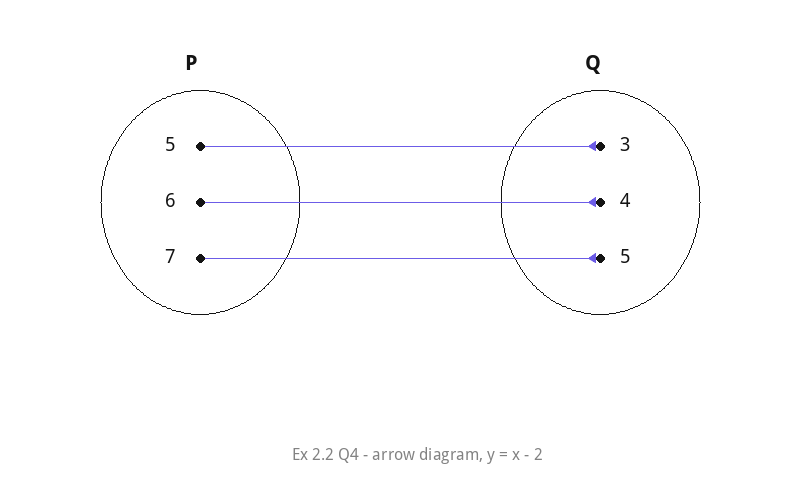
Q4. The figure shows a relationship between the sets P and Q. Write this relation (i) in set-builder form (ii) in roster form. What are their domain and range? — The arrow diagram in the textbook shows P = {5, 6, 7} and Q = {3, 4, 5}, with each…
The arrow diagram in the textbook shows P = {5, 6, 7} and Q = {3, 4, 5}, with each element of P linked to the element of Q that is exactly 2 less than it: 5 → 3, 6 → 4, and 7 → 5.
- Set-builder form: R = {(x, y): y = x − 2, x ∈ P}, i.e. R = {(x, y): y = x − 2 for x = 5, 6, 7}.
- Roster form: R = {(5, 3), (6, 4), (7, 5)}.
Domain of R = {5, 6, 7}. Range of R = {3, 4, 5}.
Q5. Let A = {1, 2, 3, 4, 6}. Let R be the relation on A defined by {(a, b): a, b ∈ A, b is exactly divisible by a}.
- Write R in roster form.
For each a in A, find every b in A that a divides exactly:
a = 1 divides 1, 2, 3, 4, 6; a = 2 divides 2, 4, 6; a = 3 divides 3, 6; a = 4 divides 4; a = 6 divides 6.
R = {(1, 1), (1, 2), (1, 3), (1, 4), (1, 6), (2, 2), (2, 4), (2, 6), (3, 3), (3, 6), (4, 4), (6, 6)} - Find the domain of R.
Every element of A appears as a first element at least once, so Domain of R = {1, 2, 3, 4, 6}. - Find the range of R.
Every element of A also appears as a second element at least once, so Range of R = {1, 2, 3, 4, 6}.
Q6. Determine the domain and range of the relation R defined by R = {(x, x + 5): x ∈ {0, 1, 2, 3, 4, 5}} — Substitute each x into x + 5: 0 → 5, 1 → 6, 2 → 7, 3 → 8, 4 → 9, 5 → 10.
Substitute each x into x + 5: 0 → 5, 1 → 6, 2 → 7, 3 → 8, 4 → 9, 5 → 10.
R = {(0, 5), (1, 6), (2, 7), (3, 8), (4, 9), (5, 10)}. Domain of R = {0, 1, 2, 3, 4, 5}. Range of R = {5, 6, 7, 8, 9, 10}.
Q7. Write the relation R = {(x, x³): x is a prime number less than 10} in roster form — The prime numbers less than 10 are 2, 3, 5, and 7. Cubing each: 2³ = 8, 3³ = 27, 5³ =…
The prime numbers less than 10 are 2, 3, 5, and 7. Cubing each: 2³ = 8, 3³ = 27, 5³ = 125, 7³ = 343.
R = {(2, 8), (3, 27), (5, 125), (7, 343)}
Q8. Let A = {x, y, z} and B = {1, 2}. Find the number of relations from A to B — A relation from A to B is any subset of A × B. First, n(A × B) = n(A) × n(B) = 3 × 2…
A relation from A to B is any subset of A × B. First, n(A × B) = n(A) × n(B) = 3 × 2 = 6. A set with 6 elements has 2⁶ possible subsets, so the number of possible relations from A to B is 2⁶ = 64.
Q9. Let R be the relation on Z defined by R = {(a, b): a, b ∈ Z, a − b is an integer}. Find the domain and range of R — Since a and b are both already integers, their difference a − b is automatically…
Since a and b are both already integers, their difference a − b is automatically always an integer, no matter what values a and b take. So the condition is satisfied for every pair of integers, and R is simply all of Z × Z.
Domain of R = Z. Range of R = Z.
Exercise 2.3
Q1. Which of the following relations are functions? Give reasons. If it is a function, determine its domain and range.
- {(2, 1), (5, 1), (8, 1), (11, 1), (14, 1), (17, 1)}
Every first element (2, 5, 8, 11, 14, 17) is distinct and has exactly one image, so this relation is a function (having the same image, 1, for different inputs is allowed – a function only forbids one input having two different outputs).
Domain = {2, 5, 8, 11, 14, 17}, Range = {1}. - {(2, 1), (4, 2), (6, 3), (8, 4), (10, 5), (12, 6), (14, 7)}
Every first element is distinct, so this relation is a function.
Domain = {2, 4, 6, 8, 10, 12, 14}, Range = {1, 2, 3, 4, 5, 6, 7}. - {(1, 3), (1, 5), (2, 5)}
Here the same first element, 1, is paired with two different second elements, 3 and 5. This violates the definition of a function, so this relation is not a function.
Q2. Find the domain and range of the following real functions.
- f(x) = −|x|
The modulus |x| is defined for every real number, so the domain of f is R. Since |x| ≥ 0 for all x, we have −|x| ≤ 0, so f(x) can never be positive but can take any value from 0 downward.
Range = (−∞, 0] - f(x) = √(9 − x²)
For the square root to be a real number, we need 9 − x² ≥ 0, i.e. x² ≤ 9, i.e. −3 ≤ x ≤ 3. So Domain = [−3, 3].
As x ranges over [−3, 3], 9 − x² ranges from 0 (at x = ±3) up to 9 (at x = 0), so √(9 − x²) ranges from 0 up to 3.
Range = [0, 3]
Q3. A function f is defined by f(x) = 2x − 5. Write down the values of (i) f(0), (ii) f(7), (iii) f(−3) — Substitute each value of x directly into 2x − 5:
Substitute each value of x directly into 2x − 5:
(i) f(0) = 2(0) − 5 = −5
(ii) f(7) = 2(7) − 5 = 14 − 5 = 9
(iii) f(−3) = 2(−3) − 5 = −6 − 5 = −11
Q4. The function t, which maps temperature in degree Celsius into temperature in degree Fahrenheit, is defined by t(C) = 9C/5 + 32. Find (i) t(0) (ii) t(28) (iii) t(−10) (iv) the value of C, when t(C) = 212 — Substitute each value of C into t(C) = 9C/5 + 32:
Substitute each value of C into t(C) = 9C/5 + 32:
(i) t(0) = 9(0)/5 + 32 = 0 + 32 = 32
(ii) t(28) = 9(28)/5 + 32 = 252/5 + 32 = 50.4 + 32 = 82.4
(iii) t(−10) = 9(−10)/5 + 32 = −18 + 32 = 14
(iv) To find C when t(C) = 212, substitute and solve: 212 = 9C/5 + 32. Subtract 32 from both sides: 180 = 9C/5. Multiply both sides by 5: 900 = 9C. Divide by 9: C = 100.
Q5. Find the range of each of the following functions.
- f(x) = 2 − 3x, x ∈ R, x > 0
Since x > 0, multiplying by −3 (which reverses the inequality) gives −3x < 0. Adding 2 to both sides: 2 − 3x < 2. So f(x) can be any value less than 2, but never equal to or greater than 2.
Range = (−∞, 2) - f(x) = x² + 2, x is a real number
For every real x, x² ≥ 0, so adding 2 to both sides gives x² + 2 ≥ 2. As x ranges over all reals, x² takes every value in [0, ∞), so x² + 2 takes every value in [2, ∞).
Range = [2, ∞) - f(x) = x, x is a real number
This is the identity function; as x ranges over all real numbers, f(x) does too.
Range = R
Miscellaneous Exercise
Q1. The relation f is defined by f(x) = x² for 0 ≤ x < 3, and f(x) = 3x for 3 ≤ x ≤ 10. The relation g is defined by g(x) = x² for 0 ≤ x ≤ 2, and g(x) = 3x for 2 ≤ x ≤ 10. Show that f is a function and g is not a function.
For f: The only place the two pieces could possibly clash is at the shared boundary point, x = 3 (the first rule covers x up to but not including 3, and the second rule covers x from 3 onward). At x = 3, the second rule gives f(3) = 3 × 3 = 9. Since the first rule does not apply at x = 3 itself (it only applies for x < 3), there is no conflicting value there – and in fact even the boundary values agree, since 3² = 9 = 3(3) as well. So every x in [0, 10] gets exactly one image under f. Hence f is a function.
For g: Here both pieces are defined to include the shared boundary point x = 2 (0 ≤ x ≤ 2 for the first rule, and 2 ≤ x ≤ 10 for the second). At x = 2, the first rule gives g(2) = 2² = 4, while the second rule gives g(2) = 3 × 2 = 6. The single input x = 2 is thus assigned two different images, 4 and 6, which is not allowed for a function. Hence g is not a function.
Q2. If f(x) = x², find [f(1.1) − f(1)] / (1.1 − 1) — Compute each piece: f(1.1) = (1.1)² = 1.21, and f(1) = (1)² = 1. So the numerator is…
Compute each piece: f(1.1) = (1.1)² = 1.21, and f(1) = (1)² = 1. So the numerator is f(1.1) − f(1) = 1.21 − 1 = 0.21, and the denominator is 1.1 − 1 = 0.1.
[f(1.1) − f(1)] / (1.1 − 1) = 0.21 / 0.1 = 2.1
Q3. Find the domain of the function f(x) = (x² + 2x + 1) / (x² − 8x + 12) — A rational function is undefined wherever its denominator equals zero, so we factorise…
A rational function is undefined wherever its denominator equals zero, so we factorise the denominator: x² − 8x + 12 = (x − 2)(x − 6), which is zero when x = 2 or x = 6. The numerator does not affect the domain here since it does not create any further restriction.
So f is defined for every real number except x = 2 and x = 6.
Domain of f = R − {2, 6}
Q4. Find the domain and the range of the real function f defined by f(x) = √(x − 1) — The square root is a real number only when the quantity inside it is non-negative: x −…
The square root is a real number only when the quantity inside it is non-negative: x − 1 ≥ 0, i.e. x ≥ 1.
Domain of f = [1, ∞)
Since x ≥ 1 means x − 1 ≥ 0, the square root √(x − 1) is always ≥ 0, and as x increases from 1 to ∞, x − 1 (and hence its square root) increases from 0 to ∞ without bound.
Range of f = [0, ∞)
Q5. Find the domain and the range of the real function f defined by f(x) = |x − 1| — The expression |x − 1| is defined for every real number x (there is no restriction…
The expression |x − 1| is defined for every real number x (there is no restriction like a denominator or a square root here), so Domain of f = R.
As x ranges over all real numbers, x − 1 also ranges over all real numbers, and taking the absolute value of “all real numbers” produces every non-negative real number (and only non-negative values, since a modulus can never be negative).
Range of f = [0, ∞), i.e. the set of all non-negative real numbers.
Q6. Let f = {(x, x²/(1 + x²)): x ∈ R} be a function from R into R. Determine the range of f — Let y = x²/(1 + x²). Since x² ≥ 0 for every real x, the numerator is never negative…
Let y = x²/(1 + x²). Since x² ≥ 0 for every real x, the numerator is never negative and the denominator 1 + x² is always positive, so y ≥ 0 for every x.
To find the upper bound, rewrite y as y = x²/(1 + x²) = [(1 + x²) − 1]/(1 + x²) = 1 − 1/(1 + x²). Since 1 + x² ≥ 1 for all real x, the fraction 1/(1 + x²) lies in the interval (0, 1], being closest to 1 only when x = 0 and approaching 0 as x grows large. So y = 1 − 1/(1 + x²) lies in [0, 1), reaching 0 exactly when x = 0, and getting arbitrarily close to 1 (but never equal to 1) as |x| grows large.
Range of f = [0, 1)
Q7. Let f, g : R → R be defined, respectively, by f(x) = x + 1, g(x) = 2x − 3. Find f + g, f − g and f/g — By definition, operations on functions are performed pointwise: (f + g)(x) = f(x) +…
By definition, operations on functions are performed pointwise: (f + g)(x) = f(x) + g(x), and similarly for subtraction and division.
(f + g)(x) = (x + 1) + (2x − 3) = 3x − 2
(f − g)(x) = (x + 1) − (2x − 3) = x + 1 − 2x + 3 = −x + 4
(f/g)(x) = f(x)/g(x) = (x + 1)/(2x − 3), valid wherever g(x) ≠ 0, i.e. wherever 2x − 3 ≠ 0, so x ≠ 3/2.
(f/g)(x) = (x + 1)/(2x − 3), x ≠ 3/2
Q8. Let f = {(1, 1), (2, 3), (0, −1), (−1, −3)} be a function from Z to Z defined by f(x) = ax + b, for some integers a, b. Determine a, b — Since f(x) = ax + b, we can substitute any two known points to form two equations. Using…
Since f(x) = ax + b, we can substitute any two known points to form two equations. Using (0, −1): f(0) = a(0) + b = b, and since f(0) = −1, we get b = −1.
Using (1, 1): f(1) = a(1) + b = a + b, and since f(1) = 1, we get a + b = 1. Substituting b = −1: a + (−1) = 1, so a = 2.
Check with the remaining points: f(2) = 2(2) − 1 = 3 ✓ (matches (2, 3)); f(−1) = 2(−1) − 1 = −3 ✓ (matches (−1, −3)). Both check out.
Answer: a = 2, b = −1.
Q9. Let R be a relation from N to N defined by R = {(a, b): a, b ∈ N and a = b²}. Are the following true? Justify your answer in each case.
- (a, a) ∈ R, for all a ∈ N
This would require a = a² for every natural number a. Testing a = 2: is 2 = 2² = 4? No. Since the statement fails for a = 2, it is not true in general. - (a, b) ∈ R implies (b, a) ∈ R
Take a = 9, b = 3: since 9 = 3², (9, 3) ∈ R. For (b, a) = (3, 9) to also be in R we would need 3 = 9² = 81, which is false. So this is not true in general. - (a, b) ∈ R, (b, c) ∈ R implies (a, c) ∈ R
Take a = 16, b = 4, c = 2: since 16 = 4², (16, 4) ∈ R; and since 4 = 2², (4, 2) ∈ R. For (a, c) = (16, 2) to be in R we would need 16 = 2² = 4, which is false. So this is not true in general.
Q10. Let A = {1, 2, 3, 4}, B = {1, 5, 9, 11, 15, 16} and f = {(1, 5), (2, 9), (3, 1), (4, 5), (2, 11)}. Are the following true? Justify your answer in each case.
- f is a relation from A to B
A relation from A to B is, by definition, any subset of A × B. Every ordered pair in f has its first element from A and its second element from B, so f ⊆ A × B. Hence f is a relation from A to B. - f is a function from A to B
For f to be a function, every element of A must have exactly one image. Here the element 2 appears twice as a first component – once paired with 9 and once with 11 – giving it two different images. Hence f is not a function from A to B.
Q11. Let f be the subset of Z × Z defined by f = {(ab, a + b): a, b ∈ Z}. Is f a function from Z to Z? Justify your answer — To test whether f is a function, we check whether the same first element can be produced…
To test whether f is a function, we check whether the same first element can be produced by two different pairs (a, b) that give different values of a + b.
Take a = 2, b = 6: then ab = 12 and a + b = 8, so (12, 8) ∈ f. Now take a = −2, b = −6: then ab = (−2)(−6) = 12 and a + b = −8, so (12, −8) ∈ f as well.
The same first element, 12, is thus linked to two different second elements, 8 and −8. Hence f is not a function from Z to Z.
Q12. Let A = {9, 10, 11, 12, 13} and let f: A → N be defined by f(n) = the highest prime factor of n. Find the range of f — Find the prime factorisation of each element of A and pick out the largest prime factor:
Find the prime factorisation of each element of A and pick out the largest prime factor:
9 = 3 × 3 → highest prime factor = 3
10 = 2 × 5 → highest prime factor = 5
11 is itself prime → highest prime factor = 11
12 = 2² × 3 → highest prime factor = 3
13 is itself prime → highest prime factor = 13
So f(9) = 3, f(10) = 5, f(11) = 11, f(12) = 3, f(13) = 13. The range collects all these output values (without repetition).
Range of f = {3, 5, 11, 13}
Class 11 Maths Chapter 2 – Notes and Extra Questions
Along with these NCERT solutions, students preparing for school tests and the CBSE board exam can also use our Chapter 2 Extra Questions for extra practice on Cartesian products, relations, and functions, and our Revision Notes for a quick summary of every definition, formula, and standard function graph (identity, constant, polynomial, rational, modulus, signum, and greatest integer functions) covered in this chapter.
- Chapter 1: Sets (2026-27)
- Chapter 3: Trigonometric Functions – Free PDF Download
- Chapter 4: Complex Numbers and Quadratic Equations – Free PDF Download
- Chapter 5: Linear Inequalities – Free PDF Download
- Chapter 6: Permutations and Combinations – Free PDF Download
- Chapter 7: Binomial Theorem – Free PDF Download
- Chapter 8: Sequences and Series – Free PDF Download
- Chapter 9: Straight Lines – Free PDF Download
- Chapter 10: Conic Sections – Free PDF Download
- Chapter 11: Introduction to Three Dimensional Geometry – Free PDF Download
- Chapter 12: Limits and Derivatives – Free PDF Download
- Chapter 13: Statistics – Free PDF Download
- Chapter 14: Probability – Free PDF Download
Frequently Asked Questions
How many exercises are there in Class 11 Maths Chapter 2, Relations and Functions?
The current rationalised NCERT textbook has three exercises – Exercise 2.1 (10 questions), Exercise 2.2 (9 questions), and Exercise 2.3 (5 questions) – plus a Miscellaneous Exercise with 12 questions, making 36 questions in total.
What is the difference between a relation and a function?
A relation from set A to set B is simply any subset of the Cartesian product A × B – it can link one element of A to any number of elements of B. A function is a special, more restrictive kind of relation in which every element of A (the domain) is linked to exactly one element of B; no element of the domain is allowed to have two different images.
Were any topics removed from this chapter under the 2023 NCERT rationalisation?
Yes. As part of the 2023 curriculum rationalisation, NCERT removed some purely descriptive theory portions from this chapter – specifically the geometric discussion of R × R and R × R × R (representing the Cartesian plane and 3-D space), and the standalone “algebra of real functions” sub-section describing addition, subtraction, multiplication and division of two real functions. However, the exercises themselves – Exercise 2.1, 2.2, 2.3, and the Miscellaneous Exercise, along with every one of their 36 questions – were retained unchanged, so students must still solve problems that touch on ordered triples (Exercise 2.1, Q5) and combining functions (Miscellaneous Exercise, Q7).
How do you check whether a given relation is a function?
List all the ordered pairs of the relation and look at the first elements. If every first element appears only once (that is, no two ordered pairs share the same first element with different second elements), the relation is a function. If any first element repeats with a different second element, the relation is not a function, because that input would have more than one image.
Recommended: Buy the Printed NCERT Class 11 Maths Book
Contains Amazon affiliate links.
If you’d like a printed copy alongside the PDF, here’s a verified option:
4.2 out of 5 stars (953 ratings) · Rs. 170
Price and availability may change on Amazon. As an Amazon Associate, ncertbooks.org earns from qualifying purchases.


