
Work, Energy and Power builds directly on the Laws of Motion by asking not just how a force changes motion, but how much effort (work) it takes and how quickly that effort can be delivered (power). This chapter introduces the work-energy theorem, potential and kinetic energy, the law of conservation of mechanical energy, spring potential energy, and elastic and inelastic collisions in one and two dimensions – all high-weightage topics for CBSE boards and competitive exams like JEE and NEET. Below are original, step-by-step solutions to all 23 in-chapter exercise questions (5.1-5.23) of the 2026-27 rationalised NCERT edition.
Last Updated: September 23, 2026
NCERT Solutions for Class 11 Physics Chapter 5: Work, Energy and Power
Q1. : Sign of Work Done in Five Situations — State carefully if the following quantities are positive or negative: (a) work done by a…
State carefully if the following quantities are positive or negative: (a) work done by a man lifting a bucket out of a well using a rope tied to the bucket, (b) work done by gravitational force in the above case, (c) work done by friction on a body sliding down an inclined plane, (d) work done by an applied force on a body moving on a rough horizontal plane with uniform velocity, (e) work done by the resistive force of air on a vibrating pendulum in bringing it to rest.
Work is defined as W = F d cosθ, where θ is the angle between the force and the displacement. (a) The rope pulls upward and the bucket also moves upward, so θ = 0° and the work is positive. (b) Gravity acts downward while the bucket moves upward, so θ = 180° and the work is negative. (c) Friction always opposes relative sliding, so it acts up the incline while the body moves down (θ = 180°), making the work negative. (d) To keep the velocity uniform against friction, the applied force must point in the direction of motion (θ = 0°), so the work is positive. (e) Air resistance always opposes the pendulum’s motion (θ = 180°), so the work is negative.
Q2. : Work Done by Applied Force and Friction (Work-Energy Theorem Check) — A body of mass 2 kg initially at rest moves under an applied horizontal force of 7 N on…
A body of mass 2 kg initially at rest moves under an applied horizontal force of 7 N on a table with coefficient of kinetic friction = 0.1. Compute (a) work done by the applied force in 10 s, (b) work done by friction in 10 s, (c) work done by the net force in 10 s, (d) change in kinetic energy in 10 s, and interpret the results.
Friction force f = μmg = 0.1 × 2 × 9.8 = 1.96 N. Net force Fnet = 7 – 1.96 = 5.04 N, so acceleration a = Fnet/m = 5.04/2 = 2.52 m s-2. Starting from rest, the distance covered in 10 s is s = ½at² = ½ × 2.52 × 10² = 126 m.
(a) Work by the applied force = F × s = 7 × 126 = 882 J.
(b) Work by friction = –f × s = –1.96 × 126 = –246.96 J (≈ –247 J).
(c) Work by the net force = Fnet × s = 5.04 × 126 = 635.04 J.
(d) Final velocity v = at = 2.52 × 10 = 25.2 m s-1, so ΔKE = ½mv² – 0 = ½ × 2 × 25.2² = 635.04 J. Since ΔKE equals the work done by the net force, this numerically confirms the work-energy theorem.
Q3. : Forbidden Regions from Potential Energy Graphs — Given examples of potential energy functions V(x) in one dimension, with the total…
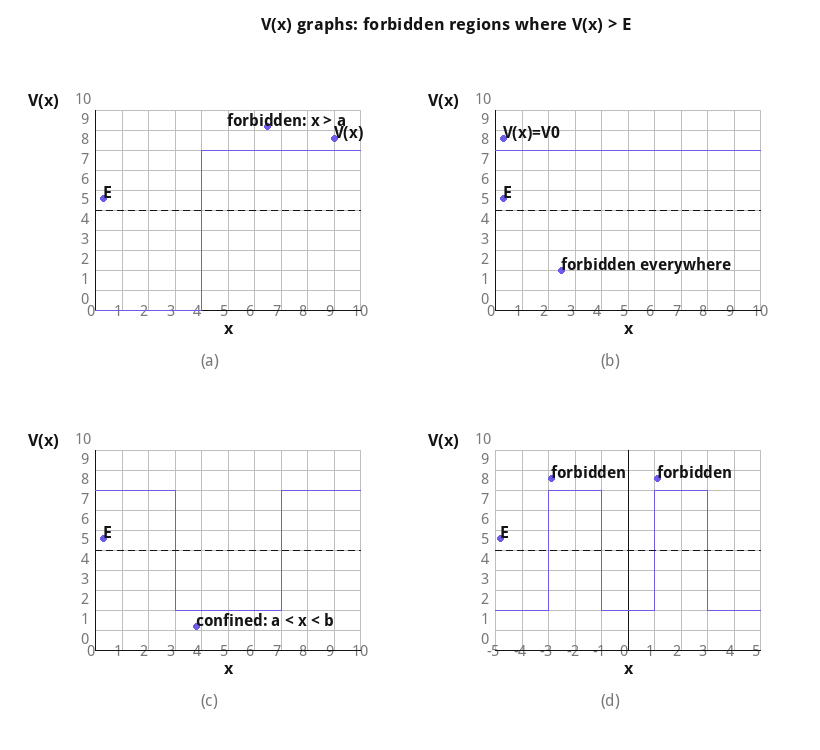
Given examples of potential energy functions V(x) in one dimension, with the total energy E of the particle marked by a cross on the vertical axis, specify the regions (if any) where the particle cannot be found, and the minimum total energy needed in each case.
Since total energy E = KE + V(x) and kinetic energy can never be negative, a particle cannot exist in any region where V(x) > E (this would require negative KE). In the first graph, V(x) = 0 between x = 0 and x = a, then rises to a constant value V0 > E for x > a – the particle is forbidden for x > a, and its minimum total energy is 0. In the second graph, V(x) = V0 exceeds E everywhere, so the particle cannot exist anywhere on this curve for the given E. In the third graph, V(x) > E for 0 ≤ x < a and for x > b, so the particle is confined between x = a and x = b (forbidden elsewhere), similar to a particle trapped in a potential well. In the fourth graph, V(x) > E in the two side bands, so the particle is forbidden between x = –b/2 and x = –a/2, and between x = a/2 and x = b/2, while it can move freely in the central region and outside the outer bands. These shapes are physically relevant to situations like a ball in a valley, a particle trapped in a potential well (e.g., a bound electron), or a particle held back by a potential barrier.
Q4. : Turning Points of a Simple Harmonic Oscillator — The potential energy function for a particle in linear SHM is V(x) = kx²/2, with k =…
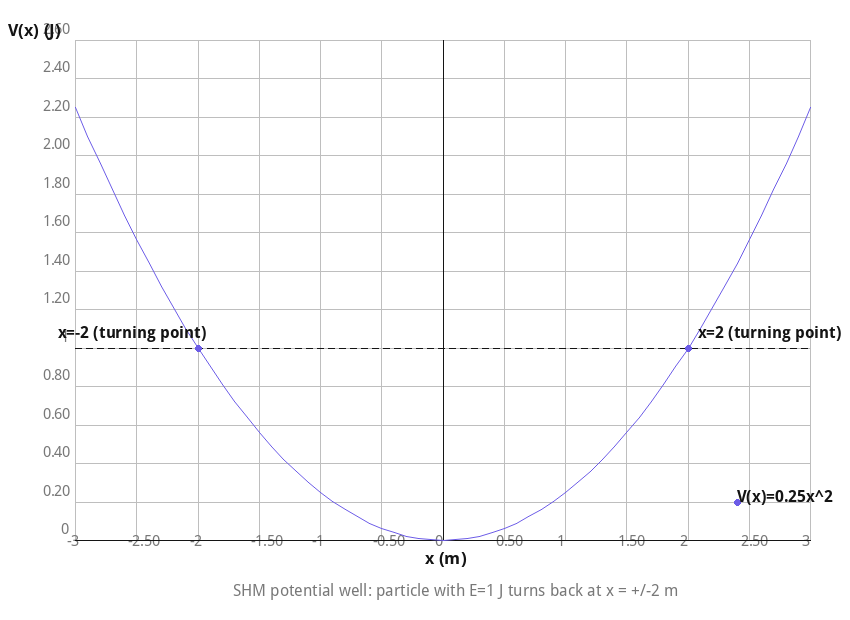
The potential energy function for a particle in linear SHM is V(x) = kx²/2, with k = 0.5 N m-1. Show that a particle of total energy 1 J moving under this potential must “turn back” when it reaches x = ±2 m.
Total energy E = KE + V(x) = ½mv² + kx²/2. The particle turns back at the point where its velocity (and hence KE) becomes zero, i.e., where E = V(x). Setting 1 = (0.5)x²/2 = 0.25x² gives x² = 4, so x = ±2 m. Beyond this point V(x) would exceed the total energy of 1 J, which is physically impossible, so the particle must reverse direction exactly at x = ±2 m.
Q5. : Conceptual Questions on Energy Conservation — (a) The casing of a rocket in flight burns up due to friction. At whose expense is the…
(a) The casing of a rocket in flight burns up due to friction. At whose expense is the heat energy obtained – the rocket or the atmosphere? (b) Comets move around the sun in highly elliptical orbits, and the gravitational force on a comet is not normal to its velocity in general, yet the work done by gravity over one complete orbit is zero. Why? (c) An artificial satellite in a thin atmosphere loses energy gradually due to atmospheric resistance, yet its speed increases progressively as it comes closer to Earth. Why? (d) In one case a man walks 2 m carrying a 15 kg mass on his hands; in another case he walks the same distance pulling a rope that passes over a pulley with a 15 kg mass hanging from the other end. In which case is the work done greater?
(a) The heat is obtained at the expense of the rocket’s own kinetic energy: atmospheric friction does negative work on the rocket, converting part of its mechanical energy into heat that burns the casing.
(b) Gravity is a conservative force, and the work done by any conservative force around a closed path is always zero, regardless of the path’s shape – so the work over one full orbit is zero.
(c) As the satellite spirals inward, its potential energy decreases faster than its total energy decreases (due to the small atmospheric drag), so its kinetic energy – and hence its speed – increases, even though the total mechanical energy is slowly falling.
(d) In the first case, the man’s supporting force is vertical while his displacement is horizontal, so θ = 90° and W = Fs cos90° = 0. In the second case, pulling the rope over the pulley raises the 15 kg mass vertically by the same 2 m that the man walks, so W = mgh = 15 × 9.8 × 2 = 294 J, which is greater than the 0 J done in the first case.
Q6. : Underlining the Correct Alternative — (a) When a conservative force does positive work on a body, its potential energy…
(a) When a conservative force does positive work on a body, its potential energy increases/decreases/remains unaltered. (b) Work done by a body against friction always results in a loss of its kinetic/potential energy. (c) The rate of change of total momentum of a many-particle system is proportional to the external force/sum of the internal forces on the system. (d) In an inelastic collision of two bodies, the quantities which do not change after the collision are the total kinetic energy/total linear momentum/total energy of the system.
(a) Because W = –Δ(PE) for a conservative force, positive work means the potential energy decreases.
(b) Work done against friction is drawn from the body’s motion, so its kinetic energy decreases.
(c) Internal forces cancel out in pairs (Newton’s third law), so only the external force can change the system’s total momentum.
(d) In an inelastic collision, total linear momentum and total energy of the system remain unchanged; only the total kinetic energy decreases, since part of it converts to heat, sound or deformation.
Q7. : True or False – Collisions and Conservation Laws — State if each statement is true or false, with reasons. (a) In an elastic collision of…
State if each statement is true or false, with reasons. (a) In an elastic collision of two bodies, the momentum and energy of each body is conserved. (b) Total energy of a system is always conserved, no matter what internal and external forces act on it. (c) Work done in the motion of a body over a closed loop is zero for every force in nature. (d) In an inelastic collision, the final kinetic energy is always less than the initial kinetic energy of the system.
(a) False – it is the total momentum and total energy of the two-body system that are conserved, not the momentum and energy of each individual body.
(b) False – an external force can do work on the system and change its total mechanical energy; energy conservation strictly holds only for an isolated system with no external work input or loss.
(c) False – this is true only for conservative forces (like gravity); non-conservative forces such as friction do non-zero (dissipative) work over a closed loop.
(d) True – by definition, an inelastic collision converts some kinetic energy into other forms (heat, sound, deformation), so the final KE is always less than the initial KE.
Q8. : Kinetic Energy and Momentum During Collisions — (a) In an elastic collision of two billiard balls, is the total kinetic energy conserved…
(a) In an elastic collision of two billiard balls, is the total kinetic energy conserved during the short time the balls are actually in contact? (b) Is the total linear momentum conserved during that short contact time? (c) What are the answers to (a) and (b) for an inelastic collision? (d) If the potential energy of two billiard balls depends only on the separation between their centres, is the collision elastic or inelastic?
(a) No – during the brief contact, the balls deform elastically and some kinetic energy is momentarily stored as elastic potential energy; KE is conserved only when compared before and after the collision, not at every instant during contact.
(b) Yes – linear momentum is conserved at every instant, since no external horizontal force acts on the two-ball system.
(c) For an inelastic collision, momentum is still conserved throughout, but kinetic energy is not conserved even after the collision is complete, since some energy is permanently lost as heat, sound or deformation.
(d) If the potential energy depends only on the separation distance (a purely conservative, position-dependent interaction with no dissipation), the collision is elastic.
Q9. : Power Delivered Under Constant Acceleration — A body initially at rest undergoes one-dimensional motion with constant acceleration.…
A body initially at rest undergoes one-dimensional motion with constant acceleration. The power delivered to it at time t is proportional to which of: (i) t1/2 (ii) t (iii) t3/2 (iv) t²?
With constant acceleration a and force F = ma (both constant), the velocity is v = at (starting from rest). Instantaneous power P = Fv = (ma)(at) = ma²t. Since m and a are constants, P is directly proportional to t – option (ii).
Q10. : Displacement Under Constant Power — A body moves unidirectionally under a source of constant power. Its displacement in time…
A body moves unidirectionally under a source of constant power. Its displacement in time t is proportional to which of: (i) t1/2 (ii) t (iii) t3/2 (iv) t²?
With power P = Fv = m v (dv/dt) held constant, separating variables gives v dv = (P/m) dt. Integrating from rest: v²/2 = (P/m)t, so v = (2Pt/m)1/2, i.e., v ∝ t1/2. Integrating v with respect to time, displacement x = ∫v dt ∝ t3/2. So displacement is proportional to t3/2 – option (iii).
Q11. : Work Done by a Constant Force Along the z-axis — A body constrained to move along the z-axis is subject to a constant force F = (–1i +…
A body constrained to move along the z-axis is subject to a constant force F = (–1i + 2j + 3k) N, where i, j, k are unit vectors along the x-, y- and z-axes. What is the work done by this force in moving the body a distance of 4 m along the z-axis?
Since the body moves only along the z-axis, the displacement vector is d = 4k m. Work is the dot product W = F · d = (–1)(0) + (2)(0) + (3)(4) = 12 J. Only the z-component of the force (3 N) contributes to the work, because the x- and y-displacements are zero.
Q12. : Speed Ratio of an Electron and a Proton — An electron and a proton in a cosmic ray experiment have kinetic energies 10 keV and 100…
An electron and a proton in a cosmic ray experiment have kinetic energies 10 keV and 100 keV respectively. Which is faster, and what is the ratio of their speeds? (me = 9.11 × 10⁻³¹ kg, mp = 1.67 × 10⁻²⁷ kg, 1 eV = 1.60 × 10⁻¹⁹ J)
Since KE = ½mv², v = √(2KE/m). Converting: KEe = 10 × 10³ × 1.6 × 10-19 = 1.6 × 10⁻¹⁵ J, and KEp = 100 × 10³ × 1.6 × 10-19 = 1.6 × 10⁻¹⁴ J.
ve = √(2 × 1.6×10-15/9.11×10-31) ≈ 5.93 × 10⁷ m s-1.
vp = √(2 × 1.6×10-14/1.67×10-27) ≈ 4.38 × 10⁶ m s-1.
Since the electron’s mass is nearly 1836 times smaller, it moves far faster despite having lower kinetic energy. The ratio ve/vp = √[(KEe/KEp) × (mp/me)] = √(0.1 × 1833) ≈ 13.5, so the electron is about 13.5 times faster than the proton.
Q13. : Work Done by Gravity and Air Resistance on a Raindrop — A raindrop of radius 2 mm falls from a height of 500 m. It falls with decreasing…
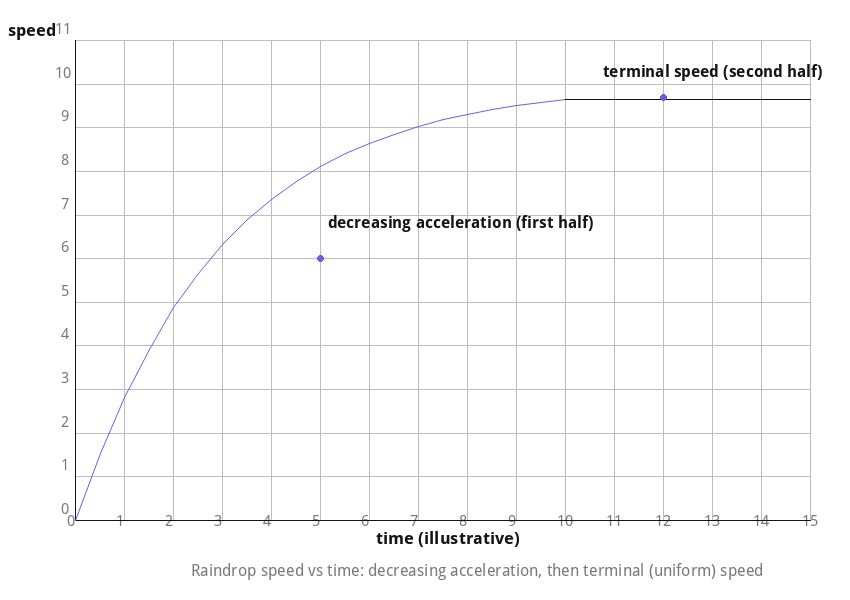
A raindrop of radius 2 mm falls from a height of 500 m. It falls with decreasing acceleration until, at half its original height, it reaches terminal speed and then falls uniformly. What is the work done by gravity in the first and second half of the journey? What is the work done by the resistive force over the entire journey if the drop’s speed on reaching the ground is 10 m s-1?
Mass of the drop m = (4/3)πr³ρ = (4/3) × 3.1416 × (2×10-3)³ × 1000 ≈ 3.351 × 10⁻⁵ kg. Each half of the journey covers h = 250 m. Since the work done by gravity depends only on vertical displacement (not on speed), it is the same in both halves: Wgravity = mgh = 3.351×10-5 × 9.8 × 250 ≈ 0.082 J in the first half, and 0.082 J in the second half (total ≈ 0.164 J over 500 m).
By the work-energy theorem over the whole fall: Wgravity + Wresistive = KEfinal – 0. Here KEfinal = ½mv² = ½ × 3.351×10-5 × 10² ≈ 1.676 × 10⁻³ J. So Wresistive = 1.676×10⁻³ – 0.164 ≈ –0.163 J – the negative sign shows that air resistance dissipates almost all the gravitational energy gained, which is why the drop reaches the ground far slower than free fall would predict.
Q14. : Elastic Collision of a Gas Molecule with a Wall — A molecule in a gas container hits a horizontal wall with speed 200 m s-1 at 30° to the…
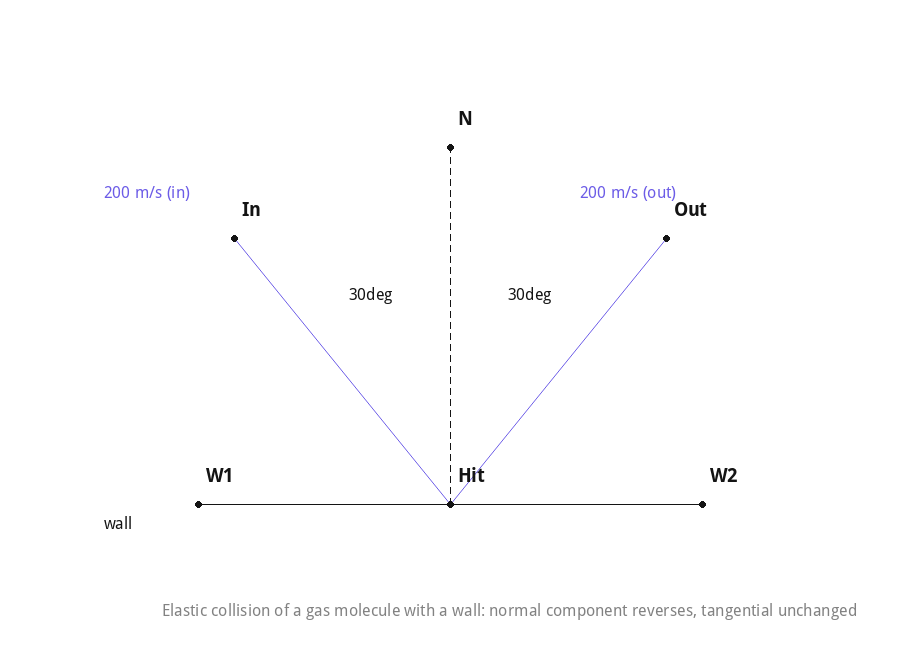
A molecule in a gas container hits a horizontal wall with speed 200 m s-1 at 30° to the normal, and rebounds with the same speed. Is momentum conserved in the collision? Is the collision elastic or inelastic?
Momentum is conserved: the wall (being effectively infinitely massive compared to the molecule) picks up an equal and opposite recoil momentum, though its resulting velocity is negligible. Since the molecule rebounds with exactly the same speed (only its normal velocity component reverses; the tangential component is unchanged), its kinetic energy after the collision equals its kinetic energy before – so the collision is elastic.
Q15. : Electric Power Consumed by a Water Pump — A pump can fill a tank of volume 30 m³ in 15 minutes, pumping water to a height of 40…
A pump can fill a tank of volume 30 m³ in 15 minutes, pumping water to a height of 40 m, with 30% efficiency. How much electric power is consumed?
Mass of water = volume × density = 30 × 1000 = 30,000 kg. Useful (output) energy = mgh = 30,000 × 9.8 × 40 = 1.176 × 10⁷ J, delivered over t = 15 × 60 = 900 s. Useful power output = 1.176×10⁷/900 ≈ 13,066.7 W. Since only 30% of the input electrical power becomes useful output, input power = 13,066.7/0.30 ≈ 43,556 W, i.e. about 43.6 kW.
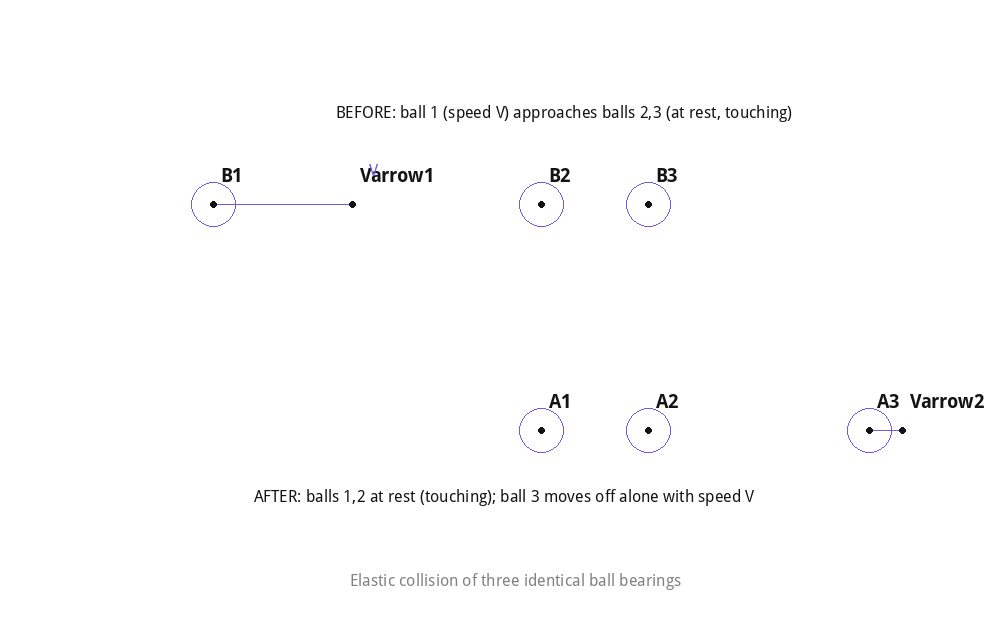
Q16. : Elastic Collision of Ball Bearings — Two identical ball bearings in contact with each other, resting on a frictionless table,…
Two identical ball bearings in contact with each other, resting on a frictionless table, are hit head-on by a third identical ball bearing moving with speed V. If the collision is elastic, what is a possible result?
Because all three balls have equal mass and the collision is elastic, both total momentum (mV) and total kinetic energy (½mV²) must be conserved after the collision. Checking the possible outcomes shown in the textbook figure, only the case where the first two balls (the striking ball and the middle ball) remain at rest, and the third (far) ball moves off alone with speed V satisfies both conservation laws simultaneously – this is the only physically possible result, exactly like the classic “Newton’s cradle” behaviour.
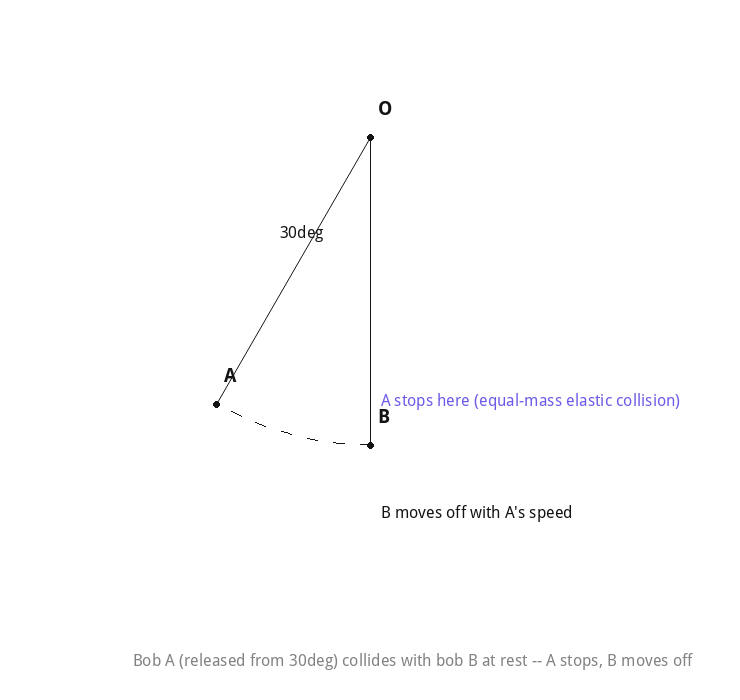
Q17. : Height Risen by Pendulum Bob After Elastic Collision — Bob A of a pendulum, released from 30° to the vertical, hits an identical bob B at rest…
Bob A of a pendulum, released from 30° to the vertical, hits an identical bob B at rest on a table. How high does bob A rise after the collision, assuming the collision is elastic and bob sizes are negligible?
For a head-on elastic collision between two bodies of exactly equal mass, the velocities are completely exchanged: the incoming body (A) comes to rest, and the target body (B) moves off with A’s entire incoming velocity. Since bob A stops moving immediately after impact, it has zero kinetic energy left to convert into height, so bob A does not rise at all (rise = 0) – the 30° release angle only determines the impact speed, not this outcome, which holds for any equal-mass elastic collision.
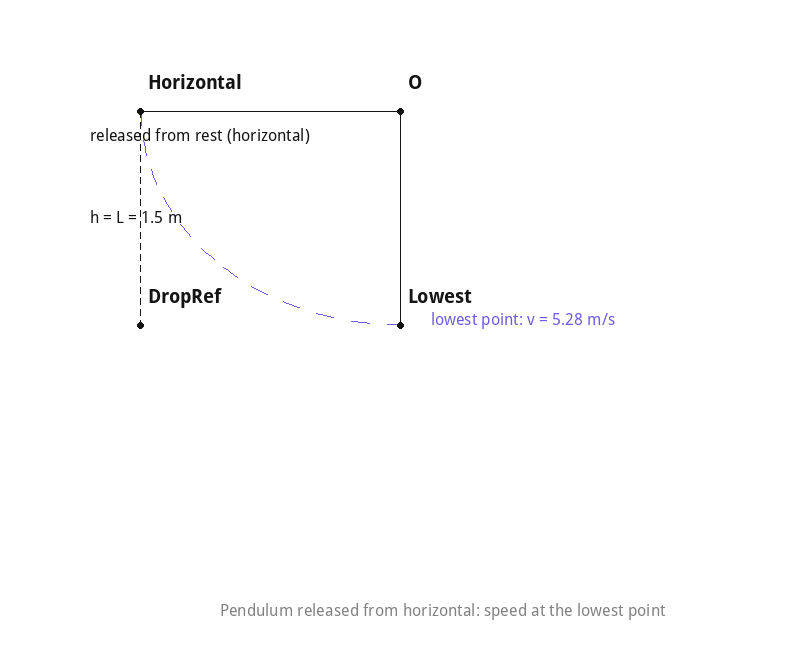
Q18. : Speed of a Pendulum Bob at the Lowest Point — A pendulum bob is released from a horizontal position. If the pendulum's length is 1.5…
A pendulum bob is released from a horizontal position. If the pendulum’s length is 1.5 m, what is the bob’s speed at the lowest point, given that 5% of its initial energy is dissipated by air resistance?
Released from horizontal, the bob falls a height equal to the pendulum’s length, h = 1.5 m, so its initial potential energy (per unit mass) is gh = 9.8 × 1.5 = 14.7 J/kg. Since 5% of this is lost to air resistance, only 95% converts to kinetic energy: ½v² = 0.95 × 14.7 = 13.965, so v² = 27.93, giving v ≈ 5.28 m s-1.
Q19. : Speed of a Leaking Sand Trolley — A trolley of mass 300 kg carrying a 25 kg sandbag moves uniformly at 27 km/h on a…
A trolley of mass 300 kg carrying a 25 kg sandbag moves uniformly at 27 km/h on a frictionless track. Sand leaks out at 0.05 kg s-1 through a hole in the floor. What is the trolley’s speed after the entire sandbag has emptied?
The leaking sand falls straight down through the hole, carrying away momentum in exact proportion to its own mass and the trolley’s current velocity – it exerts no net horizontal force on the trolley as it leaves (there is no external horizontal force on the trolley-sand system at any point). With no external horizontal force acting, the trolley’s velocity cannot change, so its speed remains 27 km/h (7.5 m s-1), unchanged after all the sand has leaked out.
Q20: Work Done by the Net Force for v = ax3/2
A body of mass 0.5 kg travels in a straight line with velocity v = ax3/2, where a = 5 m-1/2 s-1. What is the work done by the net force during its displacement from x = 0 to x = 2 m?
By the work-energy theorem, the work done equals the change in kinetic energy. At x = 0, v = 0. At x = 2 m, v² = a²x³ = 5² × 2³ = 25 × 8 = 200 m² s-2. So W = ½m(vf² – vi²) = ½ × 0.5 × (200 – 0) = 50 J.
Q21. : Electrical Power Produced by a Windmill — The blades of a windmill sweep out a circle of area A. (a) If wind flows at velocity v…
The blades of a windmill sweep out a circle of area A. (a) If wind flows at velocity v perpendicular to the circle, what mass of air passes through in time t? (b) What is the kinetic energy of that air? (c) If the windmill converts 25% of the wind’s energy to electricity, and A = 30 m², v = 36 km/h, and air density = 1.2 kg m-3, what electrical power is produced?
(a) The volume of air passing through in time t is A × v × t, so the mass is m = ρAvt.
(b) Kinetic energy of this air = ½mv² = ½ρAv³t.
(c) Converting v = 36 km/h = 10 m s-1, the wind’s kinetic energy delivered per second (i.e., wind power) is ½ρAv³ = ½ × 1.2 × 30 × 10³ = 18,000 W = 18 kW. With 25% conversion efficiency, electrical power produced = 0.25 × 18,000 = 4,500 W, i.e. 4.5 kW.
Q22. : Fat Used Up by a Dieter Lifting Weights — A dieter lifts a 10 kg mass 1000 times, to a height of 0.5 m each time, and the…
A dieter lifts a 10 kg mass 1000 times, to a height of 0.5 m each time, and the potential energy is dissipated each time she lowers it. (a) How much work does she do against gravity? (b) If fat supplies 3.8 × 10⁷ J/kg, converted to mechanical energy with 20% efficiency, how much fat does she use?
(a) Work done against gravity per lift = mgh = 10 × 9.8 × 0.5 = 49 J. Over 1000 lifts, total work W = 1000 × 49 = 49,000 J (4.9 × 10⁴ J).
(b) Since only 20% of the fat’s chemical energy converts to useful mechanical work, the energy that must be drawn from fat is 49,000/0.20 = 245,000 J. Dividing by the energy density of fat: mass of fat used = 245,000/(3.8 × 107) ≈ 6.447 × 10⁻³ kg, i.e. ≈ 6.45 g of fat.
Q23. : Roof Area Needed for Solar Power — A family uses 8 kW of power. (a) Solar energy is incident on a horizontal surface at 200…
A family uses 8 kW of power. (a) Solar energy is incident on a horizontal surface at 200 W per square metre on average. If 20% of this can be converted to useful electrical energy, how large an area is needed to supply 8 kW? (b) Compare this area to the roof of a typical house.
(a) Useful electrical power per square metre = 200 × 0.20 = 40 W/m². To supply 8000 W, the required area A = 8000/40 = 200 m².
(b) An area of 200 m² is comparable to (or larger than) the entire roof area of a typical single-family house, which illustrates why rooftop solar installations at this efficiency generally cannot meet a whole household’s power demand from a standard-sized roof alone – the panel area needed is roughly the size of a full house roof.
Class 11 Physics Chapter 5 – Notes and Extra Questions
Along with these NCERT Solutions, students can also use the Class 11 Physics Chapter 5 Extra Questions and Class 11 Physics Chapter 5 Revision Notes for quick revision and extra practice.
- Chapter 1: Units and Measurements (2026-27)
- Chapter 2: Motion in a Straight Line – Free PDF Download
- Chapter 3: Motion in a Plane – Free PDF Download
- Chapter 4: Laws of Motion – Free PDF Download
- Chapter 6: System of Particles and Rotational Motion – Free PDF Download
- Chapter 7: Gravitation – Free PDF Download
- Chapter 8: Mechanical Properties of Solids – Free PDF Download
- Chapter 9: Mechanical Properties of Fluids – Free PDF Download
- Chapter 10: Thermal Properties of Matter – Free PDF Download
- Chapter 11: Thermodynamics – Free PDF Download
- Chapter 12: Kinetic Theory – Free PDF Download
- Chapter 13: Oscillations – Free PDF Download
- Chapter 14: Waves – Free PDF Download
Frequently Asked Questions
What is the work-energy theorem?
The work-energy theorem states that the work done by the net force acting on a body equals the change in its kinetic energy: Wnet = KEfinal – KEinitial. It follows directly from Newton’s second law and the equations of motion, and it lets you calculate a body’s final speed or the work required without needing to know the details of acceleration at every instant – as demonstrated in Q2 and Q20 above, where the change in kinetic energy exactly matches the work done by the net force.
What is the difference between conservative and non-conservative forces?
A conservative force (such as gravity, the spring force, or the electrostatic force) does work that depends only on the initial and final positions of the body, not on the path taken; consequently, the work done by a conservative force around any closed path is exactly zero, and a well-defined potential energy can be associated with it. A non-conservative force (such as friction or air resistance) does work that depends on the path taken, is generally non-zero over a closed loop, and permanently converts mechanical energy into heat, sound or other forms – so no potential energy function can be defined for it.
What is the difference between elastic and inelastic collisions?
In an elastic collision, both the total linear momentum and the total kinetic energy of the colliding bodies are conserved – no energy is lost to heat, sound or deformation (e.g., collisions between hard billiard balls or gas molecules, to a good approximation). In an inelastic collision, total linear momentum is still conserved, but total kinetic energy is not – some of it converts into other forms of energy. In a perfectly inelastic collision, the colliding bodies stick together and move with a common final velocity, representing the maximum possible loss of kinetic energy consistent with momentum conservation.
What is power, and what are its SI units?
Power is the rate at which work is done or energy is transferred. Average power is P = W/t, while instantaneous power is P = F · v = Fv cosθ, where θ is the angle between the force and velocity vectors. The SI unit of power is the watt (W), equal to one joule per second (1 W = 1 J/s); larger amounts are often expressed in kilowatts (kW), and the non-SI unit horsepower (1 hp ≈ 746 W) is also common in everyday and mechanical contexts.
Recommended: Buy the Printed NCERT Class 11 Physics Book Set
Contains Amazon affiliate links.
If you’d like a printed copy alongside the PDF, here’s a verified option:
Rs. 280
Price and availability may change on Amazon. As an Amazon Associate, ncertbooks.org earns from qualifying purchases.


