
Chapter 12 of Class 12 Maths is Linear Programming. It covers formulating real-world optimization problems as linear programming problems (LPPs) and solving them graphically.
Last Updated: September 23, 2026
Linear Programming Problem (LPP)
An LPP involves optimizing (maximizing or minimizing) a linear objective function Z=ax+by, subject to a set of linear constraints (inequalities) and non-negativity restrictions (x≥0, y≥0).
Feasible Region
The feasible region is the common region satisfying all constraints simultaneously, represented graphically. It is bounded if enclosed within a finite area, or unbounded otherwise. Points within/on the boundary are feasible solutions.
Corner Point Method
The optimal value of Z (if it exists) occurs at a corner point (vertex) of the feasible region. Method: identify all corner points, evaluate Z at each, and select the maximum/minimum value.
Types of LPP
Common real-world applications: diet problems (minimize cost subject to nutritional constraints), manufacturing problems (maximize profit subject to resource constraints), transportation problems (minimize transportation cost).
Special Cases
If the feasible region is unbounded, a maximum may not exist even if Z appears large at corner points — must verify by checking if the constraint half-plane intersects the region. Multiple optimal solutions occur when Z is constant along an entire edge of the feasible region.
Exercise 12.1 Solutions (All 10 Questions)
1. Maximise Z = 3x + 4y subject to the constraints x + y ≤ 4, x ≥ 0, y ≥ 0.
Ans: The feasible region is bounded by the lines x + y = 4, x = 0 and y = 0. The corner points of the feasible region are O(0,0), A(4,0) and B(0,4). The value of Z at each corner point is: at O(0,0), Z = 0; at A(4,0), Z = 3(4)+4(0) = 12; at B(0,4), Z = 3(0)+4(4) = 16. Since the feasible region is bounded, the maximum value of Z is the largest of these values. Therefore, the maximum value of Z is 16, occurring at the point (0,4).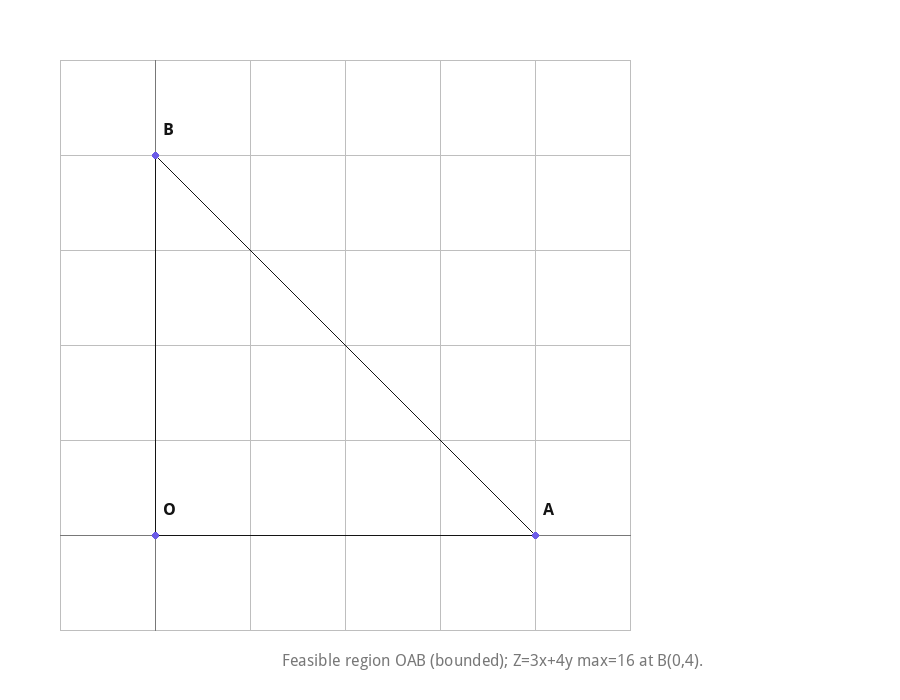
2. Minimise Z = -3x + 4y subject to x + 2y ≤ 8, 3x + 2y ≤ 12, x ≥ 0, y ≥ 0.
Ans: The feasible region is bounded by x + 2y = 8, 3x + 2y = 12, x = 0 and y = 0. Solving x + 2y = 8 and 3x + 2y = 12 simultaneously gives x = 2, y = 3. The corner points of the feasible region are O(0,0), A(4,0), B(2,3) and C(0,4). The value of Z at each corner point is: at O(0,0), Z = 0; at A(4,0), Z = -3(4)+4(0) = -12; at B(2,3), Z = -3(2)+4(3) = 6; at C(0,4), Z = -3(0)+4(4) = 16. Since the feasible region is bounded, the minimum value of Z is the smallest of these values. Therefore, the minimum value of Z is -12, occurring at the point (4,0).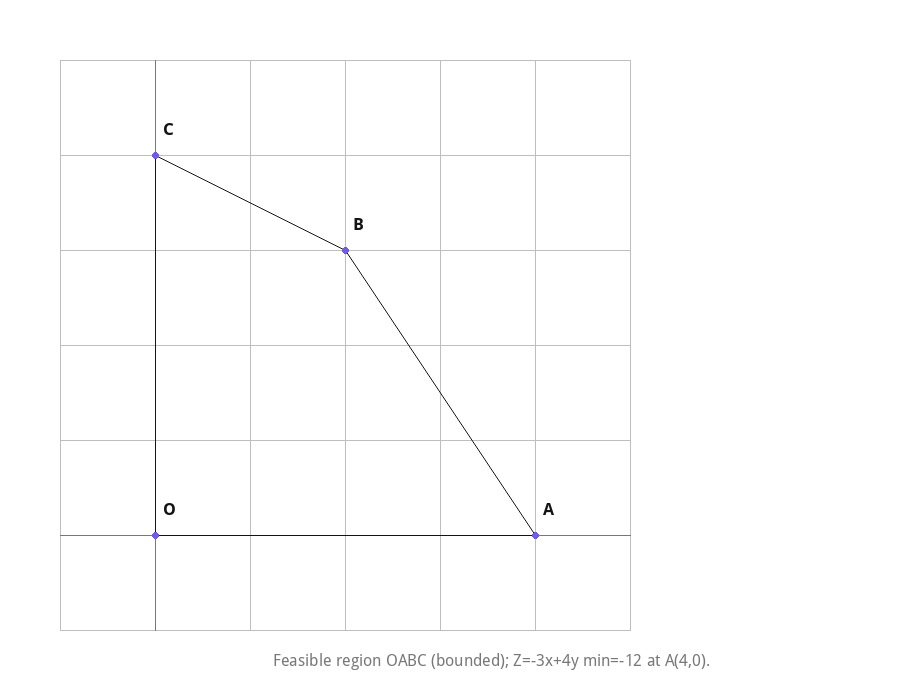
3. Maximise Z = 5x + 3y subject to 3x + 5y ≤ 15, 5x + 2y ≤ 10, x ≥ 0, y ≥ 0.
Ans: The feasible region is bounded by 3x + 5y = 15, 5x + 2y = 10, x = 0 and y = 0. Solving 3x + 5y = 15 and 5x + 2y = 10 simultaneously: multiplying the first by 2 and the second by 5 gives 6x+10y=30 and 25x+10y=50; subtracting gives 19x = 20, so x = 20/19, and then y = 45/19. The corner points of the feasible region are O(0,0), A(2,0), B(20/19,45/19) and C(0,3). The value of Z at each corner point is: at O(0,0), Z = 0; at A(2,0), Z = 5(2)+3(0) = 10; at B(20/19,45/19), Z = 5(20/19)+3(45/19) = 100/19+135/19 = 235/19; at C(0,3), Z = 5(0)+3(3) = 9. Since the feasible region is bounded, the maximum value of Z is the largest of these values. Therefore, the maximum value of Z is 235/19, occurring at the point (20/19,45/19).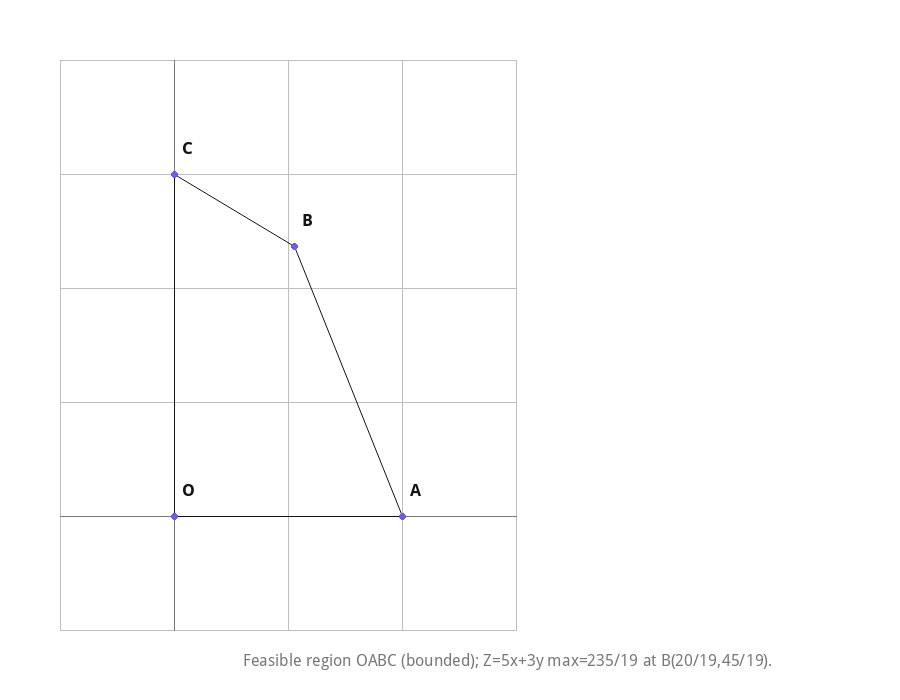
4. Minimise Z = 3x + 5y subject to x + 3y ≥ 3, x + y ≥ 2, x ≥ 0, y ≥ 0.
Ans: The feasible region is unbounded, bounded below by x + 3y = 3, x + y = 2, x = 0 and y = 0. Solving x + 3y = 3 and x + y = 2 simultaneously: subtracting gives 2y = 1, so y = 1/2, and then x = 3/2. The corner points of the feasible region are A(3,0), B(3/2,1/2) and C(0,2). The value of Z at each corner point is: at A(3,0), Z = 3(3)+5(0) = 9; at B(3/2,1/2), Z = 3(3/2)+5(1/2) = 9/2+5/2 = 7; at C(0,2), Z = 3(0)+5(2) = 10. Since the region is unbounded, we check whether 3x+5y < 7 has any point in common with the feasible region; it does not, so the minimum value of Z is 7, occurring at the point (3/2,1/2).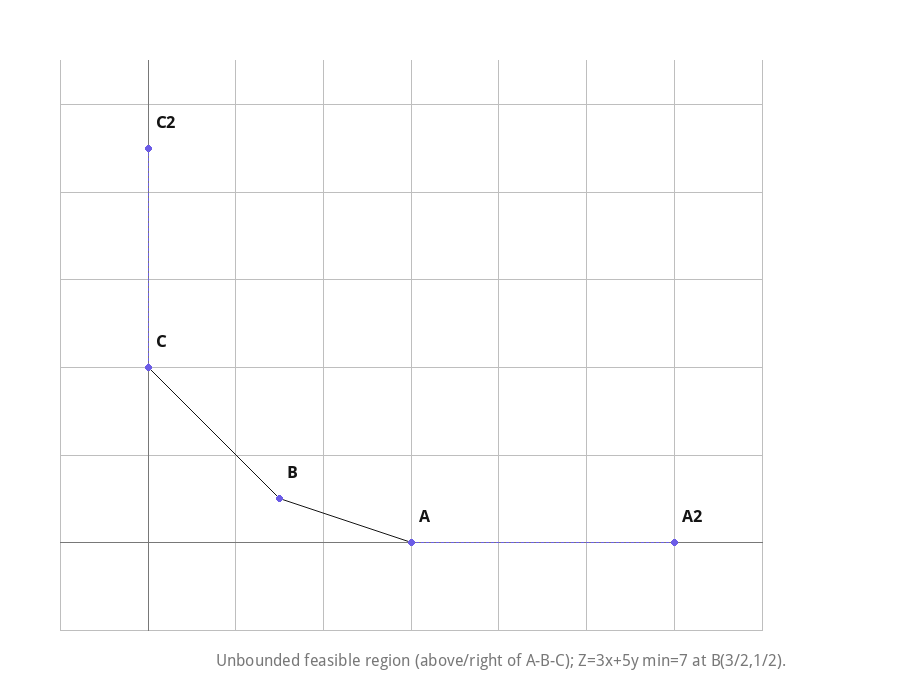
5. Maximise Z = 3x + 2y subject to x + 2y ≤ 10, 3x + y ≤ 15, x ≥ 0, y ≥ 0.
Ans: The feasible region is bounded by x + 2y = 10, 3x + y = 15, x = 0 and y = 0. Solving x + 2y = 10 and 3x + y = 15 simultaneously: from the second equation y = 15-3x; substituting gives x+2(15-3x)=10, so x+30-6x=10, giving -5x=-20, so x=4, and then y=3. The corner points of the feasible region are O(0,0), A(5,0), B(4,3) and C(0,5). The value of Z at each corner point is: at O(0,0), Z = 0; at A(5,0), Z = 3(5)+2(0) = 15; at B(4,3), Z = 3(4)+2(3) = 18; at C(0,5), Z = 3(0)+2(5) = 10. Since the feasible region is bounded, the maximum value of Z is the largest of these values. Therefore, the maximum value of Z is 18, occurring at the point (4,3).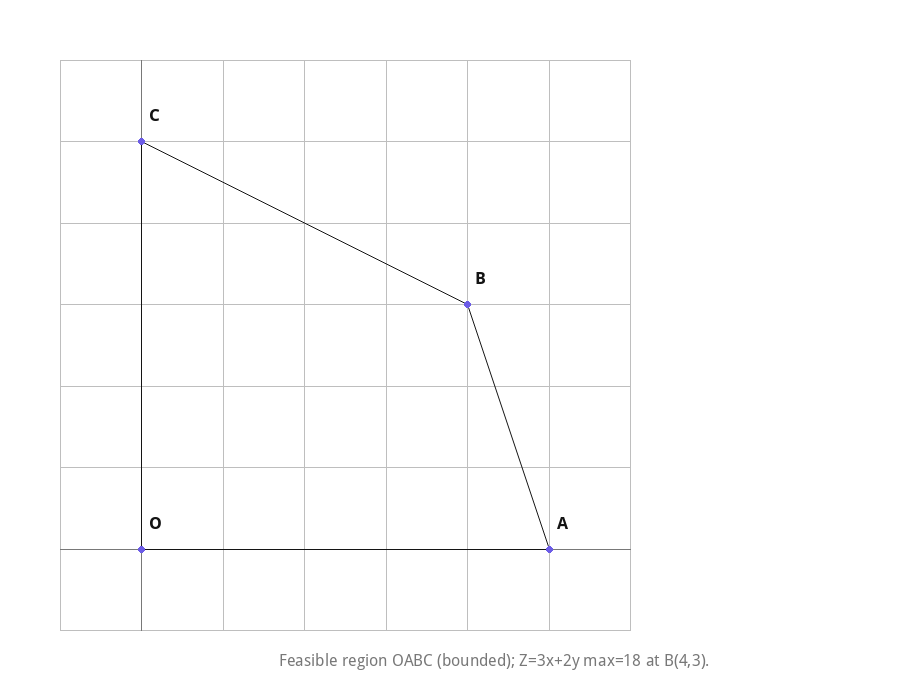
6. Minimise Z = x + 2y subject to 2x + y ≥ 3, x + 2y ≥ 6, x ≥ 0, y ≥ 0.
Ans: The feasible region is unbounded, bounded below by 2x + y = 3, x + 2y = 6, x = 0 and y = 0. Solving 2x + y = 3 and x + 2y = 6 simultaneously: from the first, y = 3-2x; substituting gives x+2(3-2x)=6, so x+6-4x=6, giving -3x=0, so x=0, and then y=3, which is the same as the point where x + 2y = 6 meets x = 0. The corner points of the feasible region are A(6,0) and B(0,3). The value of Z at each corner point is: at A(6,0), Z = 6+2(0) = 6; at B(0,3), Z = 0+2(3) = 6. Since the region is unbounded, we check whether x+2y < 6 has any point in common with the feasible region; it does not, so the minimum value of Z is 6, occurring at every point on the line segment joining the points (6,0) and (0,3).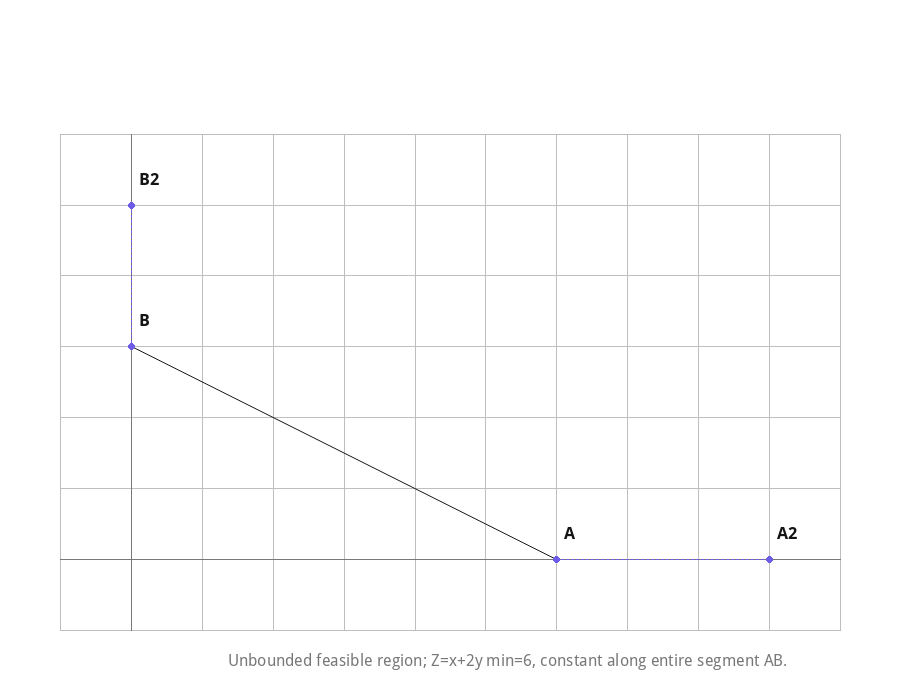
7. Minimise and Maximise Z = 5x + 10y subject to x + 2y ≤ 120, x + y ≥ 60, x – 2y ≥ 0, x ≥ 0, y ≥ 0.
Ans: The feasible region is bounded by x + 2y = 120, x + y = 60, x – 2y = 0, x = 0 and y = 0. Solving x + 2y = 120 and x – 2y = 0 simultaneously gives 2x = 120, so x = 60, y = 30. Solving x + y = 60 and x – 2y = 0 simultaneously: x = 2y, so 2y+y=60, giving y=20, x=40. The corner points of the feasible region are A(60,0), B(120,0), C(60,30) and D(40,20). The value of Z at each corner point is: at A(60,0), Z = 5(60)+10(0) = 300; at B(120,0), Z = 5(120)+10(0) = 600; at C(60,30), Z = 5(60)+10(30) = 300+300 = 600; at D(40,20), Z = 5(40)+10(20) = 200+200 = 400. Since the feasible region is bounded, the minimum value of Z is 300, occurring at the point (60,0), and the maximum value of Z is 600, occurring at every point on the line segment joining the points (120,0) and (60,30).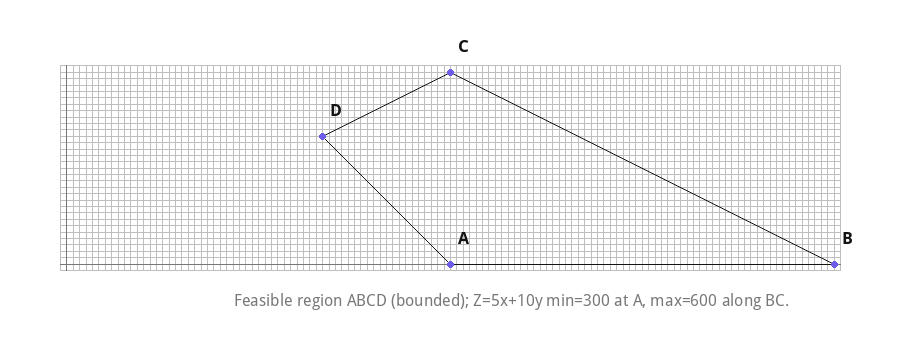
8. Minimise and Maximise Z = x + 2y subject to x + 2y ≥ 100, 2x – y ≤ 0, 2x + y ≤ 200, x ≥ 0, y ≥ 0.
Ans: The feasible region is bounded by x + 2y = 100, 2x – y = 0, 2x + y = 200, x = 0 and y = 0. Solving x + 2y = 100 and 2x – y = 0 simultaneously: y = 2x, so x+2(2x)=100, giving 5x=100, so x=20, y=40. Solving 2x – y = 0 and 2x + y = 200 simultaneously: adding gives 4x=200, so x=50, y=100. The corner points of the feasible region are A(0,50), B(20,40), C(50,100) and D(0,200). The value of Z at each corner point is: at A(0,50), Z = 0+2(50) = 100; at B(20,40), Z = 20+2(40) = 100; at C(50,100), Z = 50+2(100) = 250; at D(0,200), Z = 0+2(200) = 400. Since the feasible region is bounded, the minimum value of Z is 100, occurring at every point on the line segment joining the points (0,50) and (20,40), and the maximum value of Z is 400, occurring at the point (0,200).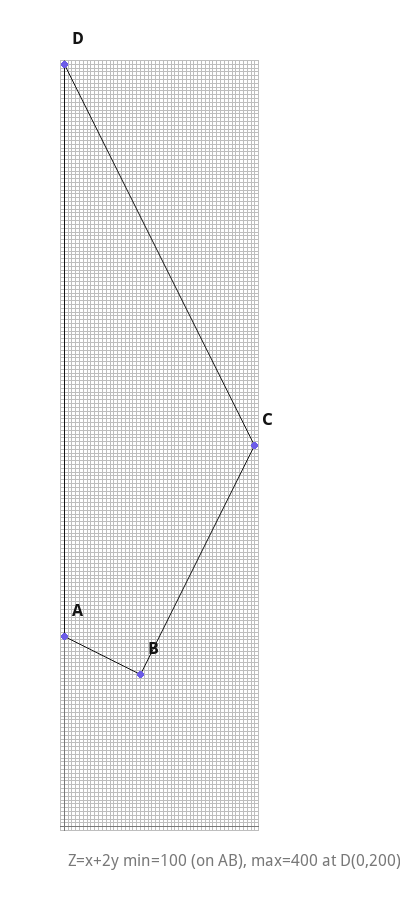
9. Maximise Z = -x + 2y subject to x ≥ 3, x + y ≥ 5, x + 2y ≥ 6, y ≥ 0.
Ans: The feasible region is unbounded, bounded below by x = 3, x + y = 5, x + 2y = 6 and y = 0. Solving x + y = 5 and x + 2y = 6 simultaneously: subtracting gives y = 1, so x = 4. Solving x = 3 and x + y = 5 simultaneously gives y = 2. The corner points of the feasible region are A(6,0), B(4,1) and C(3,2). The value of Z at each corner point is: at A(6,0), Z = -6+2(0) = -6; at B(4,1), Z = -4+2(1) = -2; at C(3,2), Z = -3+2(2) = 1. Since the feasible region is unbounded, these values may not give the maximum value of Z. To check, we plot the region -x+2y > 1 and see that it has points in common with the feasible region (for instance, taking x=3 and letting y increase without bound keeps every constraint satisfied while -x+2y grows arbitrarily large). Therefore, Z has no maximum value.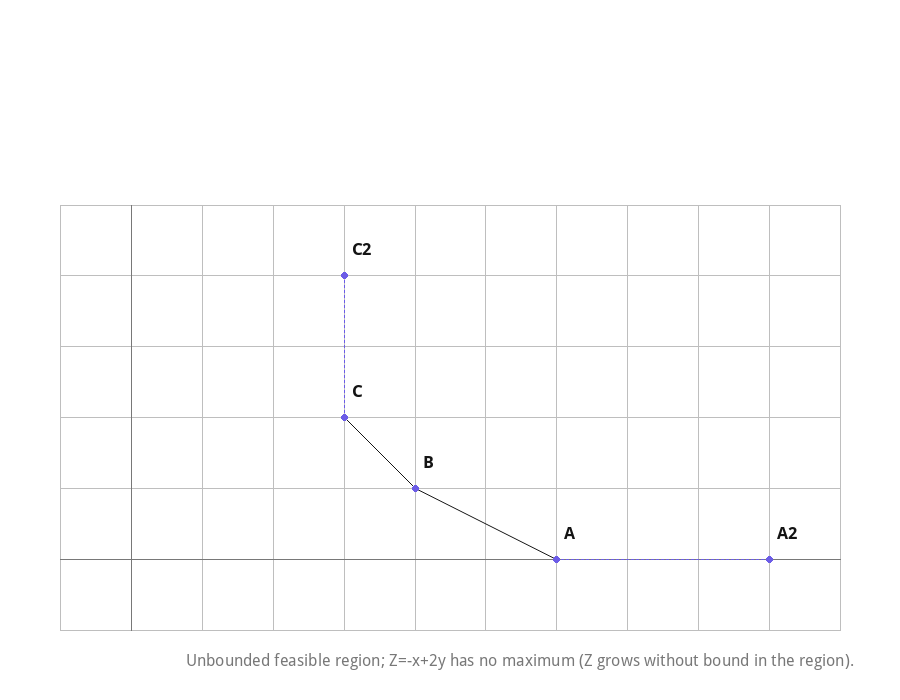
10. Maximise Z = x + y subject to x – y ≤ -1, -x + y ≤ 0, x ≥ 0, y ≥ 0.
Ans: The constraint x – y ≤ -1 means y ≥ x + 1, while the constraint -x + y ≤ 0 means y ≤ x. There is no point (x,y) that can simultaneously satisfy y ≥ x + 1 and y ≤ x, since x + 1 is always greater than x. Hence there is no point satisfying all the given constraints, so there is no feasible region. Therefore, Z has no maximum value.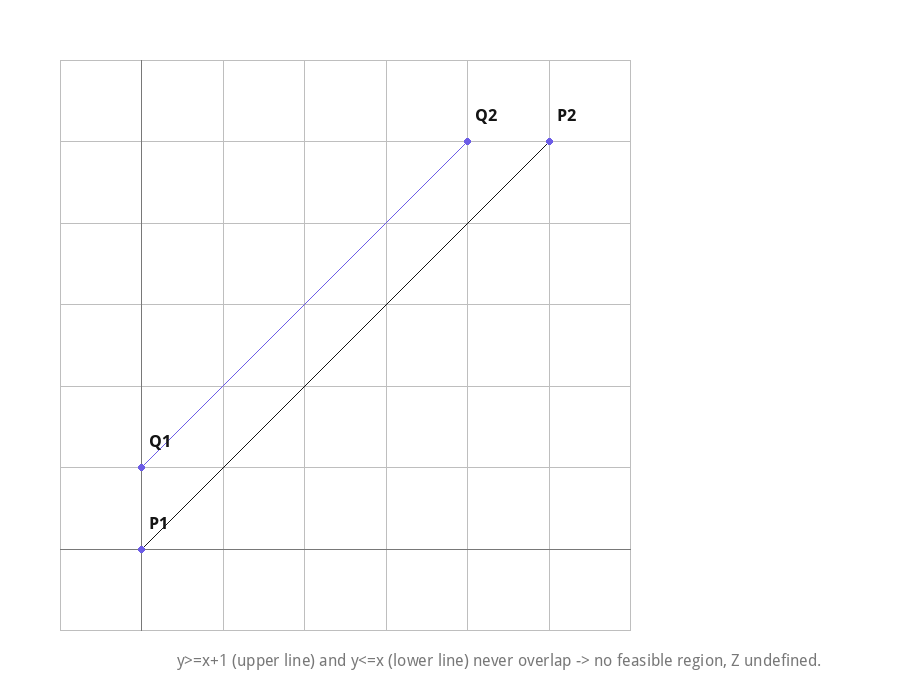
- Chapter 1: Relations and Functions – Free PDF Download
- Chapter 2: Inverse Trigonometric Functions – Free PDF Download
- Chapter 3: Matrices – Free PDF Download
- Chapter 4: Determinants – Free PDF Download
- Chapter 5: Continuity and Differentiability – Free PDF Download
- Chapter 6: Applications of Derivatives – Free PDF Download
- Chapter 7: Integrals – Free PDF Download
- Chapter 8: Applications of Integrals – Free PDF Download
- Chapter 9: Differential Equations – Free PDF Download
- Chapter 10: Vectors – Free PDF Download
- Chapter 11: Three-Dimensional Geometry – Free PDF Download
- Chapter 13: Probability – Free PDF Download
Frequently Asked Questions
What is the corner point method?
Evaluating the objective function at each vertex of the feasible region to find the optimal value.
What is a feasible region?
The region satisfying all the given linear constraints simultaneously.
Can an unbounded feasible region have a maximum?
Not always — it depends on whether the corresponding half-plane of Z=constant intersects the feasible region for large values.
Chapter Quiz — Test Your Understanding
Class 12 Mathematics Chapter 12 – Notes and Extra Questions
Along with these NCERT Solutions, students can also use the Class 12 Mathematics Chapter 12 Extra Questions and Class 12 Mathematics Chapter 12 Revision Notes for quick revision and extra practice.
See also: Chapter 1 | Chapter 2 | Chapter 3 | Chapter 4 | Chapter 5 | Chapter 6 | Chapter 7 | Chapter 8 | Chapter 9 | Chapter 10 | Chapter 11
Practice more: Chapter 1 | Chapter 2 | Chapter 3 | Chapter 4 | Chapter 5 | Chapter 6 | Chapter 7 | Chapter 8 | Chapter 9 | Chapter 10 | Chapter 11
Quick revision: Chapter 1 | Chapter 2 | Chapter 3 | Chapter 4 | Chapter 5 | Chapter 6 | Chapter 7 | Chapter 8 | Chapter 9 | Chapter 10 | Chapter 11
Recommended: Buy the Printed NCERT Class 12 Maths Book
Contains Amazon affiliate links.
If you’d like a printed copy alongside the PDF, here’s a verified option:
4.3 out of 5 stars (899 ratings) · Rs. 94
Price and availability may change on Amazon. As an Amazon Associate, ncertbooks.org earns from qualifying purchases.


