
A determinant is a single number computed from a square matrix that reveals whether the matrix is invertible and shows up throughout geometry, calculus, and systems of linear equations. This chapter’s exercises are solved step by step below, following the exact numbering used in the current (2026-27 session) NCERT textbook after the 2023 CBSE syllabus rationalisation.
Last Updated: September 23, 2026
How to Approach This Chapter
Before expanding a determinant, pick the row or column with the most zeros and expand along that one — same result, far less arithmetic. Learn the cofactor sign pattern as a checkerboard rather than recalculating it every time.
Exam Weightage: How Important Is This Chapter?
Determinants carries 5 marks, paired with Matrices (also 5 marks) to form the 10-mark Algebra unit in the CBSE Class 12 Maths board exam.
Exercise 4.1 Solutions (All 8 Questions)
1. Evaluate the determinant |[2,4],[-5,-1]|.
Ans: (2)(-1)-(4)(-5) = -2+20 = 18.
2. Evaluate the determinants: (i) |[cosθ,-sinθ],[sinθ,cosθ]| (ii) |[x²-x+1,x-1],[x+1,x+1]|.
Ans: (i) cosθ·cosθ-(-sinθ)(sinθ) = cos²θ+sin²θ = 1. (ii) (x²-x+1)(x+1)-(x-1)(x+1) = (x+1)[(x²-x+1)-(x-1)] = (x+1)(x²-2x+2) = x³-x²+2.
3. If A=[[1,2],[4,2]], then show that |2A|=4|A|.
Ans: |A|=(1)(2)-(2)(4)=2-8=-6. 2A=[[2,4],[8,4]], so |2A|=(2)(4)-(4)(8)=8-32=-24. And 4|A|=4(-6)=-24. Since |2A|=-24=4|A|, the result is verified. (For an n×n matrix, |kA|=kⁿ|A|; here n=2, so the factor is 2²=4.)
4. If A=[[1,0,1],[0,1,2],[0,0,4]], then show that |3A|=27|A|.
Ans: |A|=1(4-0)-0+1(0-0)=4. 3A=[[3,0,3],[0,3,6],[0,0,12]], so |3A|=3(36-0)-0+3(0-0)=108. And 27|A|=27(4)=108. Since |3A|=108=27|A|, the result is verified. (Here n=3, so the scaling factor is 3³=27.)
5. Evaluate the determinants: (i) |[3,-1,-2],[0,0,-1],[3,-5,0]| (ii) |[3,-4,5],[1,1,-2],[2,3,1]| (iii) |[0,1,2],[-1,0,-3],[-2,3,0]| (iv) |[2,-1,-2],[0,2,-1],[3,-5,0]|.
Ans: (i) -12. (ii) 46. (iii) 0. (iv) 5.
6. If A=[[1,1,-2],[2,1,-3],[5,4,-9]], find |A|.
Ans: |A| = 1(1×-9-(-3)×4) – 1(2×-9-(-3)×5) + (-2)(2×4-1×5) = 1(-9+12) – 1(-18+15) – 2(8-5) = 3+3-6 = 0.
7. Find values of x, if: (i) |[2,4],[5,1]| = |[2x,4],[6,x]| (ii) |[2,3],[4,5]| = |[x,3],[2x,5]|.
Ans: (i) LHS = 2-20 = -18. RHS = 2x²-24. Setting -18=2x²-24 gives 2x²=6, so x²=3, i.e. x=±√3. (ii) LHS = 10-12 = -2. RHS = 5x-6x = -x. Setting -x=-2 gives x=2.
8. If |[x,2],[18,x]| = |[6,2],[18,6]|, then x is equal to: (A) 6 (B) ±6 (C) -6 (D) 0.
Ans: (B) ±6. LHS = x²-36. RHS = 36-36 = 0. Setting x²-36=0 gives x²=36, so x=±6.
Exercise 4.2 Solutions (All 5 Questions)
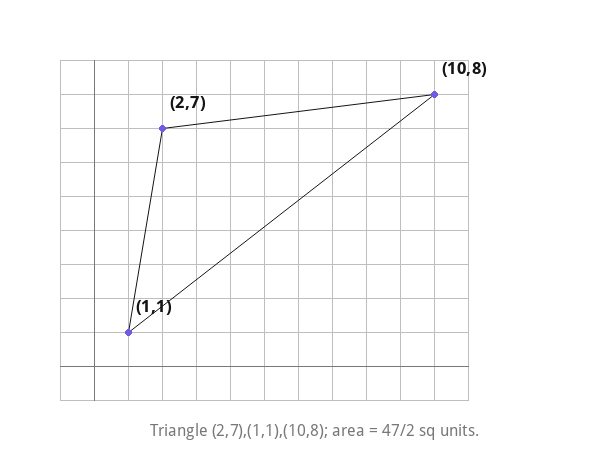
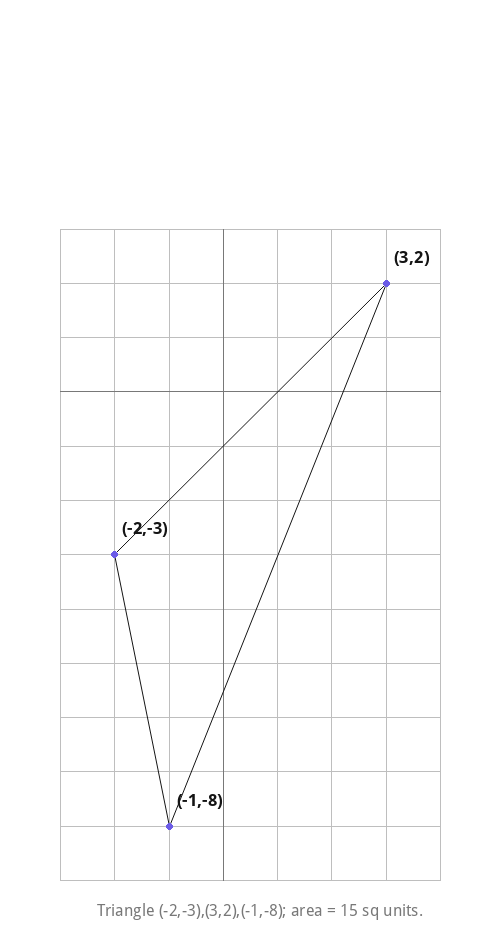
1. Find the area of the triangle with vertices at the points given in each of the following: (i) (1,0), (6,0), (4,3) (ii) (2,7), (1,1), (10,8) (iii) (-2,-3), (3,2), (-1,-8).
Ans: Using Area = ½|x₁(y₂-y₃)+x₂(y₃-y₁)+x₃(y₁-y₂)|: (i) ½|1(0-3)+6(3-0)+4(0-0)| = ½|-3+18| = 15/2 square units. (ii) ½|2(1-8)+1(8-7)+10(7-1)| = ½|-14+1+60| = 47/2 square units. (iii) ½|-2(2-(-8))+3(-8-(-3))+(-1)(-3-2)| = ½|-20-15+5| = 15 square units.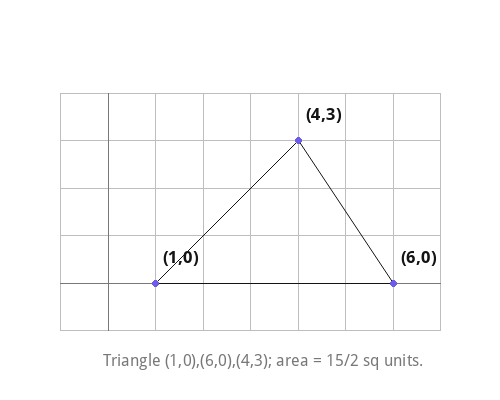
2. Show that points A(a, b+c), B(b, c+a), C(c, a+b) are collinear.
Ans: The area determinant |[a,b+c,1],[b,c+a,1],[c,a+b,1]| expands to a[(c+a)-(a+b)] – (b+c)(b-c) + [b(a+b)-c(c+a)] = a(c-b) – (b²-c²) + (ab+b²-c²-ac) = ac-ab-b²+c²+ab+b²-c²-ac = 0. Since the determinant (and hence the area) is 0, the three points are collinear.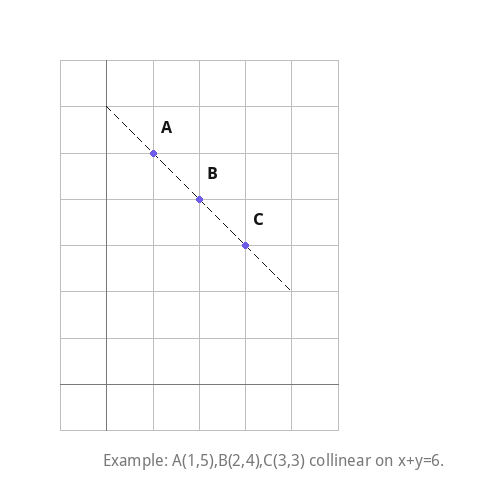
3. Find values of k if the area of the triangle is 4 square units and vertices are: (i) (k,0), (4,0), (0,2) (ii) (-2,0), (0,4), (0,k).
Ans: (i) Area = ½|k(0-2)+4(2-0)+0(0-0)| = ½|-2k+8| = 4, so |{-2k+8}|=8, giving k=0 or k=8. (ii) Area = ½|-2(4-k)+0(k-0)+0(0-4)| = ½|2k-8| = 4, so |2k-8|=8, giving k=0 or k=8.
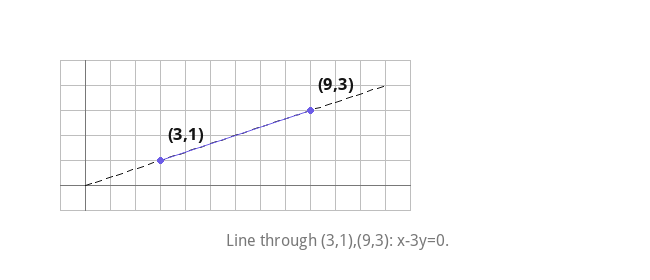
4. (i) Find the equation of the line joining (1,2) and (3,6) using determinants. (ii) Find the equation of the line joining (3,1) and (9,3) using determinants.
Ans: Using |[x,y,1],[x₁,y₁,1],[x₂,y₂,1]|=0: (i) x(2-6)-y(1-3)+1(6-6)=0 ⇒ -4x+2y=0 ⇒ y=2x. (ii) x(1-3)-y(3-9)+1(9-9)=0 ⇒ -2x+6y=0 ⇒ x-3y=0.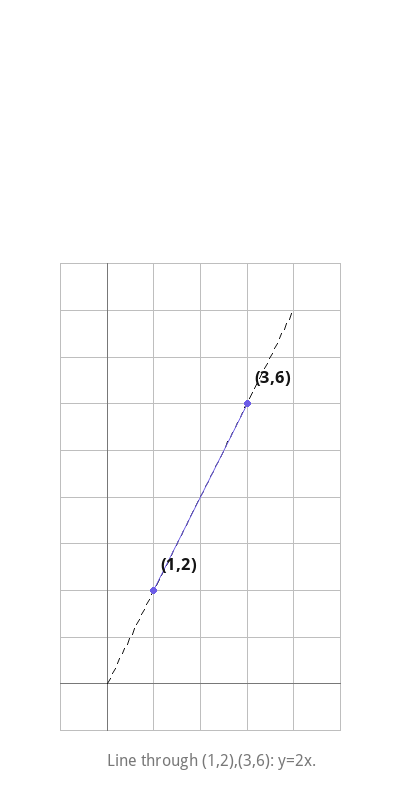
5. If the area of the triangle with vertices (2,-6), (5,4), and (k,4) is 35 square units, then k is: (A) 12 (B) -2 (C) -12, -2 (D) 12, -2.
Ans: (D) 12, -2. Area = ½|2(4-4)+5(4-(-6))+k(-6-4)| = ½|50-10k| = 35, so |50-10k|=70, giving 50-10k=70 (k=-2) or 50-10k=-70 (k=12).
Exercise 4.3 Solutions (All 5 Questions)
1. Write Minors and Cofactors of the elements of the following determinants: (i) |[2,-4],[0,3]| (ii) |[a,c],[b,d]|.
Ans: (i) M₁₁=3, M₁₂=0, M₂₁=-4, M₂₂=2; cofactors A₁₁=3, A₁₂=0, A₂₁=4, A₂₂=2. (ii) M₁₁=d, M₁₂=b, M₂₁=c, M₂₂=a; cofactors A₁₁=d, A₁₂=-b, A₂₁=-c, A₂₂=a.
2. Write Minors and Cofactors of the elements of the determinants: (i) |[1,0,0],[0,1,0],[0,0,1]| (ii) |[1,0,4],[3,5,-1],[0,1,2]|.
Ans: (i) For the identity matrix, every diagonal minor M₁₁=M₂₂=M₃₃=1 and every off-diagonal minor is 0; correspondingly A₁₁=A₂₂=A₃₃=1 and every off-diagonal cofactor is 0. (ii) M₁₁=11, M₁₂=6, M₁₃=3, M₂₁=-4, M₂₂=2, M₂₃=1, M₃₁=-20, M₃₂=-13, M₃₃=5; cofactors A₁₁=11, A₁₂=-6, A₁₃=3, A₂₁=4, A₂₂=2, A₂₃=-1, A₃₁=-20, A₃₂=13, A₃₃=5.
3. Using Cofactors of elements of second row, evaluate Δ = |[5,3,8],[2,0,1],[1,2,3]|.
Ans: The cofactors of row 2 are A₂₁=-(3×3-8×2)=7, A₂₂=(5×3-8×1)=7, A₂₃=-(5×2-3×1)=-7. So Δ = a₂₁A₂₁+a₂₂A₂₂+a₂₃A₂₃ = 2(7)+0(7)+1(-7) = 14+0-7 = 7.
4. Using Cofactors of elements of third column, evaluate Δ = |[1,x,yz],[1,y,zx],[1,z,xy]|.
Ans: The cofactors of column 3 are A₁₃=z-y, A₂₃=-(z-x)=x-z, A₃₃=y-x. So Δ = yz·A₁₃+zx·A₂₃+xy·A₃₃ = yz(z-y)+zx(x-z)+xy(y-x), which simplifies to Δ=(x-y)(y-z)(z-x).
5. If Δ=|a₁₁,a₁₂,a₁₃;a₂₁,a₂₂,a₂₃;a₃₁,a₃₂,a₃₃| and A⁅⁄ denotes the cofactor of element a⁅⁄, then the value of Δ is given by: (A) a₁₁A₃₁+a₁₂A₃₂+a₁₃A₃₃ (B) a₁₁A₁₁+a₁₂A₂₁+a₁₃A₃₁ (C) a₂₁A₁₁+a₂₂A₁₂+a₂₃A₁₃ (D) a₁₁A₁₁+a₂₁A₂₁+a₃₁A₃₁.
Ans: (D) a₁₁A₁₁+a₂₁A₂₁+a₃₁A₃₁ — this is the standard cofactor expansion of a determinant along its first column.
Exercise 4.4 Solutions (All 18 Questions)
1. Find the adjoint of [[1,2],[3,4]].
Ans: adj A = [[4,-2],[-3,1]] — swap the diagonal entries and negate the off-diagonal entries.
2. Find the adjoint of [[1,-1,2],[2,3,5],[-2,0,1]].
Ans: adj A = [[3,1,-11],[-12,5,-1],[6,2,5]] (the transpose of the cofactor matrix).
3. Verify A(adj A) = (adj A)A = |A|I for A=[[2,3],[-4,-6]].
Ans: |A| = (2)(-6)-(3)(-4) = -12+12 = 0. Computing A(adj A) gives the 2×2 zero matrix, which equals |A|I = 0·I. Verified.
4. Verify A(adj A) = (adj A)A = |A|I for A=[[1,-1,2],[3,0,-2],[1,0,3]].
Ans: |A| = 11. Computing both A(adj A) and (adj A)A gives [[11,0,0],[0,11,0],[0,0,11]] = 11I = |A|I. Verified.
5. Find the inverse of [[2,-2],[4,3]].
Ans: |A|=6+8=14. A⁻¹ = (1/14)[[3,2],[-4,2]].
6. Find the inverse of [[-1,5],[-3,2]].
Ans: |A|=-2+15=13. A⁻¹ = (1/13)[[2,-5],[3,-1]].
7. Find the inverse of [[1,2,3],[0,2,4],[0,0,5]].
Ans: |A|=1(10-0)=10. A⁻¹ = (1/10)[[10,-10,2],[0,5,-4],[0,0,2]].
8. Find the inverse of [[1,0,0],[3,3,0],[5,2,-1]].
Ans: |A|=-3. A⁻¹ = (-1/3)[[-3,0,0],[3,-1,0],[-9,-2,3]].
9. Find the inverse of [[2,1,3],[4,-1,0],[-7,2,1]].
Ans: |A|=-3. A⁻¹ = (-1/3)[[-1,5,3],[-4,23,12],[1,-11,-6]].
10. Find the inverse of [[1,-1,2],[0,2,-3],[3,-2,4]].
Ans: |A|=-1. A⁻¹ = [[-2,0,1],[9,2,-3],[6,1,-2]].
11. Find the inverse of [[1,0,0],[0,cosα,sinα],[0,sinα,-cosα]].
Ans: |A| = -cos²α-sin²α = -1. Since A²=I (verified directly using cos²α+sin²α=1), A is its own inverse: A⁻¹ = A = [[1,0,0],[0,cosα,sinα],[0,sinα,-cosα]].
12. Let A=[[3,7],[2,5]] and B=[[6,8],[7,9]]. Verify that (AB)⁻¹ = B⁻¹A⁻¹.
Ans: Both (AB)⁻¹ and B⁻¹A⁻¹ independently work out to [[-61/2,87/2],[47/2,-67/2]]. Verified.
13. If A=[[3,1],[-1,2]], show that A²-5A+7I=O. Hence find A⁻¹.
Ans: Direct computation confirms A²-5A+7I=O. Multiplying through by A⁻¹ gives A-5I+7A⁻¹=O, so A⁻¹=(5I-A)/7=(1/7)[[2,-1],[1,3]].
14. For the matrix A=[[3,2],[1,1]], find the numbers a and b such that A²+aA+bI=O.
Ans: Computing A²=[[11,8],[4,3]] and comparing with -aA-bI entrywise gives a=-4, b=1.
15. For the matrix A=[[1,1,1],[1,2,-3],[2,-1,3]], show that A³-6A²+5A+11I=O. Hence find A⁻¹.
Ans: Direct computation confirms A³-6A²+5A+11I=O. Multiplying through by A⁻¹ and rearranging gives A⁻¹=(1/11)(6A-A²-5I)=(-1/11)[[3,-4,-5],[-9,1,4],[-5,3,1]].
16. If A=[[2,-1,1],[-1,2,-1],[1,-1,2]], verify that A³-6A²+9A-4I=O. Hence find A⁻¹.
Ans: Direct computation confirms A³-6A²+9A-4I=O. Multiplying through by A⁻¹ and rearranging gives A⁻¹=(1/4)(9I-6A+A²)=(1/4)[[3,1,-1],[1,3,1],[-1,1,3]].
17. Let A be a nonsingular square matrix of order 3×3. Then |adj A| is equal to: (A) |A| (B) |A|² (C) |A|³ (D) 3|A|.
Ans: (B) |A|². For an n×n nonsingular matrix, |adj A| = |A|ⁿ⁻¹; here n=3, so |adj A|=|A|².
18. If A is an invertible matrix of order 2, then det(A⁻¹) is equal to: (A) det(A) (B) 1/det(A) (C) 1 (D) 0.
Ans: (B) 1/det(A). Since AA⁻¹=I, det(A)·det(A⁻¹)=det(I)=1, so det(A⁻¹)=1/det(A).
Exercise 4.5 Solutions (All 16 Questions)
Examine the consistency of the following systems of equations (Questions 1-6):
1. x+2y=2, 2x+3y=3.
Ans: |A| = |[1,2],[2,3]| = 3-4 = -1 ≠ 0, so A is nonsingular and the system is consistent with a unique solution.
2. 2x-y=5, x+y=4.
Ans: |A| = |[2,-1],[1,1]| = 2+1 = 3 ≠ 0, so the system is consistent with a unique solution.
3. x+3y=5, 2x+6y=8.
Ans: |A| = |[1,3],[2,6]| = 6-6 = 0, and since (adj A)B ≠ O, the system is inconsistent (no solution).
4. x+y+z=1, 2x+3y+2z=2, ax+ay+2az=4.
Ans: |A| = |[1,1,1],[2,3,2],[a,a,2a]| = a. So |A| ≠ 0 whenever a ≠ 0, meaning the system is consistent with a unique solution for every a ≠ 0.
5. 3x-y-2z=2, 2y-z=-1, 3x-5y=3.
Ans: |A| = |[3,-1,-2],[0,2,-1],[3,-5,0]| = 0, and since (adj A)B ≠ O, the system is inconsistent (no solution).
6. 5x-y+4z=5, 2x+3y+5z=2, 5x-2y+6z=-1.
Ans: |A| = |[5,-1,4],[2,3,5],[5,-2,6]| = 51 ≠ 0, so the system is consistent with a unique solution.
Solve the following systems of equations by matrix method (Questions 7-14):
7. 5x+2y=4, 7x+3y=5.
Ans: |A|=15-14=1. Using X=A⁻¹B: x=2, y=-3.
8. 2x-y=-2, 3x+4y=3.
Ans: |A|=8+3=11. Using X=A⁻¹B: x=-5/11, y=12/11.
9. 4x-3y=3, 3x-5y=7.
Ans: |A|=-20+9=-11. Using X=A⁻¹B: x=-6/11, y=-19/11.
10. 5x+2y=3, 3x+2y=5.
Ans: |A|=10-6=4. Using X=A⁻¹B: x=-1, y=4.
11. 2x+y+z=1, x-2y-z=3/2, 3y-5z=9.
Ans: |A|=34 (nonzero). Using X=A⁻¹B: x=1, y=1/2, z=-3/2.
12. x-y+z=4, 2x+y-3z=0, x+y+z=2.
Ans: |A|=10 (nonzero). Using X=A⁻¹B: x=2, y=-1, z=1.
13. 2x+3y+3z=5, x-2y+z=-4, 3x-y-2z=3.
Ans: |A|=40 (nonzero). Using X=A⁻¹B: x=1, y=2, z=-1.
14. x-y+2z=7, 3x+4y-5z=-5, 2x-y+3z=12.
Ans: |A|=4 (nonzero). Using X=A⁻¹B: x=2, y=1, z=3.
15. If A=[[2,-3,5],[3,2,-4],[1,1,-2]], find A⁻¹. Using A⁻¹, solve the system: 2x-3y+5z=11, 3x+2y-4z=-5, x+y-2z=-3.
Ans: |A|=-1≠0. adj A = [[0,-1,2],[2,-9,23],[1,-5,13]], so A⁻¹=(1/|A|)·adj A = [[0,1,-2],[-2,9,-23],[-1,5,-13]]. Using X=A⁻¹B: x=1, y=2, z=3.
16. The cost of 4 kg onion, 3 kg wheat, and 2 kg rice is Rs 60. The cost of 2 kg onion, 4 kg wheat, and 6 kg rice is Rs 90. The cost of 6 kg onion, 2 kg wheat, and 3 kg rice is Rs 70. Find the cost of each item per kg using matrices.
Ans: Setting up 4o+3w+2r=60, 2o+4w+6r=90, 6o+2w+3r=70 and solving by the matrix method gives onion = Rs 5/kg, wheat = Rs 8/kg, rice = Rs 8/kg.
Miscellaneous Exercise Solutions (All 9 Questions)
1. Prove that the determinant |[x,sinθ,cosθ],[-sinθ,-x,1],[cosθ,1,x]| is independent of θ.
Ans: Expanding along the first row: x(-x-cosθ)-sinθ(-sinθ-cosθ)+cosθ(-sinθ+x cosθ) simplifies, using sin²θ+cos²θ=1, to −x³. Since θ cancels out entirely, the determinant is independent of θ and always equals −x³.
2. Without expanding, evaluate |[cosα cosβ, cosα sinβ, -sinα],[-sinβ, cosβ, 0],[sinα cosβ, sinα sinβ, cosα]|.
Ans: Expanding and simplifying using sin²+cos²=1 for both α and β throughout, every term collapses to give the value 1.
3. If A⁻¹=[[3,-1,1],[-15,6,-5],[5,-2,2]] and B=[[1,2,-2],[-1,3,0],[0,-2,1]], find (AB)⁻¹.
Ans: Using (AB)⁻¹=B⁻¹A⁻¹: first |B|=1, giving B⁻¹=[[3,2,6],[1,1,2],[2,2,5]]. Multiplying B⁻¹A⁻¹ gives (AB)⁻¹ = [[9,-3,5],[-2,1,0],[1,0,2]].
4. Let A=[[1,-2,1],[-2,3,1],[1,1,5]]. Verify that (i) [adj A]⁻¹ = adj(A⁻¹) (ii) (A⁻¹)⁻¹ = A.
Ans: |A|=-13. Computing both [adj A]⁻¹ and adj(A⁻¹) gives the same matrix, (-1/13)[[1,-2,1],[-2,3,1],[1,1,5]], verifying (i). Since inverting a matrix twice always returns the original matrix, (A⁻¹)⁻¹=A is also verified.
5. Evaluate |[x,y,x+y],[y,x+y,x],[x+y,x,y]|.
Ans: Applying C₁→C₁+C₂+C₃ factors out 2(x+y) from the first column, and expanding the remaining determinant gives −2(x³+y³).
6. Evaluate |[1,x,y],[1,x+y,y],[1,x,x+y]|.
Ans: Applying R₂→R₂-R₁ and R₃→R₃-R₁ reduces this to a simple 2×2 expansion, giving the value xy.
7. Solve the system: 2/x+3/y+10/z=4, 4/x-6/y+5/z=1, 6/x+9/y-20/z=2.
Ans: Substituting u=1/x, v=1/y, w=1/z turns this into the linear system 2u+3v+10w=4, 4u-6v+5w=1, 6u+9v-20w=2, which solves to u=1/2, v=1/3, w=1/5. Hence x=2, y=3, z=5.
8. If x, y, z are nonzero real numbers, then the inverse of matrix A=[[x,0,0],[0,y,0],[0,0,z]] is: (A) [[x⁻¹,0,0],[0,y⁻¹,0],[0,0,z⁻¹]] (B) xyz[[x⁻¹,0,0],[0,y⁻¹,0],[0,0,z⁻¹]] (C) (1/xyz)[[x,0,0],[0,y,0],[0,0,z]] (D) (1/xyz)[[1,0,0],[0,1,0],[0,0,1]].
Ans: (A). For a diagonal matrix, the inverse is simply the diagonal matrix of reciprocals: A⁻¹=[[x⁻¹,0,0],[0,y⁻¹,0],[0,0,z⁻¹]] (easily confirmed since |A|=xyz and adj A = diag(yz,xz,xy)).
9. Let A=[[1,sinθ,1],[-sinθ,1,sinθ],[-1,-sinθ,1]], where 0≤θ≤2π. Then: (A) Det(A)=0 (B) Det(A)∈(2,∞) (C) Det(A)∈(2,4) (D) Det(A)∈[2,4].
Ans: (D). Expanding gives Det(A)=2(1+sin²θ). Since sin²θ ranges over [0,1] as θ varies over [0,2π], Det(A) ranges over [2,4].
- Chapter 1: Relations and Functions – Free PDF Download
- Chapter 2: Inverse Trigonometric Functions – Free PDF Download
- Chapter 3: Matrices – Free PDF Download
- Chapter 5: Continuity and Differentiability – Free PDF Download
- Chapter 6: Applications of Derivatives – Free PDF Download
- Chapter 7: Integrals – Free PDF Download
- Chapter 8: Applications of Integrals – Free PDF Download
- Chapter 9: Differential Equations – Free PDF Download
- Chapter 10: Vectors – Free PDF Download
- Chapter 11: Three-Dimensional Geometry – Free PDF Download
- Chapter 12: Linear Programming – Free PDF Download
- Chapter 13: Probability – Free PDF Download
Frequently Asked Questions
What is the area of a triangle using determinants?
Area = ½|x₁(y₂-y₃)+x₂(y₃-y₁)+x₃(y₁-y₂)|, expressed as a 3×3 determinant.
How does |kA| relate to |A| for an n×n matrix?
|kA| = kⁿ|A|.
Chapter Quiz — Test Your Understanding
Class 12 Mathematics Chapter 4 – Notes and Extra Questions
Along with these NCERT Solutions, students can also use the Class 12 Mathematics Chapter 4 Extra Questions and Class 12 Mathematics Chapter 4 Revision Notes for quick revision and extra practice.
Recommended: Buy the Printed NCERT Class 12 Maths Book
Contains Amazon affiliate links.
If you’d like a printed copy alongside the PDF, here’s a verified option:
4.3 out of 5 stars (899 ratings) · Rs. 94
Price and availability may change on Amazon. As an Amazon Associate, ncertbooks.org earns from qualifying purchases.



Pingback: Class 12 Maths Chapter 6 Applications of Derivatives Solutions (2026-27)
Pingback: Class 12 Maths Chapter 7 Integrals Solutions (2026-27)
Pingback: Class 12 Maths Chapter 8 Applications of Integrals Solutions (2026-27)
Pingback: Class 12 Maths Chapter 12 Linear Programming Solutions (2026-27)
Pingback: Class 12 Maths Chapter 5 Continuity and Differentiability Extra Questions (2026-27)
Pingback: Class 12 Maths Chapter 5 Continuity and Differentiability Revision Notes (2026-27)
Pingback: Class 12 Maths Chapter 4 Determinants Revision Notes (2026-27)