
NCERT Solutions for Class 11 Maths Chapter 14 Probability cover events, mutually exclusive and exhaustive events, the axiomatic approach to probability, and the addition theorem of probability, including step-by-step answers to every question from Exercise 14.1, Exercise 14.2, and the Miscellaneous Exercise, based on the latest NCERT textbook (Reprint 2026-27). These solutions help students master sample-space based classical probability problems involving coins, dice, and cards, which form a key part of the CBSE Class 11 Maths syllabus.
Last Updated: September 23, 2026
Exercise 14.1
Q1. A die is rolled. Let E be the event "die shows 4" and F be the event "die shows even number". Are E and F mutually exclusive? — The sample space is S = {1, 2, 3, 4, 5, 6}. Here E = {4} and F = {2, 4, 6}. Since E ∩…
The sample space is S = {1, 2, 3, 4, 5, 6}. Here E = {4} and F = {2, 4, 6}. Since E ∩ F = {4} ≠ φ, the events E and F are not mutually exclusive.
Q2. A die is thrown. Describe the following events: (i) A: a number less than 7 (ii) B: a number greater than 7 (iii) C: a multiple of 3 (iv) D: a number less than 4 (v) E: an even number greater than 4 (vi) F: a number not less than 3. Also find A∪B, A∩B, B∪C, E∩F, D∩E, A–C, D–E, E∩F′, F′ — The sample space is S = {1, 2, 3, 4, 5, 6}.
The sample space is S = {1, 2, 3, 4, 5, 6}.
- A = {1, 2, 3, 4, 5, 6}
- B = φ
- C = {3, 6}
- D = {1, 2, 3}
- E = {6}
- F = {3, 4, 5, 6}
Now, A∪B = {1, 2, 3, 4, 5, 6} = S; A∩B = φ; B∪C = {3, 6}; E∩F = {6}; D∩E = φ; A–C = {1, 2, 4, 5}; D–E = {1, 2, 3}; F′ = {1, 2}; E∩F′ = φ.
Q3. An experiment involves rolling a pair of dice and recording the numbers that come up. Describe the following events: A: the sum is greater than 8, B: 2 occurs on either die C: the sum is at least 7 and a multiple of 3. Which pairs of these events are mutually exclusive? — The sample space consists of 36 equally likely outcomes (i, j), i, j = 1 to 6.
The sample space consists of 36 equally likely outcomes (i, j), i, j = 1 to 6.
A = {(3,6),(4,5),(5,4),(6,3),(4,6),(5,5),(6,4),(5,6),(6,5),(6,6)}
B = {(2,1),(2,2),(2,3),(2,4),(2,5),(2,6),(1,2),(3,2),(4,2),(5,2),(6,2)}
C = {(3,6),(4,5),(5,4),(6,3),(6,6)}
Since no outcome in A has a 2, A∩B = φ, so A and B are mutually exclusive. Since B has no outcome with sum 9 or 12, B∩C = φ, so B and C are mutually exclusive. Since every outcome of C is also in A, A∩C = C ≠ φ, so A and C are not mutually exclusive. Hence, the pairs (A, B) and (B, C) are mutually exclusive.
Q4. Three coins are tossed once. Let A denote the event "three heads show", B denote the event "two heads and one tail show", C denote the event "three tails show" and D denote the event "a head shows on the first coin". Which events are (i) mutually exclusive? (ii) simple? (iii) Compound? — S = {HHH, HHT, HTH, HTT, THH, THT, TTH, TTT}. A = {HHH}, B = {HHT, HTH, THH}, C = {TTT},…
S = {HHH, HHT, HTH, HTT, THH, THT, TTH, TTT}. A = {HHH}, B = {HHT, HTH, THH}, C = {TTT}, D = {HHH, HHT, HTH, HTT}.
- A∩B = φ, A∩C = φ, B∩C = φ, C∩D = φ, but A∩D = {HHH} ≠ φ and B∩D = {HHT, HTH} ≠ φ. So the mutually exclusive pairs are (A, B), (A, C), (B, C) and (C, D).
- Simple events (single sample point): A = {HHH} and C = {TTT} are simple events.
- Compound events (more than one sample point): B and D are compound events.
Q5. Three coins are tossed. Describe (i) Two events which are mutually exclusive. (ii) Three events which are mutually exclusive and exhaustive. (iii) Two events, which are not mutually exclusive. (iv) Two events which are mutually exclusive but not exhaustive. (v) Three events which are mutually exclusive but not exhaustive — S = {HHH, HHT, HTH, HTT, THH, THT, TTH, TTT}.
S = {HHH, HHT, HTH, HTT, THH, THT, TTH, TTT}.
- Let E1: “all heads” = {HHH} and E2: “all tails” = {TTT}. E1∩E2 = φ, so they are mutually exclusive.
- Let E1: “no head” = {TTT}, E2: “exactly one head” = {HTT, THT, TTH}, E3: “at least two heads” = {HHH, HHT, HTH, THH}. These are pairwise disjoint and E1∪E2∪E3 = S, so they are mutually exclusive and exhaustive.
- Let E1: “head on the first coin” = {HHH, HHT, HTH, HTT} and E2: “head on the second coin” = {HHH, HHT, THH, THT}. Since E1∩E2 = {HHH, HHT} ≠ φ, they are not mutually exclusive.
- Let E1: “all heads” = {HHH} and E2: “all tails” = {TTT}. E1∩E2 = φ (mutually exclusive), but E1∪E2 ≠ S (not exhaustive).
- Let E1 = {HHH}, E2 = {TTT}, E3: “exactly two heads” = {HHT, HTH, THH}. These are pairwise disjoint (mutually exclusive), but their union does not include the “exactly one head” outcomes, so E1∪E2∪E3 ≠ S (not exhaustive).
Q6. Two dice are thrown. The events A, B and C are as follows: A: getting an even number on the first die. B: getting an odd number on the first die. C: getting the sum of the numbers on the dice ≤ 5. Describe the events (i) A′ (ii) not B (iii) A or B (iv) A and B (v) A but not C (vi) B or C (vii) B and C (viii) A∩B′∩C′ — The sample space has 36 outcomes. A = {(i,j): i is even}, 18 outcomes; B = {(i,j): i is…
The sample space has 36 outcomes. A = {(i,j): i is even}, 18 outcomes; B = {(i,j): i is odd}, 18 outcomes; C = {(i,j): i+j ≤ 5} = {(1,1),(1,2),(1,3),(1,4),(2,1),(2,2),(2,3),(3,1),(3,2),(4,1)}, 10 outcomes.
- A′ = B, since first die being “not even” means it is odd.
- not B = B′ = A.
- A or B = A∪B = S (all 36 outcomes), since every first-die value is either even or odd.
- A and B = A∩B = φ, since the first die cannot show both an even and an odd number.
- A but not C = A – C = A ∩ C′. Since A∩C = {(2,1),(2,2),(2,3),(4,1)}, A – C consists of the remaining 14 outcomes of A.
- B or C = B∪C. Since B∩C = {(1,1),(1,2),(1,3),(1,4),(3,1),(3,2)} (6 outcomes), n(B∪C) = 18 + 10 – 6 = 22 outcomes.
- B and C = B∩C = {(1,1),(1,2),(1,3),(1,4),(3,1),(3,2)}, 6 outcomes.
- A∩B′∩C′: Since B′ = A, A∩B′ = A. So A∩B′∩C′ = A∩C′ = A – C, the same 14 outcomes found in (v).
Q7. Refer to question 6 above, state true or false: (give reason for your answer) (i) A and B are mutually exclusive (ii) A and B are mutually exclusive and exhaustive (iii) A = B′ (iv) A and C are mutually exclusive (v) A and B′ are mutually exclusive. (vi) A′, B′, C are mutually exclusive and exhaustive.
- True. A∩B = φ since the first die cannot be both even and odd.
- True. A∩B = φ and A∪B = S.
- True. Since A and B partition S, A is exactly the complement of B, so A = B′.
- False. A∩C = {(2,1),(2,2),(2,3),(4,1)} ≠ φ, so A and C are not mutually exclusive.
- False. Since B′ = A, A∩B′ = A∩A = A ≠ φ, so they are not mutually exclusive.
- False. A′ = B and B′ = A, so this reduces to asking if A, B, C are mutually exclusive, but A∩C ≠ φ as shown in (iv).
Exercise 14.2
Q1. Which of the following can not be valid assignment of probabilities for outcomes of sample Space S = {ω1, ω2, ω3, ω4, ω5, ω6, ω7}?
- (a) 0.1, 0.01, 0.05, 0.03, 0.01, 0.2, 0.6 — Sum = 1 and each value lies in [0, 1], so this is a valid assignment.
- (b) 1/7 each — Sum = 7 × 1/7 = 1 and each lies in [0, 1], so this is a valid assignment.
- (c) 0.1, 0.2, 0.3, 0.4, 0.5, 0.6, 0.7 — Sum = 2.8 ≠ 1, so this assignment is not valid.
- (d) −0.1, 0.2, 0.3, 0.4, −0.2, 0.1, 0.3 — Contains negative probabilities, so this assignment is not valid.
- (e) 1/14, 2/14, 3/14, 4/14, 5/14, 6/14, 15/14 — The last value 15/14 exceeds 1, and the sum = 36/14 ≠ 1, so this assignment is not valid.
Q2. A coin is tossed twice, what is the probability that atleast one tail occurs? — S = {HH, HT, TH, TT}, each outcome has probability 1/4. Atleast one tail = {HT, TH, TT}.…
S = {HH, HT, TH, TT}, each outcome has probability 1/4. Atleast one tail = {HT, TH, TT}. So P(atleast one tail) = 3/4.
Q3. A die is thrown, find the probability of following events: (i) A prime number will appear (ii) A number greater than or equal to 3 will appear (iii) A number less than or equal to one will appear (iv) A number more than 6 will appear (v) A number less than 6 will appear — S = {1, 2, 3, 4, 5, 6}, each outcome has probability 1/6.
S = {1, 2, 3, 4, 5, 6}, each outcome has probability 1/6.
- Prime numbers = {2, 3, 5}, P = 3/6 = 1/2
- Numbers ≥ 3 = {3, 4, 5, 6}, P = 4/6 = 2/3
- Numbers ≤ 1 = {1}, P = 1/6
- Numbers > 6 = φ, P = 0
- Numbers < 6 = {1, 2, 3, 4, 5}, P = 5/6
Q4. A card is selected from a pack of 52 cards. (a) How many points are there in the sample space? (b) Calculate the probability that the card is an ace of spades. (c) Calculate the probability that the card is (i) an ace (ii) black card.
- (a) There are 52 points in the sample space.
- (b) P(ace of spades) = 1/52
- (c)(i) P(ace) = 4/52 = 1/13; (ii) P(black card) = 26/52 = 1/2
Q5. A fair coin with 1 marked on one face and 6 on the other and a fair die are both tossed. Find the probability that the sum of numbers that turn up is (i) 3 (ii) 12 — Coin outcomes {1, 6}, die outcomes {1, 2, 3, 4, 5, 6}, giving 12 equally likely outcomes.
Coin outcomes {1, 6}, die outcomes {1, 2, 3, 4, 5, 6}, giving 12 equally likely outcomes.
- Sum = 3 occurs only for (1, 2), so P = 1/12
- Sum = 12 occurs only for (6, 6), so P = 1/12
Q6. There are four men and six women on the city council. If one council member is selected at random, how likely is it that it is a woman? — Total council members = 10, of which 6 are women. P(woman) = 6/10 = 3/5.
Total council members = 10, of which 6 are women. P(woman) = 6/10 = 3/5.
Q7. A fair coin is tossed four times, and a person win Re 1 for each head and lose Rs 1.50 for each tail that turns up. From the sample space calculate how many different amounts of money you can have after four tosses and the probability of having each of these amounts — There are 2⁴ = 16 equally likely outcomes. If h heads occur (and 4 − h tails), the…
There are 2⁴ = 16 equally likely outcomes. If h heads occur (and 4 − h tails), the amount won is h(1) − (4 − h)(1.5) = 2.5h − 6. The five possible values of h (0 to 4) give five distinct amounts, so there are 5 different amounts:
- h = 0: amount = −₹6, number of ways = ⁴C₀ = 1, P = 1/16
- h = 1: amount = −₹3.50, number of ways = ⁴C₁ = 4, P = 4/16 = 1/4
- h = 2: amount = −₹1, number of ways = ⁴C₂ = 6, P = 6/16 = 3/8
- h = 3: amount = ₹1.50, number of ways = ⁴C₃ = 4, P = 4/16 = 1/4
- h = 4: amount = ₹4, number of ways = ⁴C₄ = 1, P = 1/16
Q8. Three coins are tossed once. Find the probability of getting (i) 3 heads (ii) 2 heads (iii) atleast 2 heads (iv) atmost 2 heads (v) no head (vi) 3 tails (vii) exactly two tails (viii) no tail (ix) atmost two tails — S has 8 equally likely outcomes, each with probability 1/8.
S has 8 equally likely outcomes, each with probability 1/8.
- 3 heads: {HHH}, P = 1/8
- 2 heads: {HHT, HTH, THH}, P = 3/8
- Atleast 2 heads: {HHH, HHT, HTH, THH}, P = 4/8 = 1/2
- Atmost 2 heads: 1 − P(3 heads) = 1 − 1/8 = 7/8
- No head: {TTT}, P = 1/8
- 3 tails: {TTT}, P = 1/8
- Exactly two tails: {HTT, THT, TTH}, P = 3/8
- No tail: {HHH}, P = 1/8
- Atmost two tails: 1 − P(3 tails) = 1 − 1/8 = 7/8
Q9. If 2/11 is the probability of an event, what is the probability of the event 'not A' — P(not A) = 1 − P(A) = 1 − 2/11 = 9/11.
P(not A) = 1 − P(A) = 1 − 2/11 = 9/11.
Q10. A letter is chosen at random from the word 'ASSASSINATION'. Find the probability that letter is (i) a vowel (ii) a consonant — The word ASSASSINATION has 13 letters, with vowels A, A, I, A, I, O (6 vowels: 3 A's, 2…
The word ASSASSINATION has 13 letters, with vowels A, A, I, A, I, O (6 vowels: 3 A’s, 2 I’s, 1 O) and consonants S, S, S, S, N, T, N (7 consonants: 4 S’s, 2 N’s, 1 T).
- P(vowel) = 6/13
- P(consonant) = 7/13
Q11. In a lottery, a person choses six different natural numbers at random from 1 to 20, and if these six numbers match with the six numbers already fixed by the lottery committee, he wins the prize. What is the probability of winning the prize in the game? [Hint order of the numbers is not important.] — Total ways to choose 6 numbers out of 20 = ²⁰C₆ = 38760. Only one combination…
Total ways to choose 6 numbers out of 20 = ²⁰C₆ = 38760. Only one combination matches the fixed numbers. So P(winning) = 1/38760.
Q12. Check whether the following probabilities P(A) and P(B) are consistently defined (i) P(A)=0.5, P(B)=0.7, P(A∩B)=0.6 (ii) P(A)=0.5, P(B)=0.4, P(A∪B)=0.8
- Since A∩B ⊆ A, we must have P(A∩B) ≤ P(A). Here P(A∩B) = 0.6 > P(A) = 0.5, which is impossible. So P(A) and P(B) are not consistently defined.
- P(A∩B) = P(A) + P(B) − P(A∪B) = 0.5 + 0.4 − 0.8 = 0.1. Since 0 ≤ P(A∩B) ≤ min{P(A), P(B)}, this is valid. So P(A) and P(B) are consistently defined.
Q13. Fill in the blanks in following table:
- (i) P(A) = 1/3, P(B) = 1/5, P(A∩B) = 1/15 ⇒ P(A∪B) = P(A) + P(B) − P(A∩B) = 1/3 + 1/5 − 1/15 = 7/15
- (ii) P(A) = 0.35, P(A∩B) = 0.25, P(A∪B) = 0.6 ⇒ P(B) = P(A∪B) − P(A) + P(A∩B) = 0.6 − 0.35 + 0.25 = 0.5
- (iii) P(A) = 0.5, P(B) = 0.35, P(A∪B) = 0.7 ⇒ P(A∩B) = P(A) + P(B) − P(A∪B) = 0.5 + 0.35 − 0.7 = 0.15
Q14. Given P(A)=3/5 and P(B)=1/5. Find P(A or B), if A and B are mutually exclusive events — Since A and B are mutually exclusive, P(A∪B) = P(A) + P(B) = 3/5 + 1/5 = 4/5.
Since A and B are mutually exclusive, P(A∪B) = P(A) + P(B) = 3/5 + 1/5 = 4/5.
Q15. If E and F are events such that P(E)=1/4, P(F)=1/2 and P(E and F)=1/8, find (i) P(E or F), (ii) P(not E and not F).
- P(E or F) = P(E∪F) = P(E) + P(F) − P(E∩F) = 1/4 + 1/2 − 1/8 = 5/8
- P(not E and not F) = P(E′∩F′) = 1 − P(E∪F) = 1 − 5/8 = 3/8
Q16. Events E and F are such that P(not E or not F)=0.25, State whether E and F are mutually exclusive — P(E′∪F′) = 0.25 ⇒ P((E∩F)′) = 0.25 ⇒ P(E∩F) = 1 − 0.25 = 0.75. Since…
P(E′∪F′) = 0.25 ⇒ P((E∩F)′) = 0.25 ⇒ P(E∩F) = 1 − 0.25 = 0.75. Since P(E∩F) = 0.75 ≠ 0, E and F are not mutually exclusive.
Q17. A and B are events such that P(A)=0.42, P(B)=0.48 and P(A and B)=0.16. Determine (i) P(not A), (ii) P(not B) and (iii) P(A or B)
- P(not A) = 1 − 0.42 = 0.58
- P(not B) = 1 − 0.48 = 0.52
- P(A or B) = P(A) + P(B) − P(A∩B) = 0.42 + 0.48 − 0.16 = 0.74
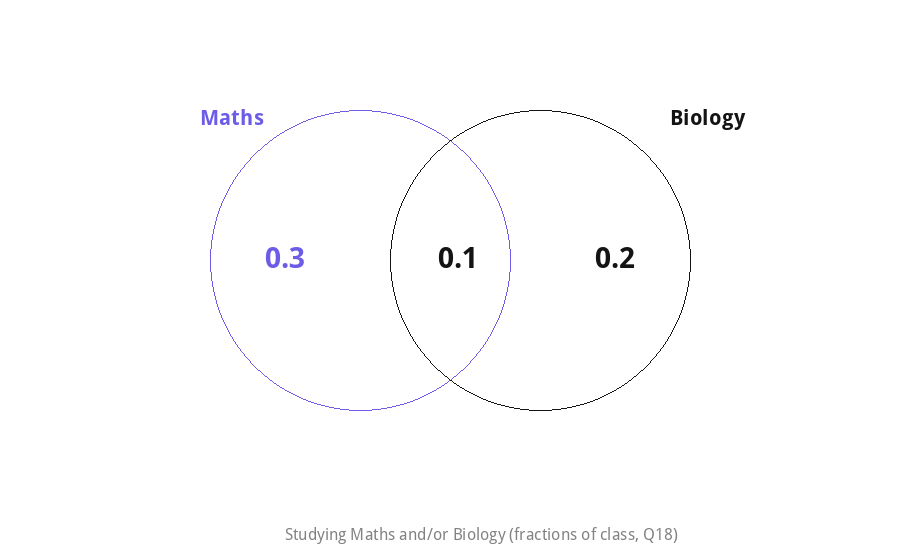
Q18. In Class XI of a school 40% of the students study Mathematics and 30% study Biology. 10% of the class study both Mathematics and Biology. If a student is selected at random from the class, find the probability that he will be studying Mathematics or Biology — P(M) = 0.4, P(B) = 0.3, P(M∩B) = 0.1. P(M∪B) = 0.4 + 0.3 − 0.1 = 0.6.
P(M) = 0.4, P(B) = 0.3, P(M∩B) = 0.1. P(M∪B) = 0.4 + 0.3 − 0.1 = 0.6.
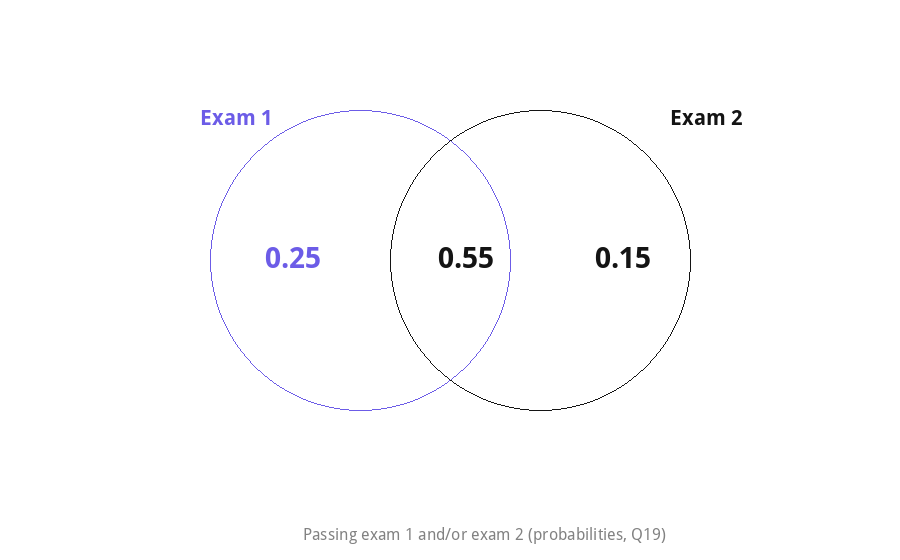
Q19. In an entrance test that is graded on the basis of two examinations, the probability of a randomly chosen student passing the first examination is 0.8 and the probability of passing the second examination is 0.7. The probability of passing atleast one of them is 0.95. What is the probability of passing both? — P(A∪B) = P(A) + P(B) − P(A∩B) ⇒ 0.95 = 0.8 + 0.7 − P(A∩B) ⇒ P(A∩B) = 1.5…
P(A∪B) = P(A) + P(B) − P(A∩B) ⇒ 0.95 = 0.8 + 0.7 − P(A∩B) ⇒ P(A∩B) = 1.5 − 0.95 = 0.55.
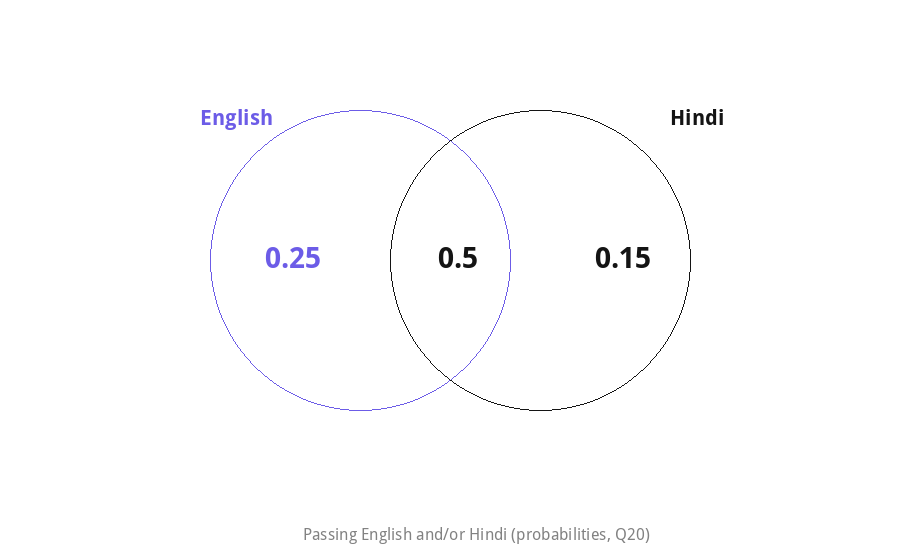
Q20. The probability that a student will pass the final examination in both English and Hindi is 0.5 and the probability of passing neither is 0.1. If the probability of passing the English examination is 0.75, what is the probability of passing the Hindi examination? — P(E∩H) = 0.5, P(E′∩H′) = 0.1 ⇒ P(E∪H) = 1 − 0.1 = 0.9. Since P(E∪H) =…
P(E∩H) = 0.5, P(E′∩H′) = 0.1 ⇒ P(E∪H) = 1 − 0.1 = 0.9. Since P(E∪H) = P(E) + P(H) − P(E∩H): 0.9 = 0.75 + P(H) − 0.5 ⇒ P(H) = 0.65.
Q21. In a class of 60 students, 30 opted for NCC, 32 opted for NSS and 24 opted for both NCC and NSS. If one of these students is selected at random, find the probability that (i) The student opted for NCC or NSS. (ii) The student has opted neither NCC nor NSS. (iii) The student has opted NSS but not NCC — P(NCC) = 30/60 = 1/2, P(NSS) = 32/60 = 8/15, P(NCC∩NSS) = 24/60 = 2/5.
P(NCC) = 30/60 = 1/2, P(NSS) = 32/60 = 8/15, P(NCC∩NSS) = 24/60 = 2/5.
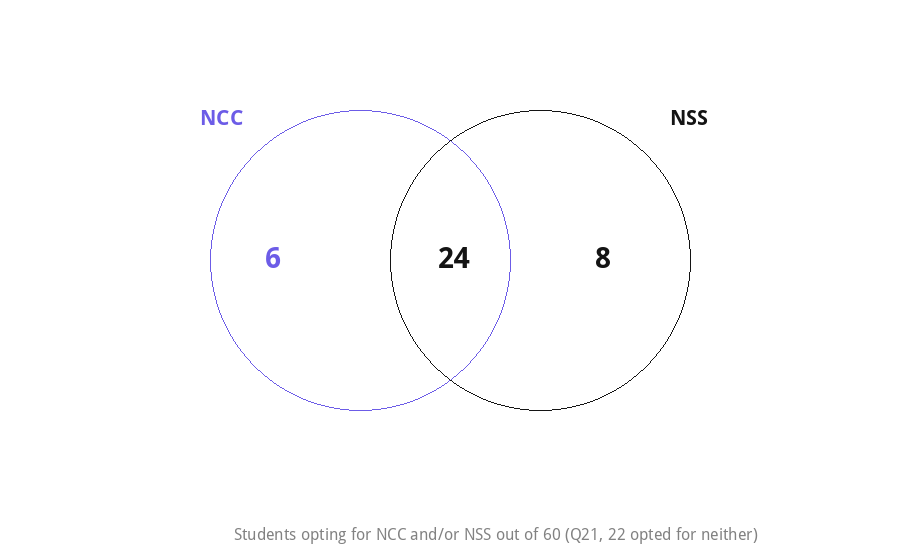
- P(NCC or NSS) = 1/2 + 8/15 − 2/5 = 15/30 + 16/30 − 12/30 = 19/30
- P(neither NCC nor NSS) = 1 − 19/30 = 11/30
- P(NSS but not NCC) = P(NSS) − P(NCC∩NSS) = 8/15 − 2/5 = 8/15 − 6/15 = 2/15
Miscellaneous Exercise
Q1. A box contains 10 red, 20 blue and 30 green marbles. 5 marbles are drawn from the box, what is the probability that (i) all will be blue? (ii) atleast one will be green? — Total marbles = 60. Total ways to draw 5 marbles = ⁶⁰C₅ = 5,461,512.
Total marbles = 60. Total ways to draw 5 marbles = ⁶⁰C₅ = 5,461,512.
- All blue: ²⁰C₅/⁶⁰C₅ = 15504/5461512 = 34/11977
- Atleast one green = 1 − P(no green) = 1 − ³⁰C₅/⁶⁰C₅ = 1 − 142506/5461512 = 1 − 117/4484 = 4367/4484
Q2. 4 cards are drawn from a well-shuffled deck of 52 cards. What is the probability of obtaining 3 diamonds and one spade? — Number of favourable ways = ¹³C₃ × ¹³C₁ = 286 × 13 = 3718. Total ways =…
Number of favourable ways = ¹³C₃ × ¹³C₁ = 286 × 13 = 3718. Total ways = ⁵²C₄ = 270725. So P = 3718/270725 = 286/20825.
Q3. A die has two faces each with number '1', three faces each with number '2' and one face with number '3'. If die is rolled once, determine (i) P(2) (ii) P(1 or 3) (iii) P(not 3) — P(1) = 2/6 = 1/3, P(2) = 3/6 = 1/2, P(3) = 1/6.
P(1) = 2/6 = 1/3, P(2) = 3/6 = 1/2, P(3) = 1/6.
- P(2) = 1/2
- P(1 or 3) = P(1) + P(3) = 1/3 + 1/6 = 1/2
- P(not 3) = 1 − 1/6 = 5/6
Q4. In a certain lottery 10,000 tickets are sold and ten equal prizes are awarded. What is the probability of not getting a prize if you buy (a) one ticket (b) two tickets (c) 10 tickets.
- (a) P(no prize with 1 ticket) = 9990/10000 = 999/1000
- (b) P(no prize with 2 tickets) = (9990/10000) × (9989/9999) = 1108779/1111000 ≈ 0.998
- (c) P(no prize with 10 tickets) = (9990/10000) × (9989/9999) × (9988/9998) × … × (9981/9991), the product of 10 successive terms ≈ 0.9900
Q5. Out of 100 students, two sections of 40 and 60 are formed. If you and your friend are among the 100 students, what is the probability that (a) you both enter the same section? (b) you both enter the different sections? — P(both in the 40-section) = (40 × 39)/(100 × 99) = 26/165. P(both in the 60-section) =…
P(both in the 40-section) = (40 × 39)/(100 × 99) = 26/165. P(both in the 60-section) = (60 × 59)/(100 × 99) = 59/165.
- P(both same section) = 26/165 + 59/165 = 85/165 = 17/33
- P(both different sections) = 1 − 17/33 = 16/33
Q6. Three letters are dictated to three persons and an envelope is addressed to each of them, the letters are inserted into the envelopes at random so that each envelope contains exactly one letter. Find the probability that at least one letter is in its proper envelope — Total arrangements = 3! = 6. Number of arrangements with no letter in its correct…
Total arrangements = 3! = 6. Number of arrangements with no letter in its correct envelope (derangements) = 2. So P(atleast one letter correct) = 1 − 2/6 = 1 − 1/3 = 2/3.
Q7. A and B are two events such that P(A)=0.54, P(B)=0.69 and P(A∩B)=0.35. Find (i) P(A∪B) (ii) P(A′∩B′) (iii) P(A∩B′) (iv) P(B∩A′)
- P(A∪B) = 0.54 + 0.69 − 0.35 = 0.88
- P(A′∩B′) = 1 − P(A∪B) = 1 − 0.88 = 0.12
- P(A∩B′) = P(A) − P(A∩B) = 0.54 − 0.35 = 0.19
- P(B∩A′) = P(B) − P(A∩B) = 0.69 − 0.35 = 0.34
Q8. From the employees of a company, 5 persons are selected to represent them in the managing committee of the company. Particulars of five persons are as follows: Harish (M, 30), Rohan (M, 33), Sheetal (F, 46), Alis (F, 28), Salim (M, 41). A person is selected at random from this group to act as a spokesperson. What is the probability that the spokesperson will be either male or over 35 years? — Males = {Harish, Rohan, Salim}, so P(Male) = 3/5. Over 35 = {Sheetal, Salim}, so P(over…
Males = {Harish, Rohan, Salim}, so P(Male) = 3/5. Over 35 = {Sheetal, Salim}, so P(over 35) = 2/5. Male and over 35 = {Salim}, so P(Male ∩ over 35) = 1/5. P(Male or over 35) = 3/5 + 2/5 − 1/5 = 4/5.
Q9. If 4-digit numbers greater than 5,000 are randomly formed from the digits 0, 1, 3, 5, and 7, what is the probability of forming a number divisible by 5 when, (i) the digits are repeated? (ii) the repetition of digits is not allowed?
- With repetition: the first digit must be 5 or 7 (2 ways), and each of the other 3 digits can be any of 5 digits, giving 2 × 5 × 5 × 5 = 250 total numbers greater than 5000. For divisibility by 5, the last digit must be 0 or 5 (2 ways), the first digit 2 ways, and the two middle digits 5 ways each, giving 2 × 5 × 5 × 2 = 100 favourable numbers. So P = 100/250 = 2/5.
- Without repetition: the first digit is 5 or 7 (2 ways), and the remaining 3 digits are chosen from the remaining 4 digits without repetition (4 × 3 × 2 = 24 ways), giving 2 × 24 = 48 total numbers. Case first digit = 5: last digit must be 0, middle two digits arranged from {1,3,7}, giving 3 × 2 = 6 numbers. Case first digit = 7: last digit is 0 or 5. If last digit = 0, middle two from {1,3,5}: 3 × 2 = 6; if last digit = 5, middle two from {0,1,3}: 3 × 2 = 6, giving 12 numbers. Total favourable = 6 + 12 = 18. So P = 18/48 = 3/8.
Q10. The number lock of a suitcase has 4 wheels, each labelled with ten digits i.e., from 0 to 9. The lock opens with a sequence of four digits with no repeats. What is the probability of a person getting the right sequence to open the suitcase? — Total number of possible 4-digit sequences with no repeats = 10 × 9 × 8 × 7 = 5040.…
Total number of possible 4-digit sequences with no repeats = 10 × 9 × 8 × 7 = 5040. Only one sequence is correct. So P(right sequence) = 1/5040.
Class 11 Maths Chapter 14 – Notes and Extra Questions
- An event is any subset of the sample space; a simple event has exactly one sample point, while a compound event has more than one.
- Two events A and B are mutually exclusive if A ∩ B = φ, and a collection of events is exhaustive if their union equals the entire sample space S.
- The axiomatic (modern) approach defines probability P as a function satisfying P(E) ≥ 0 for every event E, P(S) = 1, and P(E∪F) = P(E) + P(F) for mutually exclusive events E and F.
- For a sample space with equally likely outcomes, the classical probability of an event E is P(E) = n(E)/n(S), i.e., number of favourable outcomes divided by total possible outcomes.
- The addition theorem of probability states P(A∪B) = P(A) + P(B) − P(A∩B); if A and B are mutually exclusive, this simplifies to P(A∪B) = P(A) + P(B).
- P(not A), written P(A′), always equals 1 − P(A), since A and A′ are mutually exclusive and exhaustive.
- This chapter has only two exercises — Exercise 14.1 and Exercise 14.2 — followed by a Miscellaneous Exercise; the current NCERT edition does not include a separate Exercise 14.3.
- Extra practice: A bag has 5 red and 7 black balls; find the probability of drawing 2 balls of the same colour.
- Extra practice: Two dice are thrown together; find the probability that the sum of the numbers is either 7 or 11.
- Extra practice: From a well-shuffled deck of 52 cards, one card is drawn; find the probability that it is either a king or a heart.
- Chapter 1: Sets (2026-27)
- Chapter 2: Relations and Functions – Free PDF Download
- Chapter 3: Trigonometric Functions – Free PDF Download
- Chapter 4: Complex Numbers and Quadratic Equations – Free PDF Download
- Chapter 5: Linear Inequalities – Free PDF Download
- Chapter 6: Permutations and Combinations – Free PDF Download
- Chapter 7: Binomial Theorem – Free PDF Download
- Chapter 8: Sequences and Series – Free PDF Download
- Chapter 9: Straight Lines – Free PDF Download
- Chapter 10: Conic Sections – Free PDF Download
- Chapter 11: Introduction to Three Dimensional Geometry – Free PDF Download
- Chapter 12: Limits and Derivatives – Free PDF Download
- Chapter 13: Statistics – Free PDF Download
Frequently Asked Questions
Q1. How many exercises are there in Class 11 Maths Chapter 14 Probability? — The current NCERT Class 11 Maths Chapter 14 (Probability) has two exercises — Exercise…
The current NCERT Class 11 Maths Chapter 14 (Probability) has two exercises — Exercise 14.1 with 7 questions and Exercise 14.2 with 21 questions — followed by a Miscellaneous Exercise with 10 questions. There is no Exercise 14.3 in the present rationalised edition.
Q2. What is the difference between mutually exclusive and exhaustive events? — Events are mutually exclusive if they cannot occur together, i.e., their intersection is…
Events are mutually exclusive if they cannot occur together, i.e., their intersection is the empty set (A∩B = φ). Events are exhaustive if their union covers the entire sample space, i.e., at least one of them must occur. A set of events can be both mutually exclusive and exhaustive at the same time, as seen in several NCERT examples in this chapter.
Q3. What is the formula for the addition theorem of probability used in this chapter? — The addition theorem states that for any two events A and B, P(A∪B) = P(A) + P(B) −…
The addition theorem states that for any two events A and B, P(A∪B) = P(A) + P(B) − P(A∩B). This formula is used repeatedly in Exercise 14.2 and the Miscellaneous Exercise to find the probability of “A or B” type events. When A and B are mutually exclusive, P(A∩B) = 0, so the formula reduces to P(A∪B) = P(A) + P(B).
Q4. Is the topic of Axiomatic Probability important for board exams? — Yes, the Axiomatic Approach to Probability (covered in Section 14.2 before Exercise…
Yes, the Axiomatic Approach to Probability (covered in Section 14.2 before Exercise 14.2) is an important conceptual foundation, as it defines probability through basic axioms and is used to derive results such as P(φ) = 0 and P(A′) = 1 − P(A). Questions on validating probability assignments (as in Exercise 14.2, Q1) are frequently asked in CBSE board examinations.
Recommended: Buy the Printed NCERT Class 11 Maths Book
Contains Amazon affiliate links.
If you’d like a printed copy alongside the PDF, here’s a verified option:
4.2 out of 5 stars (953 ratings) · Rs. 170
Price and availability may change on Amazon. As an Amazon Associate, ncertbooks.org earns from qualifying purchases.



Pingback: Class 11 Maths Chapter 14 Probability Extra Questions (2026-27)