
Electricity is one of the most numerically-intensive chapters in Class 10 Science and consistently one of the highest-weightage chapters in the board exam (around 12% of the Science paper). Unlike many other Physics chapters, nearly every exercise question here is a calculation, so a solid grip on Ohm’s law, series/parallel resistance rules, and power formulas is essential — not just definitions. These Class 10 Science Chapter 11 solutions are also useful as quick revision notes before exams.
As per the current 2026-27 rationalised syllabus, this is Chapter 11 (it was Chapter 12 in the pre-2023 book, before “Periodic Classification of Elements” was removed and the numbering shifted down by one) with a single 18-question end-of-chapter exercise.
Exercise Solutions (Q1–Q18)
Q1. A wire of resistance R is cut into five equal parts. The parts are then connected in parallel. If the equivalent resistance of this combination is R′, then the ratio R/R′ is: (a) 1/25 (b) 1/5 (c) 5 (d) 25
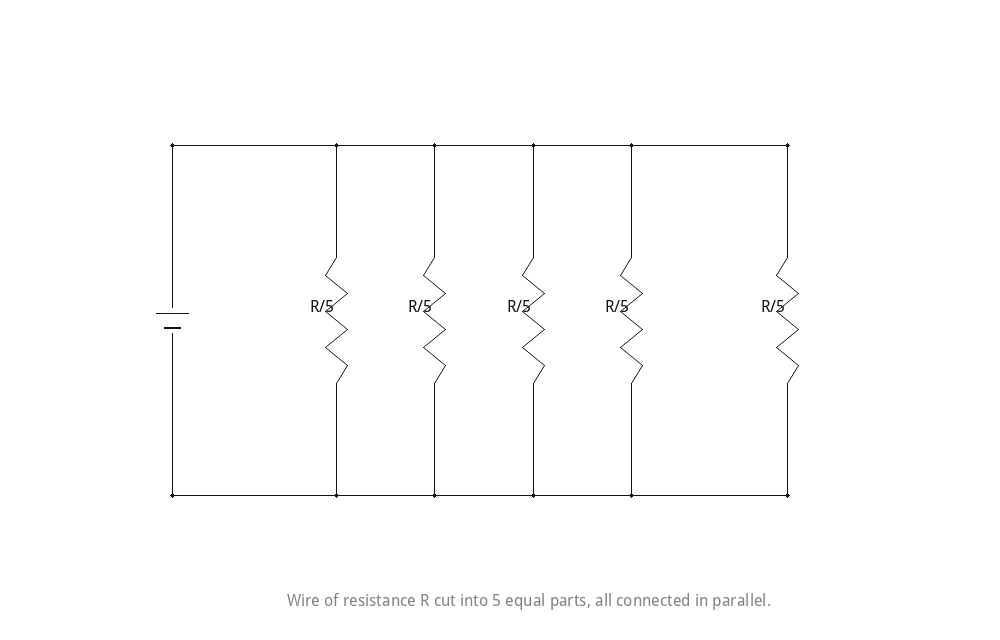
Wire of resistance R cut into 5 equal parts, all connected in parallel.
Solution: Each part = R/5. Five equal resistors in parallel: 1/R′ = 5/(R/5) = 25/R ⟹ R′ = R/25. So R/R′ = 25 — option (d).
Q2. Which of the following terms does not represent electrical power in a circuit? (a) I²R (b) IR² (c) VI (d) V²/R
Solution: P = I²R = VI = V²/R are all valid; IR² is dimensionally wrong. Answer: (b) IR².
Q3. An electric bulb is rated 220 V and 100 W. When operated on 110 V, the power consumed will be: (a) 100 W (b) 75 W (c) 50 W (d) 25 W
Solution: R = V²/P = 220²/100 = 484 Ω (fixed). New power = V²/R = 110²/484 = 12100/484 = 25 W — option (d).
Q4. Two conducting wires of the same material and of equal length and equal diameter (cross-section) are connected first in series then in parallel across the same source. The ratio of heat produced in series and parallel combinations is: (a) 1:2 (b) 2:1 (c) 1:4 (d) 4:1
Solution: For two equal resistors R in series (2R) and parallel (R/2) across the same V: heat/power ratio = (V²/2R) : (2V²/R) = 1:4 — option (c).
Q5. How is a voltmeter connected in a circuit to measure the potential difference between two points?
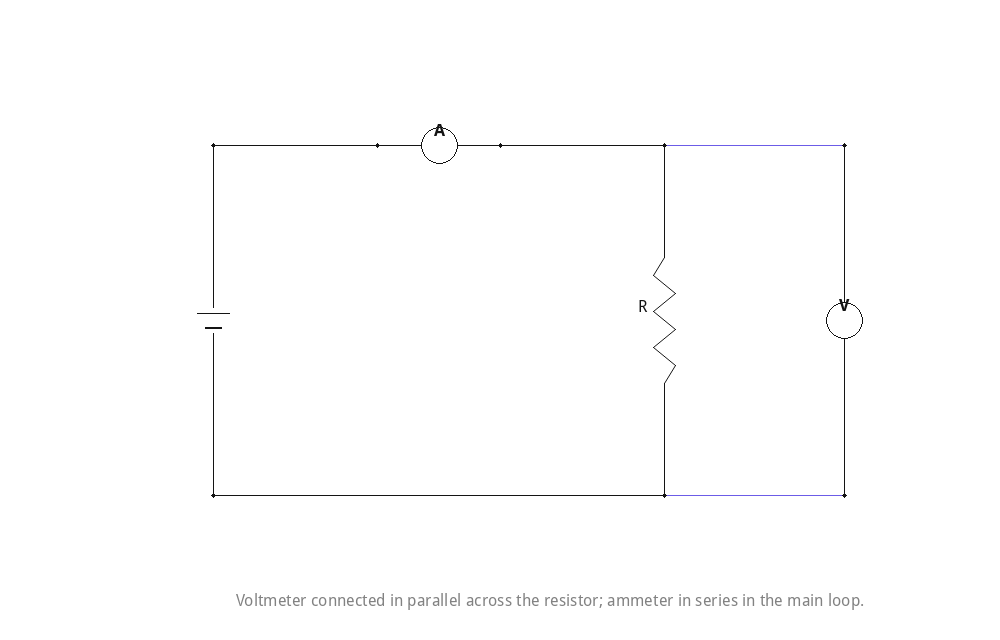
Voltmeter connected in parallel across the resistor; ammeter in series in the main loop.
Solution: A voltmeter is always connected in parallel across the two points (or the component) whose potential difference is to be measured — it has very high resistance so it draws negligible current.
Q6. A copper wire has diameter 0.5 mm and resistivity 1.6×10⁻⁸ Ω m. What length of this wire will have a resistance of 10 Ω? How much does the resistance change if the diameter is doubled?
Solution: r = 0.25 mm = 2.5×10⁻⁴ m; A = πr² ≈ 1.9625×10⁻⁷ m². L = RA/ρ = (10×1.9625×10⁻⁷)/(1.6×10⁻⁸) ≈ 122.7 m. If diameter doubles, area becomes 4× (A∝d²), so resistance (R∝1/A, length fixed) becomes one-fourth of the original.
Q7. The values of current I flowing through a resistor for corresponding values of potential difference V are given (0.5A/1.6V, 1.0A/3.4V, 2.0A/6.7V, 3.0A/10.2V, 4.0A/13.2V). Plot a graph and calculate the resistance.
Solution: The V-I graph is a straight line through the origin (Ohm’s law). Slope = R ≈ average of V/I values (3.2, 3.4, 3.35, 3.4, 3.3) ≈ 3.34 Ω.
Q8. A battery of 12 V is connected to a resistor and draws a current of 2.5 mA. Find the resistance of the resistor.
Solution: R = V/I = 12/(2.5×10⁻³) = 4800 Ω (4.8 kΩ).
Q9. A battery of 9 V is connected to resistors of 0.2 Ω, 0.3 Ω, 0.4 Ω, 0.5 Ω and 12 Ω, all in series. Find the current through the 12 Ω resistor.
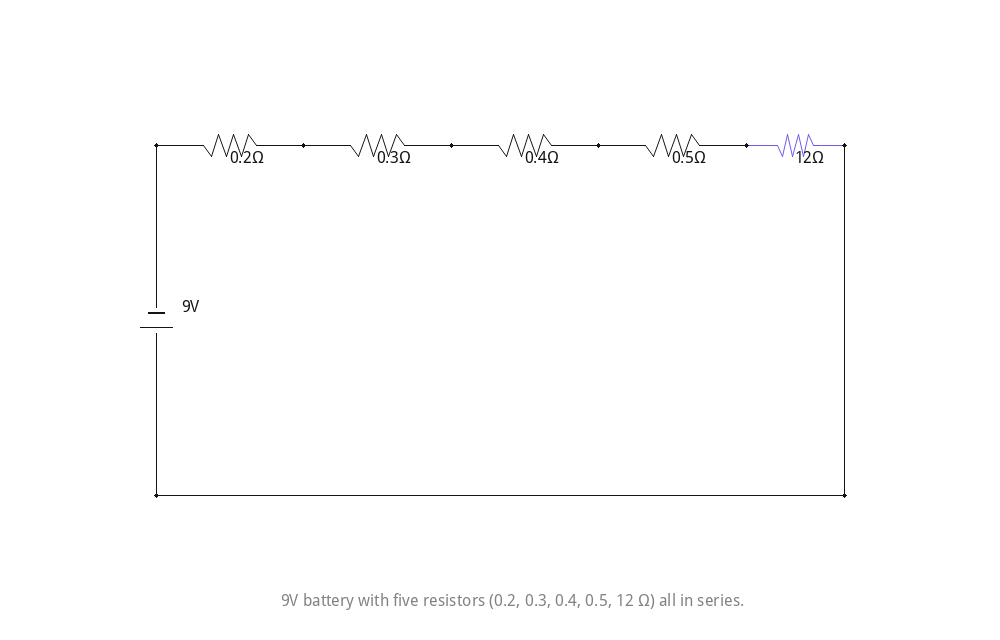
9V battery with five resistors (0.2, 0.3, 0.4, 0.5, 12 Ω) all in series.
Solution: Total R = 0.2+0.3+0.4+0.5+12 = 13.4 Ω. I = 9/13.4 ≈ 0.6716 A. In series, the same current flows everywhere: current through 12 Ω ≈ 0.67 A.
Q10. How many 176 Ω resistors (in parallel) are required to carry 5 A on a 220 V line?
Solution: Required total R = V/I = 220/5 = 44 Ω. For n resistors of 176 Ω in parallel: 176/n = 44 ⟹ n = 4.
Q11. Show how you would connect three resistors, each of resistance 6 Ω, so that the combination has a resistance of (i) 9 Ω, (ii) 4 Ω.
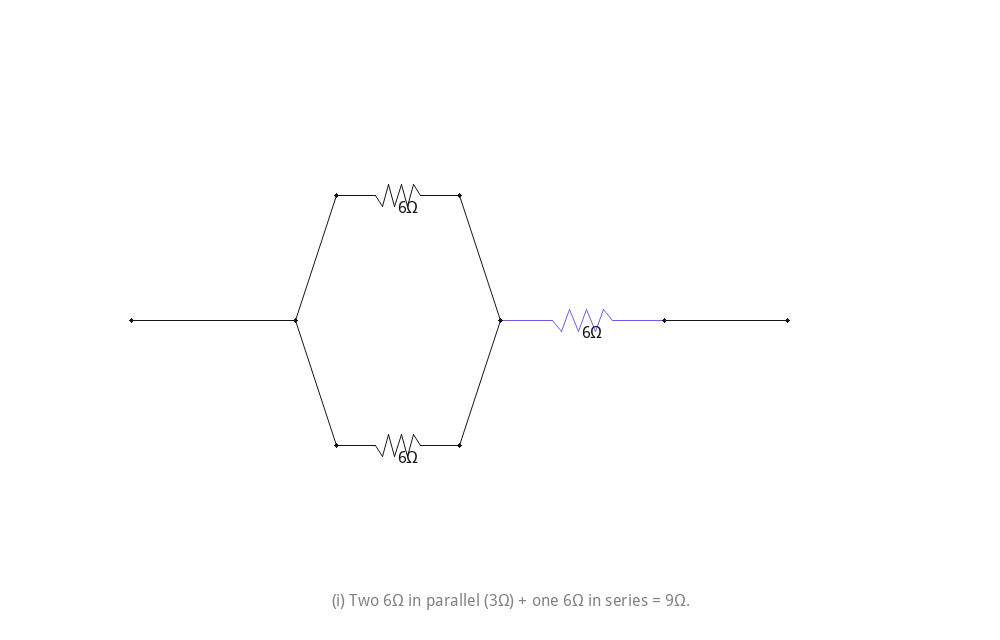
(i) Two 6Ω in parallel (3Ω) + one 6Ω in series = 9Ω.
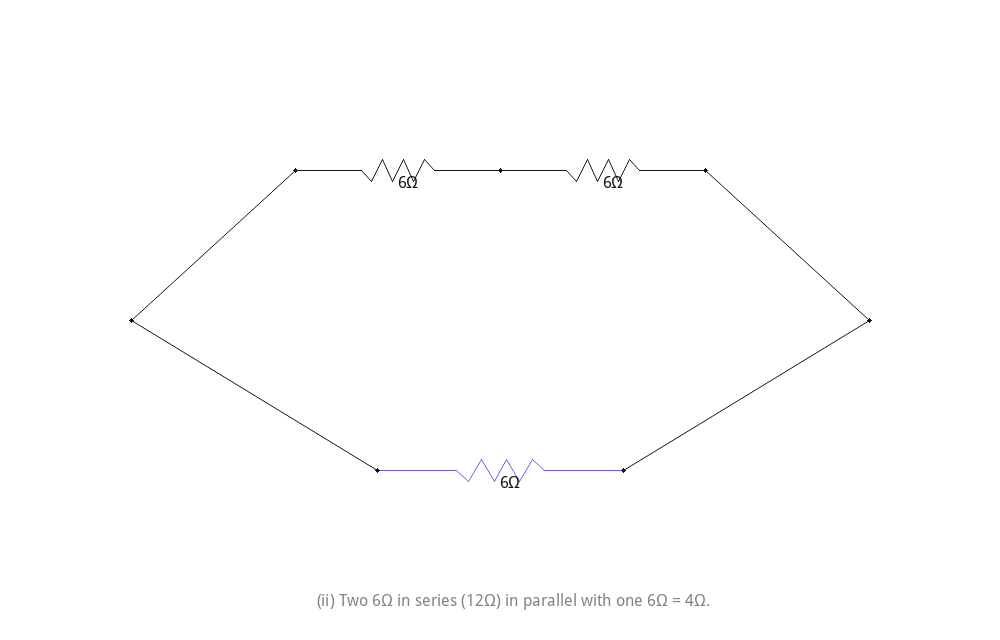
(ii) Two 6Ω in series (12Ω) in parallel with one 6Ω = 4Ω.
Solution: (i) Two 6 Ω in parallel (=3 Ω) in series with the third 6 Ω: 3+6 = 9 Ω. (ii) Two 6 Ω in series (=12 Ω) in parallel with the third 6 Ω: (12×6)/(12+6) = 4 Ω.
Q12. Several 220 V, 10 W bulbs are connected in parallel to 220 V mains. Maximum current is 5 A. Find the maximum number of bulbs.
Solution: Current per bulb = P/V = 10/220 ≈ 0.04545 A. Max bulbs = 5/0.04545 ≈ 110.
Q13. A hot plate has two coils, each of 24 Ω, on a 220 V line. Find the currents when: used separately, in series, in parallel.
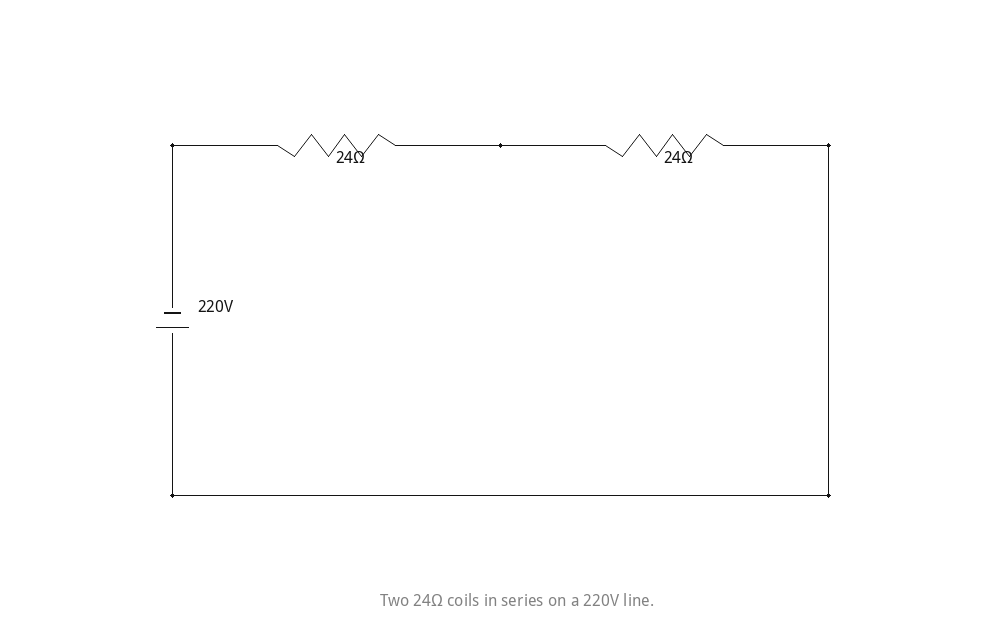
Two 24Ω coils in series on a 220V line.
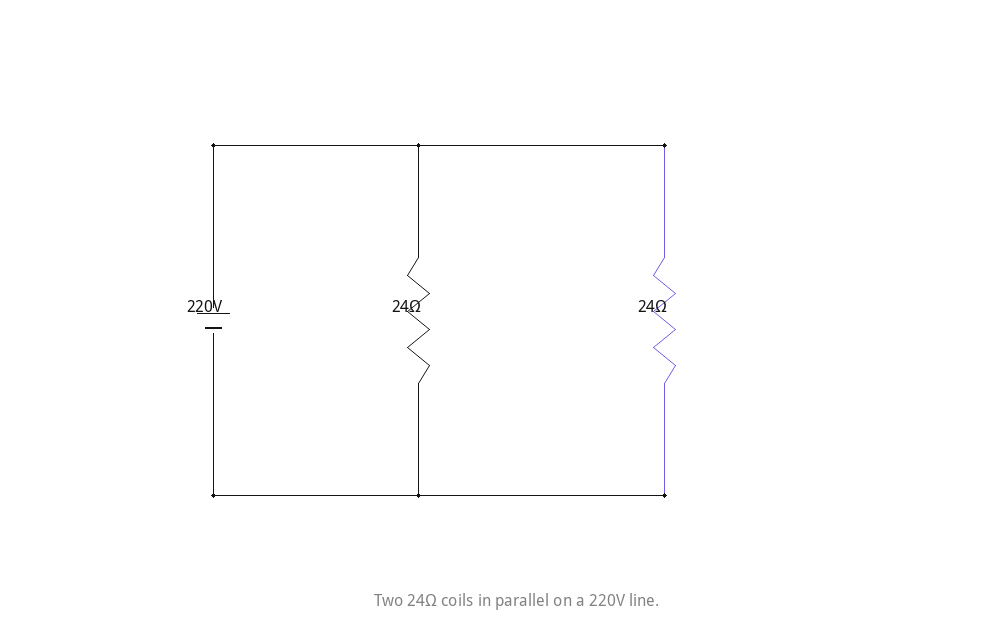
Two 24Ω coils in parallel on a 220V line.
Solution: Separately: I = 220/24 ≈ 9.17 A each. Series: R=48Ω, I = 220/48 ≈ 4.58 A. Parallel: R=12Ω, I = 220/12 ≈ 18.33 A.
Q14. Compare the power used in the 2 Ω resistor in each of the following: (i) a 6 V battery in series with 1 Ω and 2 Ω, (ii) a 4 V battery in parallel with 12 Ω and 2 Ω.
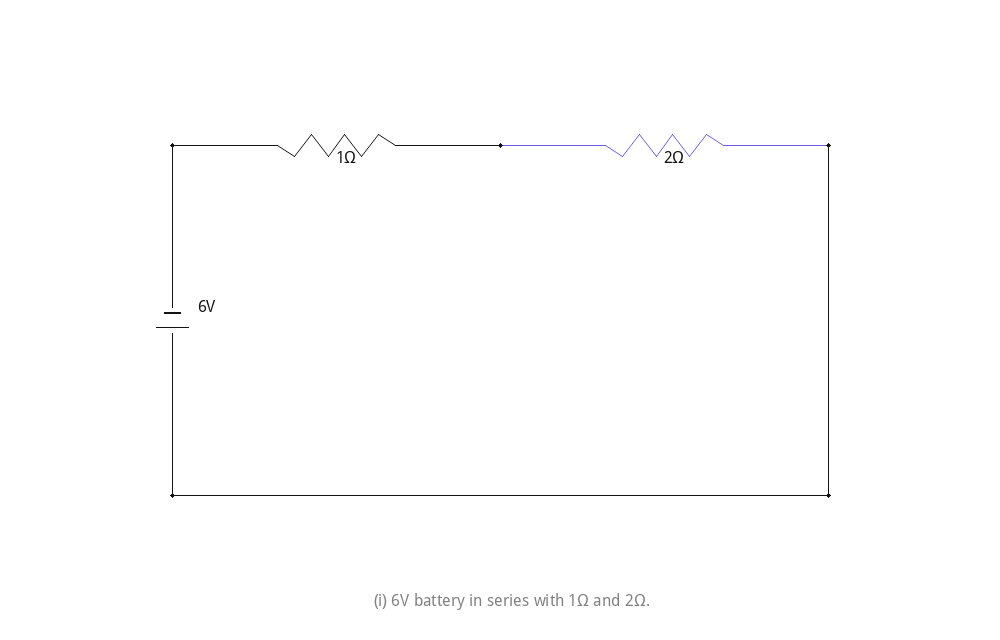
(i) 6V battery in series with 1Ω and 2Ω.
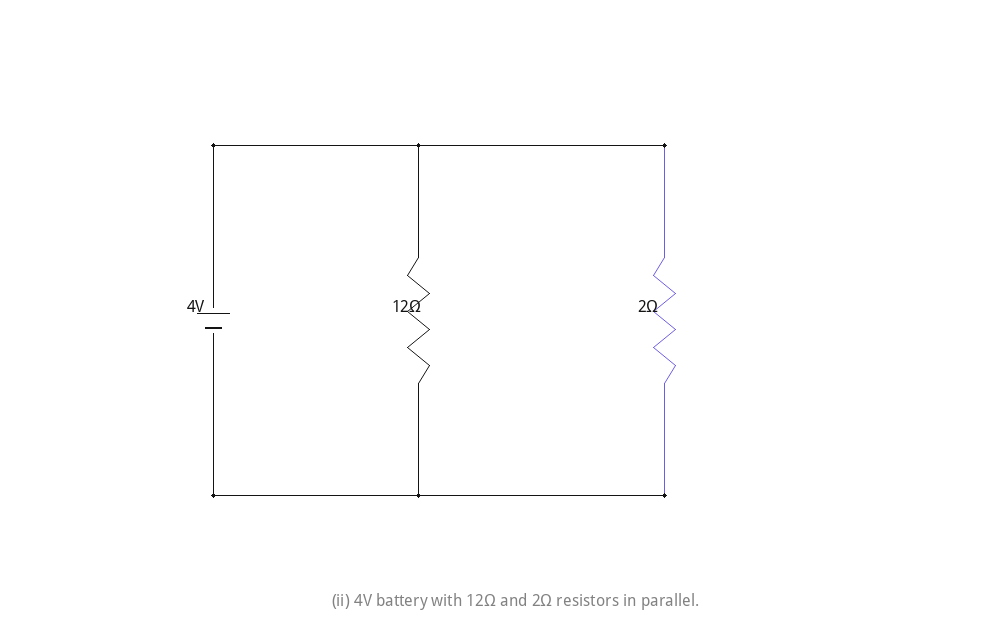
(ii) 4V battery with 12Ω and 2Ω resistors in parallel.
Solution: (i) I = 6/(1+2) = 2 A. P = I²R = 4×2 = 8 W. (ii) Both resistors have full 4 V across them (parallel). P = V²/R = 16/2 = 8 W. Both are equal.
Q15. Two lamps, rated 100 W at 220 V and 60 W at 220 V, are connected in parallel to the 220 V mains. Find the current drawn from the line.
Solution: I₁ = 100/220 ≈ 0.4545 A, I₂ = 60/220 ≈ 0.2727 A. Total I = ≈0.73 A.
Q16. Which uses more energy: a 250 W TV set run for 1 hour, or a 1200 W toaster run for 10 minutes?
Solution: TV: 250 W × 1 h = 250 Wh = 0.25 kWh. Toaster: 1200 W × (10/60) h = 200 Wh = 0.2 kWh. The TV uses more energy.
Q17. An electric heater of resistance 8 Ω draws 15 A from the service line for 2 hours. Find the rate at which heat is developed, and the total heat developed.
Solution: Rate = P = I²R = 225×8 = 1800 W (1800 J/s). Total heat over 2 h (7200 s) = 1800×7200 = 1.296×10⁷ J.
Q18. Explain the following: (a) tungsten used for bulb filaments, (b) conductors of electric heating devices made of alloys, not pure metals, (c) series arrangement not used for domestic circuits, (d) resistance of a conductor and its cross-sectional area, (e) copper/aluminium used for transmission lines.
Solution: (a) Tungsten has a very high melting point (≈3380°C) and does not oxidise/burn easily, so it can glow white-hot without melting. (b) Alloys have higher resistivity and higher melting points than pure metals, and oxidise less readily at high temperature, making them safer and more durable for heating elements. (c) In series, one faulty/switched-off appliance breaks the whole circuit, and all appliances are forced to carry the same current regardless of their rated power — parallel wiring avoids both problems. (d) Resistance is inversely proportional to cross-sectional area (R = ρL/A) — thicker wires have lower resistance. (e) Copper and aluminium have low resistivity, minimising energy loss (I²R heating) over long transmission distances.
Why This Chapter Matters for Boards
Electricity is almost guaranteed to appear as a numerical-heavy question in the board paper — often combined with the next chapter, Magnetic Effects of Electric Current. Practising series/parallel resistance switching (as in Q11 and Q13 above) is one of the most reliable ways to pick up easy marks here.
CBSE Exam Weightage
This chapter falls under Unit IV: Effects of Current in the CBSE Class 10 Science board exam syllabus. This unit typically carries around 13 marks (16.25%) of the 80-mark theory paper, based on CBSE’s published unit-wise weightage (Question Paper Design). CBSE sets weightage at the unit level rather than chapter-by-chapter, so the exact share from this specific chapter can vary a little between years and sample papers.
Class 10 Science Chapter 11 – Notes and Extra Questions
Along with these NCERT Solutions, students can also use the Class 10 Science Chapter 11 Extra Questions and Class 10 Science Chapter 11 Revision Notes for quick revision and extra practice.
- Chapter 1: Chemical Reactions and Equations – Free PDF Download
- Chapter 2: Acids, Bases and Salts – Free PDF Download
- Chapter 3: Metals and Non-metals – Free PDF Download
- Chapter 4: Carbon and its Compounds – Free PDF Download
- Chapter 5: NCERT Solutions for Class 10 Science: Periodic Classification of Elements (Supplementary — Not in Current CBSE Syllabus) – Free PDF Download
- Chapter 6: Life Processes – Free PDF Download
- Chapter 7: Control and Coordination – Free PDF Download
- Chapter 8: How do Organisms Reproduce? (2026-27) – Free PDF Download
- Chapter 9: Heredity – Free PDF Download
- Chapter 10: Light - Reflection and Refraction – Free PDF Download
- Chapter 11: The Human Eye and the Colourful World (2026-27) – Free PDF Download
- Chapter 13: Magnetic Effects of Electric Current (2026-27)
FAQs
Q: Is this Chapter 12 or Chapter 11?
A: In the current 2026-27 rationalised NCERT book it is Chapter 11. Several older solution sites still label it Chapter 12 from the pre-2023 edition — that numbering is outdated.
Q: How many questions are in the exercise?
A: 18, all in a single combined exercise (no sub-exercises like 11.1/11.2).


