
Quick last-minute revision bullets covering every definition, notation, and formula in Chapter 1 — Sets. These Class 11 Mathematics Chapter 1 notes are ideal for quick revision just before exams.
Last Updated: September 23, 2026
Basic Definitions
- Set: a well-defined collection of distinct objects.
- Element/Member: x ∈ A (belongs), x ∉ A (does not belong).
- Roster form: elements listed within braces, e.g. {1,2,3}.
- Set-builder form: a rule describing elements, e.g. {x : x is a natural number less than 4}.
Types of Sets
- Empty/Null set (φ): no elements; n(φ)=0.
- Singleton set: exactly one element.
- Finite / Infinite sets.
- Equal sets: A=B if every element of each is in the other.
- Equivalent sets: same number of elements (need not be identical).
- Universal set (U): the overall set for a given context.
Subsets and Power Set
- Subset: A⊂B if every element of A is in B.
- Proper subset: A⊂B and A≠B.
- Empty set is a subset of every set; every set is a subset of itself.
- Power set P(A): set of all subsets of A.
- Number of subsets of an n-element set = 2n; proper subsets = 2n-1.
- If A⊂B, then P(A)⊂P(B).
Intervals as Subsets of R
- Open (a,b) = {x: a<x<b}.
- Closed [a,b] = {x: a≤x≤b}.
- Semi-open/closed [a,b) or (a,b].
Operations on Sets
- Union (A∪B): {x: x∈A or x∈B}.
- Intersection (A∩B): {x: x∈A and x∈B}.
- Disjoint sets: A∩B=φ.
- Difference (A-B): {x: x∈A and x∉B} = A∩B′.
- Complement (A′): U-A.
Key Laws and Identities
- Commutative: A∪B=B∪A; A∩B=B∩A.
- Associative: (A∪B)∪C=A∪(B∪C); (A∩B)∩C=A∩(B∩C).
- Distributive: A∪(B∩C)=(A∪B)∩(A∪C); A∩(B∪C)=(A∩B)∪(A∩C).
- Identity: A∪φ=A; A∩U=A; A∪U=U; A∩φ=φ.
- Complement: A∪A′=U; A∩A′=φ; (A′)′=A; U′=φ; φ′=U.
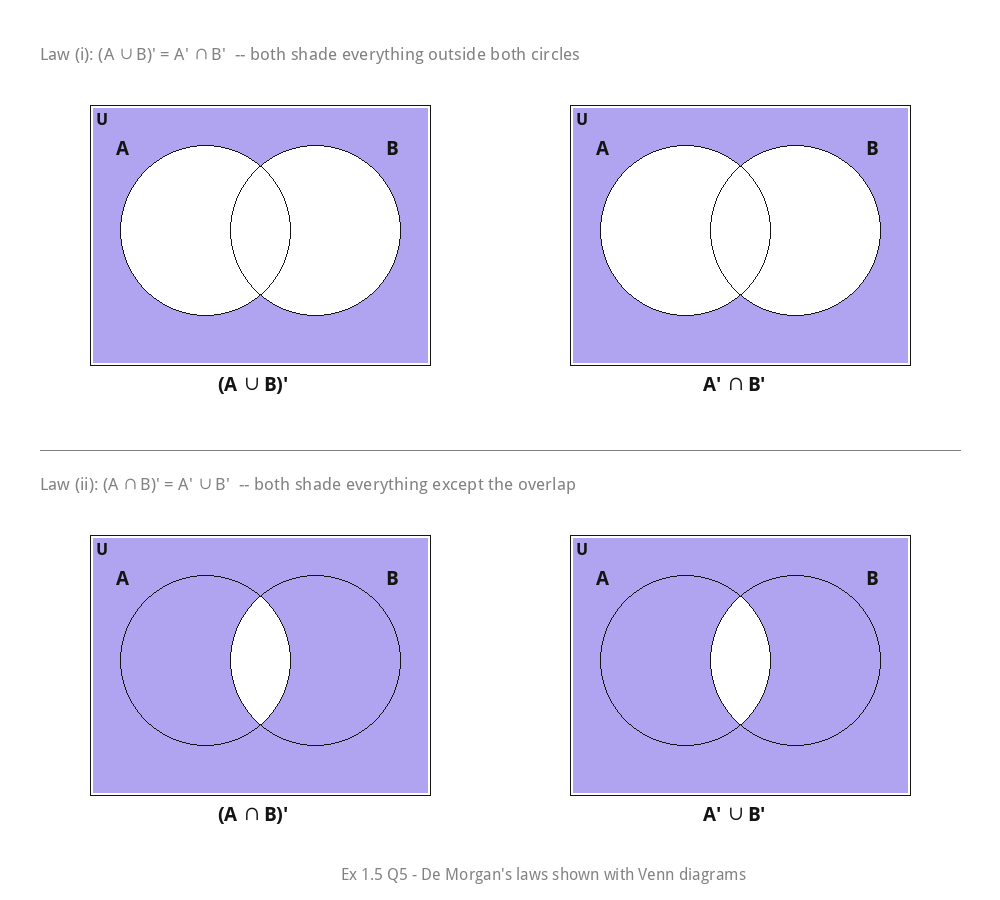
- De Morgan’s Laws: (A∪B)′=A′∩B′; (A∩B)′=A′∪B′.
- A=(A∩B)∪(A-B); A∪B=A∪(B-A).
- If A⊂B: A-B=φ, A∪B=B, A∩B=A.
Cardinal Number Formulas
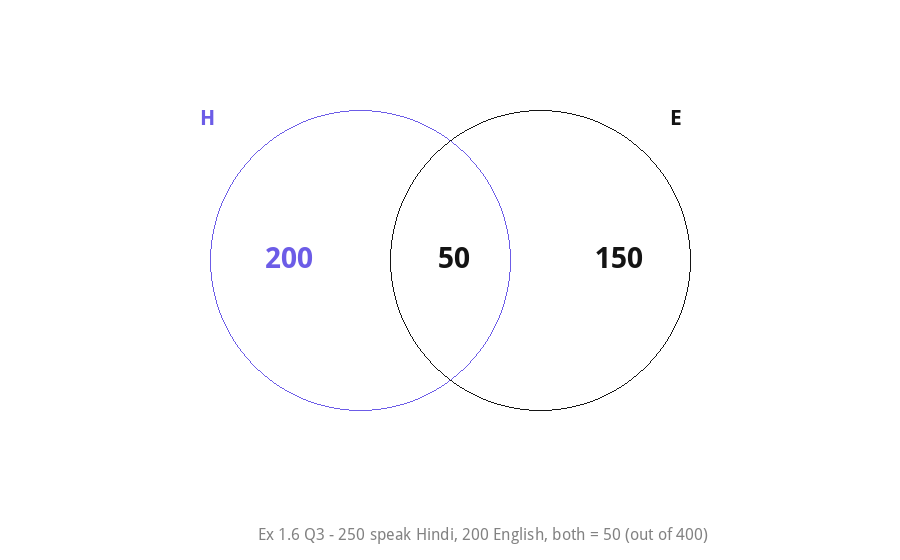
- n(A∪B) = n(A)+n(B)-n(A∩B) (two sets); disjoint ⇒ n(A∪B)=n(A)+n(B).
- n(A-B)=n(A)-n(A∩B).
- n(A∪B∪C) = n(A)+n(B)+n(C)-n(A∩B)-n(B∩C)-n(A∩C)+n(A∩B∩C) (three sets).
Related NCERT Content for Class 11 Maths Chapter 1
- NCERT Solutions for Sets
- Extra Questions (HOTS) for Sets
- Class 11 Maths Formulas Handbook
- Class 11 Maths NCERT Book (Download PDF)
Quick visual: a worked diagram from the full Solutions page, for reference.
- Chapter 2: Relations and Functions – Revision Notes
- Chapter 3: Trigonometric Functions – Revision Notes
- Chapter 4: Complex Numbers and Quadratic Equations – Revision Notes
- Chapter 5: Linear Inequalities – Revision Notes
- Chapter 6: Permutations and Combinations – Revision Notes
- Chapter 7: Binomial Theorem – Revision Notes
- Chapter 8: Sequences and Series – Revision Notes
- Chapter 9: Straight Lines – Revision Notes
- Chapter 10: Conic Sections – Revision Notes
- Chapter 11: Introduction to Three Dimensional Geometry – Revision Notes
- Chapter 12: Limits and Derivatives – Revision Notes
- Chapter 13: Statistics – Revision Notes
- Chapter 14: Probability – Revision Notes
Frequently Asked Questions
What is a set, and how is it represented in this chapter?
A set is a well-defined collection of distinct objects, called elements, and it can be represented either in roster form by listing all elements, or in set-builder form by describing a common property that all elements share.
What is the difference between a subset and a proper subset?
A subset is any set whose elements are all contained within another set, including the set itself, while a proper subset must contain fewer elements than the original set, meaning it cannot be identical to it.
Chapter Quiz — Test Your Understanding
Class 11 Mathematics Chapter 1 – Solutions and Important Questions
Need full answers or more practice? See the Class 11 Mathematics Chapter 1 Solutions and Class 11 Mathematics Chapter 1 Extra Questions.
Recommended: Buy the Printed NCERT Class 11 Maths Book
Contains Amazon affiliate links.
If you’d like a printed copy alongside the PDF, here’s a verified option:
4.2 out of 5 stars (953 ratings) · Rs. 170
Price and availability may change on Amazon. As an Amazon Associate, ncertbooks.org earns from qualifying purchases.


