
The NCERT exercises test whether you know the definitions and can apply them to specific numbers. Board and competitive exams often go one level deeper — asking you to prove a result for any sets A, B, C rather than just one example, or to work backwards from a given answer to figure out the sets. The questions below are designed to build exactly that skill. All numbers and scenarios here are freshly written and do not appear in the NCERT textbook. These Class 11 Mathematics Chapter 1 important questions are handy for last-minute exam practice.
Last Updated: September 23, 2026
Q1. General proof: Prove that for any two sets A and B, A – (A – B) = A ∩ B.
Solution: Let x ∈ A-(A-B). Then x∈A and x∉(A-B). Since x∈A, this means x is not excluded by being outside B, so x∈B. Hence x∈A∩B, giving A-(A-B)⊂A∩B. Conversely, let x∈A∩B: x∈A, x∈B. Since x∈B, x cannot be in A-B, so x∈A-(A-B). This gives A∩B⊂A-(A-B). Combining: A-(A-B)=A∩B.
Q2. Assertion-Reason
Assertion (A): If n(A)=5 and n(B)=7 and A,B are disjoint, then n(A∪B)=12.
Reason (R): For any two sets, n(A∪B)=n(A)+n(B)-n(A∩B).
Solution: R is always true. Since A,B disjoint, n(A∩B)=0, so n(A∪B)=5+7-0=12, matching A. R correctly explains A. Answer: (a) Both true, R explains A.
Q3. Reverse-engineering
n(A)=18, n(A∪B)=30, n(A∩B)=6. A student claims n(B)=20. Verify or correct, and find B if A={multiples of 3 from 3 to 54}.
Solution: 30=18+n(B)-6 ⇒ n(B)=18. The claim of 20 is incorrect; correct value is 18. Since A={3,6,…,54} has 18 elements, one valid B (with 6 overlapping elements) is B={3,6,9,12,15,18,1,2,4,5,7,8,10,11,13,14,16,17} — any set satisfying n(B)=18 and |A∩B|=6 works, showing reverse problems can have multiple valid answers.
Q4. Multi-set survey (3 sets)
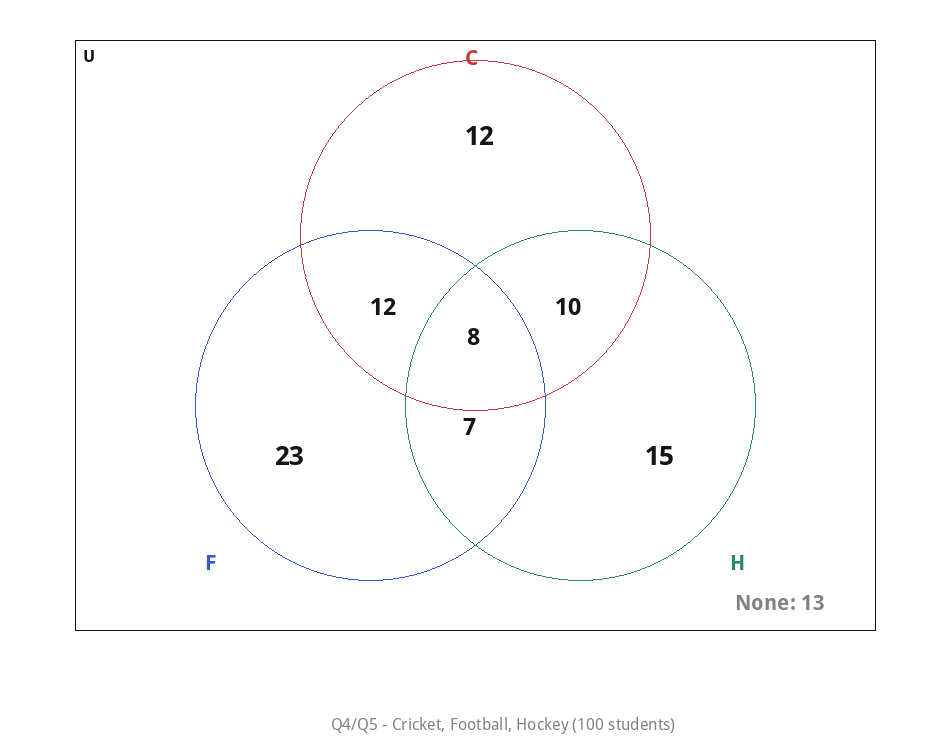
100 students: 42 play cricket, 50 football, 40 hockey. 20 both cricket & football, 15 both football & hockey, 18 both cricket & hockey, 8 play all three. How many play none?
Solution: n(C∪F∪H)=42+50+40-20-15-18+8=87. None = 100-87=13 students.
Q5. Multi-set survey – exactly one
Using Q4’s data, how many play exactly one game?
Solution: Cricket only=42-(20+18-8)=12. Football only=50-(20+15-8)=23. Hockey only=40-(15+18-8)=15. Total=12+23+15=50 students.
Q6. De Morgan’s Law – general proof
Prove (A∪B)′=A′∩B′ for any sets A,B in universal set U.
Solution: x∈(A∪B)′ ⇒ x∉A and x∉B ⇒ x∈A′∩B′, so (A∪B)′⊂A′∩B′. Conversely x∈A′∩B′ ⇒ x∉A,x∉B ⇒ x∉(A∪B) ⇒ x∈(A∪B)′. So A′∩B′⊂(A∪B)′. Combining: (A∪B)′=A′∩B′.
Q7. Assertion-Reason (power sets)
Assertion (A): A set with 6 elements has P(A) with 64 elements.
Reason (R): |P(A)| always equals 2n.
Solution: 26=64, matching A. Answer: (a) Both true, R explains A.
Q8. Reverse-engineering (complements)
U={1..15}. A′={1,2,3,4,5,6,8,10,12,14}. Find A, verify A∪A′=U and A∩A′=φ.
Solution: A=U-A′={7,9,11,13,15}. A∪A′={1..15}=U ✓. A∩A′=φ ✓.
Q9. Abstract proof
If A⊂B, prove P(A)⊂P(B).
Solution: Let S∈P(A), so S⊂A. Since A⊂B, by transitivity S⊂B, so S∈P(B). Hence P(A)⊂P(B).
Q10. Multi-set word problem (three newspapers)
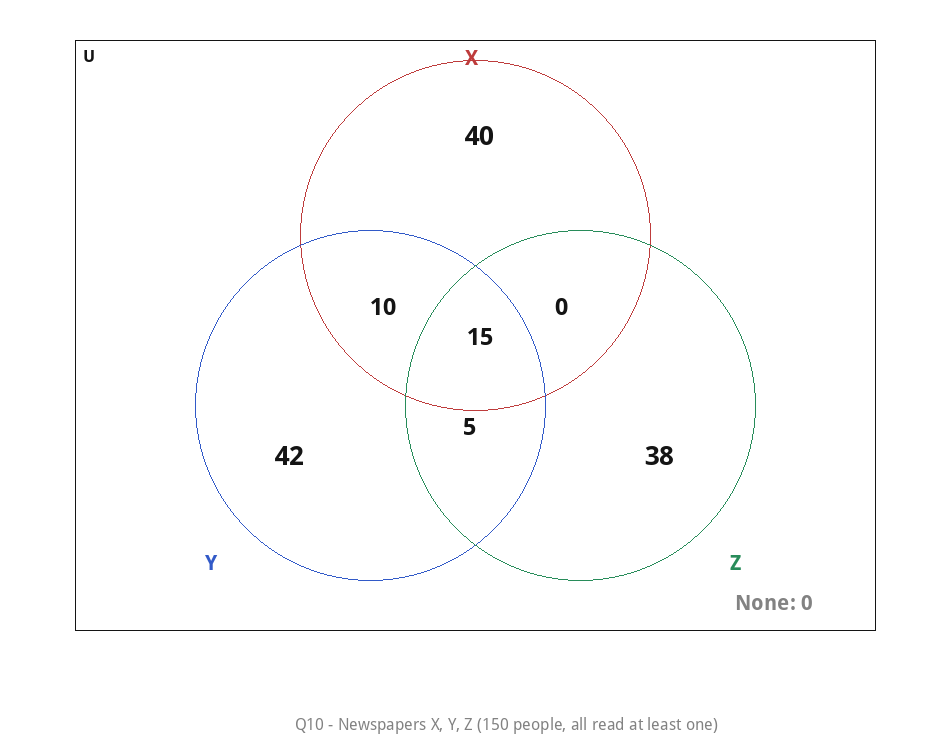
150 people: 65 read X, 72 read Y, 58 read Z, 25 both X&Y, 20 both Y&Z, 15 both X&Z, everyone reads at least one. Find how many read all three.
Solution: 150=65+72+58-25-20-15+a=135+a ⇒ a=15 people.
Q11. Assertion-Reason (set difference)
Assertion (A): A-B and B-A are always disjoint.
Reason (R): An element of A-B cannot lie in B, and an element of B-A cannot lie in A, so they cannot overlap.
Solution: R correctly explains why the two sets never overlap. Answer: (a) Both true, R explains A.
Q12. Reverse-engineering (three-set Venn, consistency check)
80 students, “exactly two subjects” total = 26, all-three = 6, n(M)=45, n(P)=40, n(C)=35, everyone studies at least one. Check consistency.
Solution: Pairwise sum = 26+3(6)=44. n(M∪P∪C)=45+40+35-44+6=82. But total given is 80 — a contradiction, showing the data is over-determined/inconsistent as stated. A useful check to apply after any real survey calculation.
Related NCERT Content for Class 11 Maths Chapter 1
- NCERT Solutions for Sets
- Revision Notes for Sets
- Class 11 Maths Formulas Handbook
- Class 11 Maths NCERT Book (Download PDF)
- Chapter 2: Relations and Functions – Extra Questions with Answers
- Chapter 3: Trigonometric Functions – Extra Questions with Answers
- Chapter 4: Complex Numbers and Quadratic Equations – Extra Questions with Answers
- Chapter 5: Linear Inequalities – Extra Questions with Answers
- Chapter 6: Permutations and Combinations – Extra Questions with Answers
- Chapter 7: Binomial Theorem – Extra Questions with Answers
- Chapter 8: Sequences and Series – Extra Questions with Answers
- Chapter 9: Straight Lines – Extra Questions with Answers
- Chapter 10: Conic Sections – Extra Questions with Answers
- Chapter 11: Introduction to Three Dimensional Geometry – Extra Questions with Answers
- Chapter 12: Limits and Derivatives – Extra Questions with Answers
- Chapter 13: Statistics – Extra Questions with Answers
- Chapter 14: Probability – Extra Questions with Answers
Frequently Asked Questions
How would you use a Venn diagram to find how many students play only cricket if 50 play cricket, 40 play football, and 20 play both?
Use the formula n(A only) = n(A) minus n(A intersection B), so students playing only cricket = 50 minus 20 = 30, shown as the non overlapping region of the cricket circle.
If a set has 6 elements, how many subsets and proper subsets does it have?
A set with 6 elements has 2 to the power 6 = 64 subsets in total, and since proper subsets exclude the set itself, there are 63 proper subsets.
Chapter Quiz — Test Your Understanding
Class 11 Mathematics Chapter 1 – Solutions and Notes
For complete step-by-step answers and a quick summary, check the Class 11 Mathematics Chapter 1 Solutions and Class 11 Mathematics Chapter 1 Revision Notes.
Recommended: Buy the Printed NCERT Class 11 Maths Book
Contains Amazon affiliate links.
If you’d like a printed copy alongside the PDF, here’s a verified option:
4.2 out of 5 stars (953 ratings) · Rs. 170
Price and availability may change on Amazon. As an Amazon Associate, ncertbooks.org earns from qualifying purchases.


