
Applying derivatives to real curves means finding tangent and normal slopes, locating critical points, and using the second derivative test, all of which this question set covers.
Last Updated: September 23, 2026
Very Short Answer Questions (1 mark)
Q1. What is the slope of the tangent to y=f(x) at x=x₀?
Ans: f'(x₀).
Q2. What is the slope of the normal at the same point?
Ans: −1/f'(x₀).
Q3. State the condition for a critical point.
Ans: f'(x)=0 or f'(x) does not exist.
Q4. If f”(c)<0 at a critical point c, what does this indicate?
Ans: c is a point of local maximum.
Q5. Write the formula for approximating Δy using differentials.
Ans: Δy≈f'(x)Δx=dy.
Short Answer Questions (2–3 marks)
Q6. Find the equation of the tangent to y=x² at the point (2,4).
Ans: dy/dx=2x, so slope at x=2 is 4. Tangent: y−4=4(x−2), i.e., y=4x−4.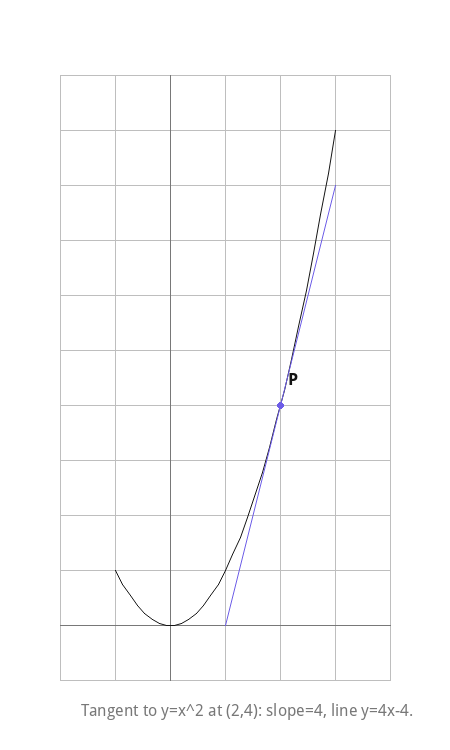
Q7. Show that f(x)=3x+7 is strictly increasing on R.
Ans: f'(x)=3>0 for all x, so f is strictly increasing everywhere on R.
Q8. Use differentials to approximate √25.3.
Ans: Let f(x)=√x, x=25, Δx=0.3. f'(x)=1/(2√x), f'(25)=1/10. Δy≈(1/10)(0.3)=0.03. So √25.3≈5+0.03=5.03.
Higher-Order Thinking / Application Questions
Q9. A ladder 5 m long is leaning against a wall. The bottom of the ladder is pulled along the ground away from the wall at 2 cm/s. Find the rate at which the top of the ladder is sliding down when the bottom is 4 m from the wall.
Ans: Let x=distance of bottom from wall, y=height of top on wall. By Pythagoras, x²+y²=25 (constant, since ladder length=5). Differentiating both sides with respect to time t: 2x(dx/dt)+2y(dy/dt)=0, so dy/dt=−(x/y)(dx/dt). Given dx/dt=2 cm/s and x=4 m=400 cm (keeping consistent units, or working in metres: x=4, dx/dt=0.02 m/s). When x=4, y²=25−16=9, so y=3. Then dy/dt=−(4/3)(0.02)=−0.0267 m/s (using metres throughout), or equivalently −8/3 cm/s if dx/dt=2 cm/s is used directly with x,y in metres converted consistently: dy/dt=−(x/y)(dx/dt)=−(4/3)(2)=−8/3 cm/s. The negative sign indicates the top is sliding DOWN at a rate of 8/3 cm/s (≈2.67 cm/s) at that instant. This is a classic related-rates problem showing how differentiating a constraint equation (constant ladder length) connects the rates of change of two related quantities.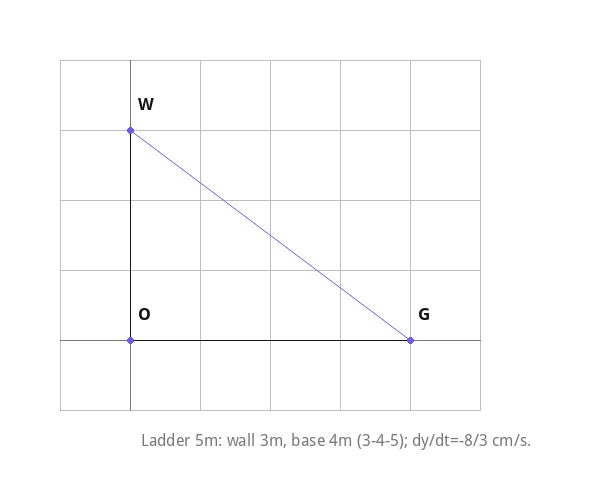
Q10. Find two positive numbers whose sum is 24 and whose product is maximum, proving your answer using the second derivative test.
Ans: Let the two numbers be x and 24−x (so their sum is fixed at 24), with x>0 and 24−x>0, i.e., 0<x<24. Let P(x)=x(24−x)=24x−x² be their product. To maximize P, differentiate: P'(x)=24−2x. Setting P'(x)=0 gives 24−2x=0, so x=12, which is a critical point within the valid domain (0,24). To confirm this is a maximum (not minimum), apply the second derivative test: P”(x)=−2, which is negative for all x, confirming that x=12 gives a local (and here, global, since P is a downward parabola) maximum. At x=12, the second number is 24−12=12, so the two numbers are 12 and 12, and their maximum product is 12×12=144. This result makes intuitive sense: for a fixed sum, the product of two positive numbers is maximized when the numbers are equal, illustrating a general principle in optimization (AM-GM-related) that calculus confirms rigorously here.
- Chapter 1: Extra Questions (HOTS) - Relations and Functions
- Chapter 2: Inverse Trigonometric Functions – Extra Questions with Answers
- Chapter 3: Matrices – Extra Questions with Answers
- Chapter 4: Determinants – Extra Questions with Answers
- Chapter 5: Continuity and Differentiability – Extra Questions with Answers
- Chapter 7: Integrals – Extra Questions with Answers
- Chapter 8: Applications of Integrals – Extra Questions with Answers
- Chapter 9: Differential Equations – Extra Questions with Answers
- Chapter 10: Vectors – Extra Questions with Answers
- Chapter 11: Three-Dimensional Geometry – Extra Questions with Answers
- Chapter 12: Linear Programming – Extra Questions with Answers
- Chapter 13: Probability – Extra Questions with Answers
Frequently Asked Questions
How would you find the rate of change of the area of a circle when its radius is increasing at 2 cm per second and the radius is currently 5 cm?
Using dA over dt = 2 pi r times dr over dt = 2 pi times 5 times 2 = 20 pi square cm per second.
How would you find the maximum value of the function f(x) = negative x squared + 4x + 1?
Setting the derivative to zero gives x = 2, and since the second derivative is negative, this is a maximum, giving a value of 5.
Chapter Quiz — Test Your Understanding
Class 12 Mathematics Chapter 6 – Solutions and Notes
For complete step-by-step answers and a quick summary, check the Class 12 Mathematics Chapter 6 Solutions and Class 12 Mathematics Chapter 6 Revision Notes.
See also: Chapter 1 | Chapter 2 | Chapter 3 | Chapter 4 | Chapter 5 | Chapter 6
Practice more: Chapter 1 | Chapter 2 | Chapter 3 | Chapter 4 | Chapter 5
Quick revision: Chapter 1 | Chapter 2 | Chapter 3 | Chapter 4 | Chapter 5
Recommended: Buy the Printed NCERT Class 12 Maths Book
Contains Amazon affiliate links.
If you’d like a printed copy alongside the PDF, here’s a verified option:
4.3 out of 5 stars (899 ratings) · Rs. 94
Price and availability may change on Amazon. As an Amazon Associate, ncertbooks.org earns from qualifying purchases.



Pingback: Class 12 Maths Chapter 6 Applications of Derivatives Solutions (2026-27)
Pingback: Class 12 Maths Chapter 12 Linear Programming Extra Questions (2026-27)
Pingback: Class 12 Maths Chapter 10 Vectors Revision Notes (2026-27)