
Locating a point on the Cartesian plane comes down to reading its abscissa and ordinate correctly, and these questions run through quadrants, axes, and coordinate notation.
Last Updated: September 23, 2026
Very Short Answer Questions (1 mark)
Q1. What are the coordinates of a point lying on the x-axis, in general form?
Ans: (x, 0).
Q2. In which quadrant does the point (5, −2) lie?
Ans: Quadrant IV.
Q3. What is the other name for the x-coordinate of a point?
Ans: Abscissa.
Q4. How many quadrants does the Cartesian plane have?
Ans: Four.
Q5. What are the coordinates of a point lying on the y-axis, in general form?
Ans: (0, y).
Short Answer Questions (2–3 marks)
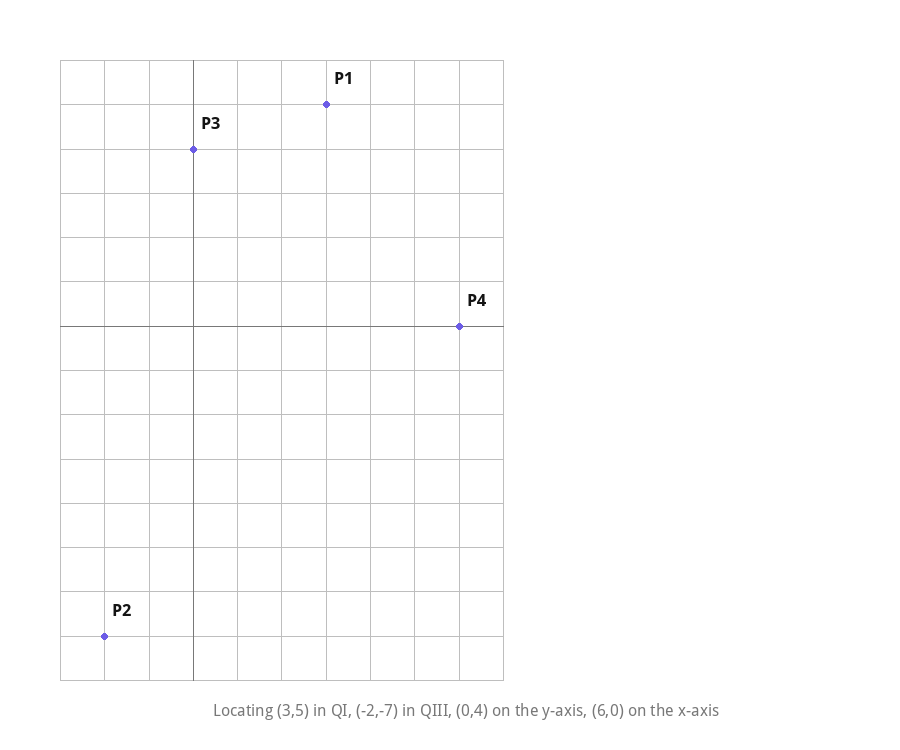
Q6. Identify the quadrant (or axis) for each of these points: (3, 5), (−2, −7), (0, 4), (6, 0).
Ans: (3, 5) → Quadrant I; (−2, −7) → Quadrant III; (0, 4) → on the y-axis; (6, 0) → on the x-axis.
Q7. Explain why (2, 5) and (5, 2) represent two different points on the Cartesian plane.
Ans: Coordinates are ordered pairs, so the order matters: in (2, 5), the x-coordinate is 2 and y-coordinate is 5, while in (5, 2), the x-coordinate is 5 and y-coordinate is 2 — these describe two different positions relative to the axes, even though the same two numbers are used.
Q8. If a point has equal positive x and y coordinates, in which quadrant does it lie, and what shape does the set of all such points trace?
Ans: It lies in Quadrant I (since both coordinates are positive). The set of all such points (where x = y, both positive) traces a straight line through the origin at 45° to both axes.
Higher-Order Thinking / Application Questions
Q9. A point P is reflected across the x-axis to get point Q, and P has coordinates (4, 7). What are the coordinates of Q, and what general rule does this illustrate?
Ans: Q has coordinates (4, −7). This illustrates that reflecting a point across the x-axis keeps the x-coordinate the same but reverses the sign of the y-coordinate.
Q10. Four points form a rectangle: (1, 1), (5, 1), (5, 4), and (1, 4). Without drawing, determine the length and breadth of the rectangle using the coordinates.
Ans: The length (horizontal side) is the difference between x-coordinates of two points sharing the same y-coordinate: 5 − 1 = 4 units. The breadth (vertical side) is the difference between y-coordinates of two points sharing the same x-coordinate: 4 − 1 = 3 units. So the rectangle is 4 units by 3 units.
- Chapter 2: Introduction to Linear Polynomials – Extra Questions with Answers
- Chapter 3: The World of Numbers – Extra Questions with Answers
- Chapter 4: Exploring Algebraic Identities – Extra Questions with Answers
- Chapter 5: I'm Up and Down, and Round and Round – Extra Questions with Answers
- Chapter 6: Measuring Space: Perimeter and Area – Extra Questions with Answers
- Chapter 7: The Mathematics of Maybe: Introduction to Probability – Extra Questions with Answers
- Chapter 8: Predicting What Comes Next?: Exploring Sequences and Progressions – Extra Questions with Answers
Frequently Asked Questions
Why are two numbers, rather than just one, needed to describe the exact position of a point on a plane?
A plane has two independent directions, horizontal and vertical, so a single number can only describe position along one direction, while two numbers, the x and y coordinates, pinpoint an exact location.
What is the significance of the point where the x-axis and y-axis intersect?
This point is called the origin, and it serves as the reference point with coordinates (0, 0) from which the position of every other point on the plane is measured.
Chapter Quiz — Test Your Understanding
Class 9 Mathematics Chapter 1 – Solutions and Notes
For complete step-by-step answers and a quick summary, check the Class 9 Mathematics Chapter 1 Solutions and Class 9 Mathematics Chapter 1 Revision Notes.
See also: Chapter 1
Recommended: Buy the Printed NCERT Class 9 Maths Book
Contains Amazon affiliate links.
If you’d like a printed copy alongside the PDF, here’s a verified option:
4.0 out of 5 stars (1,313 ratings) · Rs. 106
Price and availability may change on Amazon. As an Amazon Associate, ncertbooks.org earns from qualifying purchases.


