
This set of questions on Integrals runs through standard antiderivatives and techniques such as integration by parts, the reverse process to differentiation.
Last Updated: September 23, 2026
Very Short Answer Questions (1 mark)
Q1. Evaluate ∫x³dx.
Ans: x⁴/4+C.
Q2. Evaluate ∫sec²x dx.
Ans: tan x+C.
Q3. Evaluate ∫012x dx.
Ans: [x²]01=1−0=1.
Q4. State the formula for integration by parts.
Ans: ∫u dv=uv−∫v du.
Q5. Evaluate ∫1/x dx.
Ans: log|x|+C.
Short Answer Questions (2–3 marks)
Q6. Evaluate ∫x cos x dx using integration by parts.
Ans: Let u=x, dv=cos x dx, so du=dx, v=sin x. ∫x cos x dx=x sin x−∫sin x dx=x sin x+cos x+C.
Q7. Evaluate ∫0π/2sin x dx.
Ans: [−cos x]0π/2=−cos(π/2)−(−cos 0)=0−(−1)=1.
Q8. Evaluate ∫2x/(1+x²) dx using substitution.
Ans: Let t=1+x², dt=2x dx. Integral becomes ∫dt/t=log|t|+C=log|1+x²|+C.
Higher-Order Thinking / Application Questions
Q9. Evaluate ∫0π/2√(sin x)/[√(sin x)+√(cos x)] dx using the property ∫0af(x)dx=∫0af(a−x)dx.
Ans: Let I=∫0π/2√(sin x)/[√(sin x)+√(cos x)] dx. Applying the property with a=π/2, replace x with (π/2−x): sin(π/2−x)=cos x and cos(π/2−x)=sin x, so I=∫0π/2√(cos x)/[√(cos x)+√(sin x)] dx. Call this second expression I again (it equals the same I by the property, just rewritten). Adding the original I and this rewritten I: 2I=∫0π/2{√(sin x)/[√(sin x)+√(cos x)]+√(cos x)/[√(cos x)+√(sin x)]}dx=∫0π/2[√(sin x)+√(cos x)]/[√(sin x)+√(cos x)] dx=∫0π/21 dx=π/2. Therefore 2I=π/2, giving I=π/4. This elegant technique — adding a definite integral to its (a−x)-substituted version to cancel the complicated denominator — is a standard trick for definite integrals with symmetric trigonometric structure.
Q10. Find the area bounded by the curve y=x² and the line y=4 using definite integrals, explaining the setup with a sketch description.
Ans: The parabola y=x² and the horizontal line y=4 intersect where x²=4, i.e., x=−2 and x=2. Between these points, the line y=4 lies above the parabola y=x² (since e.g. at x=0, line value 4>parabola value 0). The bounded region is symmetric about the y-axis, resembling a shape between the upward parabola and the horizontal line capping it. The area is Area=∫−22(4−x²)dx (top curve minus bottom curve, integrated over x). By symmetry, this equals 2∫02(4−x²)dx=2[4x−x³/3]02=2[(8−8/3)−0]=2[(24−8)/3]=2(16/3)=32/3 square units. This demonstrates the general method for area between curves: identify intersection points as limits, subtract the lower function from the upper function, and integrate (using symmetry to simplify computation where applicable).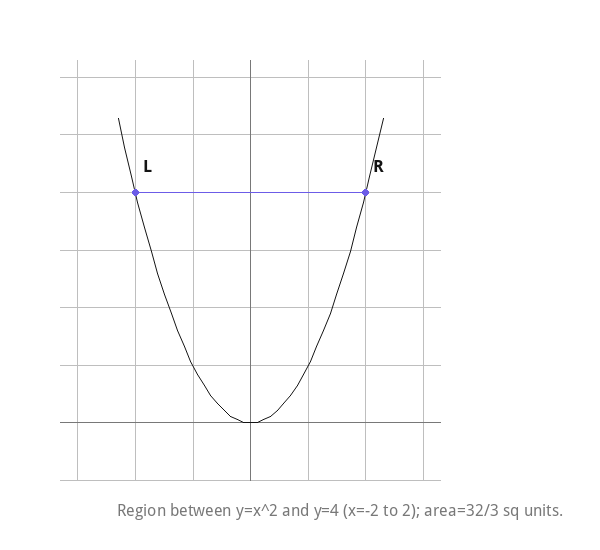
- Chapter 1: Extra Questions (HOTS) - Relations and Functions
- Chapter 2: Inverse Trigonometric Functions – Extra Questions with Answers
- Chapter 3: Matrices – Extra Questions with Answers
- Chapter 4: Determinants – Extra Questions with Answers
- Chapter 5: Continuity and Differentiability – Extra Questions with Answers
- Chapter 6: Applications of Derivatives – Extra Questions with Answers
- Chapter 8: Applications of Integrals – Extra Questions with Answers
- Chapter 9: Differential Equations – Extra Questions with Answers
- Chapter 10: Vectors – Extra Questions with Answers
- Chapter 11: Three-Dimensional Geometry – Extra Questions with Answers
- Chapter 12: Linear Programming – Extra Questions with Answers
- Chapter 13: Probability – Extra Questions with Answers
Frequently Asked Questions
How would you evaluate the integral of x squared with respect to x?
Using the power rule for integration, the integral is x cubed over 3 plus a constant.
How would you evaluate the definite integral of sin(x) from 0 to pi?
The antiderivative of sin(x) is negative cos(x), so evaluating from 0 to pi gives 1+1 = 2.
Chapter Quiz — Test Your Understanding
Class 12 Mathematics Chapter 7 – Solutions and Notes
For complete step-by-step answers and a quick summary, check the Class 12 Mathematics Chapter 7 Solutions and Class 12 Mathematics Chapter 7 Revision Notes.
See also: Chapter 1 | Chapter 2 | Chapter 3 | Chapter 4 | Chapter 5 | Chapter 6 | Chapter 7
Practice more: Chapter 1 | Chapter 2 | Chapter 3 | Chapter 4 | Chapter 5 | Chapter 6
Quick revision: Chapter 1 | Chapter 2 | Chapter 3 | Chapter 4 | Chapter 5 | Chapter 6
Recommended: Buy the Printed NCERT Class 12 Maths Book
Contains Amazon affiliate links.
If you’d like a printed copy alongside the PDF, here’s a verified option:
4.3 out of 5 stars (899 ratings) · Rs. 94
Price and availability may change on Amazon. As an Amazon Associate, ncertbooks.org earns from qualifying purchases.



Pingback: Class 12 Maths Chapter 7 Integrals Solutions (2026-27)
Pingback: Class 12 Maths Chapter 8 Applications of Integrals Solutions (2026-27)