
Applications of Integrals uses definite integrals to measure area, and these questions work through finding the area under a curve, between two curves, and even a circle’s area by integration.
Last Updated: September 23, 2026
Very Short Answer Questions (1 mark)
Q1. Write the formula for area under y=f(x) from x=a to x=b.
Ans: Area=∫ab|f(x)|dx.
Q2. What is the area of a circle of radius a using integration?
Ans: πa².
Q3. If f(x)≥g(x) on [a,b], write the area formula between them.
Ans: ∫ab[f(x)−g(x)]dx.
Q4. Why do we sketch curves before setting up the integral?
Ans: To correctly identify which curve is upper/lower and the correct limits of integration.
Q5. What is the area enclosed by the parabola y²=4ax and its latus rectum x=a?
Ans: 8a²/3 (standard result).
Short Answer Questions (2–3 marks)
Q6. Find the area bounded by y=x, the x-axis, and the lines x=0, x=4.
Ans: Area=∫04x dx=[x²/2]04=8 sq units.![Area under y=x, x=0 to 4 = [x^2/2] = 8 sq units.](https://ncertbooks.org/wp-content/uploads/2026/09/ncb-diagram-4303-exq-q6.png)
Q7. Find the area of the region bounded by y²=9x and x=4 in the first quadrant.
Ans: y=3√x. Area=∫043√x dx=3[2x3/2/3]04=2(8)=16 sq units.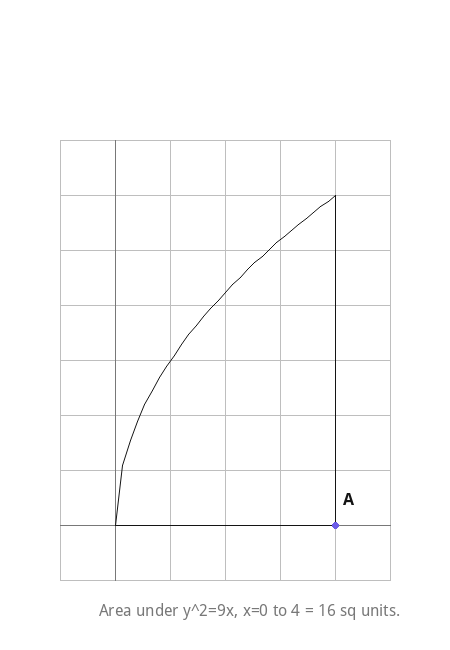
Q8. Find the points of intersection of y=x and y=x².
Ans: x=x² ⇒ x²−x=0 ⇒ x(x−1)=0 ⇒ x=0,1. Points: (0,0) and (1,1).
Higher-Order Thinking / Application Questions
Q9. Find the area of the region bounded by the curves y=x² and y=x, showing the full setup with sketch reasoning and limits.
Ans: First find intersection points: x²=x ⇒ x(x−1)=0 ⇒ x=0 or x=1, giving points (0,0) and (1,1). Between x=0 and x=1, we check which curve is on top by testing a value, say x=0.5: y=x gives 0.5, y=x² gives 0.25. Since 0.5>0.25, the line y=x lies above the parabola y=x² throughout this interval. Therefore, Area=∫01(x−x²)dx=[x²/2−x³/3]01=(1/2−1/3)−0=3/6−2/6=1/6 sq unit. Geometrically, this represents the small lens-shaped/parabolic-segment region enclosed between the straight line and the parabola between their two intersection points, and the small value (1/6) makes sense given how close the two curves are throughout the unit interval.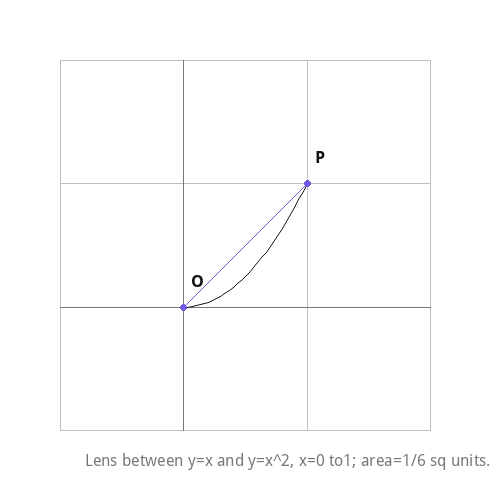
Q10. Using integration, find the area of the region in the first quadrant enclosed by the circle x²+y²=4, the line x=√3y, and the x-axis, explaining how the region splits into two parts.
Ans: The circle x²+y²=4 has radius 2. The line x=√3y, i.e., y=x/√3, passes through the origin with slope 1/√3, corresponding to an angle of 30° with the x-axis. To find where the line meets the circle: substitute x=√3y into x²+y²=4: 3y²+y²=4 ⇒ 4y²=4 ⇒ y=1 (taking positive root in first quadrant), so x=√3. The intersection point is (√3,1). The region in the first quadrant bounded by the circle, the line, and the x-axis splits naturally into two parts: Part 1, from x=0 to x=√3, bounded above by the line y=x/√3 (since the line is below the circle here); Part 2, from x=√3 to x=2, bounded above by the circle y=√(4−x²). Part 1 area=∫0√3(x/√3)dx=(1/√3)[x²/2]0√3=(1/√3)(3/2)=√3/2. Part 2 area=∫√32√(4−x²)dx=[x√(4−x²)/2+2sin⁻¹(x/2)]√32=(0+2sin⁻¹(1))−(√3(1)/2+2sin⁻¹(√3/2))=(2·π/2)−(√3/2+2·π/3)=π−√3/2−2π/3=π/3−√3/2. Total area=√3/2+(π/3−√3/2)=π/3 sq units. This demonstrates the standard technique of splitting a composite region into simpler sub-regions when a single integral cannot capture the full boundary in one expression.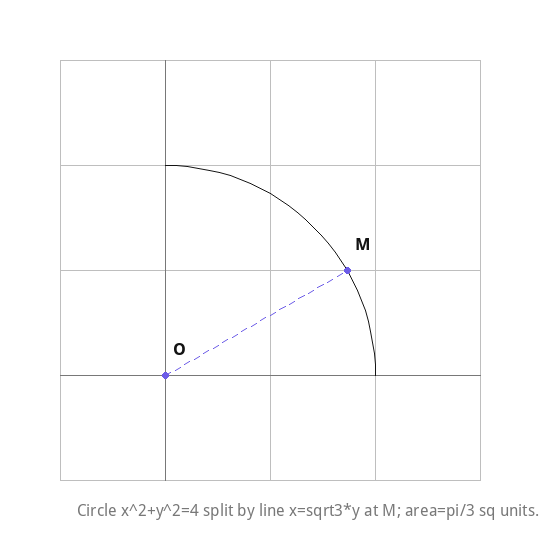
- Chapter 1: Extra Questions (HOTS) - Relations and Functions
- Chapter 2: Inverse Trigonometric Functions – Extra Questions with Answers
- Chapter 3: Matrices – Extra Questions with Answers
- Chapter 4: Determinants – Extra Questions with Answers
- Chapter 5: Continuity and Differentiability – Extra Questions with Answers
- Chapter 6: Applications of Derivatives – Extra Questions with Answers
- Chapter 7: Integrals – Extra Questions with Answers
- Chapter 9: Differential Equations – Extra Questions with Answers
- Chapter 10: Vectors – Extra Questions with Answers
- Chapter 11: Three-Dimensional Geometry – Extra Questions with Answers
- Chapter 12: Linear Programming – Extra Questions with Answers
- Chapter 13: Probability – Extra Questions with Answers
Frequently Asked Questions
How would you find the area under the curve y = x squared between x=0 and x=2 using integration?
Integrate x squared from 0 to 2, giving x cubed over 3 evaluated from 0 to 2, which is 8 over 3 square units.
How would you find the area enclosed between the line y=x and the curve y=x squared from x=0 to x=1?
Integrate the difference (x minus x squared) from 0 to 1, giving half minus one third = one sixth square units.
Chapter Quiz — Test Your Understanding
Class 12 Mathematics Chapter 8 – Solutions and Notes
For complete step-by-step answers and a quick summary, check the Class 12 Mathematics Chapter 8 Solutions and Class 12 Mathematics Chapter 8 Revision Notes.
See also: Chapter 1 | Chapter 2 | Chapter 3 | Chapter 4 | Chapter 5 | Chapter 6 | Chapter 7 | Chapter 8
Practice more: Chapter 1 | Chapter 2 | Chapter 3 | Chapter 4 | Chapter 5 | Chapter 6 | Chapter 7
Quick revision: Chapter 1 | Chapter 2 | Chapter 3 | Chapter 4 | Chapter 5 | Chapter 6 | Chapter 7
Recommended: Buy the Printed NCERT Class 12 Maths Book
Contains Amazon affiliate links.
If you’d like a printed copy alongside the PDF, here’s a verified option:
4.3 out of 5 stars (899 ratings) · Rs. 94
Price and availability may change on Amazon. As an Amazon Associate, ncertbooks.org earns from qualifying purchases.



Pingback: Class 12 Maths Chapter 8 Applications of Integrals Solutions (2026-27)
Pingback: Class 12 Maths Chapter 12 Linear Programming Solutions (2026-27)