
Linear Programming questions here focus on setting up the objective function, applying non-negativity constraints, and locating the optimal value at a corner point of the feasible region.
Last Updated: September 23, 2026
Very Short Answer Questions (1 mark)
Q1. What is the objective function in an LPP?
Ans: The linear function Z=ax+by to be maximized or minimized.
Q2. What are the non-negativity constraints usually imposed?
Ans: x≥0, y≥0.
Q3. Where does the optimal value of Z occur in a bounded feasible region?
Ans: At a corner point (vertex) of the feasible region.
Q4. What is a feasible solution?
Ans: Any point satisfying all the constraints of the LPP.
Q5. Name one real-world application of linear programming.
Ans: Diet problem (or manufacturing/transportation problem).
Short Answer Questions (2–3 marks)
Q6. Find the corner points of the feasible region bounded by x+y≤4, x≥0, y≥0.
Ans: The region is a triangle with vertices (0,0), (4,0), (0,4).
Q7. Maximize Z=3x+4y subject to x+y≤4, x≥0, y≥0.
Ans: Corner points: (0,0),(4,0),(0,4). Z values: 0, 12, 16. Maximum Z=16 at (0,4).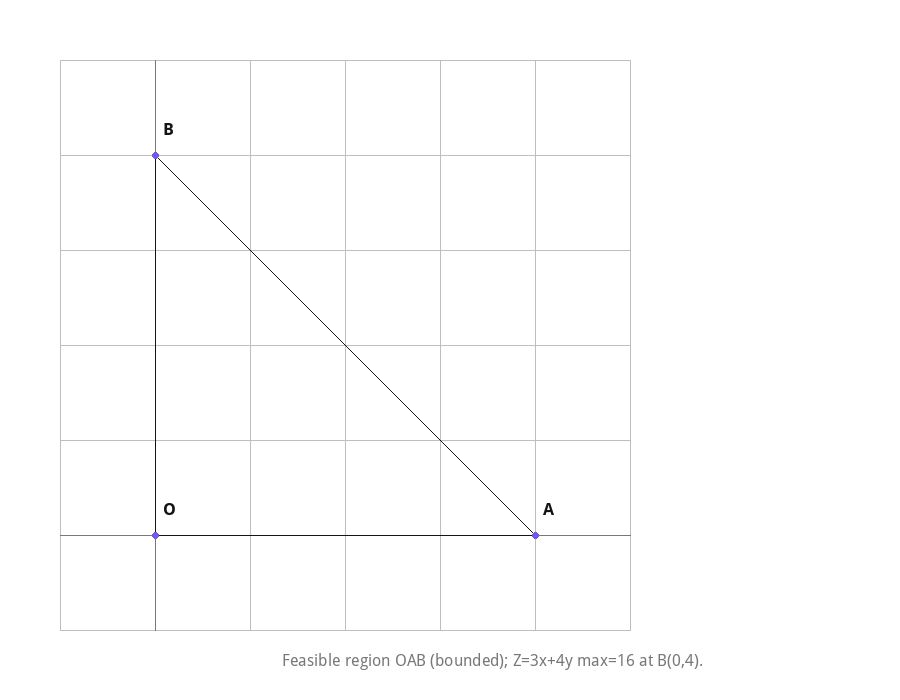
Q8. State whether the feasible region for x+y≥4, x≥0, y≥0 is bounded or unbounded.
Ans: Unbounded (the region extends infinitely away from the origin).
Higher-Order Thinking / Application Questions
Q9. A factory makes two products, A and B. Each unit of A requires 2 hours of machine time and 1 hour of labour; each unit of B requires 1 hour of machine time and 2 hours of labour. The factory has 40 machine hours and 50 labour hours available. Profit is Rs.30 per unit of A and Rs.40 per unit of B. Formulate this as an LPP and solve graphically to find the maximum profit.
Ans: Let x=units of A, y=units of B. Objective: Maximize Z=30x+40y. Constraints: 2x+y≤40 (machine time), x+2y≤50 (labour time), x≥0, y≥0. Find corner points of the feasible region: (0,0); (20,0) [from 2x+y=40 setting y=0]; (0,25) [from x+2y=50 setting x=0]; and the intersection of 2x+y=40 and x+2y=50: multiply first by 2: 4x+2y=80; subtract second: 4x+2y−(x+2y)=80−50 ⇒ 3x=30 ⇒ x=10, then y=40−2(10)=20, giving point (10,20). Evaluate Z at each corner: Z(0,0)=0; Z(20,0)=600; Z(0,25)=1000; Z(10,20)=30(10)+40(20)=300+800=1100. The maximum profit is Rs.1100, achieved by producing 10 units of A and 20 units of B. This demonstrates the standard corner-point method: after correctly identifying all vertices (including intersection points of binding constraints), evaluating the objective function at each reveals the true optimum, which need not be at an “obvious” axis-intercept point.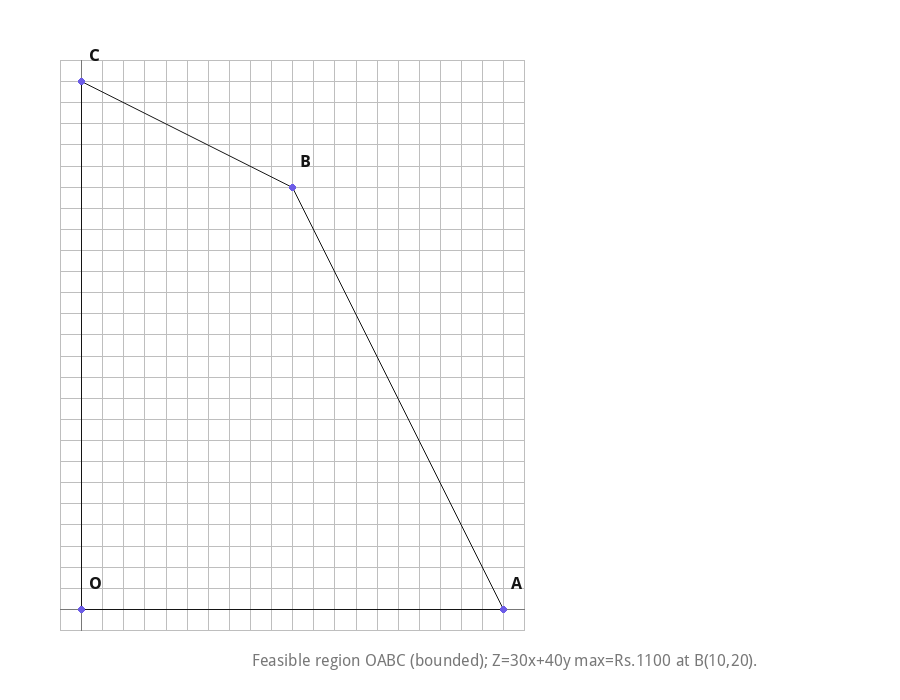
Q10. Explain, with an example, why the optimal solution of an LPP always occurs at a corner point of the feasible region rather than at an interior point, and describe what happens when multiple optimal solutions exist.
Ans: The objective function Z=ax+by is linear, so its level curves (lines where Z=constant) are straight lines with a fixed slope (−a/b). As we increase or decrease the constant, these parallel lines sweep across the plane. Since the feasible region is a convex polygon (intersection of half-planes from linear constraints), as the level-curve line sweeps to increase (or decrease) Z, the LAST point of the feasible region it touches before leaving (for maximization) or the FIRST point it touches (for minimization) must be a vertex, because a straight line can only be tangent to (touch only at a single point of) a convex polygon at a corner, UNLESS the line happens to be exactly parallel to one of the edges of the polygon. In that special case, where the objective function slope exactly matches an edge slope, the level line coincides with that entire edge when it is optimal, meaning EVERY point on that edge (not just the two corner endpoints) gives the same optimal value of Z — this is the case of multiple (infinitely many) optimal solutions. For example, if maximizing Z=2x+3y subject to constraints where one edge of the feasible region also has the equation 2x+3y=constant, then all points along that edge are equally optimal. In practice, we can still identify this situation using the corner point method: if two adjacent corner points give the same (maximum or minimum) value of Z, then every point on the edge joining them is also optimal.
- Chapter 1: Extra Questions (HOTS) - Relations and Functions
- Chapter 2: Inverse Trigonometric Functions – Extra Questions with Answers
- Chapter 3: Matrices – Extra Questions with Answers
- Chapter 4: Determinants – Extra Questions with Answers
- Chapter 5: Continuity and Differentiability – Extra Questions with Answers
- Chapter 6: Applications of Derivatives – Extra Questions with Answers
- Chapter 7: Integrals – Extra Questions with Answers
- Chapter 8: Applications of Integrals – Extra Questions with Answers
- Chapter 9: Differential Equations – Extra Questions with Answers
- Chapter 10: Vectors – Extra Questions with Answers
- Chapter 11: Three-Dimensional Geometry – Extra Questions with Answers
- Chapter 13: Probability – Extra Questions with Answers
Frequently Asked Questions
How would you find the maximum value of Z = 3x + 4y subject to x+y is less than or equal to 4, x is greater than or equal to 0, y is greater than or equal to 0?
Evaluate Z at each corner point of the feasible region: (0,0) gives 0, (4,0) gives 12, and (0,4) gives 16, so the maximum value is 16 at (0,4).
In a linear programming problem, why must the feasible region be checked at its corner points rather than just anywhere inside it?
Because the optimal value of a linear objective function over a convex feasible region always occurs at one of its corner points, by the extreme point theorem.
Chapter Quiz — Test Your Understanding
Class 12 Mathematics Chapter 12 – Solutions and Notes
For complete step-by-step answers and a quick summary, check the Class 12 Mathematics Chapter 12 Solutions and Class 12 Mathematics Chapter 12 Revision Notes.
See also: Chapter 1 | Chapter 2 | Chapter 3 | Chapter 4 | Chapter 5 | Chapter 6 | Chapter 7 | Chapter 8 | Chapter 9 | Chapter 10 | Chapter 11 | Chapter 12
Practice more: Chapter 1 | Chapter 2 | Chapter 3 | Chapter 4 | Chapter 5 | Chapter 6 | Chapter 7 | Chapter 8 | Chapter 9 | Chapter 10 | Chapter 11
Quick revision: Chapter 1 | Chapter 2 | Chapter 3 | Chapter 4 | Chapter 5 | Chapter 6 | Chapter 7 | Chapter 8 | Chapter 9 | Chapter 10 | Chapter 11
Recommended: Buy the Printed NCERT Class 12 Maths Book
Contains Amazon affiliate links.
If you’d like a printed copy alongside the PDF, here’s a verified option:
4.3 out of 5 stars (899 ratings) · Rs. 94
Price and availability may change on Amazon. As an Amazon Associate, ncertbooks.org earns from qualifying purchases.



Pingback: Class 12 Maths Chapter 12 Linear Programming Solutions (2026-27)