
When a triangle’s height isn’t given but its three sides are, Heron’s formula steps in, and these questions practice applying it alongside standard perimeter and area formulas.
Last Updated: September 23, 2026
Very Short Answer Questions (1 mark)
Q1. Write Heron’s formula for the area of a triangle.
Ans: Area = √[s(s−a)(s−b)(s−c)], where s = (a+b+c)/2.
Q2. Find the semi-perimeter of a triangle with sides 5 cm, 6 cm, and 7 cm.
Ans: s = (5+6+7)/2 = 9 cm.
Q3. What is the area formula for a parallelogram?
Ans: Area = base × height.
Q4. When is Heron’s formula especially useful?
Ans: When only the three side lengths of a triangle are known and the height is not directly given.
Q5. How is the area of a quadrilateral found using a diagonal?
Ans: By splitting it into two triangles along the diagonal and adding their individual areas.
Short Answer Questions (2–3 marks)
Q6. Find the area of a triangle with sides 3 cm, 4 cm, and 5 cm using Heron’s formula.
Ans: s = (3+4+5)/2 = 6. Area = √[6(6−3)(6−4)(6−5)] = √[6×3×2×1] = √36 = 6 cm².
Q7. A triangular park has sides 30 m, 40 m, and 50 m. Find its area using Heron’s formula, and verify using the base-height formula (noting this is a right triangle).
Ans: Heron’s: s = 60, Area = √[60(60−30)(60−40)(60−50)] = √[60×30×20×10] = √360000 = 600 m². Verification: since 30²+40²=50² (900+1600=2500), it’s a right triangle with legs 30, 40; Area = ½×30×40 = 600 m². Matches.
Q8. Explain why Heron’s formula is more versatile than the ½ × base × height formula for finding a triangle’s area in real-world surveying.
Ans: In real-world surveying, it is often easier to directly measure the three sides of a triangular plot than to measure a perpendicular height accurately (which requires knowing the exact right-angle direction). Heron’s formula only needs the three side lengths, making it more practical and versatile for field measurements.
Higher-Order Thinking / Application Questions
Q9. A quadrilateral field ABCD has diagonal AC = 20 m, splitting it into triangle ABC (sides AB=9m, BC=12m, AC=20m… wait, use realistic values) with sides 9m, 40m, and 41m in triangle 1, and 20m, 15m, 25m in triangle 2 (sharing diagonal 25m). Find the total area of the field using Heron’s formula for each triangle.
Ans: Triangle 1 (sides 9, 40, 41): s=45, Area=√[45(45−9)(45−40)(45−41)]=√[45×36×5×4]=√32400=180 m². Triangle 2 (sides 20, 15, 25): s=30, Area=√[30(30−20)(30−15)(30−25)]=√[30×10×15×5]=√22500=150 m². Total area = 180+150 = 330 m².
Q10. Two triangles have the same perimeter but different side length combinations. Explain, using Heron’s formula conceptually, why they can have different areas despite having the same perimeter.
Ans: Heron’s formula depends not just on the semi-perimeter s, but on the individual differences (s−a), (s−b), (s−c) for each specific side. Even with the same total perimeter (and thus the same s), different combinations of individual side lengths change these difference terms, which changes the product under the square root, and therefore changes the resulting area — showing that perimeter alone does not determine a triangle’s area.
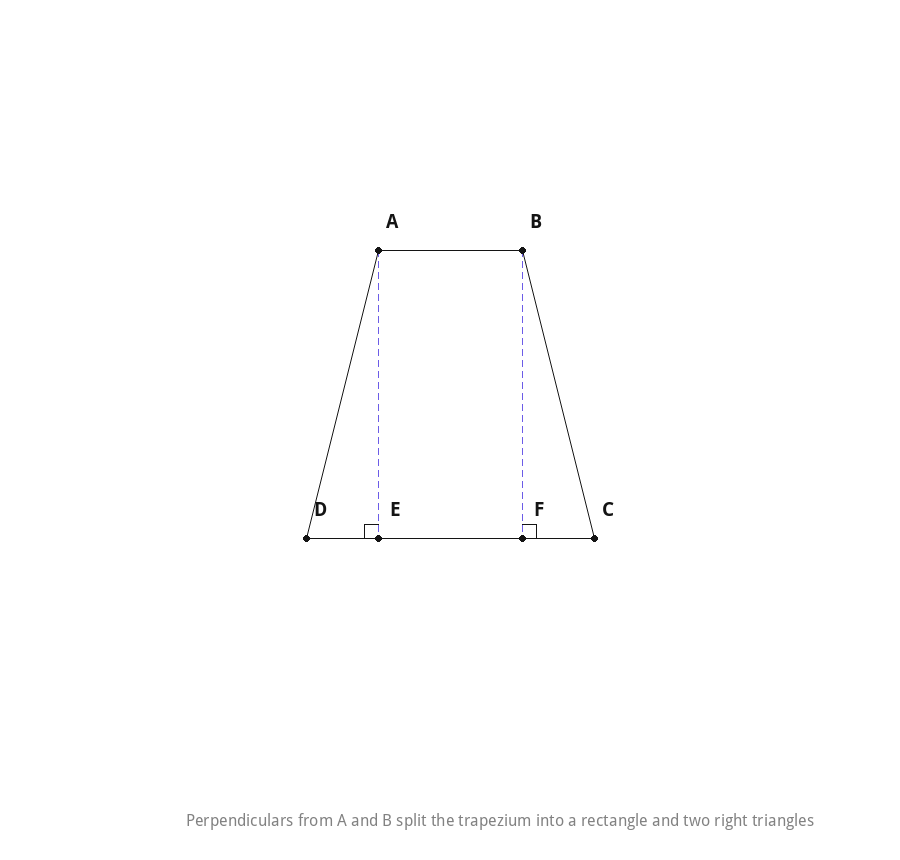
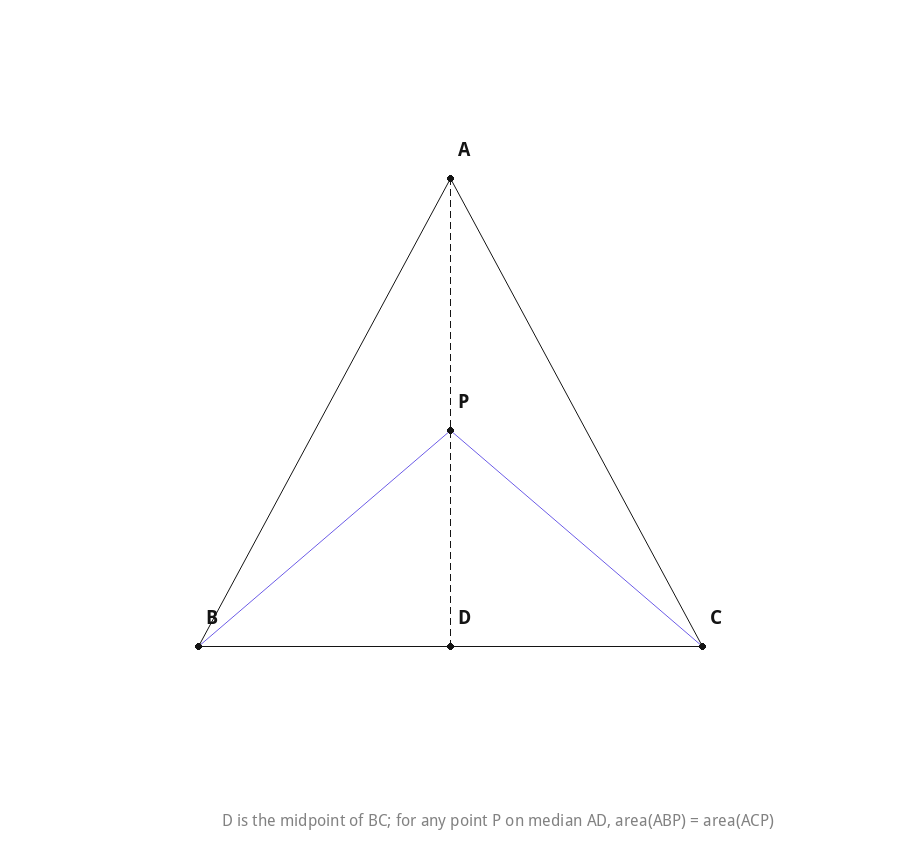
Quick visual: a worked diagram from the full Solutions page, for reference.
- Chapter 1: Orienting Yourself: The Use of Coordinates – Extra Questions with Answers
- Chapter 2: Introduction to Linear Polynomials – Extra Questions with Answers
- Chapter 3: The World of Numbers – Extra Questions with Answers
- Chapter 4: Exploring Algebraic Identities – Extra Questions with Answers
- Chapter 5: I'm Up and Down, and Round and Round – Extra Questions with Answers
- Chapter 7: The Mathematics of Maybe: Introduction to Probability – Extra Questions with Answers
- Chapter 8: Predicting What Comes Next?: Exploring Sequences and Progressions – Extra Questions with Answers
Frequently Asked Questions
How would you find the area of a plot of land shaped like a combination of a rectangle and a triangle?
The composite shape is divided into a rectangle and a triangle, the area of each is calculated separately using their formulas, and the two areas are added together to find the total area.
Why does the unit used for measuring area always need to be squared, such as square metres rather than simply metres?
Area is a two-dimensional quantity depending on both length and width, so the unit must reflect this by being squared, since multiplying two length measurements together naturally produces a squared unit.
Chapter Quiz — Test Your Understanding
Class 9 Mathematics Chapter 6 – Solutions and Notes
For complete step-by-step answers and a quick summary, check the Class 9 Mathematics Chapter 6 Solutions and Class 9 Mathematics Chapter 6 Revision Notes.
See also: Chapter 1 | Chapter 2 | Chapter 3 | Chapter 4 | Chapter 5 | Chapter 6
Practice more: Chapter 1 | Chapter 2 | Chapter 3 | Chapter 4 | Chapter 5
Quick revision: Chapter 1 | Chapter 2 | Chapter 3 | Chapter 4 | Chapter 5
Recommended: Buy the Printed NCERT Class 9 Maths Book
Contains Amazon affiliate links.
If you’d like a printed copy alongside the PDF, here’s a verified option:
4.0 out of 5 stars (1,313 ratings) · Rs. 106
Price and availability may change on Amazon. As an Amazon Associate, ncertbooks.org earns from qualifying purchases.


