
Not every number can be written as a terminating or repeating decimal, and this set of questions tests the difference between rational and irrational numbers along with the exponent rules that govern them.
Last Updated: September 23, 2026
Very Short Answer Questions (1 mark)
Q1. Is √4 rational or irrational?
Ans: Rational, since √4 = 2 = 2/1.
Q2. What type of decimal expansion does an irrational number have?
Ans: Non-terminating and non-repeating.
Q3. Simplify: 2³ × 2².
Ans: 2⁵ = 32.
Q4. Is every integer a rational number?
Ans: Yes, since every integer n can be written as n/1.
Q5. Name the set that includes both rational and irrational numbers.
Ans: Real numbers.
Short Answer Questions (2–3 marks)
Q6. Classify the following as rational or irrational: 0.333…, √9, √7, 22/7.
Ans: 0.333… is rational (repeating decimal, equals 1/3). √9 = 3 is rational. √7 is irrational (non-perfect square). 22/7 is rational (a fraction of integers — note this is only an approximation of π, not π itself).
Q7. Rationalise the denominator of 1/√2.
Ans: Multiply numerator and denominator by √2: (1×√2)/(√2×√2) = √2/2.
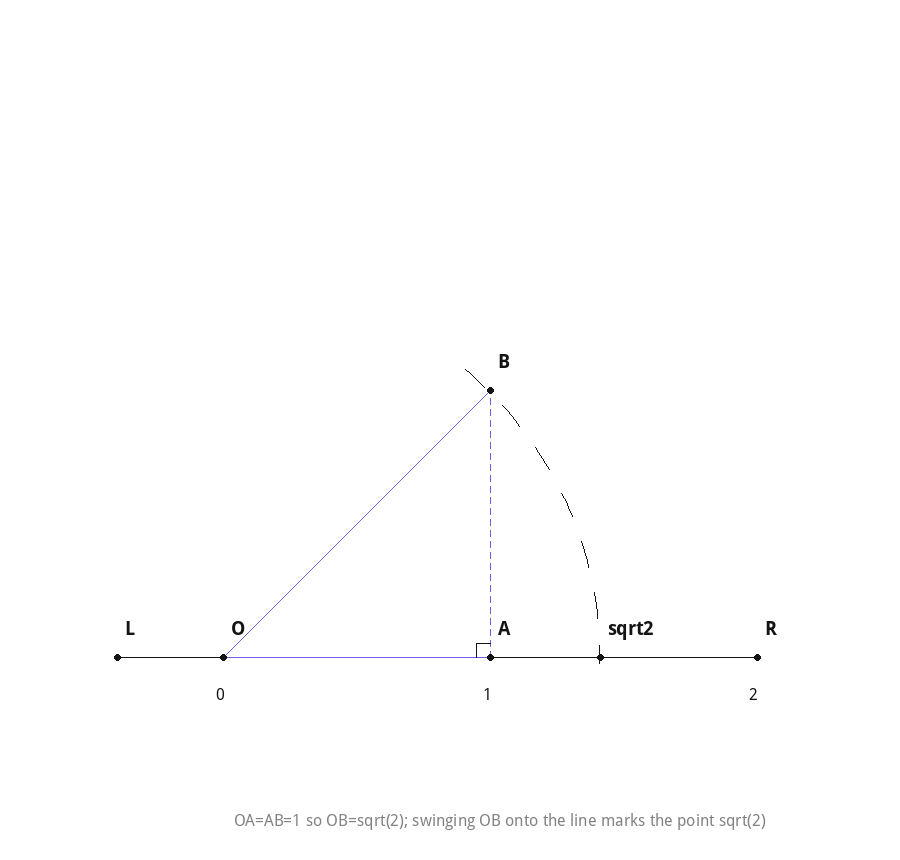
Q8. Describe, in words, how √2 can be represented accurately on the number line using a geometric construction.
Ans: Construct a right-angled triangle with both legs of length 1 unit on the number line; by the Pythagoras theorem, the hypotenuse has length √(1²+1²) = √2. Using a compass, this hypotenuse length can be transferred (swung as an arc) from the origin onto the number line, precisely marking the point √2.
Higher-Order Thinking / Application Questions
Q9. A student claims that the product of two irrational numbers is always irrational, citing √2 × √3 = √6 as an example. Show, using a different example, that this claim is not always true.
Ans: The claim is false. Consider √2 × √2 = 2, which is rational, even though both √2 factors are irrational. So the product of two irrational numbers can be either rational or irrational, depending on the specific numbers involved.
Q10. Simplify the expression (3²)³ ÷ 3⁴ using laws of exponents, showing each step, and explain which law is applied at each step.
Ans: Step 1: (3²)³ = 3²×³ = 3⁶ (using the law (am)n = amn). Step 2: 3⁶ ÷ 3⁴ = 3⁶⁻⁴ = 3² = 9 (using the law am/an = am−n).
- Chapter 1: Orienting Yourself: The Use of Coordinates – Extra Questions with Answers
- Chapter 2: Introduction to Linear Polynomials – Extra Questions with Answers
- Chapter 4: Exploring Algebraic Identities – Extra Questions with Answers
- Chapter 5: I'm Up and Down, and Round and Round – Extra Questions with Answers
- Chapter 6: Measuring Space: Perimeter and Area – Extra Questions with Answers
- Chapter 7: The Mathematics of Maybe: Introduction to Probability – Extra Questions with Answers
- Chapter 8: Predicting What Comes Next?: Exploring Sequences and Progressions – Extra Questions with Answers
Frequently Asked Questions
How can you show that a number like 0.333… repeating is a rational number even though its decimal expansion never ends?
A repeating decimal like 0.333… can be expressed exactly as the fraction one-third, and since it can be written as a ratio of two integers, it satisfies the definition of a rational number.
Why is the square root of 2 classified as an irrational number?
The square root of 2 cannot be expressed exactly as a ratio of two integers, and its decimal expansion continues infinitely without repeating in any pattern, the defining characteristic of an irrational number.
Chapter Quiz — Test Your Understanding
Class 9 Mathematics Chapter 3 – Solutions and Notes
For complete step-by-step answers and a quick summary, check the Class 9 Mathematics Chapter 3 Solutions and Class 9 Mathematics Chapter 3 Revision Notes.
Recommended: Buy the Printed NCERT Class 9 Maths Book
Contains Amazon affiliate links.
If you’d like a printed copy alongside the PDF, here’s a verified option:
4.0 out of 5 stars (1,313 ratings) · Rs. 106
Price and availability may change on Amazon. As an Amazon Associate, ncertbooks.org earns from qualifying purchases.


