
An arithmetic progression is defined by a constant common difference between terms, and these questions work through identifying APs, finding their common difference, and computing specific terms.
Last Updated: September 23, 2026
Very Short Answer Questions (1 mark)
Q1. Find the common difference of the AP: 5, 9, 13, 17, …
Ans: d = 9 − 5 = 4.
Q2. Write the formula for the nth term of an AP.
Ans: an = a + (n−1)d.
Q3. Is the sequence 2, 4, 8, 16 an AP? Why or why not?
Ans: No, the differences (2, 4, 8) are not constant, so it is not an AP (it’s a geometric progression instead).
Q4. Find the 5th term of the AP with first term 3 and common difference 2.
Ans: a₅ = 3 + (5−1)(2) = 3 + 8 = 11.
Q5. What is another name for the terms of a sequence that follow a specific rule?
Ans: Terms of the sequence.
Short Answer Questions (2–3 marks)
Q6. Find the sum of the first 10 terms of the AP: 2, 5, 8, 11, …
Ans: a=2, d=3, n=10. S₁₀ = 10/2 × [2(2) + (10−1)(3)] = 5 × [4 + 27] = 5 × 31 = 155.
Q7. The 3rd term of an AP is 12, and the 7th term is 24. Find the first term and common difference.
Ans: a + 2d = 12 and a + 6d = 24. Subtracting: 4d = 12, so d = 3. Substituting back: a + 2(3) = 12, so a = 6.
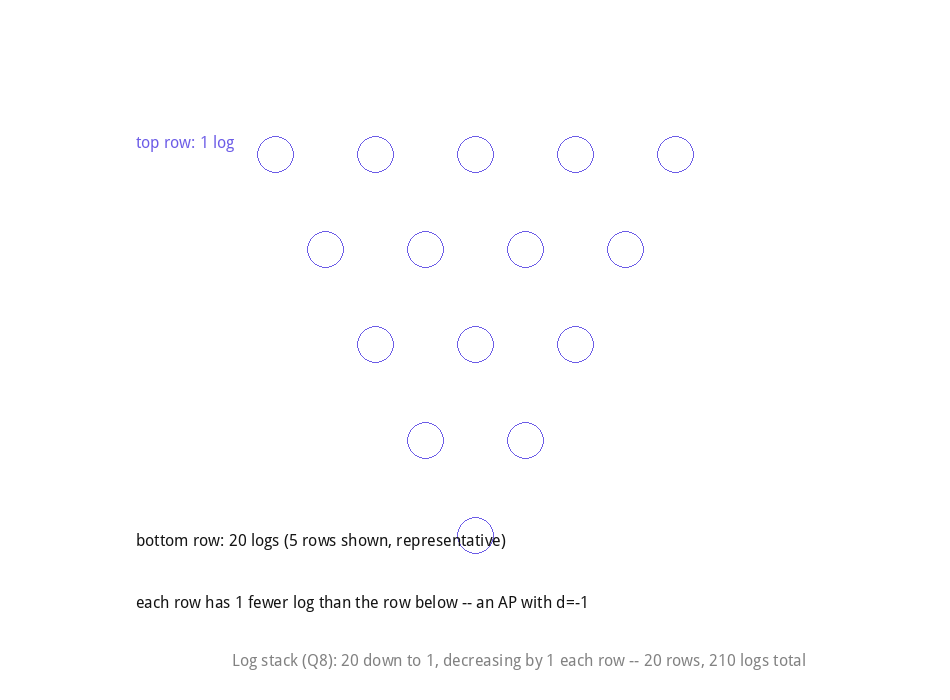
Q8. A stack of logs has 20 logs in the bottom row, 19 in the next row, and so on, decreasing by 1 each row, up to a single log at the top. Find the total number of rows and the total number of logs, recognising this as an AP.
Ans: This is an AP with a=20, d=−1, going down to an=1. Using an=a+(n−1)d: 1 = 20 + (n−1)(−1), so (n−1) = 19, giving n = 20 rows. Total logs: S₂₀ = 20/2 × (20+1) = 10 × 21 = 210 logs.
Higher-Order Thinking / Application Questions
Q9. A person starts saving ₹500 in the first month and increases their savings by ₹100 every subsequent month. Using the AP formulas, find how much they save in the 12th month, and their total savings over the first 12 months.
Ans: a=500, d=100. 12th month savings: a₁₂ = 500 + (12−1)(100) = 500 + 1100 = ₹1600. Total over 12 months: S₁₂ = 12/2 × [2(500) + (12−1)(100)] = 6 × [1000 + 1100] = 6 × 2100 = ₹12600.
Q10. Prove, using algebra, that if three numbers a, b, c are in arithmetic progression, then 2b = a + c.
Ans: If a, b, c are in AP, the common difference between consecutive terms is equal: b − a = c − b (since both equal the common difference d). Rearranging: b + b = a + c, so 2b = a + c. This confirms that the middle term of three numbers in AP is the average of the other two.
- Chapter 1: Orienting Yourself: The Use of Coordinates – Extra Questions with Answers
- Chapter 2: Introduction to Linear Polynomials – Extra Questions with Answers
- Chapter 3: The World of Numbers – Extra Questions with Answers
- Chapter 4: Exploring Algebraic Identities – Extra Questions with Answers
- Chapter 5: I'm Up and Down, and Round and Round – Extra Questions with Answers
- Chapter 6: Measuring Space: Perimeter and Area – Extra Questions with Answers
- Chapter 7: The Mathematics of Maybe: Introduction to Probability – Extra Questions with Answers
Frequently Asked Questions
How can you find the 10th term of an arithmetic progression if you know the first term and the common difference?
The nth term is found using first term plus (n minus 1) multiplied by the common difference, so substituting n equals 10 gives the 10th term directly without listing all preceding terms.
What distinguishes a sequence that grows by a constant ratio from one that grows by a constant difference?
A sequence growing by a constant ratio is a geometric progression, while one growing by a constant difference is an arithmetic progression, and these grow at very different rates over time.
Chapter Quiz — Test Your Understanding
Class 9 Mathematics Chapter 8 – Solutions and Notes
For complete step-by-step answers and a quick summary, check the Class 9 Mathematics Chapter 8 Solutions and Class 9 Mathematics Chapter 8 Revision Notes.
See also: Chapter 1 | Chapter 2 | Chapter 3 | Chapter 4 | Chapter 5 | Chapter 6 | Chapter 7 | Chapter 8
Practice more: Chapter 1 | Chapter 2 | Chapter 3 | Chapter 4 | Chapter 5 | Chapter 6 | Chapter 7
Quick revision: Chapter 1 | Chapter 2 | Chapter 3 | Chapter 4 | Chapter 5 | Chapter 6 | Chapter 7
Recommended: Buy the Printed NCERT Class 9 Maths Book
Contains Amazon affiliate links.
If you’d like a printed copy alongside the PDF, here’s a verified option:
4.0 out of 5 stars (1,313 ratings) · Rs. 106
Price and availability may change on Amazon. As an Amazon Associate, ncertbooks.org earns from qualifying purchases.


