
Circle geometry runs on a small set of angle rules, such as a diameter always subtending a 90-degree angle, and these questions apply them to chords, cyclic quadrilaterals and circumcircles.
Last Updated: September 23, 2026
Very Short Answer Questions (1 mark)
Q1. What is the angle subtended by a diameter at any point on the circle?
Ans: 90°.
Q2. What line always passes through the centre of a circle when drawn perpendicular to a chord from the centre?
Ans: The line bisects the chord (perpendicular from centre bisects the chord).
Q3. In a cyclic quadrilateral, if one angle is 70°, what is its opposite angle?
Ans: 110° (since opposite angles are supplementary: 180 − 70 = 110).
Q4. What is the longest chord of a circle called?
Ans: The diameter.
Q5. If an arc subtends 80° at the centre, what angle does it subtend at a point on the remaining circle?
Ans: 40° (half of the central angle).
Short Answer Questions (2–3 marks)
Q6. Two chords of a circle are equal in length. What can you conclude about the angles they subtend at the centre, and why?
Ans: The angles they subtend at the centre are also equal, because equal chords of a circle always subtend equal angles at the centre — this is a direct property of circles.
Q7. In a cyclic quadrilateral ABCD, angle A = 85° and angle B = 95°. Find angles C and D.
Ans: Since opposite angles are supplementary: angle C = 180 − angle A = 180 − 85 = 95°. Angle D = 180 − angle B = 180 − 95 = 85°.
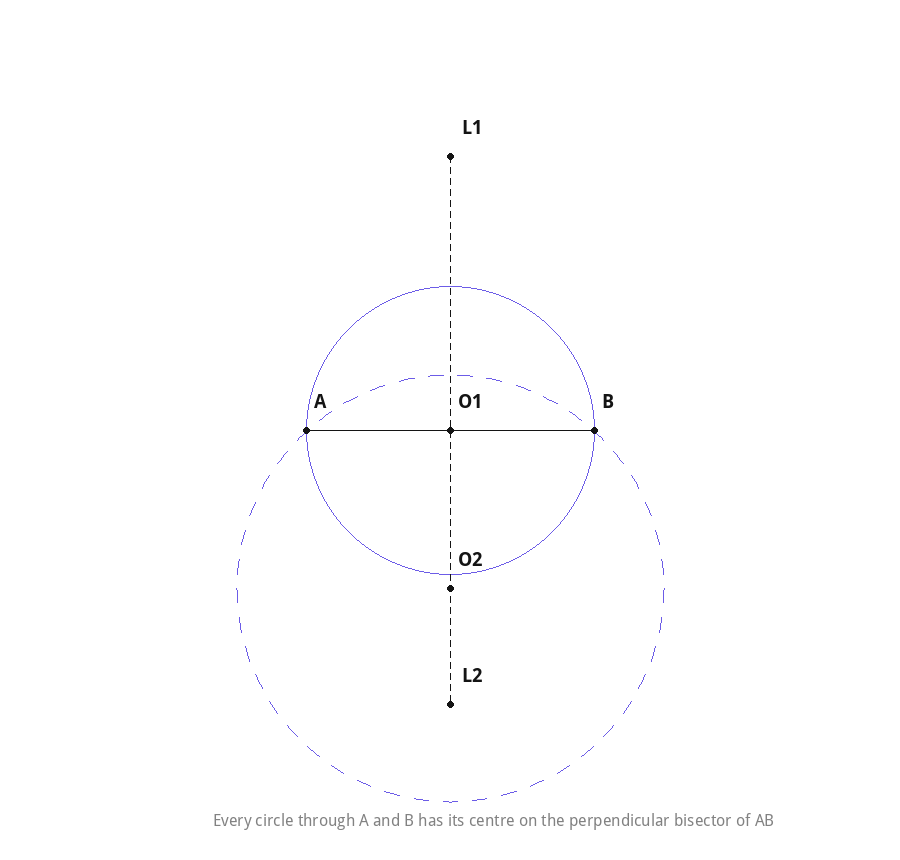
Q8. Explain why the perpendicular bisector of any chord of a circle must pass through the centre.
Ans: Every point on the perpendicular bisector of a chord is equidistant from the chord’s two endpoints. Since the centre of the circle is, by definition, equidistant from every point on the circle (including both endpoints of the chord), the centre must lie on this perpendicular bisector.
Higher-Order Thinking / Application Questions
Q9. A triangle is inscribed in a semicircle such that one side is the diameter. Prove, using the angle-in-a-semicircle property, that the triangle must be right-angled, and identify which angle is 90°.
Ans: Since one side of the triangle is the diameter of the circle, and the diameter subtends an angle of 90° at any point on the remaining part of the circle (where the third vertex lies), the angle at that third vertex (opposite the diameter) must be 90°. This proves the triangle is right-angled, with the right angle at the vertex not on the diameter.
Q10. A cyclic quadrilateral has one exterior angle of 65° at a vertex. Find the interior opposite angle, and explain the property you used.
Ans: The interior opposite angle is 65°, since in a cyclic quadrilateral, the exterior angle at any vertex equals the interior angle opposite to it — a property that follows directly from the fact that opposite interior angles are supplementary (the exterior angle is itself supplementary to its adjacent interior angle, making it numerically equal to the opposite interior angle).
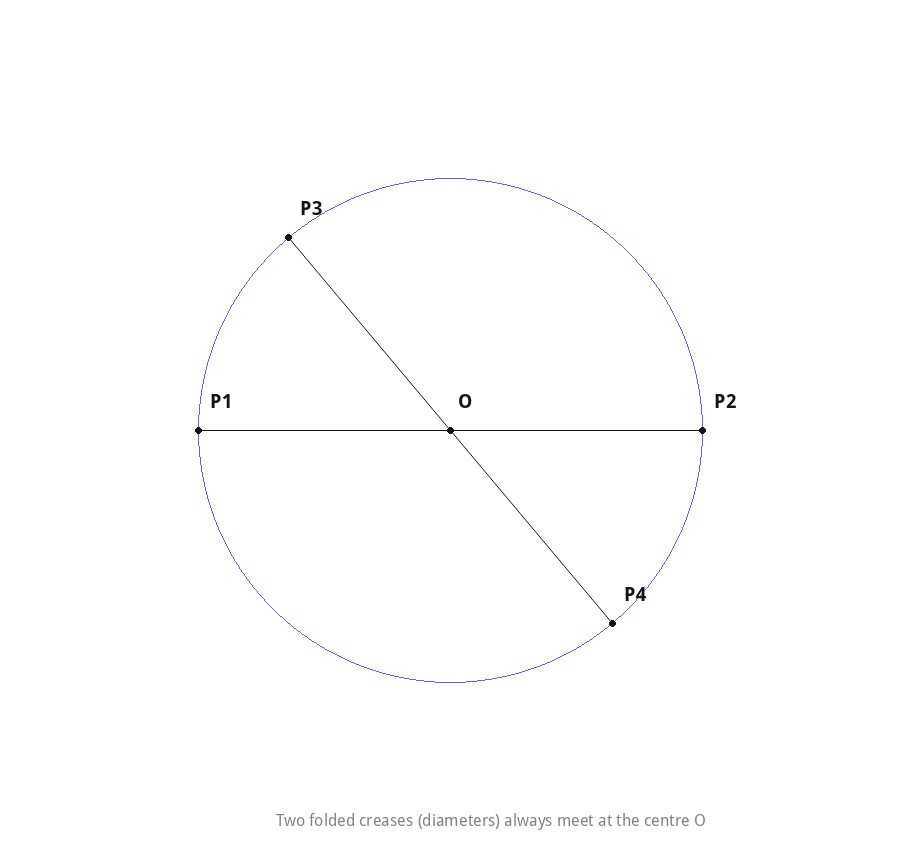
Quick visual: a worked diagram from the full Solutions page, for reference.
- Chapter 1: Orienting Yourself: The Use of Coordinates – Extra Questions with Answers
- Chapter 2: Introduction to Linear Polynomials – Extra Questions with Answers
- Chapter 3: The World of Numbers – Extra Questions with Answers
- Chapter 4: Exploring Algebraic Identities – Extra Questions with Answers
- Chapter 6: Measuring Space: Perimeter and Area – Extra Questions with Answers
- Chapter 7: The Mathematics of Maybe: Introduction to Probability – Extra Questions with Answers
- Chapter 8: Predicting What Comes Next?: Exploring Sequences and Progressions – Extra Questions with Answers
Frequently Asked Questions
Why does plotting a linear equation in two variables always result in a straight line on a graph?
A linear equation has variables raised only to the first power with a constant rate of relationship between them, and this constant rate is exactly what produces a straight line when the solutions are plotted.
How many points are actually needed to accurately draw the graph of a linear equation, and why?
Only two points are mathematically enough to determine a unique straight line, but a third point is often plotted as a check, since if all three do not lie on the same line, it indicates a calculation error.
Chapter Quiz — Test Your Understanding
Class 9 Mathematics Chapter 5 – Solutions and Notes
For complete step-by-step answers and a quick summary, check the Class 9 Mathematics Chapter 5 Solutions and Class 9 Mathematics Chapter 5 Revision Notes.
See also: Chapter 1 | Chapter 2 | Chapter 3 | Chapter 4 | Chapter 5
Practice more: Chapter 1 | Chapter 2 | Chapter 3 | Chapter 4
Quick revision: Chapter 1 | Chapter 2 | Chapter 3 | Chapter 4
Recommended: Buy the Printed NCERT Class 9 Maths Book
Contains Amazon affiliate links.
If you’d like a printed copy alongside the PDF, here’s a verified option:
4.0 out of 5 stars (1,313 ratings) · Rs. 106
Price and availability may change on Amazon. As an Amazon Associate, ncertbooks.org earns from qualifying purchases.


