
A projectile launched at an angle traces out a parabola, and its range depends on the launch angle in a specific way. These Class 11 Physics Chapter 3 questions cover vector quantities, centripetal acceleration, and the geometry of projectile motion.
Last Updated: September 23, 2026
Very Short Answer Questions (1 mark)
Q1. Give an example of a vector quantity.
Ans: Displacement (or velocity, force, acceleration).
Q2. What is the formula for centripetal acceleration?
Ans: ac = v²/r.
Q3. At what angle of projection is the range of a projectile maximum?
Ans: 45°.
Q4. What is the shape of the path followed by a projectile?
Ans: A parabola.
Q5. Define angular velocity.
Ans: The rate of change of angular displacement, ω = v/r, measured in rad/s.
Short Answer Questions (2–3 marks)
Q6. A vector has magnitude 10 units at 30° to the x-axis. Find its rectangular components.
Ans: Ax=10cos30°=8.66 units, Ay=10sin30°=5 units.
Q7. A ball is projected with speed 20 m/s at 30° above the horizontal. Find its time of flight (g=10 m/s²).
Ans: T=2u sinθ/g = 2(20)sin30°/10 = 2(20)(0.5)/10 = 2 s.
Q8. A stone tied to a 1 m string moves in a circle at 2 m/s. Find its centripetal acceleration.
Ans: ac=v²/r = 4/1 = 4 m/s².
Higher-Order Thinking / Application Questions
Q9. A projectile is launched at 40 m/s at an angle of 30° with the horizontal (g=10 m/s²). Calculate the maximum height, time of flight, and horizontal range, and explain why the range would be the same for a launch angle of 60°.
Ans: H=u²sin²θ/2g = 1600(0.25)/20 = 20 m. T=2u sinθ/g = 2(40)(0.5)/10 = 4 s. R=u²sin2θ/g = 1600 sin60°/10 = 1600(0.866)/10 = 138.6 m. The range is the same for 30° and 60° because sin2θ is the same for complementary angles (sin60° = sin120°), so R depends on sin2θ which is identical for θ and (90°−θ).
Q10. Explain why an object in uniform circular motion is accelerating even though its speed is constant, and describe the direction of this acceleration at any instant.
Ans: Acceleration is the rate of change of velocity, which is a vector. Even if the magnitude (speed) of velocity is constant, its direction is continuously changing as the object moves along the circle, so the velocity vector itself is changing, meaning there is a nonzero acceleration. This acceleration, called centripetal acceleration, is directed radially inward, toward the centre of the circular path, at every instant.
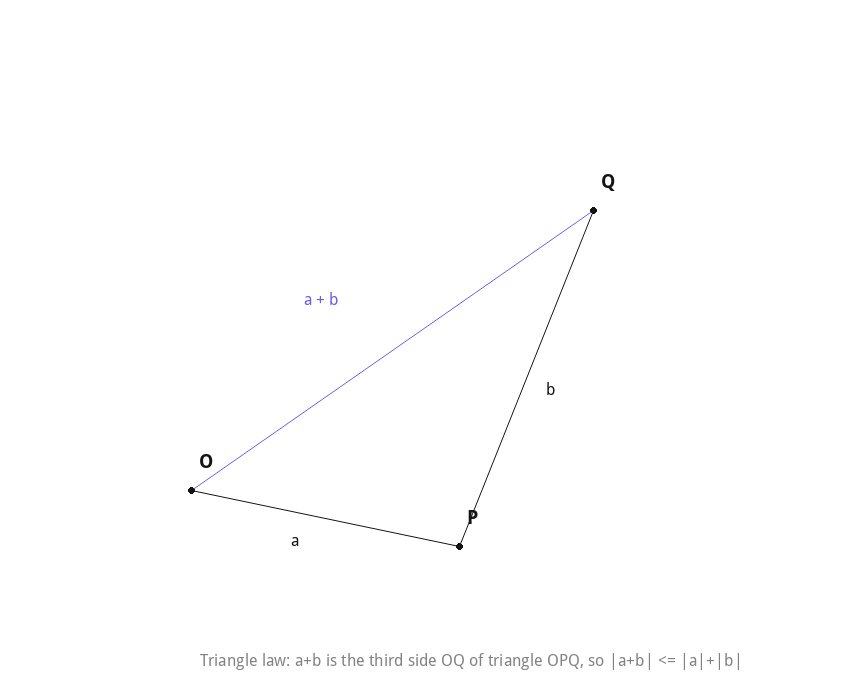
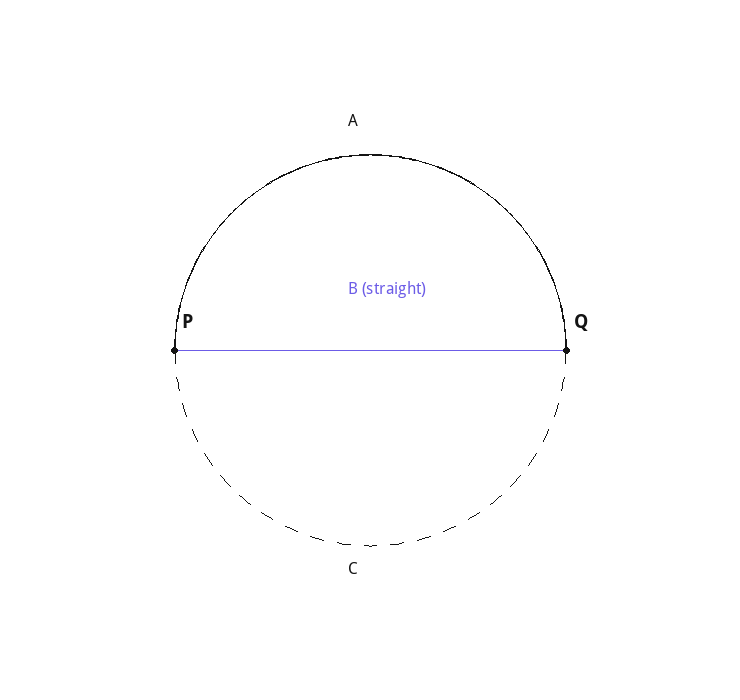
Quick visual: a worked diagram from the full Solutions page, for reference.
- Chapter 1: Units and Measurements - HOTS & Extra Questions with Answers
- Chapter 2: Motion in a Straight Line – Extra Questions with Answers
- Chapter 4: Laws of Motion – Extra Questions with Answers
- Chapter 5: Work, Energy and Power – Extra Questions with Answers
- Chapter 6: System of Particles and Rotational Motion – Extra Questions with Answers
- Chapter 7: Gravitation – Extra Questions with Answers
- Chapter 8: Mechanical Properties of Solids – Extra Questions with Answers
- Chapter 9: Mechanical Properties of Fluids – Extra Questions with Answers
- Chapter 10: Thermal Properties of Matter – Extra Questions with Answers
- Chapter 11: Thermodynamics – Extra Questions with Answers
- Chapter 12: Kinetic Theory – Extra Questions with Answers
- Chapter 13: Oscillations – Extra Questions with Answers
- Chapter 14: Waves – Extra Questions with Answers
Frequently Asked Questions
A projectile is launched at 30 m/s at an angle of 45 degrees, how would you find its maximum horizontal range?
Use R = u squared sin(2theta) over g = (900 times sin90) over 9.8, which is about 91.8 m.
How would you find the resultant of two vectors of magnitude 3 and 4 units acting at right angles?
Since they are perpendicular, the resultant is root(3 squared + 4 squared) = 5 units.
Chapter Quiz — Test Your Understanding
Class 11 Physics Chapter 3 – Solutions and Notes
For complete step-by-step answers and a quick summary, check the Class 11 Physics Chapter 3 Solutions and Class 11 Physics Chapter 3 Revision Notes.
Recommended: Buy the Printed NCERT Class 11 Physics Book Set
Contains Amazon affiliate links.
If you’d like a printed copy alongside the PDF, here’s a verified option:
Rs. 280
Price and availability may change on Amazon. As an Amazon Associate, ncertbooks.org earns from qualifying purchases.


