
The zeroth law of thermodynamics, which defines temperature itself through thermal equilibrium, anchors the first set of questions here. Later ones test isothermal and adiabatic processes and the efficiency formula for a heat engine.
Last Updated: September 23, 2026
Very Short Answer Questions (1 mark)
Q1. State the zeroth law of thermodynamics.
Ans: If two systems are separately in thermal equilibrium with a third system, they are in thermal equilibrium with each other.
Q2. What is ΔU in an isothermal process?
Ans: Zero, since temperature (and hence internal energy of an ideal gas) does not change.
Q3. What is ΔQ in an adiabatic process?
Ans: Zero, no heat exchange occurs.
Q4. Write the formula for efficiency of a heat engine.
Ans: η=W/Q1=1−Q2/Q1.
Q5. Can the efficiency of any real heat engine be 100%?
Ans: No, by the second law of thermodynamics, no engine can be 100% efficient.
Short Answer Questions (2–3 marks)
Q6. A gas absorbs 500 J of heat and does 200 J of work on its surroundings. Find the change in internal energy.
Ans: ΔU=ΔQ−ΔW=500−200=300 J.
Q7. A Carnot engine operates between 600 K and 300 K. Find its efficiency.
Ans: η=1−T2/T1=1−300/600=0.5=50%.
Q8. A heat engine absorbs 800 J from a hot reservoir and rejects 500 J to a cold reservoir. Find its efficiency.
Ans: η=1−Q2/Q1=1−500/800=0.375=37.5%.
Higher-Order Thinking / Application Questions
Q9. A Carnot engine operating between 500 K and 300 K absorbs 1000 J of heat from the source. Calculate the work done by the engine and the heat rejected to the sink, showing the steps.
Ans: Efficiency η=1−T2/T1=1−300/500=0.4. Work done W=ηQ1=0.4(1000)=400 J. Heat rejected Q2=Q1−W=1000−400=600 J (this can also be verified using Q2/Q1=T2/T1=300/500=0.6, so Q2=0.6×1000=600 J, consistent).
Q10. Explain, using the second law of thermodynamics, why a refrigerator (which moves heat from a colder region to a hotter region) requires external work input to operate, even though the first law alone does not forbid spontaneous heat flow from cold to hot.
Ans: The first law of thermodynamics is simply a statement of energy conservation and does not by itself specify the direction in which heat can flow — it would technically allow heat to spontaneously flow from a cold body to a hot body as long as total energy is conserved. However, the second law of thermodynamics (Clausius statement) explicitly forbids heat from flowing spontaneously from a colder to a hotter body without external work being done on the system. This is why a refrigerator, which removes heat from its cold interior and dumps it into the warmer room, must consume electrical energy (external work) to force this non-spontaneous heat flow to happen — without this work input, the process would violate the second law.
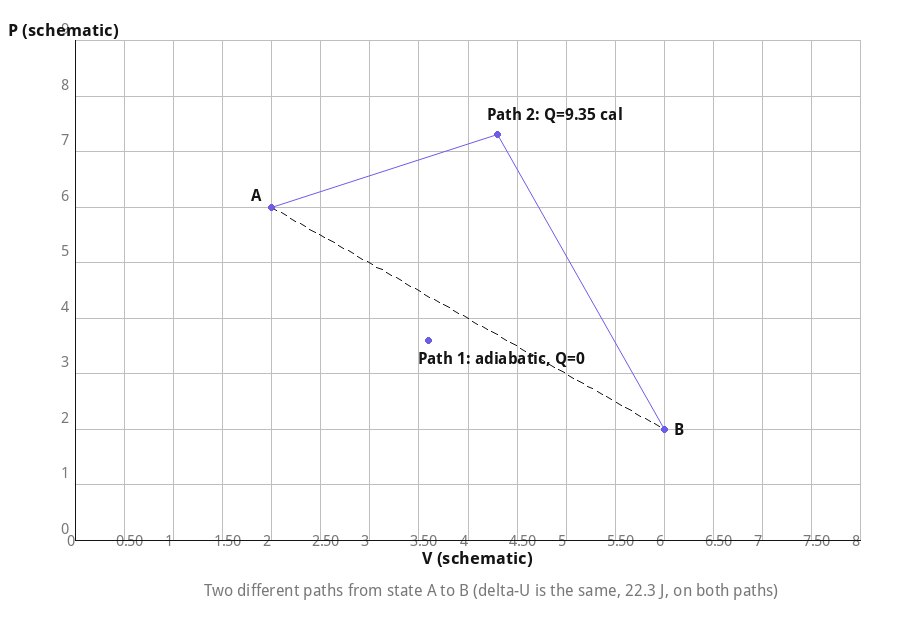
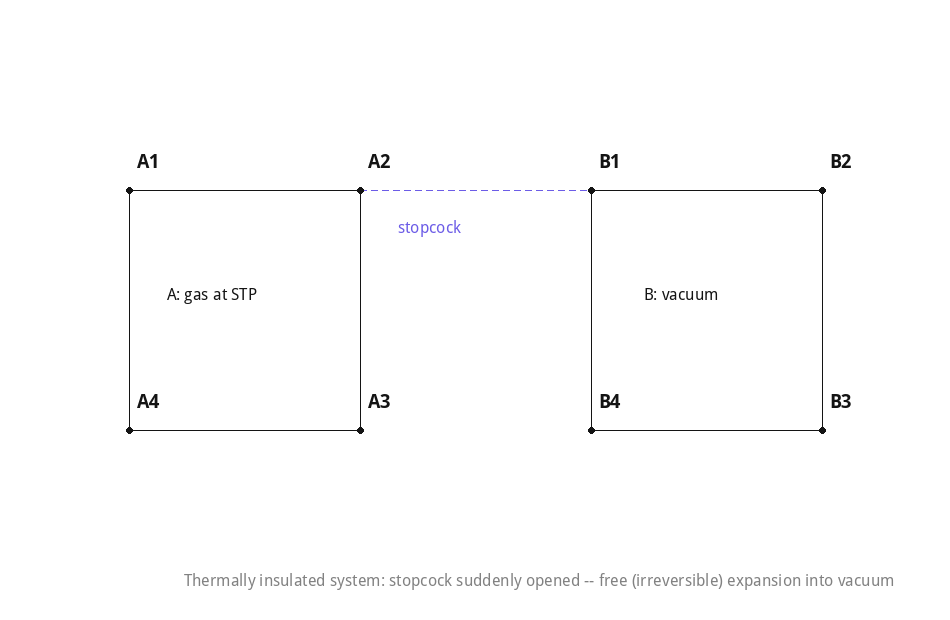
Quick visual: a worked diagram from the full Solutions page, for reference.
- Chapter 1: Units and Measurements - HOTS & Extra Questions with Answers
- Chapter 2: Motion in a Straight Line – Extra Questions with Answers
- Chapter 3: Motion in a Plane – Extra Questions with Answers
- Chapter 4: Laws of Motion – Extra Questions with Answers
- Chapter 5: Work, Energy and Power – Extra Questions with Answers
- Chapter 6: System of Particles and Rotational Motion – Extra Questions with Answers
- Chapter 7: Gravitation – Extra Questions with Answers
- Chapter 8: Mechanical Properties of Solids – Extra Questions with Answers
- Chapter 9: Mechanical Properties of Fluids – Extra Questions with Answers
- Chapter 10: Thermal Properties of Matter – Extra Questions with Answers
- Chapter 12: Kinetic Theory – Extra Questions with Answers
- Chapter 13: Oscillations – Extra Questions with Answers
- Chapter 14: Waves – Extra Questions with Answers
Frequently Asked Questions
In an isothermal process for an ideal gas, how would you describe the relationship between pressure and volume?
Since temperature stays constant, pressure and volume are inversely proportional, following PV = constant.
How would you find the work done by a gas expanding at constant pressure of 2×10 to the 5 Pa from 1 to 3 cubic meters?
Work = P times change in volume = 2×10 to the 5 times 2 = 4×10 to the 5 joules.
Chapter Quiz — Test Your Understanding
Class 11 Physics Chapter 11 – Solutions and Notes
For complete step-by-step answers and a quick summary, check the Class 11 Physics Chapter 11 Solutions and Class 11 Physics Chapter 11 Revision Notes.
See also: Chapter 1 | Chapter 2 | Chapter 3 | Chapter 4 | Chapter 5 | Chapter 6 | Chapter 7 | Chapter 8 | Chapter 9 | Chapter 10 | Chapter 11
Practice more: Chapter 1 | Chapter 2 | Chapter 3 | Chapter 4 | Chapter 5 | Chapter 6 | Chapter 7 | Chapter 8 | Chapter 9 | Chapter 10
Quick revision: Chapter 1 | Chapter 2 | Chapter 3 | Chapter 4 | Chapter 5 | Chapter 6 | Chapter 7 | Chapter 8 | Chapter 9 | Chapter 10
Recommended: Buy the Printed NCERT Class 11 Physics Book Set
Contains Amazon affiliate links.
If you’d like a printed copy alongside the PDF, here’s a verified option:
Rs. 280
Price and availability may change on Amazon. As an Amazon Associate, ncertbooks.org earns from qualifying purchases.


