
A hydraulic lift works because pressure applied anywhere in an enclosed fluid transmits equally in all directions, a principle known as Pascal’s law. These Class 11 Physics Chapter 9 questions cover pressure, the equation of continuity, viscosity, and surface tension.
Last Updated: September 23, 2026
Very Short Answer Questions (1 mark)
Q1. What is the SI unit of pressure?
Ans: Pascal (Pa), equal to N/m².
Q2. State the equation of continuity.
Ans: A1v1=A2v2 for incompressible flow.
Q3. What device works on Pascal’s law?
Ans: Hydraulic lift/hydraulic brake.
Q4. What is the SI unit of viscosity coefficient?
Ans: Pascal-second (Pa·s) or poiseuille (Pl).
Q5. Why do small insects like water striders float on water without sinking?
Ans: Due to the surface tension of water, which supports their weight.
Short Answer Questions (2–3 marks)
Q6. Find the pressure at a depth of 5 m in water (ρ=1000 kg/m³, g=10 m/s²), ignoring atmospheric pressure.
Ans: P=ρgh=1000(10)(5)=50000 Pa=5×10⁴ Pa.
Q7. Water flows through a pipe of area 2 cm² at 3 m/s. It enters a narrower section of area 1 cm². Find the velocity there.
Ans: A1v1=A2v2; 2(3)=1(v2); v2=6 m/s.
Q8. A block of density 800 kg/m³ and volume 0.002 m³ is fully submerged in water (density 1000 kg/m³). Find the buoyant force (g=10 m/s²).
Ans: Buoyant force = ρwaterVg = 1000(0.002)(10) = 20 N.
Higher-Order Thinking / Application Questions
Q9. Water flows through a horizontal pipe that narrows from area 4 cm² to 2 cm². If the pressure in the wider section is 2×10⁴ Pa and the velocity there is 2 m/s, find the pressure in the narrower section (ρwater=1000 kg/m³), and explain the physical reasoning using Bernoulli’s principle.
Ans: By continuity, A1v1=A2v2; 4(2)=2(v2); v2=4 m/s. By Bernoulli’s equation (horizontal, so gh terms cancel): P1+1/2ρv1²=P2+1/2ρv2². 2×10⁴+1/2(1000)(4)=P2+1/2(1000)(16). 2×10⁴+2000=P2+8000. P2=20000+2000−8000=14000 Pa. This shows that as the pipe narrows, the fluid speeds up (continuity), and since Bernoulli’s equation requires the sum of pressure and kinetic energy terms to stay constant, the pressure must drop to compensate for the increased kinetic energy.
Q10. A steel ball is dropped into a tall column of glycerine (a viscous fluid) and eventually reaches a constant terminal velocity. Explain, in terms of the forces acting on the ball, why it does not keep accelerating indefinitely.
Ans: As the ball falls through the viscous fluid, three forces act on it: gravity (downward, driving the fall), the buoyant force (upward, from Archimedes’ principle, constant since it depends on displaced volume), and the viscous drag force (upward, opposing motion, given by Stokes’ law F=6πηrv, which increases with velocity). Initially, gravity exceeds the sum of buoyant and drag forces, so the ball accelerates downward. As its velocity increases, the viscous drag force (proportional to v) increases too. Eventually, the ball reaches a velocity at which the net force becomes zero (weight = buoyant force + viscous drag), at which point it moves at constant velocity called the terminal velocity, and stops accelerating.
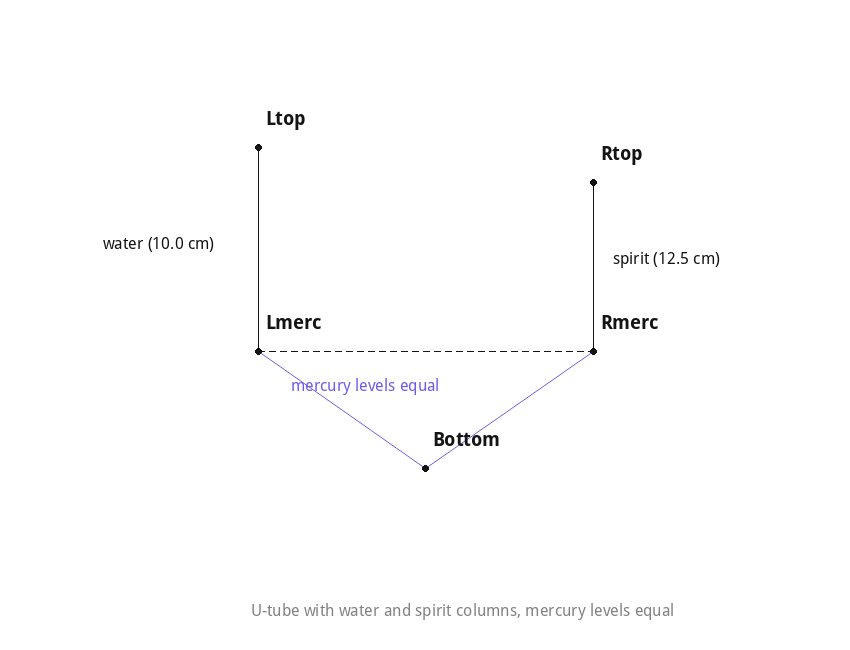
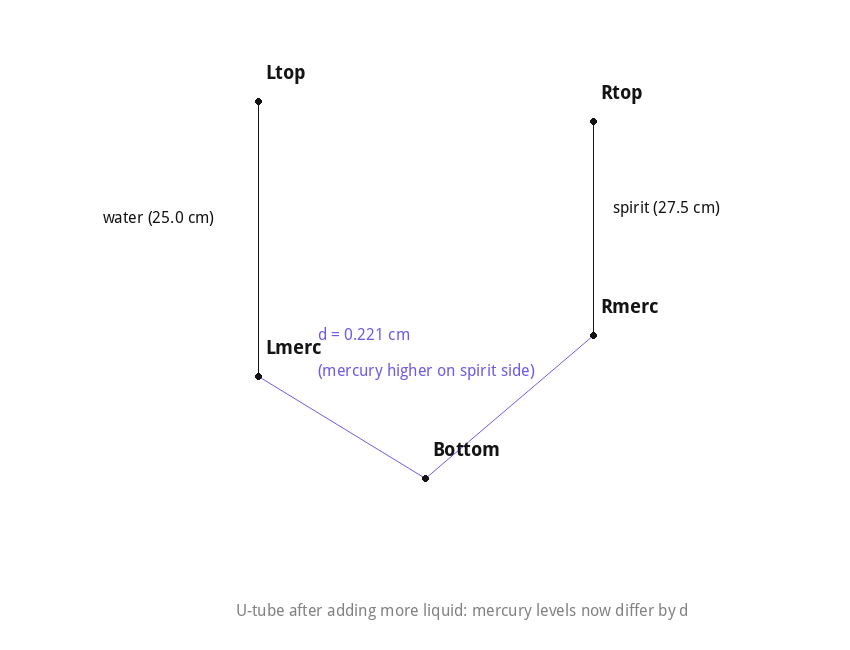
Quick visual: a worked diagram from the full Solutions page, for reference.
- Chapter 1: Units and Measurements - HOTS & Extra Questions with Answers
- Chapter 2: Motion in a Straight Line – Extra Questions with Answers
- Chapter 3: Motion in a Plane – Extra Questions with Answers
- Chapter 4: Laws of Motion – Extra Questions with Answers
- Chapter 5: Work, Energy and Power – Extra Questions with Answers
- Chapter 6: System of Particles and Rotational Motion – Extra Questions with Answers
- Chapter 7: Gravitation – Extra Questions with Answers
- Chapter 8: Mechanical Properties of Solids – Extra Questions with Answers
- Chapter 10: Thermal Properties of Matter – Extra Questions with Answers
- Chapter 11: Thermodynamics – Extra Questions with Answers
- Chapter 12: Kinetic Theory – Extra Questions with Answers
- Chapter 13: Oscillations – Extra Questions with Answers
- Chapter 14: Waves – Extra Questions with Answers
Frequently Asked Questions
How would you find the pressure at a depth of 10 m in water?
Using P = h times density times g = 10 times 1000 times 9.8 = 98000 Pa, plus atmospheric pressure.
A small ball falls through a viscous liquid and reaches terminal velocity, how would you describe the forces acting at that point?
At terminal velocity the net force is zero, so gravity is balanced exactly by the sum of the viscous drag force and the buoyant force.
Chapter Quiz — Test Your Understanding
Class 11 Physics Chapter 9 – Solutions and Notes
For complete step-by-step answers and a quick summary, check the Class 11 Physics Chapter 9 Solutions and Class 11 Physics Chapter 9 Revision Notes.
See also: Chapter 1 | Chapter 2 | Chapter 3 | Chapter 4 | Chapter 5 | Chapter 6 | Chapter 7 | Chapter 8 | Chapter 9
Practice more: Chapter 1 | Chapter 2 | Chapter 3 | Chapter 4 | Chapter 5 | Chapter 6 | Chapter 7 | Chapter 8
Quick revision: Chapter 1 | Chapter 2 | Chapter 3 | Chapter 4 | Chapter 5 | Chapter 6 | Chapter 7 | Chapter 8
Recommended: Buy the Printed NCERT Class 11 Physics Book Set
Contains Amazon affiliate links.
If you’d like a printed copy alongside the PDF, here’s a verified option:
Rs. 280
Price and availability may change on Amazon. As an Amazon Associate, ncertbooks.org earns from qualifying purchases.


