
Temperature scales, specific heat, and modes of heat transfer are the recurring themes tested from this chapter, starting with conversions like 100°C into Kelvin. The questions below work through calorimetry, expansion coefficients, and radiation in short, exam-style answers.
Last Updated: September 23, 2026
Very Short Answer Questions (1 mark)
Q1. Convert 100°C to Kelvin.
Ans: K=100+273.15=373.15 K.
Q2. What is the SI unit of specific heat capacity?
Ans: J/(kg·K).
Q3. Which mode of heat transfer does not require a medium?
Ans: Radiation.
Q4. Write the relation between linear (α) and volume (γ) expansion coefficients.
Ans: γ=3α.
Q5. What is latent heat?
Ans: The heat absorbed or released per unit mass during a phase change at constant temperature.
Short Answer Questions (2–3 marks)
Q6. A metal rod of length 2 m and α=1.2×10⁻⁵/°C is heated through 50°C. Find its increase in length.
Ans: ΔL=LαΔT=2(1.2×10⁻⁵)(50)=1.2×10⁻³ m=1.2 mm.
Q7. How much heat is needed to raise the temperature of 2 kg of water by 10°C (cwater=4200 J/kg·K)?
Ans: Q=mcΔT=2(4200)(10)=84000 J.
Q8. Find the heat needed to melt 0.5 kg of ice at 0°C (Lfusion=3.34×10⁵ J/kg).
Ans: Q=mL=0.5(3.34×10⁵)=1.67×10⁵ J.
Higher-Order Thinking / Application Questions
Q9. 0.1 kg of steam at 100°C is passed into 1 kg of water at 20°C. Using the principle of calorimetry (and given Lvaporisation=2.26×10⁶ J/kg, cwater=4200 J/kg·K), set up (without fully solving) the heat balance equation, explaining each term.
Ans: Heat lost by steam condensing and then cooling = Heat gained by water in warming up. Heat lost = msteamLvap + msteamcwater(100−Tf), where the first term is the heat released when steam condenses to water at 100°C, and the second term is heat released as this condensed water cools from 100°C to the final temperature Tf. Heat gained = mwatercwater(Tf−20), the heat absorbed by the original water as it warms from 20°C to Tf. Setting heat lost = heat gained gives an equation that can be solved for Tf.
Q10. Explain why a metal spoon left in a hot cup of tea feels hot at the top end (outside the tea) after some time, and why the same effect is not observed with a wooden spoon, in terms of thermal conductivity.
Ans: The metal spoon has a high thermal conductivity, meaning heat is efficiently conducted through its molecular/electronic structure from the hot end (in contact with the tea) to the cooler end (outside the cup), causing the top of the spoon to become noticeably warm within a short time due to conduction. A wooden spoon has very low thermal conductivity (wood is a good thermal insulator), so heat conducted from the hot end to the top is extremely slow and negligible over the same time period, meaning the top of a wooden spoon remains close to room temperature even after prolonged contact with hot tea.
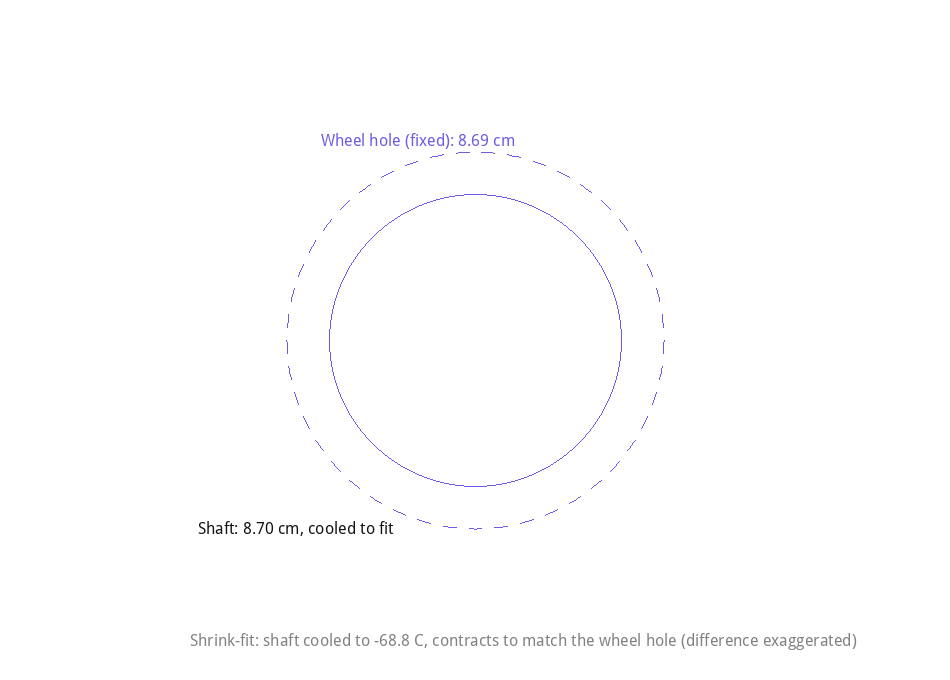
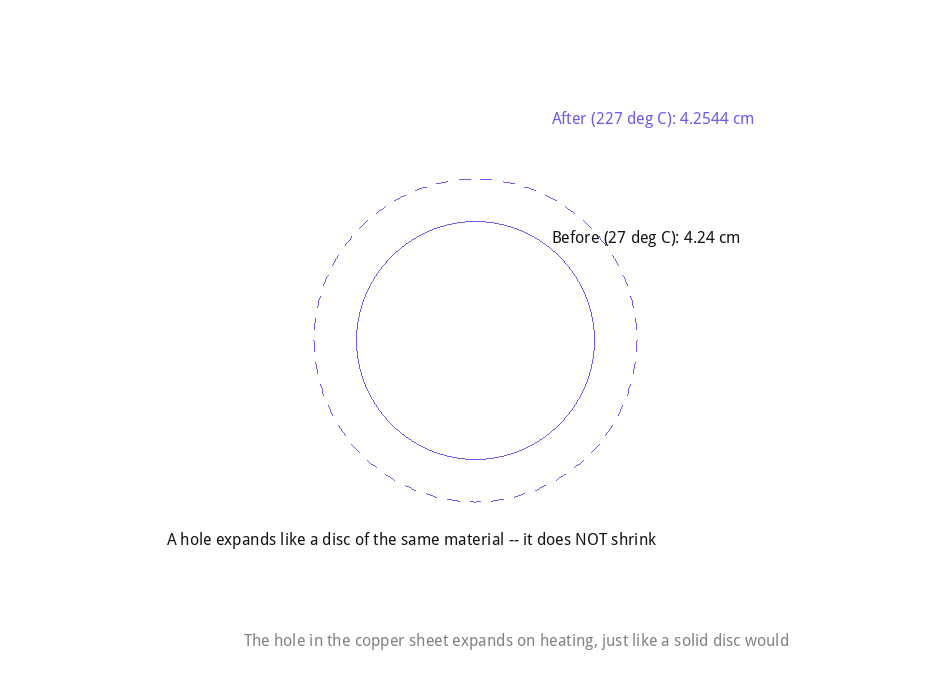
Quick visual: a worked diagram from the full Solutions page, for reference.
- Chapter 1: Units and Measurements - HOTS & Extra Questions with Answers
- Chapter 2: Motion in a Straight Line – Extra Questions with Answers
- Chapter 3: Motion in a Plane – Extra Questions with Answers
- Chapter 4: Laws of Motion – Extra Questions with Answers
- Chapter 5: Work, Energy and Power – Extra Questions with Answers
- Chapter 6: System of Particles and Rotational Motion – Extra Questions with Answers
- Chapter 7: Gravitation – Extra Questions with Answers
- Chapter 8: Mechanical Properties of Solids – Extra Questions with Answers
- Chapter 9: Mechanical Properties of Fluids – Extra Questions with Answers
- Chapter 11: Thermodynamics – Extra Questions with Answers
- Chapter 12: Kinetic Theory – Extra Questions with Answers
- Chapter 13: Oscillations – Extra Questions with Answers
- Chapter 14: Waves – Extra Questions with Answers
Frequently Asked Questions
How would you convert a temperature of 37 degrees Celsius to Kelvin?
Add 273 to the Celsius value, giving 310 K.
If 500 g of water is heated from 20 to 80 degrees Celsius, how would you find the heat required?
Using Q = mc times delta T = 0.5 times 4200 times 60 = 126000 joules.
Chapter Quiz — Test Your Understanding
Class 11 Physics Chapter 10 – Solutions and Notes
For complete step-by-step answers and a quick summary, check the Class 11 Physics Chapter 10 Solutions and Class 11 Physics Chapter 10 Revision Notes.
See also: Chapter 1 | Chapter 2 | Chapter 3 | Chapter 4 | Chapter 5 | Chapter 6 | Chapter 7 | Chapter 8 | Chapter 9 | Chapter 10
Practice more: Chapter 1 | Chapter 2 | Chapter 3 | Chapter 4 | Chapter 5 | Chapter 6 | Chapter 7 | Chapter 8 | Chapter 9
Quick revision: Chapter 1 | Chapter 2 | Chapter 3 | Chapter 4 | Chapter 5 | Chapter 6 | Chapter 7 | Chapter 8 | Chapter 9
Recommended: Buy the Printed NCERT Class 11 Physics Book Set
Contains Amazon affiliate links.
If you’d like a printed copy alongside the PDF, here’s a verified option:
Rs. 280
Price and availability may change on Amazon. As an Amazon Associate, ncertbooks.org earns from qualifying purchases.


