
Newton’s laws explain why objects at rest stay at rest and why every force comes with an equal, opposite reaction. This set of Class 11 Physics Chapter 4 questions tests momentum, self-adjusting static friction, and the forces behind circular motion.
Last Updated: September 23, 2026
Very Short Answer Questions (1 mark)
Q1. State Newton’s first law of motion.
Ans: A body continues in its state of rest or uniform motion in a straight line unless acted upon by an external unbalanced force.
Q2. What is the SI unit of force?
Ans: Newton (N).
Q3. Define momentum.
Ans: Momentum is the product of mass and velocity, p=mv.
Q4. Is friction a self-adjusting force? Explain in one line.
Ans: Yes, static friction adjusts its magnitude (up to a limit) to exactly balance the applied force to prevent motion.
Q5. What provides the centripetal force for a car turning on a level road?
Ans: Friction between the tyres and the road.
Short Answer Questions (2–3 marks)
Q6. A force of 10 N acts on a mass of 2 kg. Find the acceleration produced.
Ans: a=F/m=10/2=5 m/s².
Q7. A bullet of mass 0.02 kg moving at 300 m/s embeds in a stationary block of mass 5.98 kg. Find the common velocity after collision using momentum conservation.
Ans: m1u1=(m1+m2)v; 0.02(300)=(6)v; v=6/6=1 m/s.
Q8. A block of mass 4 kg rests on a surface with coefficient of static friction 0.5. Find the maximum static friction force (g=10 m/s²).
Ans: fs(max)=μsN=0.5(4)(10)=20 N.
Higher-Order Thinking / Application Questions
Q9. A body of mass 5 kg is pulled by a horizontal force of 20 N on a rough surface with μk=0.2 (g=10 m/s²). Calculate the net acceleration of the body, showing how friction opposes the applied force.
Ans: Normal force N=mg=5(10)=50 N. Kinetic friction fk=μkN=0.2(50)=10 N, opposing motion. Net force = 20−10=10 N. Acceleration a=Fnet/m=10/5=2 m/s².
Q10. Two blocks of masses 3 kg and 2 kg are connected by a string over a frictionless pulley, with the 3 kg block on a table and the 2 kg block hanging. Explain the concept used and calculate the system’s acceleration (g=10 m/s², ignore friction on the table).
Ans: This uses Newton’s second law applied to a connected system: the tension is the same throughout an ideal string, and both blocks share the same magnitude of acceleration. For the hanging block: m2g−T=m2a. For the block on table: T=m1a. Adding: m2g=(m1+m2)a, so a=m2g/(m1+m2)=2(10)/5=4 m/s².
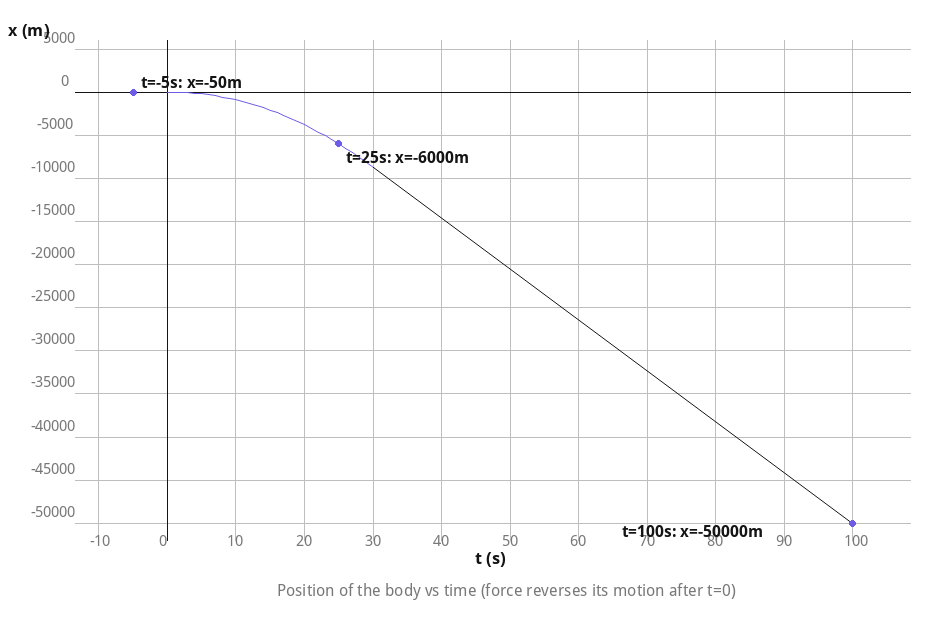
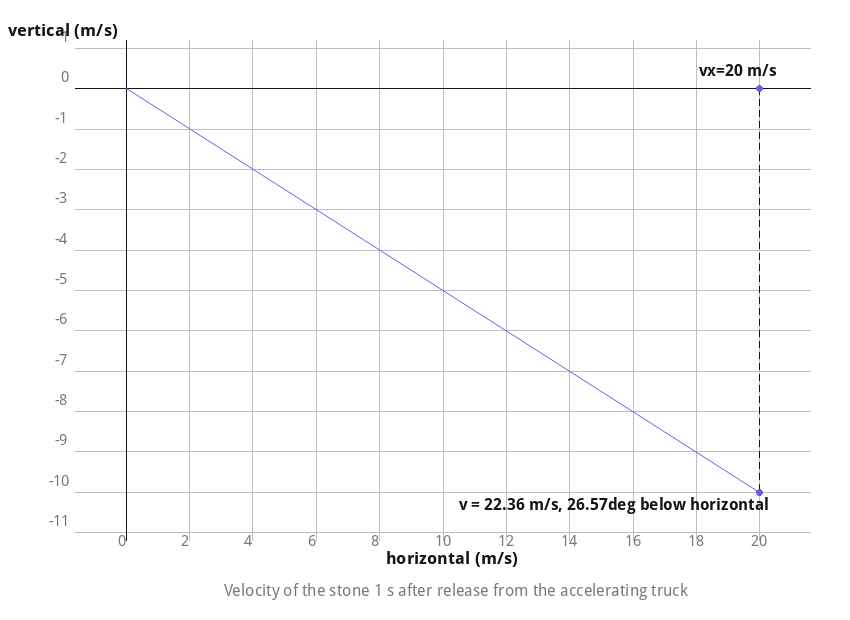
Quick visual: a worked diagram from the full Solutions page, for reference.
- Chapter 1: Units and Measurements - HOTS & Extra Questions with Answers
- Chapter 2: Motion in a Straight Line – Extra Questions with Answers
- Chapter 3: Motion in a Plane – Extra Questions with Answers
- Chapter 5: Work, Energy and Power – Extra Questions with Answers
- Chapter 6: System of Particles and Rotational Motion – Extra Questions with Answers
- Chapter 7: Gravitation – Extra Questions with Answers
- Chapter 8: Mechanical Properties of Solids – Extra Questions with Answers
- Chapter 9: Mechanical Properties of Fluids – Extra Questions with Answers
- Chapter 10: Thermal Properties of Matter – Extra Questions with Answers
- Chapter 11: Thermodynamics – Extra Questions with Answers
- Chapter 12: Kinetic Theory – Extra Questions with Answers
- Chapter 13: Oscillations – Extra Questions with Answers
- Chapter 14: Waves – Extra Questions with Answers
Frequently Asked Questions
A 5 kg block is pushed with a force of 20 N on a frictionless surface, how would you find its acceleration?
Using F = ma, a = F over m = 20 over 5 = 4 m per second squared.
If a rocket of mass 1000 kg ejects gas at 500 m/s to gain a thrust of 50000 N, how would you find the rate of mass ejection?
Using thrust = velocity times rate of mass loss, rate = 50000 over 500 = 100 kg per second.
Chapter Quiz — Test Your Understanding
Class 11 Physics Chapter 4 – Solutions and Notes
For complete step-by-step answers and a quick summary, check the Class 11 Physics Chapter 4 Solutions and Class 11 Physics Chapter 4 Revision Notes.
See also: Chapter 1 | Chapter 2 | Chapter 3 | Chapter 4
Recommended: Buy the Printed NCERT Class 11 Physics Book Set
Contains Amazon affiliate links.
If you’d like a printed copy alongside the PDF, here’s a verified option:
Rs. 280
Price and availability may change on Amazon. As an Amazon Associate, ncertbooks.org earns from qualifying purchases.


