
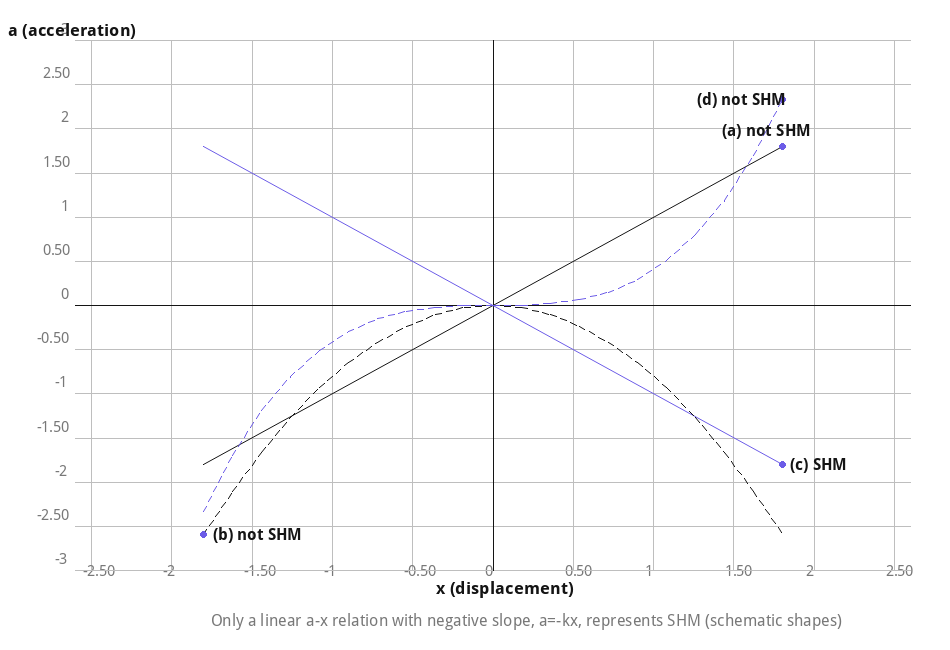
Simple harmonic motion is defined by one condition, a=−ω²x, and that relationship underlies nearly every question in this set. Others ask about velocity and acceleration at the mean and extreme positions, and the time period of a spring-mass system.
Last Updated: September 23, 2026
Very Short Answer Questions (1 mark)
Q1. Write the differential condition for SHM.
Ans: a=−ω²x (acceleration proportional to and opposite of displacement).
Q2. What is the formula for the time period of a spring-mass system?
Ans: T=2π√(m/k).
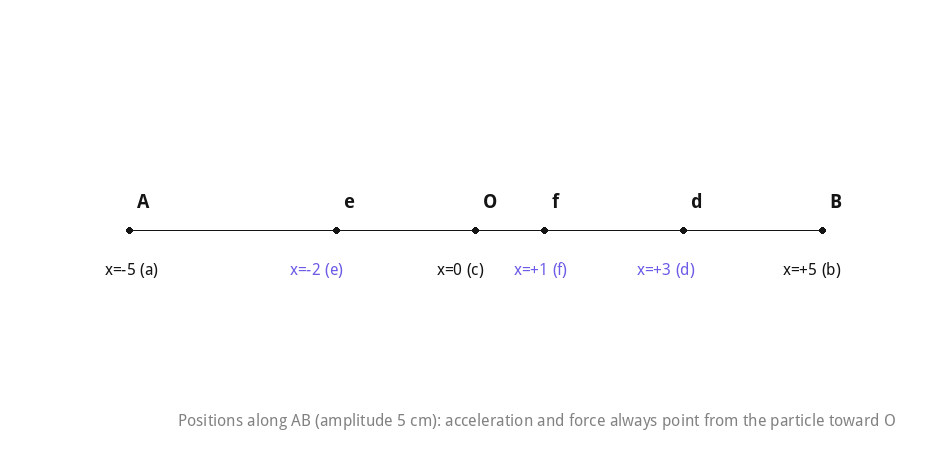
Q3. At the mean position, what is the velocity and acceleration in SHM?
Ans: Velocity is maximum; acceleration is zero.
Q4. At extreme position, what is the velocity in SHM?
Ans: Zero.
Q5. Write the total energy formula for a particle in SHM.
Ans: E=½mω²A².
Short Answer Questions (2–3 marks)
Q6. A simple pendulum has length 1 m. Find its time period (g=9.8 m/s²).
Ans: T=2π√(l/g)=2π√(1/9.8)=2π(0.319)≈2 s.
Q7. A particle in SHM has amplitude 0.1 m and angular frequency 5 rad/s. Find its maximum velocity and maximum acceleration.
Ans: vmax=Aω=0.1(5)=0.5 m/s. amax=Aω²=0.1(25)=2.5 m/s².
Q8. A mass of 0.5 kg is attached to a spring of spring constant 200 N/m. Find the period of oscillation.
Ans: T=2π√(m/k)=2π√(0.5/200)=2π(0.05)≈0.314 s.
Higher-Order Thinking / Application Questions
Q9. A particle executes SHM with amplitude 4 cm and angular frequency 2 rad/s. Find its displacement, velocity, and acceleration at t such that ωt=π/6 (taking φ=0), and explain the relationship between the three at this instant.
Ans: x=A sin(ωt)=4 sin(30°)=4(0.5)=2 cm. v=Aωcos(ωt)=4(2)cos(30°)=8(0.866)=6.93 cm/s. a=−ω²x=−4(2)=−8 cm/s². At this instant, the particle is partway between the mean and extreme positions; its velocity is still fairly large (not yet zero) while its acceleration (which always points back toward the mean position) is negative, correctly opposing the positive displacement, confirming that acceleration in SHM always acts as a restoring influence proportional to displacement.
Q10. Explain why the kinetic energy and potential energy of a particle in SHM continuously interconvert, and describe how their sum behaves throughout one complete oscillation, using energy conservation reasoning.
Ans: In SHM, as a particle moves from the mean position toward an extreme position, its speed decreases (approaching zero at the extreme) while the restoring force (and hence potential energy stored, ½mω²x²) increases, since displacement from the mean position increases. Conversely, as the particle moves back from an extreme position toward the mean position, potential energy converts back into kinetic energy, with speed (and KE) becoming maximum exactly at the mean position where displacement (and PE) is zero. Because SHM is an idealized frictionless oscillation, no energy is lost to non-conservative forces, so by the law of conservation of energy, the total mechanical energy E=KE+PE=½mω²A² remains constant throughout the motion, even though the individual KE and PE values vary periodically and continuously interconvert into one another.
Quick visual: a worked diagram from the full Solutions page, for reference.
- Chapter 1: Units and Measurements - HOTS & Extra Questions with Answers
- Chapter 2: Motion in a Straight Line – Extra Questions with Answers
- Chapter 3: Motion in a Plane – Extra Questions with Answers
- Chapter 4: Laws of Motion – Extra Questions with Answers
- Chapter 5: Work, Energy and Power – Extra Questions with Answers
- Chapter 6: System of Particles and Rotational Motion – Extra Questions with Answers
- Chapter 7: Gravitation – Extra Questions with Answers
- Chapter 8: Mechanical Properties of Solids – Extra Questions with Answers
- Chapter 9: Mechanical Properties of Fluids – Extra Questions with Answers
- Chapter 10: Thermal Properties of Matter – Extra Questions with Answers
- Chapter 11: Thermodynamics – Extra Questions with Answers
- Chapter 12: Kinetic Theory – Extra Questions with Answers
- Chapter 14: Waves – Extra Questions with Answers
Frequently Asked Questions
A simple pendulum has a length of 1 m, how would you find its time period on Earth?
Using T = 2 pi root(L over g) = 2 pi root(1 over 9.8), which is about 2.01 seconds.
How would you find the maximum velocity of a particle in simple harmonic motion with amplitude 0.1 m and angular frequency 5 rad per second?
Maximum velocity = amplitude times angular frequency = 0.1 times 5 = 0.5 m per second.
Chapter Quiz — Test Your Understanding
Class 11 Physics Chapter 13 – Solutions and Notes
For complete step-by-step answers and a quick summary, check the Class 11 Physics Chapter 13 Solutions and Class 11 Physics Chapter 13 Revision Notes.
See also: Chapter 1 | Chapter 2 | Chapter 3 | Chapter 4 | Chapter 5 | Chapter 6 | Chapter 7 | Chapter 8 | Chapter 9 | Chapter 10 | Chapter 11 | Chapter 12 | Chapter 13
Practice more: Chapter 1 | Chapter 2 | Chapter 3 | Chapter 4 | Chapter 5 | Chapter 6 | Chapter 7 | Chapter 8 | Chapter 9 | Chapter 10 | Chapter 11 | Chapter 12
Quick revision: Chapter 1 | Chapter 2 | Chapter 3 | Chapter 4 | Chapter 5 | Chapter 6 | Chapter 7 | Chapter 8 | Chapter 9 | Chapter 10 | Chapter 11 | Chapter 12
Recommended: Buy the Printed NCERT Class 11 Physics Book Set
Contains Amazon affiliate links.
If you’d like a printed copy alongside the PDF, here’s a verified option:
Rs. 280
Price and availability may change on Amazon. As an Amazon Associate, ncertbooks.org earns from qualifying purchases.


