
Chapter 8, Introduction to Trigonometry, is one of the highest-weightage chapters in the Class 10 Maths board exam — it introduces the six trigonometric ratios, their values for standard angles, and the identities that Chapter 9 (Applications of Trigonometry) builds on directly.
Last Updated: October 24, 2026
How to Approach This Chapter
Memorise the standard-angle ratio table cold before attempting the exercises — nearly every problem in this chapter reduces to substituting a standard angle’s ratio into an expression. When proving an identity, start from the side with more terms and simplify toward the simpler side, rather than trying to work both sides at once.
This post covers the current 2026-27 rationalised exercise set: Exercise 8.1 (11 questions), Exercise 8.2 (4 questions) and Exercise 8.3 (complementary-angle identities). Every answer below is derived step by step from the ratio definitions, not copied from any answer key.
Exercise 8.1
Q1. In ΔABC, right-angled at B, AB = 24 cm, BC = 7 cm. Determine (i) sin A, cos A (ii) sin C, cos C.
Solution: By Pythagoras, AC² = 24² + 7² = 625, so AC = 25 cm.
sin A = 7/25, cos A = 24/25. sin C = 24/25, cos C = 7/25.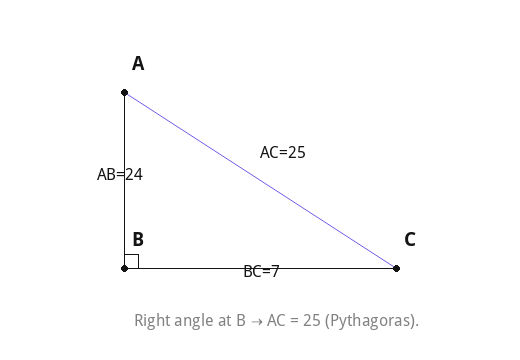
Q2. In ΔPQR, right-angled at Q, PR = 13 cm, PQ = 12 cm. Find tan P − cot R.
Solution: QR² = 169 − 144 = 25, QR = 5 cm. tan P = 5/12, cot R = 5/12. tan P − cot R = 0.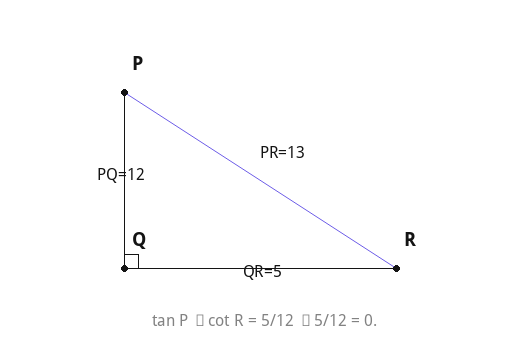
Q3. If sin A = 3/4, calculate cos A and tan A.
Solution: adjacent = √(16−9) = √7. cos A = √7/4, tan A = 3/√7.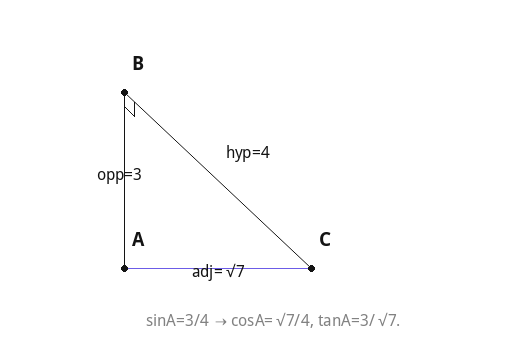
Q4. Given 15 cot A = 8, find sin A and sec A.
Solution: cot A = 8/15, hypotenuse = √(64+225) = 17. sin A = 15/17, sec A = 17/8.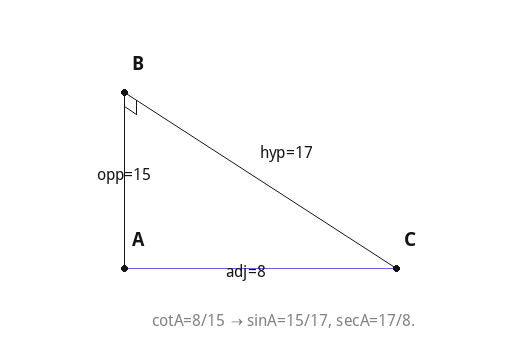
Q5. Given sec θ = 13/12, calculate all other trigonometric ratios.
Solution: opposite = √(169−144) = 5. sin θ=5/13, cos θ=12/13, tan θ=5/12, cosec θ=13/5, cot θ=12/5.
Q6. If ∠A and ∠B are acute angles with cos A = cos B, show ∠A = ∠B.
Solution: Cosine is one-to-one and strictly decreasing on 0°–90°, so equal cosine values force equal angles.
Q7. If cot θ = 7/8, evaluate (i) [(1+sinθ)(1−sinθ)]/[(1+cosθ)(1−cosθ)] (ii) cot²θ.
Solution: (1−sin²θ)/(1−cos²θ) = cos²θ/sin²θ = cot²θ = 49/64 for both parts.
Q8. If 3 cot A = 4, check (1−tan²A)/(1+tan²A) = cos²A−sin²A.
Solution: tan A = 3/4, sin A=3/5, cos A=4/5. LHS = (7/16)/(25/16)=7/25. RHS = 16/25−9/25=7/25. Verified equal.
Q9. In ΔABC, right-angled at B, tan A = 1/√3. Find (i) sinAcosC+cosAsinC (ii) cosAcosC−sinAsinC.
Solution: A=30°, C=60°. (i) sin(A+C)=sin90°=1. (ii) cos(A+C)=cos90°=0.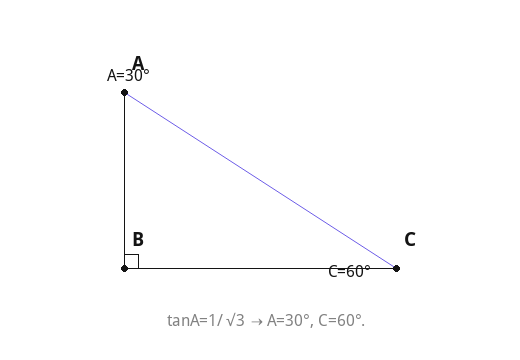
Q10. In ΔPQR, right-angled at Q, PR+QR=25 cm, PQ=5 cm. Find sinP, cosP, tanP.
Solution: (PR−QR)(PR+QR)=PQ²=25 ⇒ PR−QR=1, so PR=13, QR=12. sinP=12/13, cosP=5/13, tanP=12/5.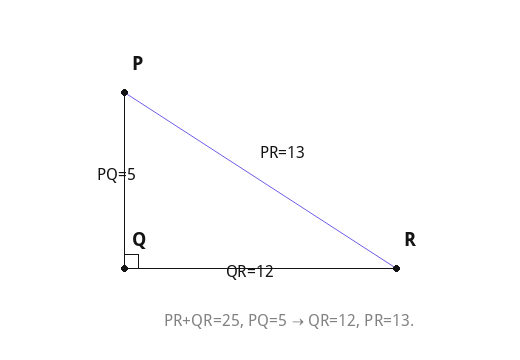
Q11. True/False: (i) tan A always <1 — False. (ii) sec A=12/5 possible — True. (iii) cos A abbreviates cosecant — False. (iv) cot A is a product of cot and A — False. (v) sinθ=4/3 possible — False (sinθ ≤ 1 always).
Exercise 8.2
Q1. Evaluate: (i) sin60°cos30°+sin30°cos60° = 1. (ii) 2tan²45°+cos²30°−sin²60° = 2. (iii) cos45°/(sec30°+cosec30°) = (3√2−√6)/8. (iv) (sin30°+tan45°−cosec60°)/(sec30°+cos60°+cot45°) = (43−24√3)/11. (v) (5cos²60°+4sec²30°−tan²45°)/(sin²30°+cos²30°) = 67/12.
Q2. Choose the correct option: (i) (2tan30°)/(1+tan²30°) = sin60°. (ii) (1−tan²45°)/(1+tan²45°) = 0. (iii) sin2A=2sinA true when A=0°. (iv) (2tan30°)/(1−tan²30°) = tan60°.
Q3. If tan(A+B)=√3 and tan(A−B)=1/√3, find A and B.
Solution: A+B=60°, A−B=30°. A=45°, B=15°.
Q4. True/False: (i) sin(A+B)=sinA+sinB — False. (ii) sinθ increases as θ increases — True. (iii) cosθ increases as θ increases — False. (iv) sinθ=cosθ for all θ — False. (v) cot A undefined at A=0° — True.
Exercise 8.3 — complementary angles
Q1. Evaluate (i) sin18°/cos72° (ii) tan26°/cot64° (iii) cos48°−sin42° (iv) cosec31°−sec59°.
Solution: Each pair is complementary, so each expression collapses to a ratio over itself or a difference of equals: answers are 1, 1, 0, 0.
Q2. Show (i) tan48°tan23°tan42°tan67°=1 (ii) cos38°cos52°−sin38°sin52°=0.
Solution: (i) tan48°·tan42°=1 and tan23°·tan67°=1 by complementary pairing, product=1. (ii) equals cos(38°+52°)=cos90°=0.
Q3. tan2A=cot(A−18°), find A. Solution: 90°−2A=A−18° ⇒ A=36°.
Q4. If tanA=cotB, prove A+B=90°. Solution: cotB=tan(90°−B) ⇒ A=90°−B.
Q5. sec4A=cosec(A−20°), find A. Solution: 90°−4A=A−20° ⇒ A=22°.
Q6. Show sin((B+C)/2)=cos(A/2) for ΔABC. Solution: B+C=180°−A ⇒ (B+C)/2=90°−A/2.
Q7. Express sin67°+cos75° in terms of angles below 45°. Solution: = cos23°+sin15°.
Why this chapter matters for boards
These ratios and complementary-angle identities reappear directly in Chapter 9’s heights-and-distances problems and show up as standalone 2-mark questions across the paper — spotting A+(90°−A) pairs quickly is worth practising until automatic.
CBSE Exam Weightage
This chapter falls under Unit V: Trigonometry in the CBSE Class 10 Maths board exam syllabus. This unit typically carries around 12 marks (15%) of the 80-mark theory paper, based on CBSE’s published unit-wise weightage (Question Paper Design). CBSE sets weightage at the unit level rather than chapter-by-chapter, so the exact share from this specific chapter can vary a little between years and sample papers.
Chapter Quiz — Test Your Understanding
Class 10 Mathematics Chapter 8 – Notes and Extra Questions
Along with these NCERT Solutions, students can also use the Class 10 Mathematics Chapter 8 Extra Questions and Class 10 Mathematics Chapter 8 Revision Notes for quick revision and extra practice.
- Chapter 1: Real Numbers – Free PDF Download
- Chapter 2: Polynomials – Free PDF Download
- Chapter 3: Pair of Linear Equations in Two Variables – Free PDF Download
- Chapter 4: Quadratic Equations – Free PDF Download
- Chapter 5: Arithmetic Progressions – Free PDF Download
- Chapter 6: Triangles – Free PDF Download
- Chapter 7: Coordinate Geometry – Free PDF Download
- Chapter 9: Some Applications of Trigonometry – Free PDF Download
- Chapter 10: Circles – Free PDF Download
- Chapter 11: Areas Related to Circles (2026-27) – Free PDF Download
- Chapter 12: Surface Areas and Volumes (2026-27) – Free PDF Download
- Chapter 13: Statistics (2026-27)
- Chapter 14: Probability (2026-27)
FAQ
Is Class 10 Trigonometry hard? Not if the ratio definitions and standard-angle values (0°,30°,45°,60°,90°) are memorised first.
How many exercises does Chapter 8 have for 2026-27? Three — 8.1 (11 questions), 8.2 (4 questions), 8.3 (complementary-angle identities).
See every chapter’s official PDF links on the https://ncertbooks.org/ncert-books/class-10-mathematics-ncert-book-pdf/ page. For harder practice see the https://ncertbooks.org/ncert-extra-questions-class-10-maths-chapter-8-trigonometry/ post, for quick revision see https://ncertbooks.org/ncert-revision-notes-class-10-maths-chapter-8-trigonometry/, and every formula from this chapter is indexed in the https://ncertbooks.org/ncert-class-10-maths-formulas-handbook/.
Part of the Class 10 Maths Chapter 8 cluster: Solutions | Extra Questions (HOTS) | Revision Notes | Formulas Handbook | Class 10 Maths book page.
Recommended: Buy the Printed NCERT Class 10 Maths Book
Contains Amazon affiliate links.
If you’d like a printed copy alongside the PDF, here’s a verified option:
Check the latest price on Amazon
Price and availability may change on Amazon. As an Amazon Associate, ncertbooks.org earns from qualifying purchases.

Pingback: Class 10 Maths Chapter 8 Extra Questions HOTS - Introduction to Trigonometry