
Looking for Trigonometry extra questions for Class 10? These HOTS-level questions go beyond the standard NCERT exercise for Chapter 8, Introduction to Trigonometry.
Last Updated: October 24, 2026
How to Approach the HOTS Questions in This Chapter
HOTS questions on trigonometry often combine two identities, or ask you to eliminate an angle between two given equations, rather than testing a single identity directly — practice manipulating expressions algebraically after substituting known identities, instead of searching for one formula that solves the question outright.
These go beyond the textbook exercise — general/abstract proofs and reverse-engineering problems using fresh numbers, at HOTS level for board exam extension questions. These Class 10 Mathematics Chapter 8 important questions are handy for last-minute exam practice.
Q1 (General proof). Prove that (sinθ+cosθ)² + (sinθ−cosθ)² = 2, for any angle θ.
Solution: Expanding both squares: (sin²θ+2sinθcosθ+cos²θ) + (sin²θ−2sinθcosθ+cos²θ) = 2sin²θ+2cos²θ = 2(sin²θ+cos²θ) = 2. Proved for all θ, not just a specific value.
Q2 (General proof, harder). Prove that sec A (1 − sin A)(sec A + tan A) = 1.
Solution: (1−sinA)(secA+tanA) = secA+tanA−sinA·secA−sinA·tanA. Since sinA·secA = tanA, this becomes secA−sinA·tanA = secA−sin²A/cosA = (1−sin²A)/cosA = cos²A/cosA = cosA. So the full expression = secA·cosA = 1.
Q3 (General proof, 3D-style). If x = r sinA cosB, y = r sinA sinB, z = r cosA, prove x²+y²+z² = r².
Solution: x²+y² = r²sin²A(cos²B+sin²B) = r²sin²A. Adding z²: r²sin²A + r²cos²A = r².
Q4 (Reverse-engineering). If tanθ+cotθ = 2, find tan²θ+cot²θ without assuming θ = 45°.
Solution: Square both sides: (tanθ+cotθ)² = tan²θ+2+cot²θ = 4. So tan²θ+cot²θ = 4−2 = 2.
Q5 (Fresh-numbers quadratic-in-trig). Find x (0°≤x≤90°) if 2sin²x + 3cos x = 3.
Solution: Substitute sin²x = 1−cos²x: 2−2cos²x+3cosx = 3 ⇒ 2cos²x−3cosx+1 = 0. Solving the quadratic: cosx = (3±1)/4 = 1 or 1/2. cos x = 1/2 gives the meaningful acute-angle solution, x = 60°.
Q6 (Assertion-Reason). Assertion (A): If cosθ = 12/13, then sinθ = 5/13.
Reason (R): For any angle, sin²θ+cos²θ = 1.
Solution: sinθ = √(1−144/169) = √(25/169) = 5/13, so A is true. R is also true and is exactly why A holds. Both A and R are true, and R correctly explains A.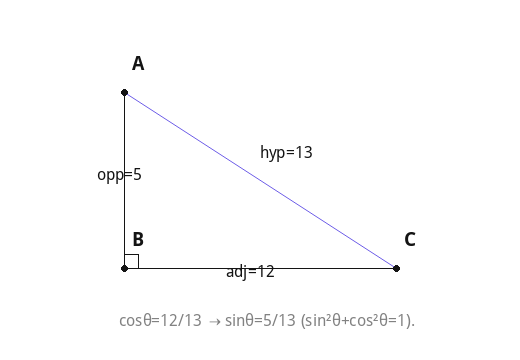
Q7 (Exam strategy tip). A common mistake in HOTS trigonometry questions is applying an identity meant for acute angles to a general angle without checking the domain, or forgetting to rationalise a surd in the final answer. Before submitting a proof, re-check that every identity used (like sin²θ+cos²θ=1 or 1+tan²θ=sec²θ) was valid for the specific range given in the question, and that the final simplified form matches what was asked — a numeric value, a proof, or a simplified expression.
Part of the Class 10 Maths Chapter 8 cluster: Solutions | Extra Questions (HOTS) | Revision Notes | Formulas Handbook | Class 10 Maths book page.
- Chapter 1: Real Numbers
- Chapter 2: Extra Questions - Polynomials (HOTS)
- Chapter 3: Pair of Linear Equations in Two Variables
- Chapter 4: Quadratic Equations
- Chapter 5: Arithmetic Progressions
- Chapter 6: Triangles
- Chapter 7: Coordinate Geometry
- Chapter 9: Extra Questions - Some Applications of Trigonometry (HOTS)
- Chapter 10: Extra Questions - Circles (HOTS)
- Chapter 11: Areas Related to Circles Extra Questions (HOTS)
- Chapter 12: Surface Areas and Volumes Extra Questions (HOTS)
- Chapter 13: Statistics Extra Questions (HOTS)
- Chapter 14: Probability Extra Questions (HOTS)
Frequently Asked Questions
Why do the values of trigonometric ratios only depend on the angle and not on the size of the right triangle?
Trigonometric ratios are ratios between the lengths of two sides of a right triangle, and since similar triangles have proportional sides, the ratio between corresponding sides remains constant regardless of the triangle size.
What is a trigonometric identity, and how is it different from a trigonometric ratio?
A trigonometric ratio is a specific numerical relationship for a given angle, while a trigonometric identity is an equation involving trigonometric ratios that holds true for all values of the angle, such as sine squared plus cosine squared equals one.
Chapter Quiz — Test Your Understanding
Class 10 Mathematics Chapter 8 – Solutions and Notes
For complete step-by-step answers and a quick summary, check the Class 10 Mathematics Chapter 8 Solutions and Class 10 Mathematics Chapter 8 Revision Notes.
Recommended: Buy the Printed NCERT Class 10 Maths Book
Contains Amazon affiliate links.
If you’d like a printed copy alongside the PDF, here’s a verified option:
Check the latest price on Amazon
Price and availability may change on Amazon. As an Amazon Associate, ncertbooks.org earns from qualifying purchases.



Pingback: Revision Notes Class 10 Maths Chapter 8 – Introduction to Trigonometry | NCERT Books