
Class 10 Maths Chapter 10 – Circles: NCERT Solutions
Chapter 10 of Class 10 Maths covers tangents to a circle — their properties and the key theorems that connect a tangent line to the circle’s radius and centre. In the current 2026-27 rationalised syllabus this chapter has two exercises: Exercise 10.1 (4 questions) and Exercise 10.2 (13 questions), 17 questions in total.
Last Updated: October 24, 2026
How to Approach This Chapter
For any tangent-based proof, start by drawing the radius to the point of contact — this single construction step unlocks most proofs in this chapter. Before applying the equal-tangents theorem, clearly identify the external point and the two tangent segments it draws to the circle.
Why this chapter matters for boards
Circle-tangent proofs are a classic 2-3 mark CBSE question, and the “lengths of tangents from an external point are equal” theorem is one of the most frequently tested results in the whole Class 10 syllabus — it reappears inside larger geometry and mensuration problems too.
Exercise 10.1 Solutions
- Q1. How many tangents can a circle have?
Answer: Infinitely many — a tangent can be drawn at every point on the circle’s circumference. - Q2. Fill in the blanks: (i) A tangent to a circle intersects it in ___ point(s). (ii) A line intersecting a circle in two points is called a ___. (iii) A circle can have ___ parallel tangents at most. (iv) The common point of a tangent to a circle and the circle is called ___.
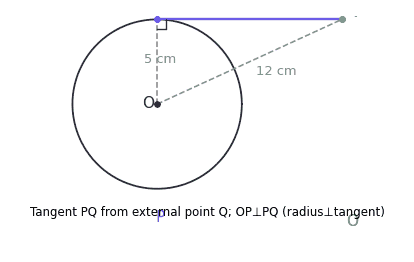
Answers: (i) one (ii) secant (iii) two (iv) point of contact. - Q3. A tangent PQ at a point P of a circle of radius 5 cm meets a line through the centre O at a point Q so that OQ = 12 cm. Find the length PQ.
Answer: Since a tangent is perpendicular to the radius at the point of contact, triangle OPQ is right-angled at P. PQ = √(OQ² – OP²) = √(144 – 25) = √119 cm.
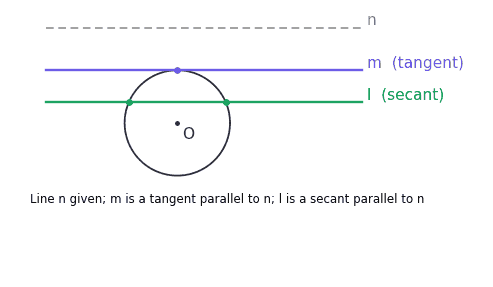
- Q4. Draw a circle and two lines parallel to a given line such that one is a tangent and the other a secant to the circle.
Answer: A construction question — draw the given line l, then draw a circle, then draw one line parallel to l that touches the circle at exactly one point (the tangent) and another parallel line that crosses the circle at two points (the secant), both at different distances from the circle’s centre than the radius/less-than-radius respectively.
Exercise 10.2 Solutions
All 13 questions of Exercise 10.2, solved in the order they appear in the current 2026-27 NCERT textbook.
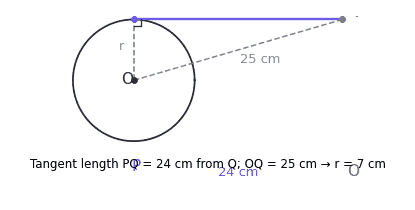
- Q1. From a point Q, the length of the tangent to a circle is 24 cm and the distance of Q from the centre is 25 cm. Find the radius of the circle.
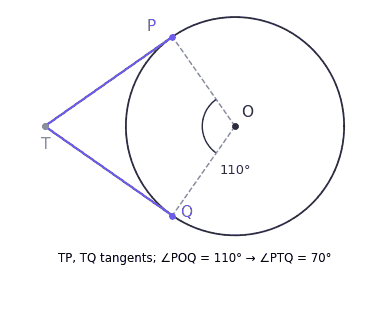
Answer: By the tangent-radius right angle, r = √(OQ² – PQ²) = √(625 – 576) = √49 = 7 cm. - Q2. In the figure, TP and TQ are tangents to a circle with centre O so that ∠POQ = 110°. Find ∠PTQ.
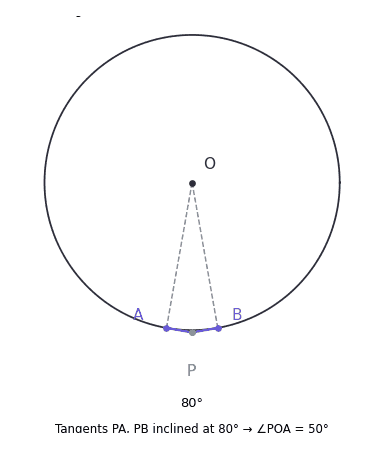
Answer: In quadrilateral OPTQ, ∠OPT = ∠OQT = 90° (radius⊥tangent). Angle sum of a quadrilateral is 360°, so ∠PTQ = 360° – 90° – 90° – 110° = 70°. - Q3. If tangents PA and PB from an external point P to a circle with centre O are inclined to each other at an angle of 80°, find ∠POA.
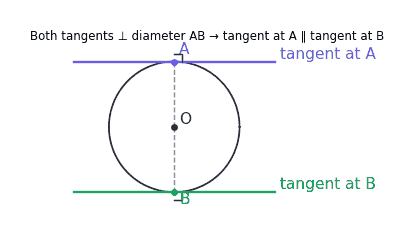
Answer: ΔOAP ≅ ΔOBP (OA=OB radii, PA=PB equal tangents, OP common — SSS), so ∠AOP = ∠BOP. Since ∠AOB + ∠APB = 180° (quadrilateral OAPB), ∠AOB = 180° – 80° = 100°. So ∠POA = ½ × 100° = 50°. - Q4. Prove that the tangents drawn at the ends of a diameter of a circle are parallel.
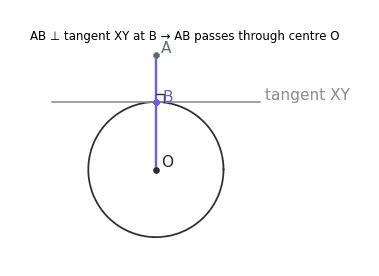
Answer (proof): Both tangents are perpendicular to the same diameter at its two ends, so both make a 90° angle with the same line — two lines perpendicular to the same line are parallel to each other. Proved. - Q5. Prove that the perpendicular at the point of contact to the tangent to a circle passes through the centre.
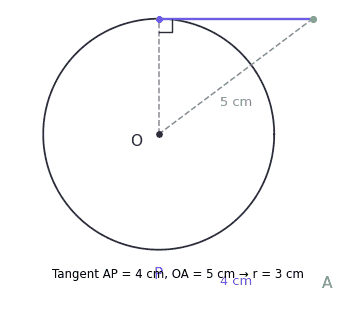
Answer (proof): The radius is always perpendicular to the tangent at the point of contact, and there is only one line through that point perpendicular to the tangent — so that unique perpendicular line must be the radius itself, which passes through the centre. Proved. - Q6. The length of a tangent from a point A at distance 5 cm from the centre of a circle is 4 cm. Find the radius of the circle.
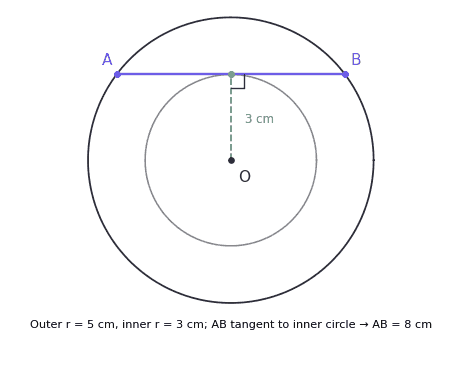
Answer: r = √(5²-4²) = √9 = 3 cm. - Q7. Two concentric circles have radii 5 cm and 3 cm. Find the length of the chord of the larger circle which touches the smaller circle.
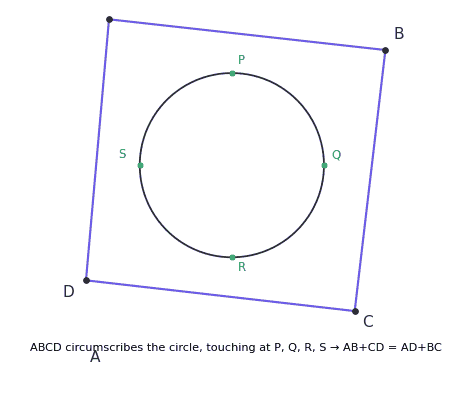
Answer: The chord touches the inner circle, so the radius to the point of contact is perpendicular to the chord, bisecting it. Half-chord = √(5²-3²) = √16 = 4 cm, so the full chord = 8 cm. - Q8. A quadrilateral ABCD is drawn to circumscribe a circle. Prove that AB + CD = AD + BC.
Answer (proof): Using the “tangents from an external point are equal” theorem at each vertex (AP=AS, BP=BQ, CQ=CR, DR=DS), adding gives AB+CD = (AP+PB)+(CR+RD) = (AS+BQ)+(CQ+DS) = (AS+DS)+(BQ+CQ) = AD+BC. Proved. - Q9. In the figure, XY and X'Y' are two parallel tangents to a circle with centre O, and another tangent AB with point of contact C intersects XY at A and X'Y' at B. Prove that ∠AOB = 90°.Answer (proof): OA bisects ∠PAC and OB bisects ∠P'BC (congruent triangles from equal tangents at A and at B). Since XY∥X'Y', co-interior angles on the same side of transversal AB give ∠PAC + ∠P'BC = 180°, so ∠OAC + ∠OBC = 90°. The third angle of ΔAOB is therefore ∠AOB = 180° – 90° = 90°. Proved.
- Q10. Prove that the angle between the two tangents drawn from an external point to a circle is supplementary to the angle subtended by the line segment joining the points of contact at the centre.
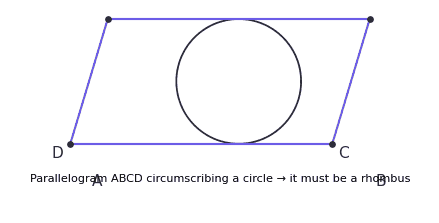
Answer (proof): In quadrilateral OPTQ (O=centre, T=external point, P,Q=points of contact), ∠OPT = ∠OQT = 90°. Since the angles of a quadrilateral sum to 360°: ∠PTQ + ∠POQ = 360° – 90° – 90° = 180° — so the two angles are supplementary. Proved. - Q11. Prove that the parallelogram circumscribing a circle is a rhombus.
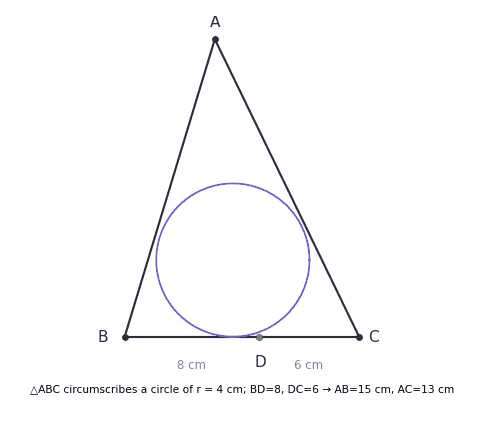
Answer (proof): For a parallelogram ABCD circumscribing a circle, the equal-tangent-length argument (as in Q8) gives AB+CD = AD+BC. Since opposite sides of a parallelogram are equal (AB=CD, AD=BC), this forces AB = AD — so all four sides are equal, making it a rhombus. Proved. - Q12. A triangle ABC is drawn to circumscribe a circle of radius 4 cm, such that the segments BD and DC into which BC is divided by the point of contact D are 8 cm and 6 cm. Find the sides AB and AC.
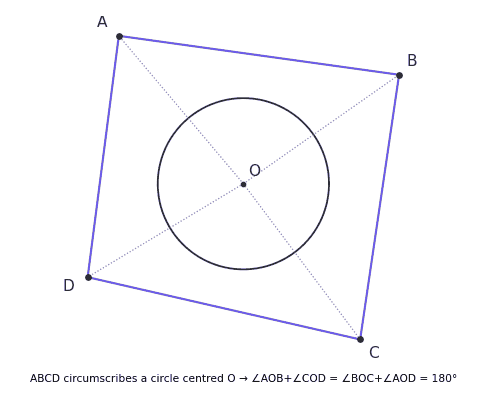
Answer: Let AE=AF=x (tangent lengths from A). Then AB=x+8, AC=x+6, BC=14, and s=14+x. By Heron's formula, Area = √[s(s-a)(s-b)(s-c)] = √[(14+x)(x)(8)(6)]. Also Area = r×s = 4(14+x). Equating and simplifying: 48x(14+x) = 16(14+x)² ⇒ 48x = 16(14+x) ⇒ 32x = 224 ⇒ x = 7. So AB = 15 cm, AC = 13 cm. - Q13. Prove that opposite sides of a quadrilateral circumscribing a circle subtend supplementary angles at the centre of the circle.
Answer (proof): Let ABCD touch the circle at P (on AB), Q (on BC), R (on CD), S (on DA), centre O. Joining O to each vertex splits the four vertex-angles into equal half-pairs (congruent triangles from equal tangents); calling these four half-angles w, x, y, z, going around the centre gives 2(w+x+y+z) = 360°, i.e. w+x+y+z = 180°. Since ∠AOB = w+x and ∠COD = y+z, ∠AOB + ∠COD = 180°; similarly ∠BOC + ∠AOD = 180°. So opposite sides subtend supplementary angles at the centre. Proved.
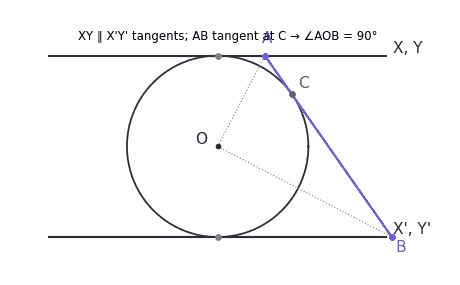 Answer (proof): OA bisects ∠PAC and OB bisects ∠P'BC (congruent triangles from equal tangents at A and at B). Since XY∥X'Y', co-interior angles on the same side of transversal AB give ∠PAC + ∠P'BC = 180°, so ∠OAC + ∠OBC = 90°. The third angle of ΔAOB is therefore ∠AOB = 180° – 90° = 90°. Proved.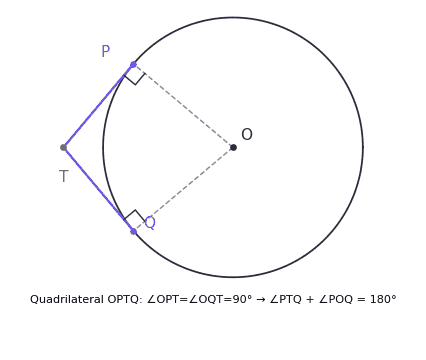
Extra Practice (Beyond This Exercise)
Two further tangent problems, built on the same theorems, worth practicing alongside Exercise 10.2:
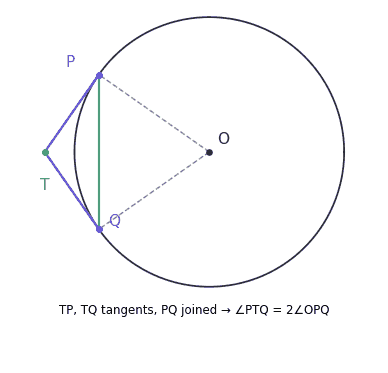
- Extra 1. Two tangents TP and TQ are drawn to a circle with centre O from an external point T. Prove that ∠PTQ = 2∠OPQ.
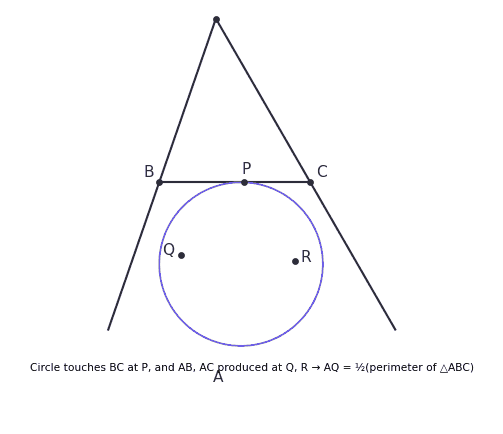
Answer (proof): Let ∠PTQ = θ. Since TP = TQ (equal tangents), triangle TPQ is isosceles, so ∠TPQ = ∠TQP = (180°-θ)/2 = 90° – θ/2. Since OP⊥TP, ∠OPQ = ∠OPT – ∠TPQ = 90° – (90°-θ/2) = θ/2. So ∠PTQ = θ = 2 × (θ/2) = 2∠OPQ. Proved. - Extra 2. A circle touches side BC of a triangle ABC at P and touches AB and AC produced at Q and R. Prove that AQ = ½(perimeter of triangle ABC).
Answer (proof): Using equal tangents from each vertex (AQ=AR, BP=BQ, CP=CR), the perimeter AB+BC+CA works out to 2AQ once BP=BQ and CP=CR are substituted in, so AQ = ½ perimeter. Proved.
CBSE Exam Weightage
This chapter falls under Unit IV: Geometry in the CBSE Class 10 Maths board exam syllabus. This unit typically carries around 15 marks (18.75%) of the 80-mark theory paper, based on CBSE’s published unit-wise weightage (Question Paper Design). CBSE sets weightage at the unit level rather than chapter-by-chapter, so the exact share from this specific chapter can vary a little between years and sample papers.
Chapter Quiz — Test Your Understanding
Class 10 Mathematics Chapter 10 – Notes and Extra Questions
Along with these NCERT Solutions, students can also use the Class 10 Mathematics Chapter 10 Extra Questions and Class 10 Mathematics Chapter 10 Revision Notes for quick revision and extra practice.
Related
- Chapter 1: Real Numbers – Free PDF Download
- Chapter 2: Polynomials – Free PDF Download
- Chapter 3: Pair of Linear Equations in Two Variables – Free PDF Download
- Chapter 4: Quadratic Equations – Free PDF Download
- Chapter 5: Arithmetic Progressions – Free PDF Download
- Chapter 6: Triangles – Free PDF Download
- Chapter 7: Coordinate Geometry – Free PDF Download
- Chapter 8: Introduction to Trigonometry (2026-27) – Free PDF Download
- Chapter 9: Some Applications of Trigonometry – Free PDF Download
- Chapter 11: Areas Related to Circles (2026-27) – Free PDF Download
- Chapter 12: Surface Areas and Volumes (2026-27) – Free PDF Download
- Chapter 13: Statistics (2026-27)
- Chapter 14: Probability (2026-27)
FAQs
Q: What is the most important theorem in this chapter?
The lengths of tangents drawn from an external point to a circle are equal — almost every proof in Exercise 10.2 builds on this result.
Q: How many exercises are in Class 10 Maths Chapter 10?
Two — Exercise 10.1 (4 questions) and Exercise 10.2 (13 questions), 17 questions total in the current rationalised syllabus.
Recommended: Buy the Printed NCERT Class 10 Maths Book
Contains Amazon affiliate links.
If you’d like a printed copy alongside the PDF, here’s a verified option:
Check the latest price on Amazon
Price and availability may change on Amazon. As an Amazon Associate, ncertbooks.org earns from qualifying purchases.


Pingback: Class 10 Maths Chapter 10 Extra Questions HOTS - Circles
Pingback: Class 10 Maths Chapter 10 Revision Notes - Circles (2026-27)