
Class 10 Maths Chapter 9 – Some Applications of Trigonometry: NCERT Solutions
Chapter 9 of Class 10 Maths applies the trigonometric ratios learned in Chapter 8 to real-life problems of heights and distances. In the current 2026-27 rationalised syllabus, this chapter has a single exercise, Exercise 9.1, with 16 questions. Every solution below is worked from first principles using the standard trigonometric ratio values.
Last Updated: October 24, 2026
How to Approach This Chapter
Always draw a labelled diagram before attempting any height-and-distance problem — identify the right triangle, the given angle, and which sides are known or unknown, before choosing a trigonometric ratio. Double-check whether the given angle is elevation (looking up) or depression (looking down) before setting up the equation.
Why this chapter matters for boards
Height-and-distance problems are a guaranteed 3-5 mark question in every CBSE Class 10 Maths board paper. They test whether a student can correctly translate a word problem into a right triangle, identify the angle of elevation/depression, and apply the correct trig ratio. Diagrams and clean step-by-step working earn method marks even if the final answer has a small arithmetic slip.
Key idea before you start
Angle of elevation is measured upward from the horizontal to the line of sight; angle of depression is measured downward. In every problem here, draw the right triangle first, mark the known side and angle, then choose tan, sin, or cos based on which two sides are involved.
Exercise 9.1 Solutions
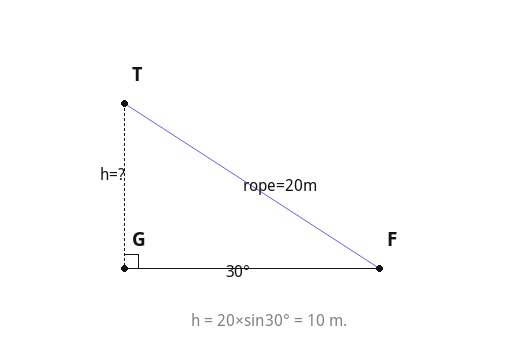
- Q1. A circus artist climbs a 20 m rope tied from the top of a vertical pole to the ground, making a 30° angle with the ground. Find the height of the pole.
Height = 20 × sin30° = 20 × 1/2 = 10 m.
- Q2. A tree breaks in a storm; the broken top touches the ground 8 m from the foot, making a 30° angle with the ground. Find the height of the tree.
Standing part h = 8 tan30° = 8/√3 m. Broken part l = 8/cos30° = 16/√3 m. Total height = 8/√3 + 16/√3 = 24/√3 = 8√3 m (approx 13.86 m). - Q3. Two slides: one 1.5 m high at 30°, one 3 m high at 60°. Find each slide length.
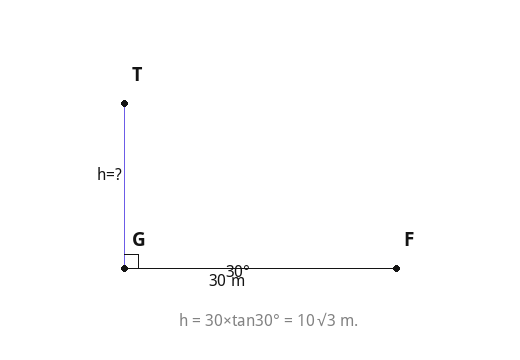
Slide 1: length = 1.5/sin30° = 3 m. Slide 2: length = 3/sin60° = 6/√3 = 2√3 m. - Q4. A point on the ground is 30 m from a tower’s foot; angle of elevation of the top is 30°. Find the tower’s height.
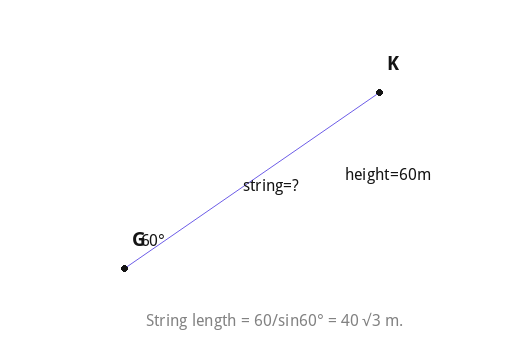
Height = 30 tan30° = 30/√3 = 10√3 m. - Q5. A kite flies at 60 m height; the string makes a 60° angle with the ground. Find the string length.
Length = 60/sin60° = 120/√3 = 40√3 m. - Q6. A 1.5 m boy watches a 30 m building; elevation increases from 30° to 60° as he walks closer. Find the distance walked.
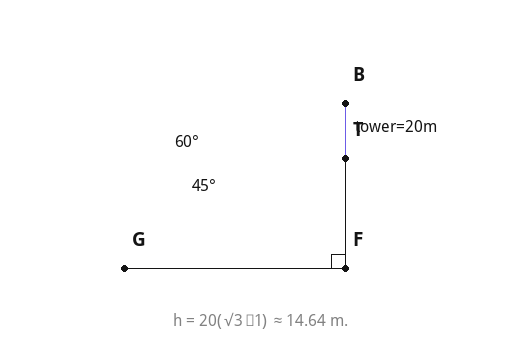
Height above eye level = 28.5 m. d1 = 28.5/tan30° = 28.5√3. d2 = 28.5/tan60° = 28.5/√3. Distance walked = 28.5√3 – 28.5/√3 = 19√3 m (approx 32.9 m). - Q7. From a point on the ground, angles of elevation of the bottom and top of a 20 m tall transmission tower fixed atop a building are 45° and 60°. Find the tower’s (aerial’s) height.
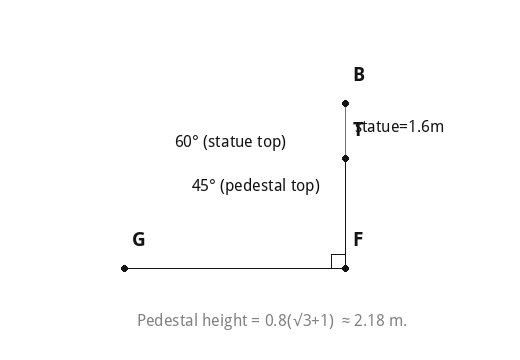
Distance from point d = 20/tan45° = 20 m. tan60° = (20+h)/20 => 20√3 = 20+h => h = 20(√3 – 1) m (approx 14.64 m). - Q8. A 1.6 m statue stands on a pedestal; elevation of statue-top is 60°, of pedestal-top is 45°, from the same point. Find pedestal height.
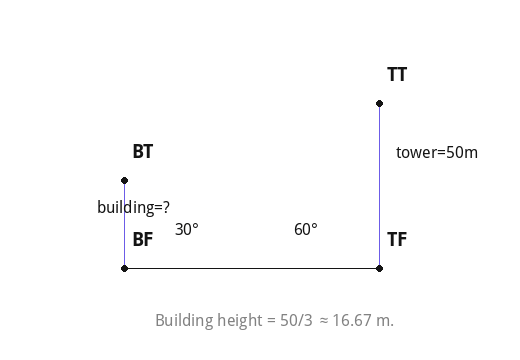
Let pedestal height h, distance d = h (since tan45°=1). tan60° = (h+1.6)/h => √3h = h+1.6 => h(√3-1) = 1.6 => h = 0.8(√3+1) m (approx 2.18 m). - Q9. Elevation of a building’s top from a tower’s foot is 30°; elevation of the 50 m tower’s top from the building’s foot is 60°. Find the building’s height.
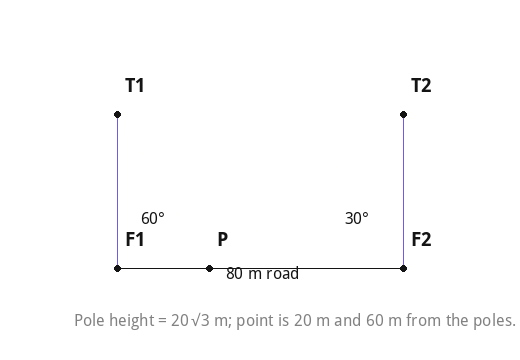
Distance d = 50/tan60° = 50/√3. Building height = d tan30° = (50/√3)(1/√3) = 50/3 m (approx 16.67 m). - Q10. Two equal poles stand on either side of an 80 m wide road; from a point between them, elevations are 60° and 30°. Find pole height and distances from each pole.
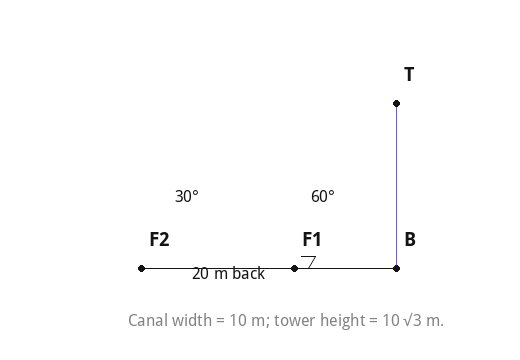
Let distances x and 80-x. x√3 = (80-x)/√3 => 3x = 80-x => x = 20. Height = 20√3 m; distances 20 m and 60 m. - Q11. From one bank of a canal, elevation of a TV tower on the other bank is 60°; 20 m further back, elevation is 30°. Find the tower height and canal width.
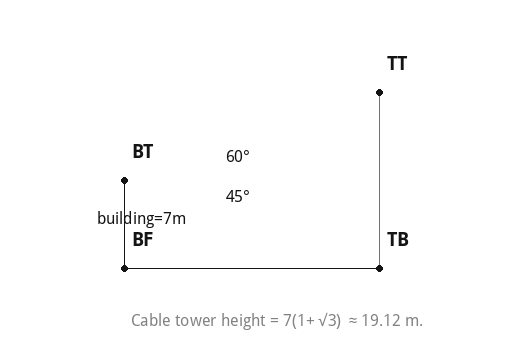
Width d: d√3 = (d+20)/√3 => 3d = d+20 => d = 10. Width = 10 m, height = 10√3 m. - Q12. From atop a 7 m building, elevation of a cable tower’s top is 60° and depression of its foot is 45°. Find the tower’s height.
Horizontal distance d = 7/tan45° = 7 m. Height above building level = 7 tan60° = 7√3. Total tower height = 7(1+√3) m (approx 19.12 m). - Q13. From a 75 m lighthouse, angles of depression of two ships (in line, same side) are 30° and 45°. Find the distance between them.
d1 (45°) = 75 m. d2 (30°) = 75√3 m. Distance = 75(√3-1) m (approx 54.9 m). - Q14. A 1.2 m girl watches a balloon at 88.2 m height; elevation reduces from 60° to 30°. Find the distance travelled by the balloon.
Height above eye = 87 m. d1 = 87/√3 = 29√3. d2 = 87√3. Distance = 87√3-29√3 = 58√3 m (approx 100.4 m). - Q15. From a tower, a car’s angle of depression changes from 30° to 60° in 6 seconds as it approaches. Find the further time to reach the tower’s foot.
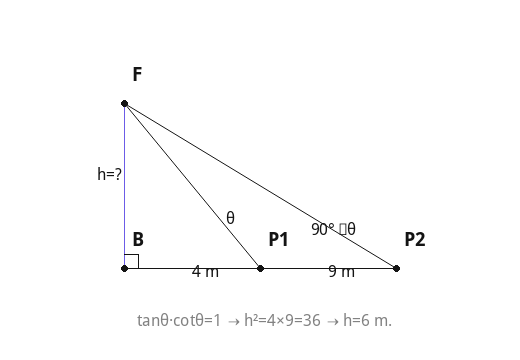
Let height h. d1 = h√3, d2 = h/√3. Distance covered in 6s = 2h/√3, speed = h/(3√3) per second. Remaining distance d2 = h/√3, time = d2/speed = 3 seconds. - Q16. From two points 4 m and 9 m from a tower’s base (same line), the elevations are complementary. Prove the tower’s height is 6 m.
tanθ = h/4 and tan(90-θ) = h/9, so tanθ × cotθ = 1 = h²/36, giving h² = 36, h = 6 m. Proved.


CBSE Exam Weightage
This chapter falls under Unit V: Trigonometry in the CBSE Class 10 Maths board exam syllabus. This unit typically carries around 12 marks (15%) of the 80-mark theory paper, based on CBSE’s published unit-wise weightage (Question Paper Design). CBSE sets weightage at the unit level rather than chapter-by-chapter, so the exact share from this specific chapter can vary a little between years and sample papers.
Chapter Quiz — Test Your Understanding
Class 10 Mathematics Chapter 9 – Notes and Extra Questions
Along with these NCERT Solutions, students can also use the Class 10 Mathematics Chapter 9 Extra Questions and Class 10 Mathematics Chapter 9 Revision Notes for quick revision and extra practice.
Related
- Chapter 1: Real Numbers – Free PDF Download
- Chapter 2: Polynomials – Free PDF Download
- Chapter 3: Pair of Linear Equations in Two Variables – Free PDF Download
- Chapter 4: Quadratic Equations – Free PDF Download
- Chapter 5: Arithmetic Progressions – Free PDF Download
- Chapter 6: Triangles – Free PDF Download
- Chapter 7: Coordinate Geometry – Free PDF Download
- Chapter 8: Introduction to Trigonometry (2026-27) – Free PDF Download
- Chapter 10: Circles – Free PDF Download
- Chapter 11: Areas Related to Circles (2026-27) – Free PDF Download
- Chapter 12: Surface Areas and Volumes (2026-27) – Free PDF Download
- Chapter 13: Statistics (2026-27)
- Chapter 14: Probability (2026-27)
FAQs
Q: What is the difference between angle of elevation and angle of depression?
Elevation is measured upward from the horizontal to an object above the observer; depression is measured downward to an object below the observer.
Q: Which trig ratio should I use in a height-distance problem?
If you know the angle and the side adjacent to it and want the opposite side (or vice versa), use tan. If you know/want the hypotenuse, use sin or cos.
Q: How many questions are in Class 10 Maths Chapter 9?
Exercise 9.1 has 16 questions — the only exercise in the current rationalised syllabus.
Recommended: Buy the Printed NCERT Class 10 Maths Book
Contains Amazon affiliate links.
If you’d like a printed copy alongside the PDF, here’s a verified option:
Check the latest price on Amazon
Price and availability may change on Amazon. As an Amazon Associate, ncertbooks.org earns from qualifying purchases.



Pingback: Class 10 Maths Chapter 9 Extra Questions HOTS - Applications of Trigonometry