
On a position-time graph, the slope at any point tells you the velocity at that instant. These Class 11 Physics Chapter 2 questions apply the kinematic equations and distinguish average speed from average velocity in one-dimensional motion.
Last Updated: September 23, 2026
Very Short Answer Questions (1 mark)
Q1. Is velocity a scalar or vector quantity?
Ans: Vector.
Q2. What does the slope of a position-time graph represent?
Ans: Velocity.
Q3. Write the kinematic equation relating v, u, a, t.
Ans: v = u + at.
Q4. Can average speed ever be greater than the magnitude of average velocity?
Ans: Yes, since speed considers total distance while velocity considers displacement, which can be smaller.
Q5. What is the formula for instantaneous velocity in calculus terms?
Ans: dx/dt (derivative of position with respect to time).
Short Answer Questions (2–3 marks)
Q6. A car travels 100 m north, then 40 m south. Find the total distance travelled and the net displacement.
Ans: Distance = 100+40 = 140 m. Displacement = 100−40 = 60 m north.
Q7. A particle starts from rest and accelerates uniformly at 2 m/s² for 5 seconds. Find its final velocity and the distance covered.
Ans: v=u+at = 0+2(5) = 10 m/s. x=ut+½at² = 0+½(2)(25) = 25 m.
Q8. Two trains, A and B, move in the same direction with velocities 30 m/s and 20 m/s. Find the relative velocity of A with respect to B.
Ans: vAB = vA−vB = 30−20 = 10 m/s.
Higher-Order Thinking / Application Questions
Q9. A ball is thrown vertically upward with initial velocity 20 m/s (taking g=10 m/s² downward as deceleration). Find the maximum height reached and the total time to return to the starting point, explaining the sign convention used.
Ans: Taking upward as positive, at maximum height v=0: v²=u²−2gh, so 0=20²−2(10)h, giving h=400/20=20 m. Time to reach max height: v=u−gt, 0=20−10t, so t=2s. By symmetry, total time to return = 2×2 = 4 s.
Q10. Explain, using the concept of relative velocity, why two cars moving in the same direction at the same speed appear stationary relative to each other, and how this changes if one car accelerates.
Ans: If both cars have the same velocity, vAB = vA−vB = 0, meaning from either driver’s perspective, the other car appears to not be moving relative to them (constant position from each other). If one car accelerates, their velocities become unequal, so vAB becomes non-zero, and the cars will appear to move apart or come closer to each other, changing their relative separation over time.
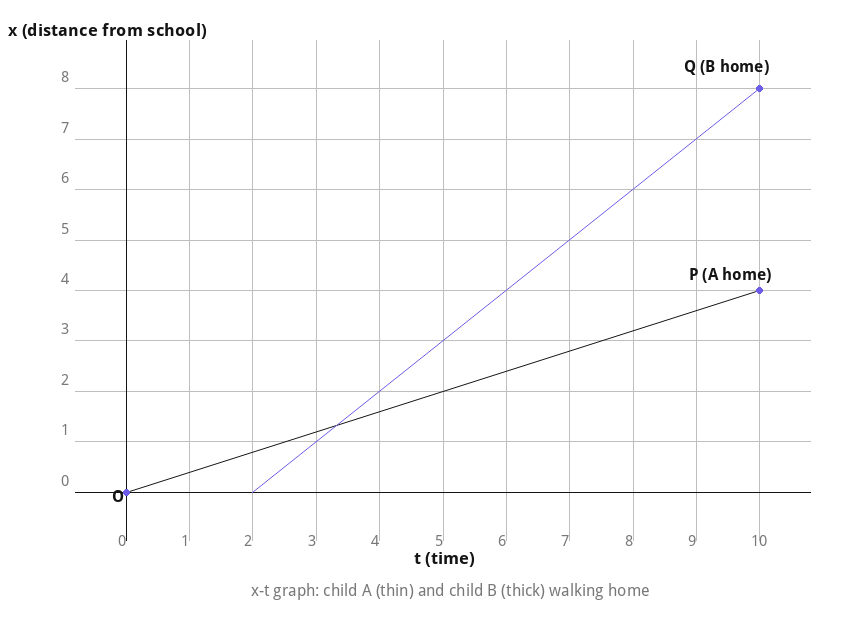
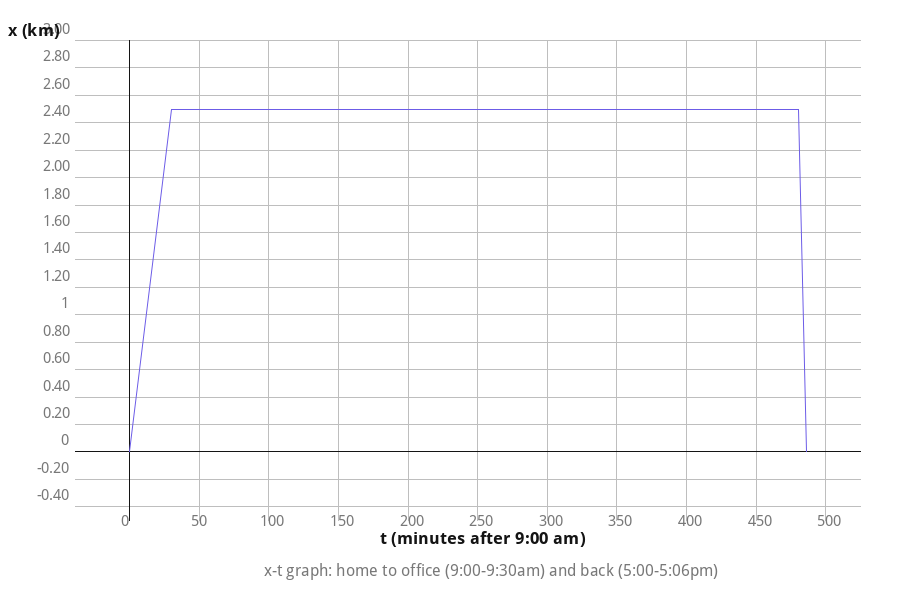
Quick visual: a worked diagram from the full Solutions page, for reference.
- Chapter 1: Units and Measurements - HOTS & Extra Questions with Answers
- Chapter 3: Motion in a Plane – Extra Questions with Answers
- Chapter 4: Laws of Motion – Extra Questions with Answers
- Chapter 5: Work, Energy and Power – Extra Questions with Answers
- Chapter 6: System of Particles and Rotational Motion – Extra Questions with Answers
- Chapter 7: Gravitation – Extra Questions with Answers
- Chapter 8: Mechanical Properties of Solids – Extra Questions with Answers
- Chapter 9: Mechanical Properties of Fluids – Extra Questions with Answers
- Chapter 10: Thermal Properties of Matter – Extra Questions with Answers
- Chapter 11: Thermodynamics – Extra Questions with Answers
- Chapter 12: Kinetic Theory – Extra Questions with Answers
- Chapter 13: Oscillations – Extra Questions with Answers
- Chapter 14: Waves – Extra Questions with Answers
Frequently Asked Questions
A car accelerates from 10 m/s to 30 m/s in 5 seconds, how would you find its acceleration?
Use a = (v minus u) over t = (30 minus 10) over 5 = 4 m per second squared.
If a ball is thrown upward with initial velocity 20 m/s, how long does it take to reach maximum height?
At maximum height velocity is zero, so using v = u minus gt, t = 20 over 9.8 which is about 2.04 seconds.
Chapter Quiz — Test Your Understanding
Class 11 Physics Chapter 2 – Solutions and Notes
For complete step-by-step answers and a quick summary, check the Class 11 Physics Chapter 2 Solutions and Class 11 Physics Chapter 2 Revision Notes.
Recommended: Buy the Printed NCERT Class 11 Physics Book Set
Contains Amazon affiliate links.
If you’d like a printed copy alongside the PDF, here’s a verified option:
Rs. 280
Price and availability may change on Amazon. As an Amazon Associate, ncertbooks.org earns from qualifying purchases.



Pingback: Class 11 Physics Chapter 11 Thermodynamics Extra Questions (2026-27)