
How Forces Affect Motion contrasts balanced and unbalanced forces before working through friction and each of Newton’s three laws, and this page condenses that progression into a quick reference.
Last Updated: September 23, 2026
Common Mistakes Students Make in Force and Laws of Motion
- Mixing up the first and third laws: attributing an object’s resistance to a change in motion (inertia, first law) to an action-reaction situation (third law), or vice versa.
- Sign errors with deceleration: forgetting acceleration is negative when a body is slowing down in F = ma problems.
- Momentum direction errors: not consistently accounting for direction (sign) when two objects move toward or away from each other in conservation-of-momentum questions.
- Confusing mass and weight, or the two bodies in an action-reaction pair: forgetting action and reaction forces act on two different objects, never the same one.
Balanced vs Unbalanced Forces
- Balanced: cancel out, no change in motion.
- Unbalanced: don’t cancel, change speed/direction.
Friction
- Opposes relative motion between surfaces.
- Reduce: lubricants, smoother surfaces, rollers/wheels.
- Increase: rough surfaces (e.g. tyre treads).
Newton’s Laws
- 1st law (Inertia): object stays at rest/uniform motion unless acted on by unbalanced force.
- 2nd law: F = ma; rate of change of momentum ∝ force.
- 3rd law: every action has an equal and opposite reaction, on two different bodies.
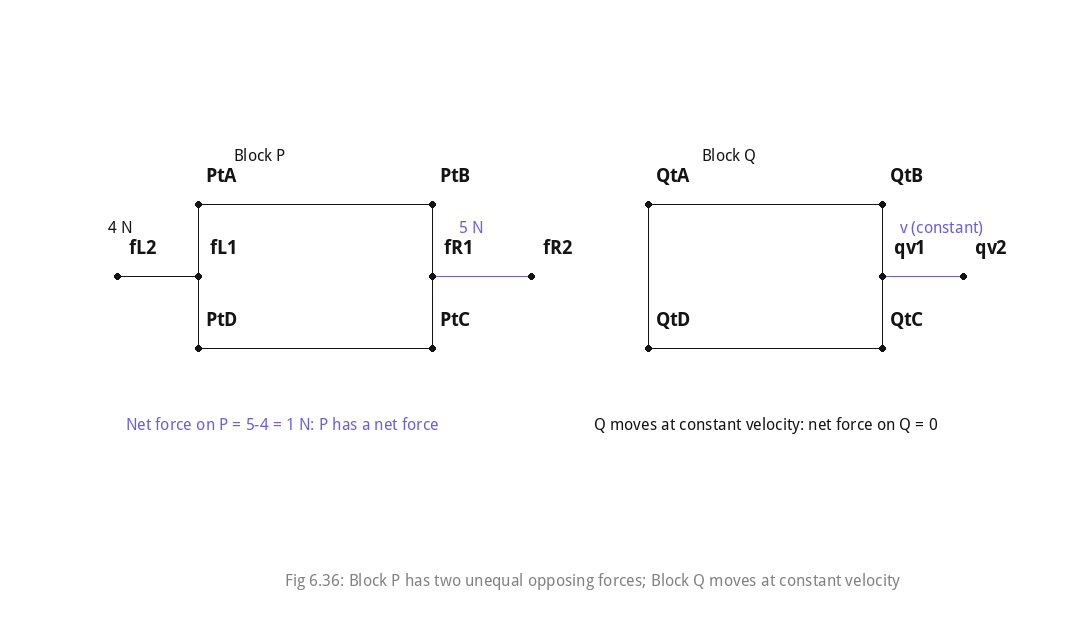
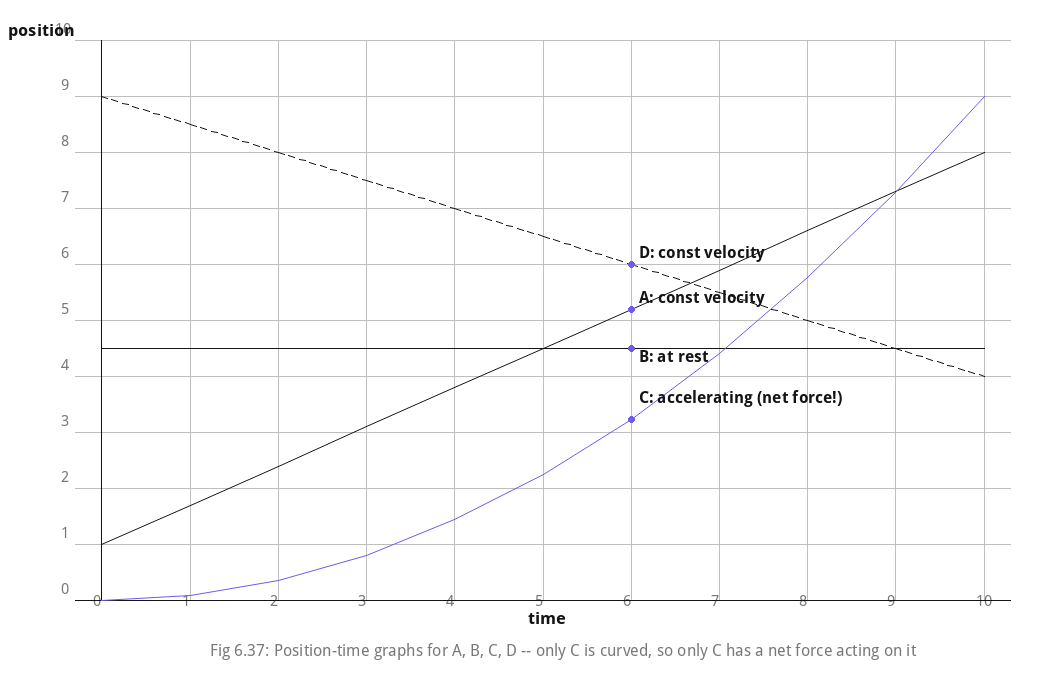
Quick visual: a worked diagram from the full Solutions page, for reference.
One-Line Summary
Motion changes only under unbalanced forces, friction opposes relative motion between surfaces, and Newton’s three laws together explain why objects resist changes in motion (inertia), how force relates to acceleration (F=ma), and why forces always come in equal-and-opposite pairs acting on different objects.
- Chapter 1: Entering the World of Secondary Science – Revision Notes
- Chapter 2: Cell: The Building Block of Life – Revision Notes
- Chapter 3: Tissues in Action – Revision Notes
- Chapter 4: Describing Motion Around Us – Revision Notes
- Chapter 5: Exploring Mixtures and their Separation – Revision Notes
- Chapter 7: Work, Energy and Simple Machines – Revision Notes
- Chapter 8: Journey Inside the Atom – Revision Notes
- Chapter 9: Atomic Foundations of Matter – Revision Notes
- Chapter 10: Sound Waves: Characteristics and Applications – Revision Notes
- Chapter 11: Reproduction: How Life Continues – Revision Notes
- Chapter 12: Patterns in Life: Diversity and Classification – Revision Notes
- Chapter 13: Earth as a System: Energy, Matter and Life – Revision Notes
Frequently Asked Questions
What does Newton First Law of Motion state about force and motion?
The First Law of Motion states that an object continues in its state of rest or uniform motion in a straight line unless an external unbalanced force acts on it, which is why it is also called the law of inertia.
How is force related to acceleration according to the Second Law of Motion?
The Second Law of Motion states that the rate of change of momentum of an object is directly proportional to the applied force, which simplifies to force equals mass times acceleration for a body of constant mass.
Chapter Quiz — Test Your Understanding
See also: Chapter 1 | Chapter 2 | Chapter 3 | Chapter 4 | Chapter 5 | Chapter 6
Practice more: Chapter 1 | Chapter 2 | Chapter 3 | Chapter 4 | Chapter 5 | Chapter 6
Quick revision: Chapter 1 | Chapter 2 | Chapter 3 | Chapter 4 | Chapter 5
What to Revise First (and Last) in This Chapter
Prioritise the three laws of motion with one clear example each, and the momentum conservation formula, since these are tested most often together. Leave detailed numericals involving multiple simultaneous forces for an earlier, slower revision pass.
Recommended: Buy the Printed NCERT Class 9 Science Book
Contains Amazon affiliate links.
If you’d like a printed copy alongside the PDF, here’s a verified option:
3.8 out of 5 stars (931 ratings) · Rs. 187
Price and availability may change on Amazon. As an Amazon Associate, ncertbooks.org earns from qualifying purchases.


