Scalars, vectors, and the equations relating velocity and acceleration give Chapter 4 of Class 9 Science its structure, and these extra questions apply that framework to graphs and circular motion.
Last Updated: September 23, 2026
How to Approach the HOTS Questions in This Chapter
HOTS questions on Motion often combine two stages of movement in one problem (e.g. accelerating, then moving at constant speed) or ask you to interpret an unusual graph shape — practice breaking multi-stage motion problems into separate parts, solving each stage’s equations independently before combining the results.
Very Short Answer Questions (1 mark)
Q1. Is speed a scalar or vector quantity?
Ans: Scalar.
Q2. What does the slope of a velocity-time graph represent?
Ans: Acceleration.
Q3. Write the equation of motion relating v, u, a, and t.
Ans: v = u + at.
Q4. What is negative acceleration called?
Ans: Retardation (or deceleration).
Q5. In uniform circular motion, does the speed of the object change?
Ans: No, speed stays constant; only direction (and hence velocity) changes.
Short Answer Questions (2–3 marks)
Q6. Distinguish between distance and displacement with an example.
Ans: Distance is the total path length covered (always positive, no direction), while displacement is the shortest straight-line distance between initial and final positions, with direction. Example: if a person walks 4 m east and then 4 m west back to the start, distance = 8 m, but displacement = 0 m.
Q7. What does the area under a velocity-time graph represent? Explain briefly.
Ans: The area under a velocity-time graph gives the displacement covered by the object during that time interval, since displacement is the product of velocity and time (or the sum of many such small products across the interval).
Q8. Why is uniform circular motion an example of accelerated motion?
Ans: Even though the speed remains constant, the direction of motion is continuously changing as the object moves along the circular path. Since velocity depends on both magnitude and direction, a continuous change in direction means the velocity is continuously changing, which is the definition of acceleration.
Higher-Order Thinking / Application Questions
Q9. A cyclist starts from rest and accelerates uniformly to reach a velocity of 10 m/s in 5 seconds. Using an equation of motion, describe how you would calculate the distance covered, without solving numerically, and identify the initial velocity used.
Ans: Since the cyclist starts from rest, initial velocity u = 0 m/s. The distance covered can be calculated using s = ut + ½at², where a is found first from v = u + at (using v = 10 m/s, u = 0, t = 5 s), and then substituted along with t into the distance equation.
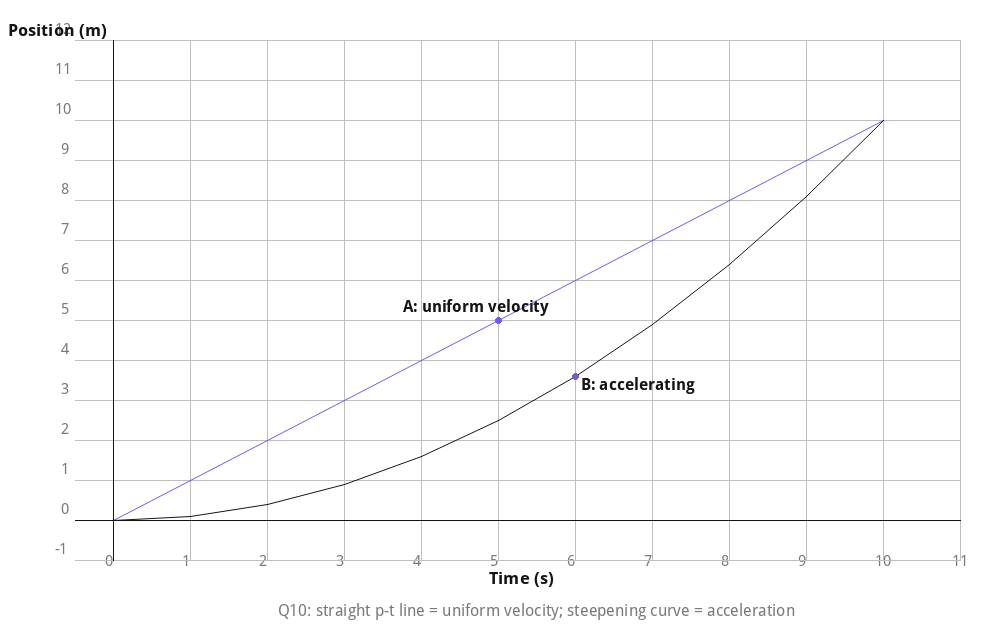
Q10. Two position-time graphs are drawn for two runners: Runner A’s graph is a straight line, while Runner B’s graph is a curve that gets steeper over time. Compare their motion.
Ans: Runner A moves with uniform velocity, since a straight-line position-time graph indicates a constant slope (constant velocity). Runner B’s velocity is increasing over time, since the graph curve becomes steeper (steeper slope means higher velocity), indicating Runner B is accelerating rather than moving at constant velocity.
- Chapter 1: Entering the World of Secondary Science – Extra Questions with Answers
- Chapter 2: Cell: The Building Block of Life – Extra Questions with Answers
- Chapter 3: Tissues in Action – Extra Questions with Answers
- Chapter 5: Exploring Mixtures and their Separation – Extra Questions with Answers
- Chapter 6: How Forces Affect Motion – Extra Questions with Answers
- Chapter 7: Work, Energy and Simple Machines – Extra Questions with Answers
- Chapter 8: Journey Inside the Atom – Extra Questions with Answers
- Chapter 9: Atomic Foundations of Matter – Extra Questions with Answers
- Chapter 10: Sound Waves: Characteristics and Applications – Extra Questions with Answers
- Chapter 11: Reproduction: How Life Continues – Extra Questions with Answers
- Chapter 12: Patterns in Life: Diversity and Classification – Extra Questions with Answers
- Chapter 13: Earth as a System: Energy, Matter and Life – Extra Questions with Answers
Frequently Asked Questions
If a runner covers 400 metres on a circular track and returns to the starting point, what can you say about the distance travelled versus the displacement?
The distance travelled is 400 metres, the full track length, but since the runner returns to the exact starting point, the displacement is zero, showing distance and displacement can differ significantly.
How would you describe motion that has a constant speed but a continuously changing velocity?
An object moving in a circular path at constant speed has changing velocity, because velocity includes direction, and the direction of motion continuously changes as the object moves along the curve.
Chapter Quiz — Test Your Understanding
See also: Chapter 1 | Chapter 2 | Chapter 3 | Chapter 4
Recommended: Buy the Printed NCERT Class 9 Science Book
Contains Amazon affiliate links.
If you’d like a printed copy alongside the PDF, here’s a verified option:
3.8 out of 5 stars (931 ratings) · Rs. 187
Price and availability may change on Amazon. As an Amazon Associate, ncertbooks.org earns from qualifying purchases.