
Class 10 Science Chapter 10, The Human Eye and the Colourful World, has 17 end-of-chapter exercise questions in the current 2026-27 rationalised session (this is Chapter 10 in the current rationalised numbering; it was Chapter 11 before Periodic Classification of Elements was removed from the syllabus in 2023 — confirmed via multiple independent sources before writing). Below are original, concept-based solutions to all 17.
Last Updated: September 10, 2026
Why This Chapter Matters for Boards
This chapter blends the Human Eye (a high-scoring biology-meets-physics topic covering myopia, hypermetropia and lens power numericals) with Atmospheric Refraction and Scattering of Light (twinkling of stars, reddish sunrise/sunset, blue sky). Both numerical and reasoning-based questions are common in the CBSE board exam.
Exercise Solutions
- Q1. What is meant by power of accommodation of the eye?
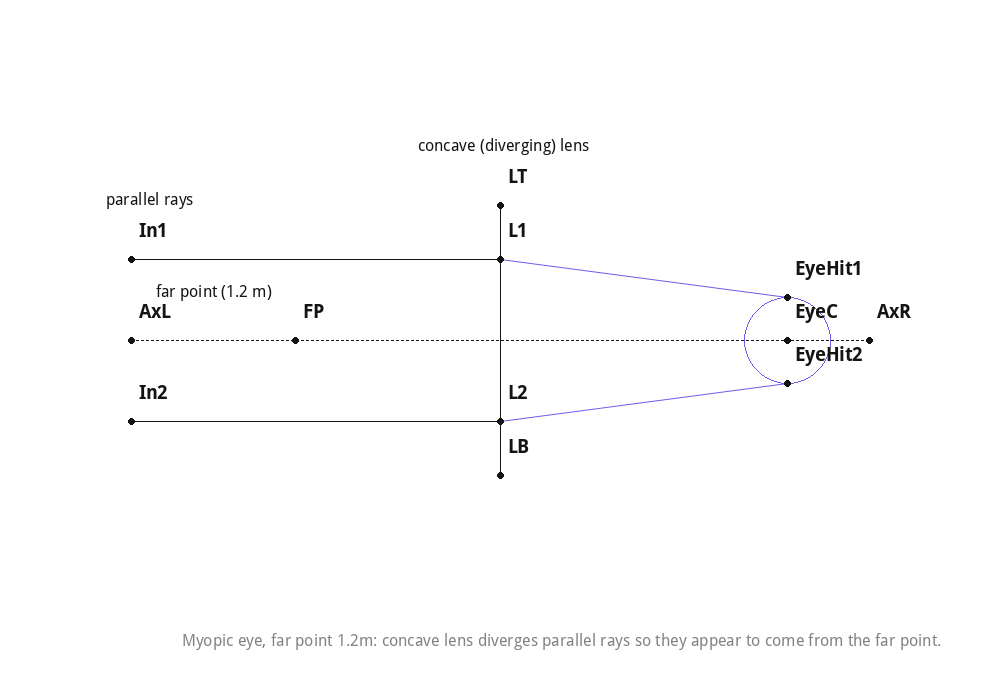
The ability of the eye lens to adjust its focal length, by the action of the ciliary muscles, so that objects at different distances can be focused clearly on the retina. This is called the power of accommodation. - Q2. A person with a myopic eye cannot see objects beyond 1.2 m distinctly. What is the type of corrective lens used to restore proper vision?
This is myopia (near-sightedness); the far point is 1.2 m instead of infinity. A concave (diverging) lens of focal length f = −1.2 m is required. Power = 1/f = 1/(−1.2) = −0.83 D (approx.)
- Q3. What is the far point and near point of the human eye with normal vision?
Far point: infinity. Near point: about 25 cm from the eye. - Q4. A student has difficulty reading the blackboard while sitting in the last row. What could be the defect the child is suffering from? How can it be corrected?
The child likely has myopia (cannot see distant objects clearly). It can be corrected using spectacles with a suitable concave lens, or by consulting an eye specialist for the exact power required; sitting closer temporarily helps but is not a correction. - Q5. (MCQ) The human eye can focus objects at different distances by adjusting the focal length of the eye lens. This is due to:
(a) presbyopia (b) accommodation (c) near-sightedness (d) far-sightedness
Answer: (b) accommodation — achieved by the ciliary muscles changing the curvature of the eye lens. - Q6. (MCQ) The human eye forms the image of an object at its:
(a) cornea (b) iris (c) pupil (d) retina
Answer: (d) retina - Q7. (MCQ) The least distance of distinct vision for a young adult with normal vision is about:
(a) 25 m (b) 2.5 cm (c) 25 cm (d) 2.5 m
Answer: (c) 25 cm - Q8. (MCQ) The change in focal length of an eye lens is caused by the action of the:
(a) pupil (b) retina (c) ciliary muscles (d) iris
Answer: (c) ciliary muscles — they contract or relax to change the curvature (and hence focal length) of the eye lens. - Q9. A person needs a lens of power +1.5 D for correcting distant vision… wait – correction for near vision, and −5.5 D for correcting distant vision. Find the focal length of each lens.
Near vision lens: f = 1/P = 1/1.5 = +0.67 m (converging — hypermetropia correction)
Distant vision lens: f = 1/(−5.5) = −0.18 m (diverging — myopia correction). This person needs bifocal lenses. - Q10. The far point of a myopic person is 80 cm in front of the eye. What is the power of the lens required to enable him to see distant objects clearly?
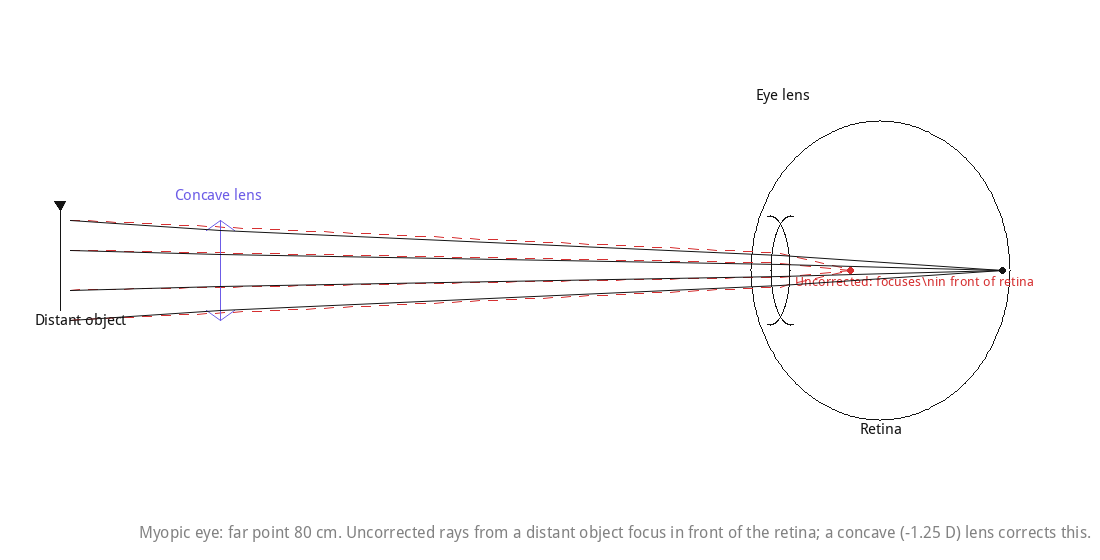
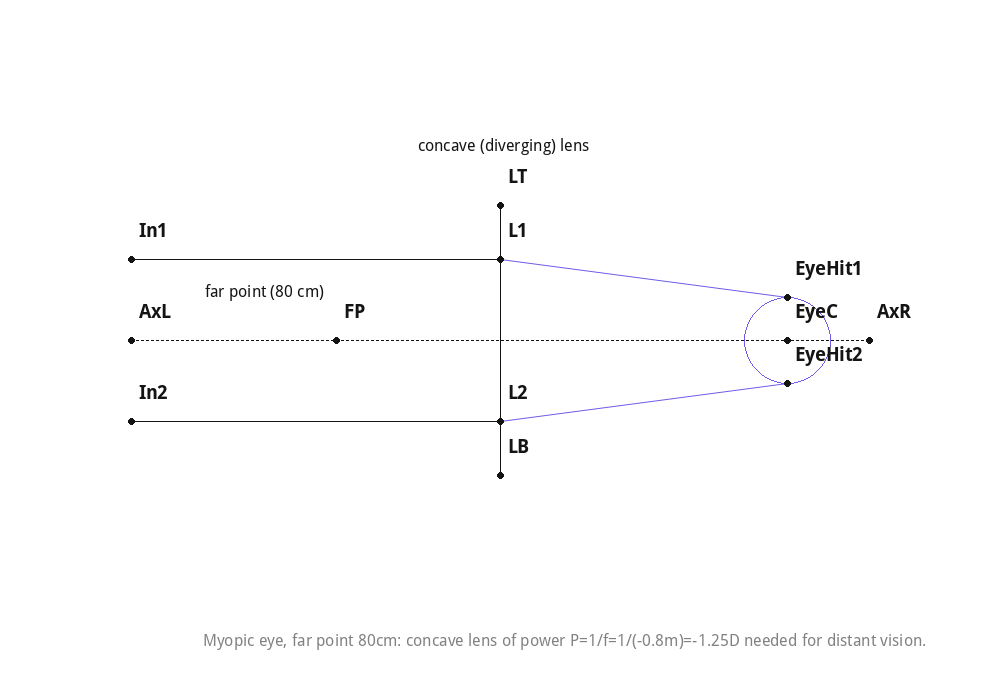
Myopic eye: far point 80 cm. Uncorrected rays from a distant object focus in front of the retina; a concave (-1.25 D) lens corrects this.
f = −0.8 m. P = 1/f = 1/(−0.8) = −1.25 D
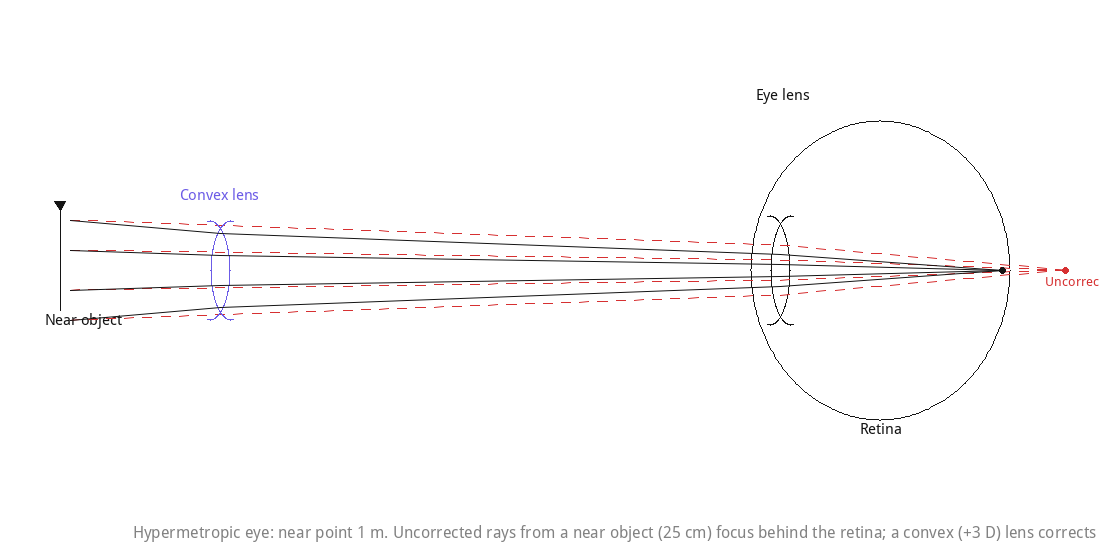
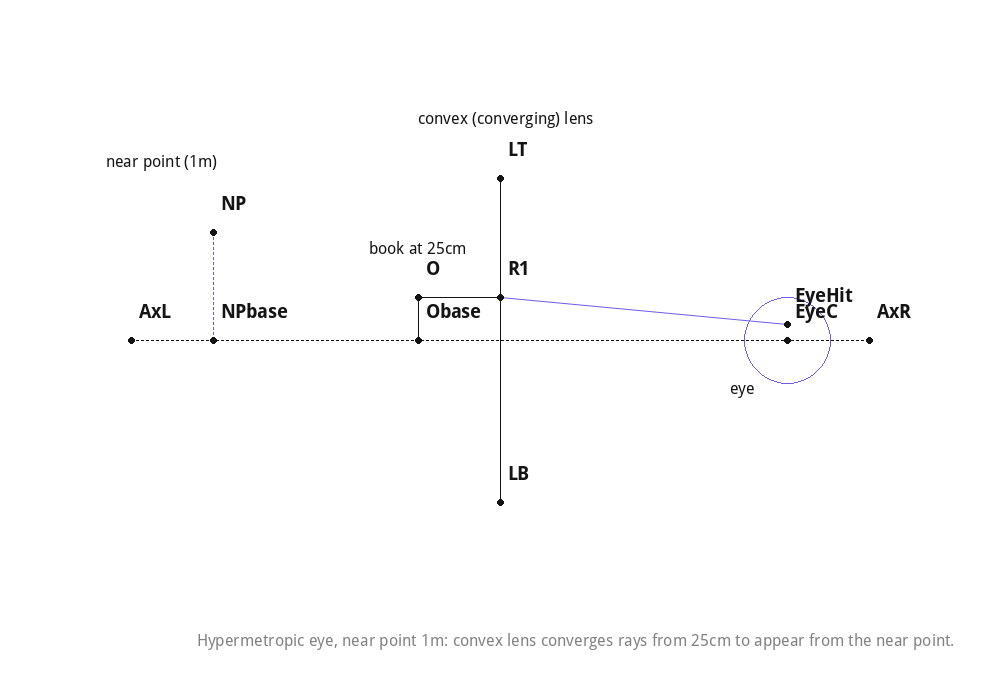
- Q11. A hypermetropic person can see objects clearly only beyond 1 m. Draw a ray diagram to show the defect and find the power of the corrective lens needed to read a book at 25 cm.
Hypermetropic eye: near point 1 m. Uncorrected rays from a near object (25 cm) focus behind the retina; a convex (+3 D) lens corrects this.
Object at u = −0.25 m must form a virtual image at the near point, v = −1 m.
1/f = 1/v − 1/u = 1/(−1) − 1/(−0.25) = −1 + 4 = 3 ⇒ f = 1/3 m. Power = +3 D (converging lens). - Q12. Why does a normal eye not see objects placed closer than 25 cm distinctly?
Below 25 cm, the ciliary muscles cannot contract further to shorten the eye-lens focal length enough to focus the image sharply on the retina — the image would form behind the retina, causing blurred vision. 25 cm is the least distance at which the eye can still comfortably focus. - Q13. What happens to the image distance in the eye when we increase the distance of an object from the eye?
The image is always formed on the retina, so the image distance (eye-lens-to-retina distance) stays essentially constant; instead, the ciliary muscles relax, increasing the eye lens’s focal length as the object moves farther away. - Q14. Why do stars twinkle?
Starlight undergoes continuous refraction as it passes through the atmosphere, whose density (and hence refractive index) varies with altitude and keeps fluctuating. This causes the apparent position/brightness of the star to vary rapidly, seen as twinkling. - Q15. Explain why planets do not twinkle, while stars do.
Planets are much closer to Earth and appear as extended sources (a collection of many point sources). The twinkling effect of the many individual points averages/cancels out, so the net variation is negligible — planets appear to shine steadily. - Q16. Why does the Sun appear reddish early in the morning?
At sunrise, sunlight travels a much longer path through the atmosphere. Shorter wavelengths (blue/violet) are scattered away almost completely along this long path, while the longer-wavelength red light is scattered the least and reaches the eye directly, making the Sun appear reddish. - Q17. Why does the sky appear dark instead of blue to an astronaut?
At high altitudes there is little or no atmosphere to scatter sunlight. Since scattering is what makes the sky appear blue from the ground, the absence of a scattering medium means no light reaches the astronaut’s eyes from other directions, so the sky appears black even though the Sun is shining brightly.
- NCERT Solutions – Chapter 10
- Extra Questions (HOTS) – Chapter 10
- Revision Notes – Chapter 10
- Class 10 Science Book (Catalog Page)
CBSE Exam Weightage
This chapter falls under Unit III: Natural Phenomena in the CBSE Class 10 Science board exam syllabus. This unit typically carries around 12 marks (15%) of the 80-mark theory paper, based on CBSE’s published unit-wise weightage (Question Paper Design). CBSE sets weightage at the unit level rather than chapter-by-chapter, so the exact share from this specific chapter can vary a little between years and sample papers.
Class 10 Science Chapter 10 – Notes and Extra Questions
Along with these NCERT Solutions, students can also use the Class 10 Science Chapter 10 Extra Questions and Class 10 Science Chapter 10 Revision Notes for quick revision and extra practice.
- Chapter 1: Chemical Reactions and Equations – Free PDF Download
- Chapter 2: Acids, Bases and Salts – Free PDF Download
- Chapter 3: Metals and Non-metals – Free PDF Download
- Chapter 4: Carbon and its Compounds – Free PDF Download
- Chapter 5: Life Processes – Free PDF Download
- Chapter 6: Control and Coordination – Free PDF Download
- Chapter 7: How do Organisms Reproduce? (2026-27) – Free PDF Download
- Chapter 8: Heredity – Free PDF Download
- Chapter 9: Light - Reflection and Refraction – Free PDF Download
- Chapter 11: Electricity (2026-27) – Free PDF Download
- Chapter 12: Magnetic Effects of Electric Current (2026-27)
- Chapter 13: Our Environment – Free PDF Download
FAQ
Q: Is this content updated for the 2026-27 NCERT edition?
A: Yes. This chapter is Chapter 10 in the current rationalised numbering (it was Chapter 10 before the 2023 rationalisation) — confirmed via cross-checking multiple independent current-session sources before writing.
Q: What is the single most important formula in this chapter?
A: Power of a lens, P = 1/f (f in metres, unit dioptre D) — concave lens power is negative, convex lens power is positive.



Pingback: Class 10 Science Ch 10 Human Eye Extra Questions (HOTS) (2026-27)