
Fluid mechanics in this chapter ties together pressure, buoyancy, and flow, starting from the basic relation P=F/A and Pascal’s law for pressure transmitted through an enclosed liquid. It builds up to Bernoulli’s principle and viscosity, showing how liquids and gases behave both at rest and in motion.
Last Updated: September 23, 2026
Pressure
- P=F/A; at depth h: P=P0+ρgh.
- Pascal’s law: pressure transmitted equally in enclosed fluid.
Buoyancy and Flow
- Archimedes’ principle: buoyant force=weight of displaced fluid.
- Continuity: A1v1=A2v2.
Bernoulli and Viscosity
- Bernoulli: P+½ρv²+ρgh=constant.
- Stokes’ law: F=6πηrv.
One-Line Summary
Mechanical properties of fluids cover pressure, buoyancy, flow continuity, Bernoulli’s principle, viscosity, and surface tension — the physics governing how liquids and gases behave at rest and in motion.
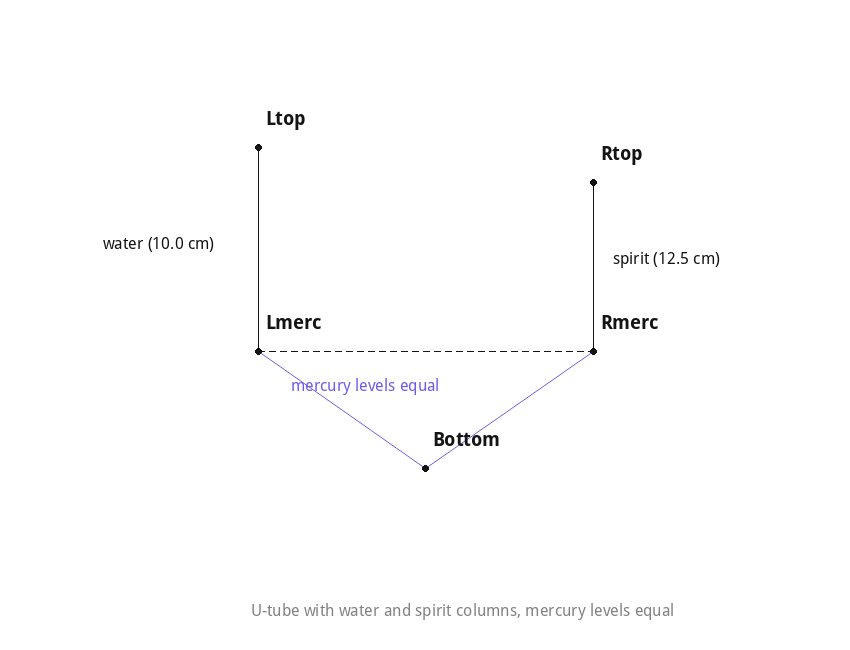
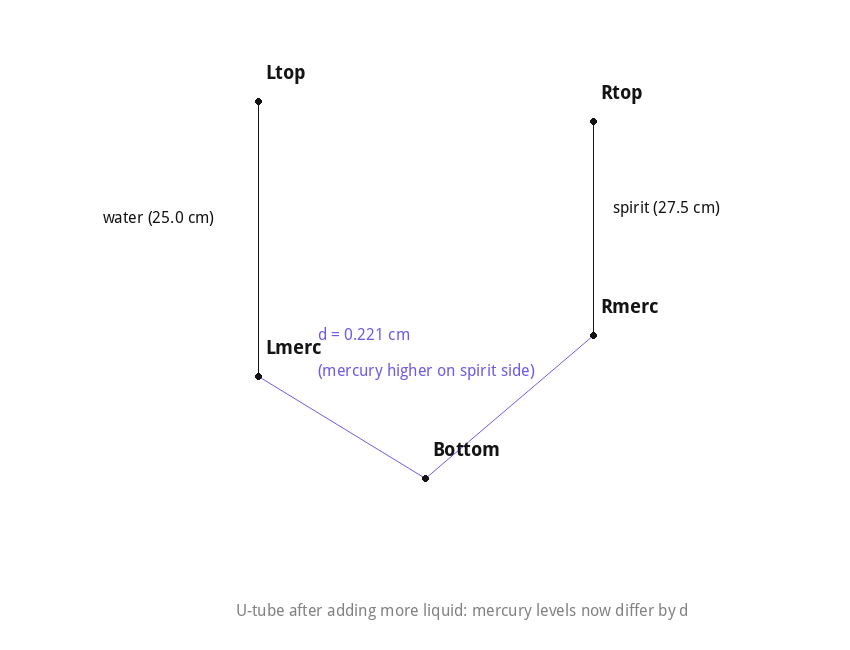
Quick visual: a worked diagram from the full Solutions page, for reference.
- Chapter 1: Units and Measurements - Quick Revision Notes
- Chapter 2: Motion in a Straight Line – Revision Notes
- Chapter 3: Motion in a Plane – Revision Notes
- Chapter 4: Laws of Motion – Revision Notes
- Chapter 5: Work, Energy and Power – Revision Notes
- Chapter 6: System of Particles and Rotational Motion – Revision Notes
- Chapter 7: Gravitation – Revision Notes
- Chapter 8: Mechanical Properties of Solids – Revision Notes
- Chapter 10: Thermal Properties of Matter – Revision Notes
- Chapter 11: Thermodynamics – Revision Notes
- Chapter 12: Kinetic Theory – Revision Notes
- Chapter 13: Oscillations – Revision Notes
- Chapter 14: Waves – Revision Notes
Frequently Asked Questions
What is the difference between pressure and thrust in fluids?
Thrust is the total force acting perpendicular to a surface, while pressure is that thrust divided by the area over which it acts, which is why the same force can feel very different depending on how spread out or concentrated it is.
How does the Bernoulli Principle explain phenomena like the lift on an aircraft wing?
The Bernoulli Principle states that faster-moving fluid exerts lower pressure. Since air moves faster over the curved top of an aircraft wing than beneath it, the pressure difference created generates an upward lift force.
Chapter Quiz — Test Your Understanding
Class 11 Physics Chapter 9 – Solutions and Important Questions
Need full answers or more practice? See the Class 11 Physics Chapter 9 Solutions and Class 11 Physics Chapter 9 Extra Questions.
See also: Chapter 1 | Chapter 2 | Chapter 3 | Chapter 4 | Chapter 5 | Chapter 6 | Chapter 7 | Chapter 8 | Chapter 9
Practice more: Chapter 1 | Chapter 2 | Chapter 3 | Chapter 4 | Chapter 5 | Chapter 6 | Chapter 7 | Chapter 8 | Chapter 9
Quick revision: Chapter 1 | Chapter 2 | Chapter 3 | Chapter 4 | Chapter 5 | Chapter 6 | Chapter 7 | Chapter 8
Recommended: Buy the Printed NCERT Class 11 Physics Book Set
Contains Amazon affiliate links.
If you’d like a printed copy alongside the PDF, here’s a verified option:
Rs. 280
Price and availability may change on Amazon. As an Amazon Associate, ncertbooks.org earns from qualifying purchases.


