
Chapter 8 of Class 11 Physics quantifies how solids resist deformation through stress and strain, following Hooke’s law within the elastic limit. It defines Young’s, shear, and bulk moduli, along with Poisson’s ratio and the elastic energy stored per unit volume.
Last Updated: September 23, 2026
Stress and Strain
- Stress=F/A; Strain=fractional deformation (dimensionless).
- Hooke’s Law: stress ∝ strain (within elastic limit).
Elastic Moduli
- Young’s modulus Y=(F/A)/(ΔL/L).
- Shear modulus G=shear stress/shear strain.
- Bulk modulus K=−ΔP/(ΔV/V).
Other Concepts
- Poisson’s ratio = lateral strain/longitudinal strain.
- Elastic PE per unit volume = ½ × stress × strain.
One-Line Summary
Mechanical properties of solids describe how materials deform under stress, quantified through Young’s, shear, and bulk moduli, with Hooke’s law holding within the elastic limit.
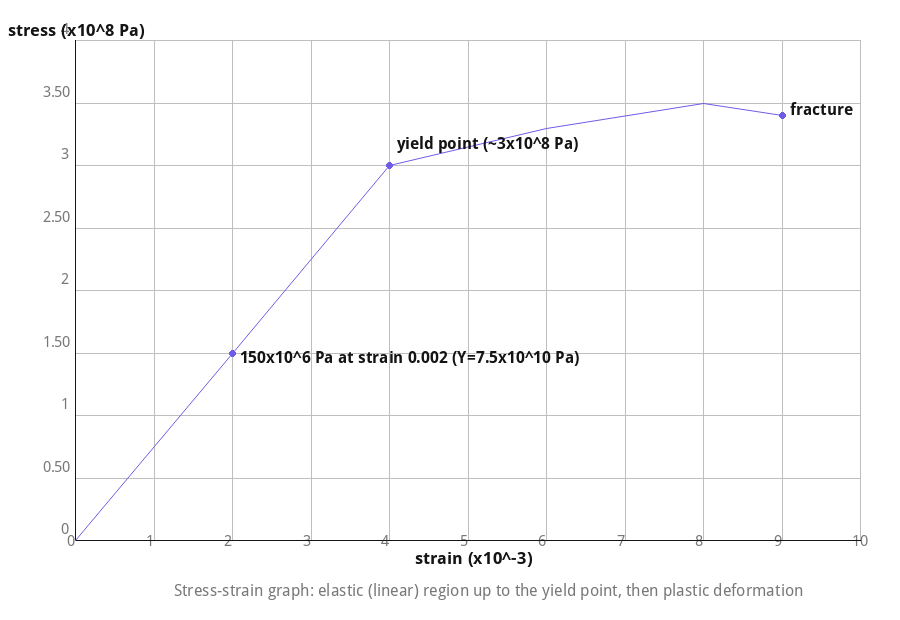
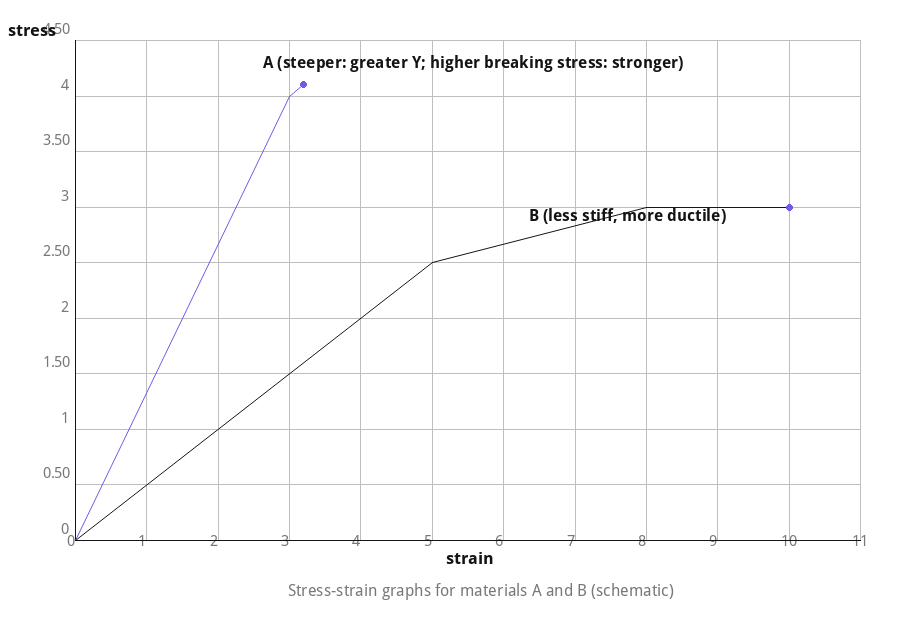
Quick visual: a worked diagram from the full Solutions page, for reference.
- Chapter 1: Units and Measurements - Quick Revision Notes
- Chapter 2: Motion in a Straight Line – Revision Notes
- Chapter 3: Motion in a Plane – Revision Notes
- Chapter 4: Laws of Motion – Revision Notes
- Chapter 5: Work, Energy and Power – Revision Notes
- Chapter 6: System of Particles and Rotational Motion – Revision Notes
- Chapter 7: Gravitation – Revision Notes
- Chapter 9: Mechanical Properties of Fluids – Revision Notes
- Chapter 10: Thermal Properties of Matter – Revision Notes
- Chapter 11: Thermodynamics – Revision Notes
- Chapter 12: Kinetic Theory – Revision Notes
- Chapter 13: Oscillations – Revision Notes
- Chapter 14: Waves – Revision Notes
Frequently Asked Questions
What is the difference between elastic and plastic deformation?
Elastic deformation is temporary, meaning the object returns to its original shape once the deforming force is removed, while plastic deformation is permanent, meaning the object does not fully recover its original shape.
What does the Young Modulus of a material indicate?
Young Modulus measures the stiffness of a solid material, defined as the ratio of tensile stress to tensile strain within the elastic limit. A higher value means the material is stiffer and harder to stretch or compress.
Chapter Quiz — Test Your Understanding
Class 11 Physics Chapter 8 – Solutions and Important Questions
Need full answers or more practice? See the Class 11 Physics Chapter 8 Solutions and Class 11 Physics Chapter 8 Extra Questions.
See also: Chapter 1 | Chapter 2 | Chapter 3 | Chapter 4 | Chapter 5 | Chapter 6 | Chapter 7 | Chapter 8
Practice more: Chapter 1 | Chapter 2 | Chapter 3 | Chapter 4 | Chapter 5 | Chapter 6 | Chapter 7 | Chapter 8
Quick revision: Chapter 1 | Chapter 2 | Chapter 3 | Chapter 4 | Chapter 5 | Chapter 6 | Chapter 7
Recommended: Buy the Printed NCERT Class 11 Physics Book Set
Contains Amazon affiliate links.
If you’d like a printed copy alongside the PDF, here’s a verified option:
Rs. 280
Price and availability may change on Amazon. As an Amazon Associate, ncertbooks.org earns from qualifying purchases.


