
These HOTS-level questions go beyond the 18-question textbook exercise — general derivations, assertion-reason, reverse-engineering, and fresh numbers not reused from the Solutions post. These Class 10 Science Chapter 11 important questions are handy for last-minute exam practice.
Last Updated: October 24, 2026
How to Approach the HOTS Questions in This Chapter
HOTS questions on Electricity often combine two steps in one problem — e.g. finding the equivalent resistance of a mixed series-parallel network before applying Ohm’s law, or comparing power/energy use across two different circuit configurations — so practice multi-step problems where the circuit has to be simplified first, not just single-formula plug-ins.
Q1 (General derivation). Derive an expression for the equivalent resistance of n identical resistors, each of resistance R, when connected (a) in series, (b) in parallel. Hence show that R_series / R_parallel = n².
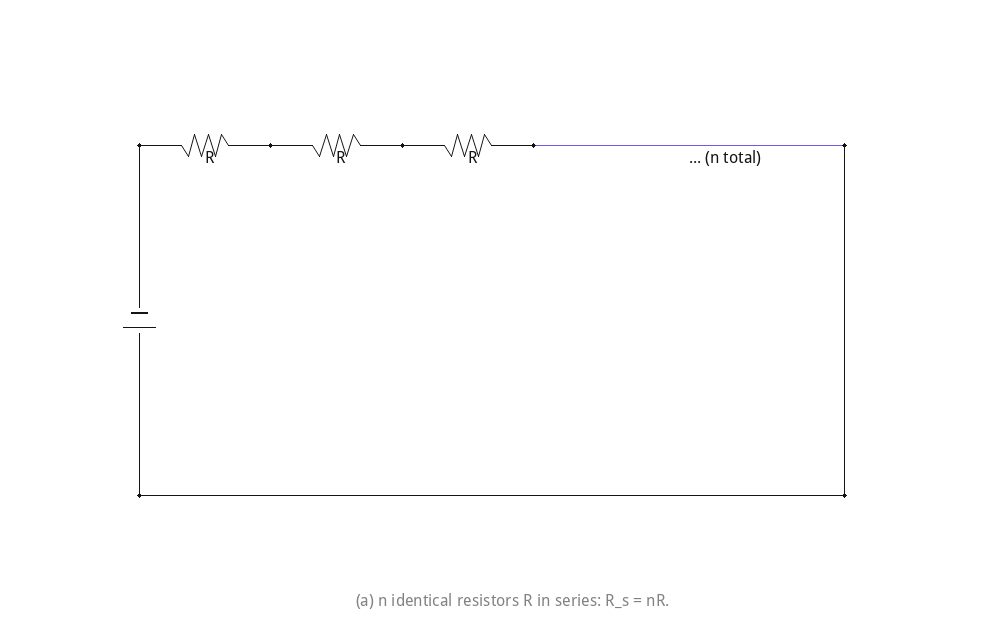
(a) n identical resistors R in series: R_s = nR.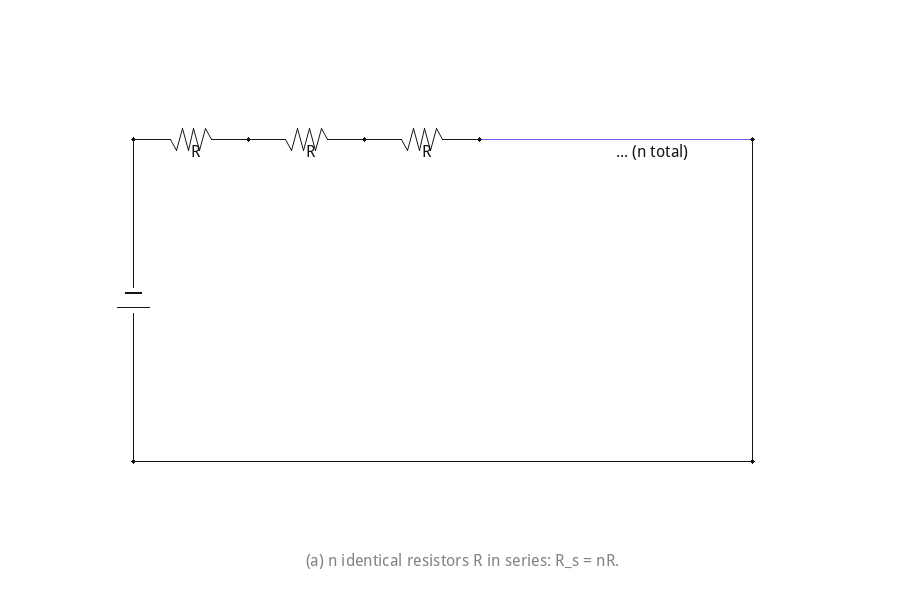
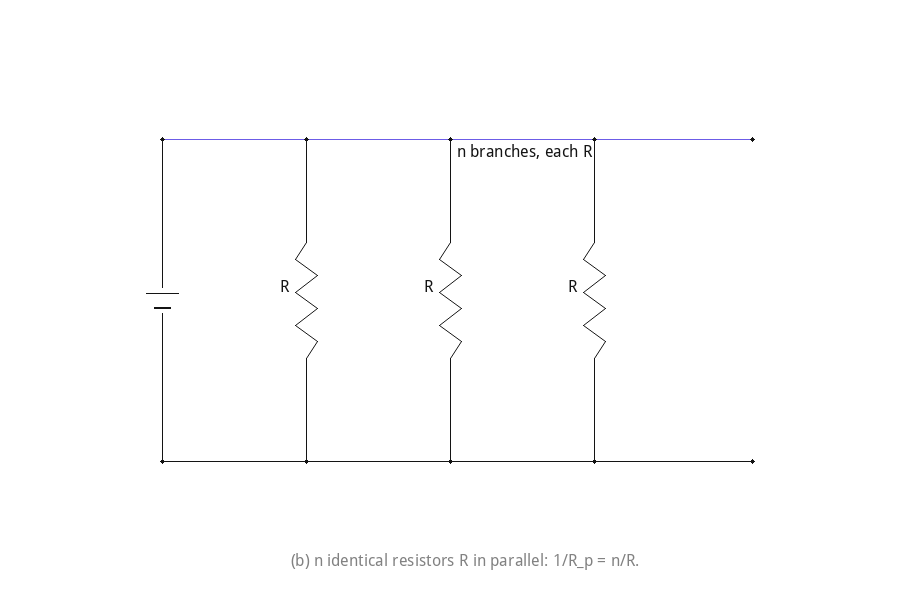
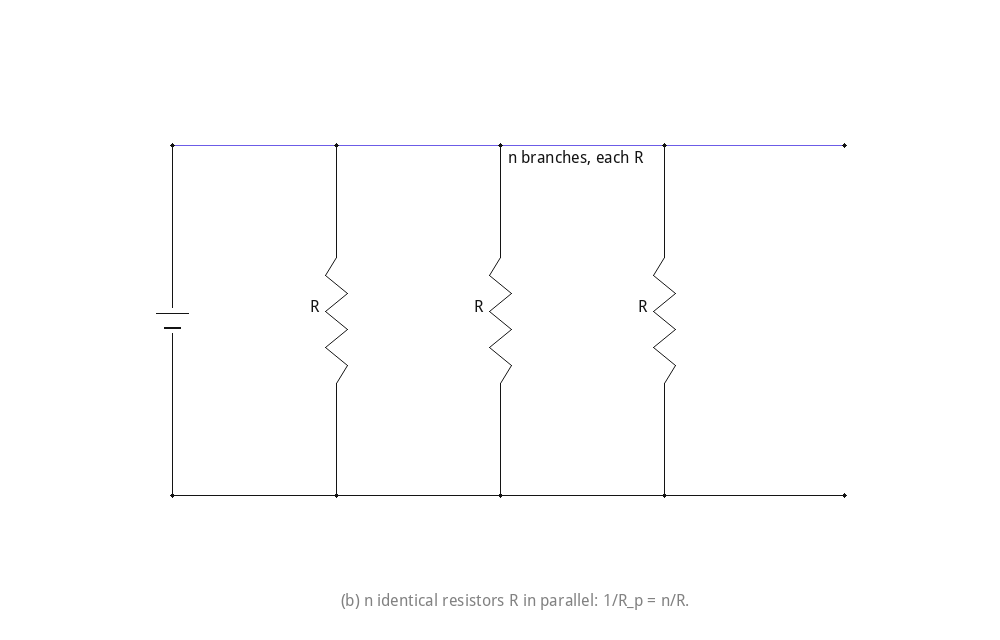
(b) n identical resistors R in parallel: 1/R_p = n/R.
Solution: (a) Series: R_s = R+R+…(n times) = nR. (b) Parallel: 1/R_p = n/R ⟹ R_p = R/n.
R_s/R_p = nR ÷ (R/n) = n². (Proved — this is why series resistance grows much faster than parallel resistance drops as you add more identical resistors.)
Q2 (Reverse-engineering). Two resistors are connected in series to a 12 V battery, drawing a current of 0.5 A. When connected in parallel to the same battery, the current drawn is 4 A. Find the two resistances.
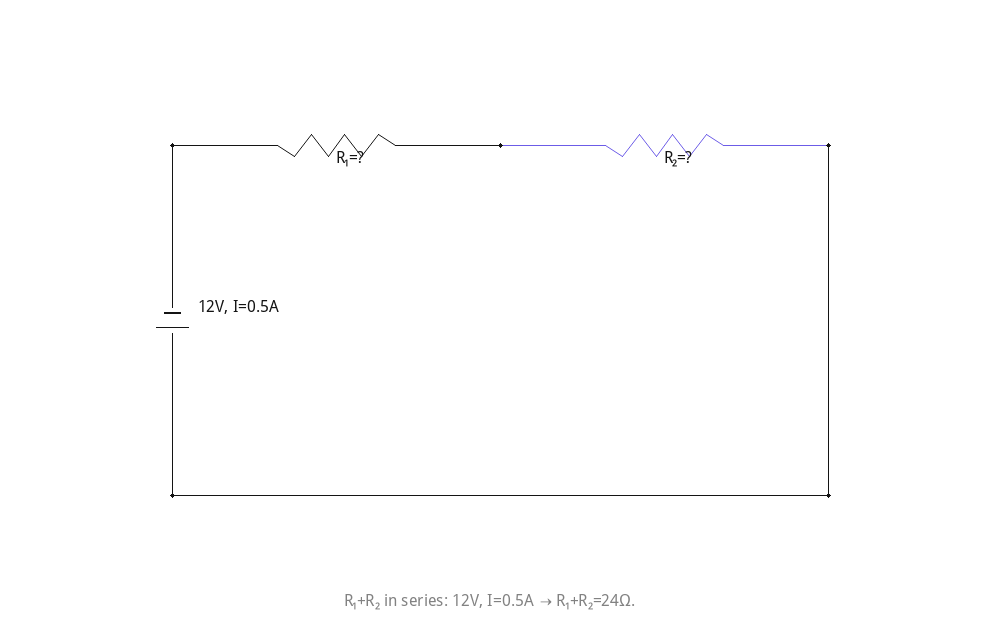
R₁+R₂ in series: 12V, I=0.5A → R₁+R₂=24Ω.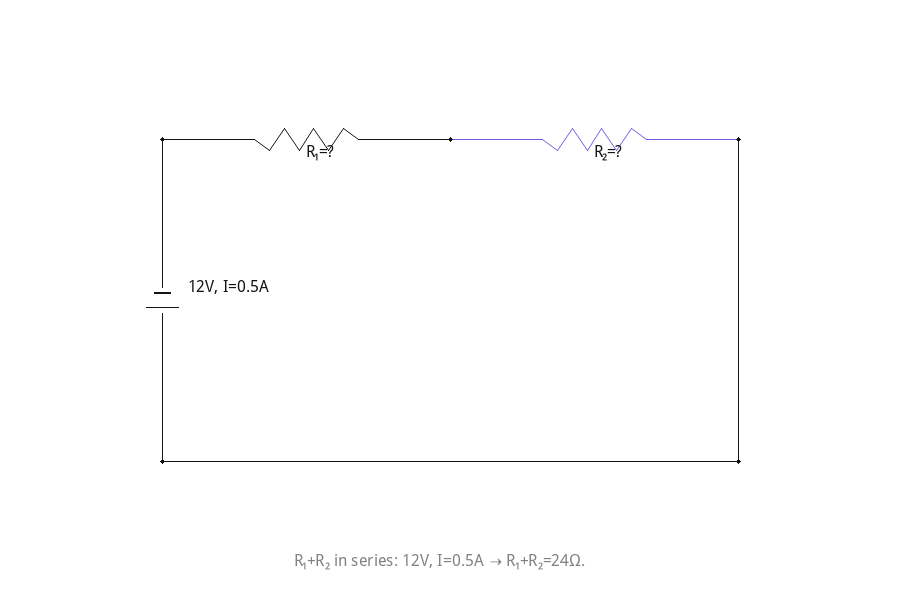
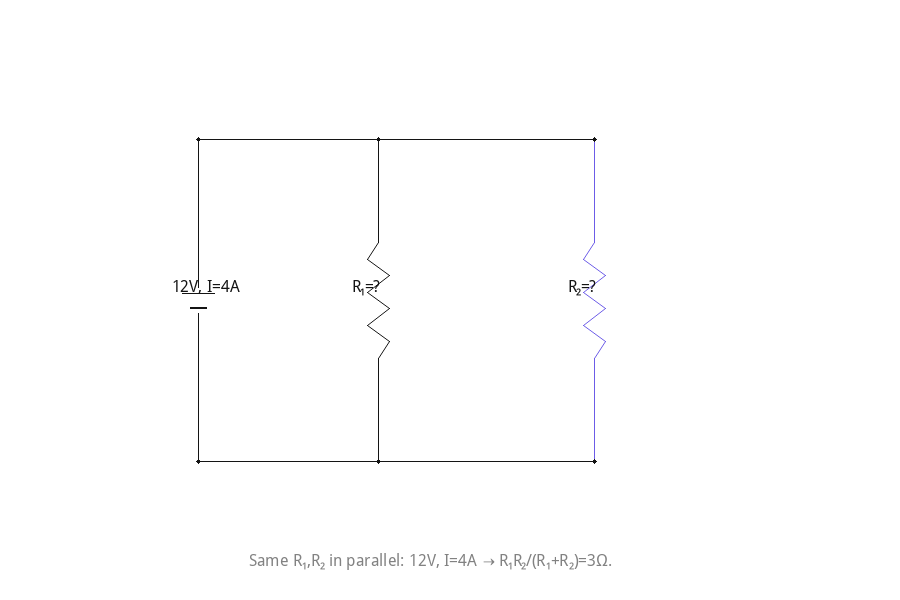
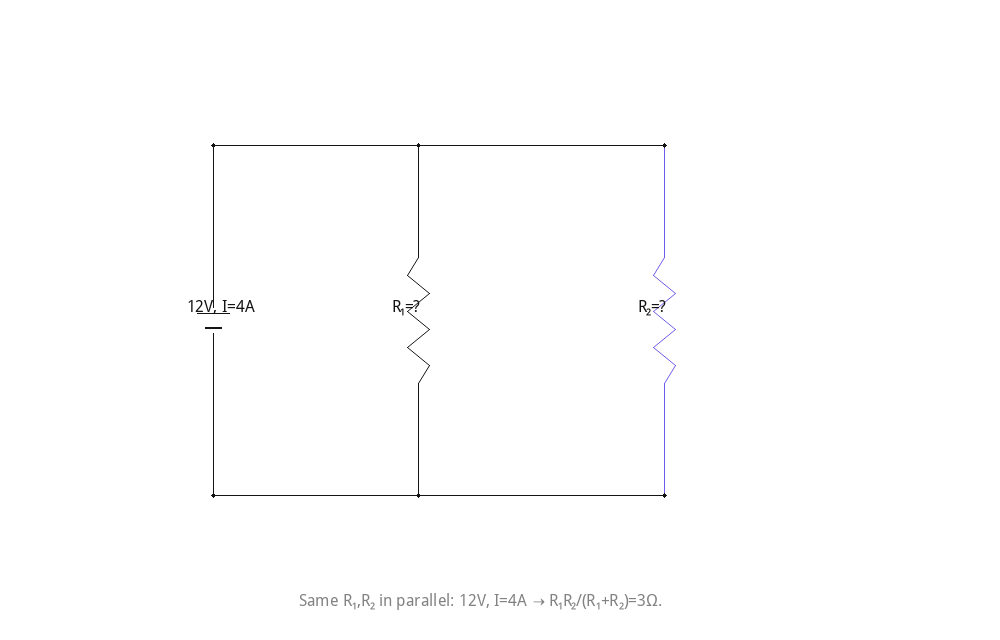
Same R₁,R₂ in parallel: 12V, I=4A → R₁R₂/(R₁+R₂)=3Ω.
Solution: Series: R₁+R₂ = 12/0.5 = 24 Ω. Parallel: R₁R₂/(R₁+R₂) = 12/4 = 3 ⟹ R₁R₂ = 3×24 = 72.
R₁, R₂ are roots of x² − 24x + 72 = 0 ⟹ x = [24 ± √(576−288)]/2 = [24 ± √288]/2 = [24 ± 16.97]/2 ⟹ x ≈ 20.48 Ω and 3.51 Ω.
Q3 (Assertion-Reason). Assertion (A): The equivalent resistance of a parallel combination is always less than the smallest individual resistance in the group.
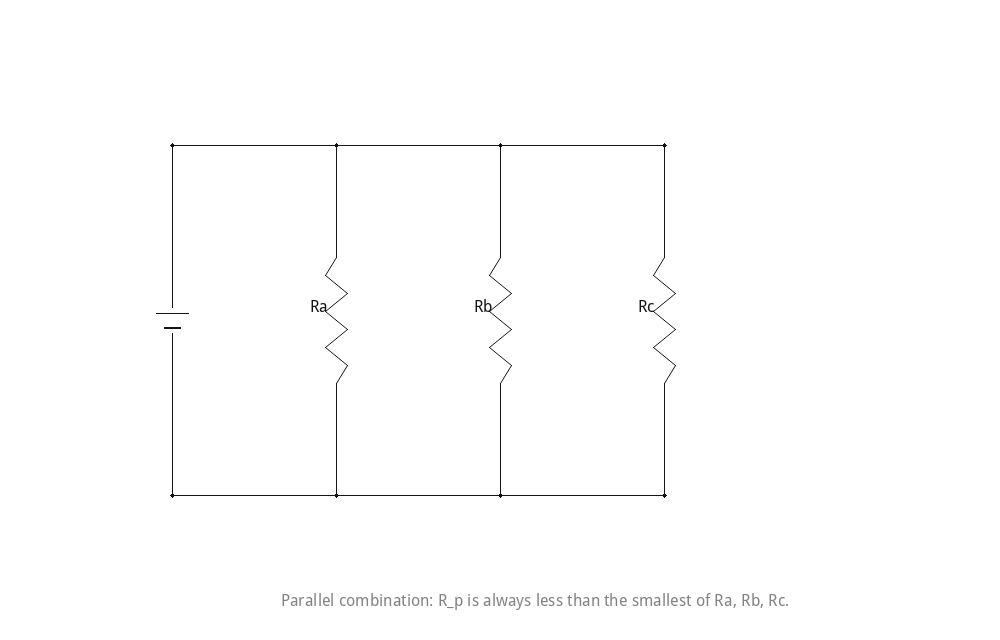
Parallel combination: R_p is always less than the smallest of Ra, Rb, Rc.
Reason (R): Adding a resistor in parallel always creates an additional path for current, increasing the total current drawn from the source for the same voltage.
Solution: Both A and R are true, and R correctly explains A — more parallel paths mean more total current for the same voltage, which by V=IR means lower equivalent resistance. Answer: (a) Both A and R are true, and R is the correct explanation of A.
Q4 (Fresh-numbers word problem). An electric iron of resistance 20 Ω draws a current of 5 A. Calculate the electrical energy consumed in 30 minutes, and the cost of using it for 30 days at this rate if electricity costs ₹7 per unit (kWh).
Solution: P = I²R = 25×20 = 500 W = 0.5 kW. Energy per day = 0.5 kW × 0.5 h = 0.25 kWh. Over 30 days: 0.25×30 = 7.5 kWh. Cost = 7.5×7 = ₹52.50.
Q5 (Circuit-reasoning, fresh numbers). Three resistors of 4 Ω, 6 Ω and 12 Ω are all connected in parallel to a 24 V battery. Find (a) the equivalent resistance, (b) the total current drawn, (c) the current through the 6 Ω resistor.
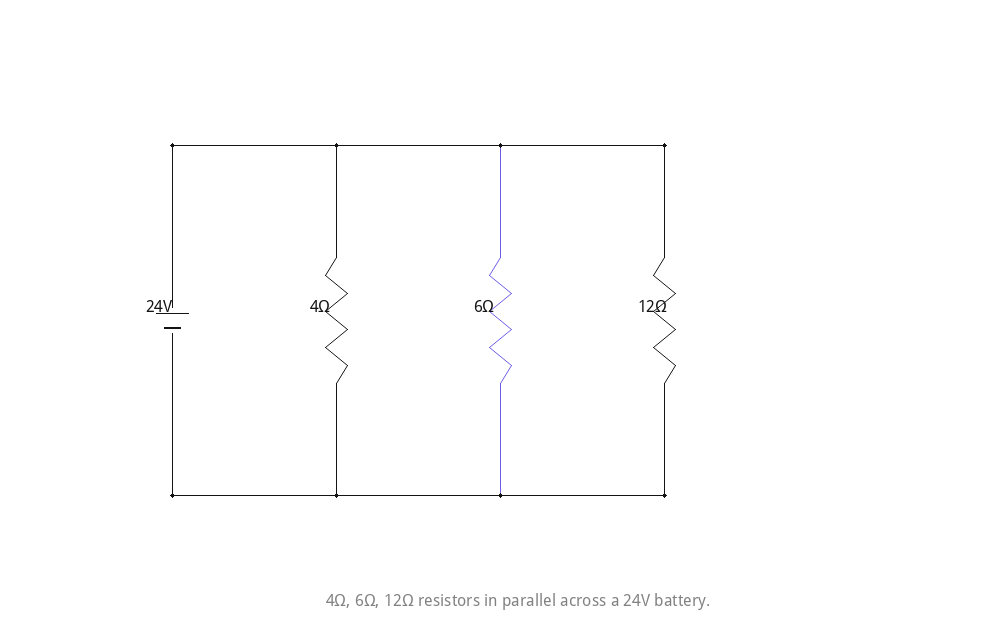
4Ω, 6Ω, 12Ω resistors in parallel across a 24V battery.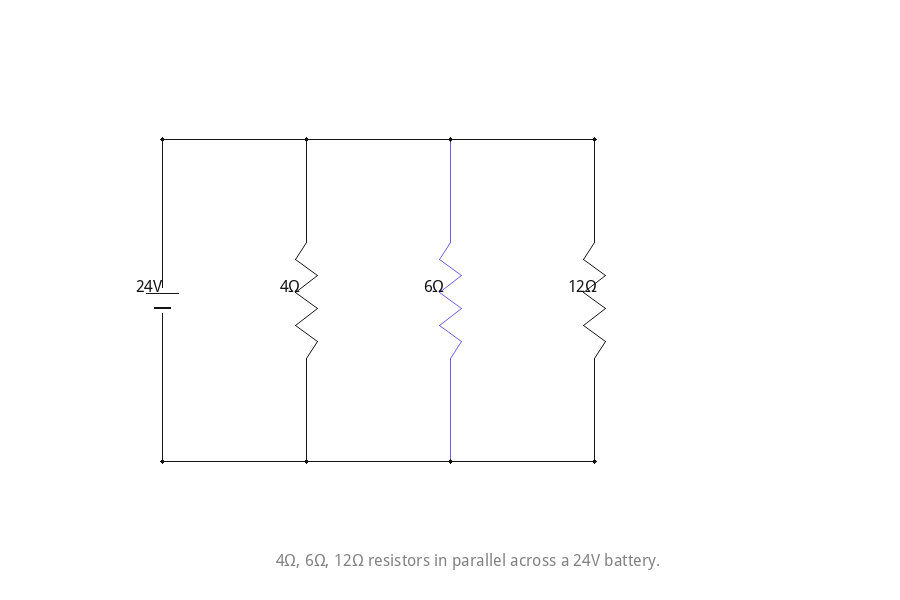
Solution: 1/R_p = 1/4 + 1/6 + 1/12 = 3/12+2/12+1/12 = 6/12 = 1/2 ⟹ R_p = 2 Ω. Total current I = 24/2 = 12 A. Current through 6 Ω (parallel, full 24 V across it) = 24/6 = 4 A.
Q6 (Power-heat synthesis). Two heating coils, X (resistance 10 Ω) and Y (resistance 20 Ω), are available. Which coil, used alone across the same voltage supply, will produce heat faster, and by what factor?
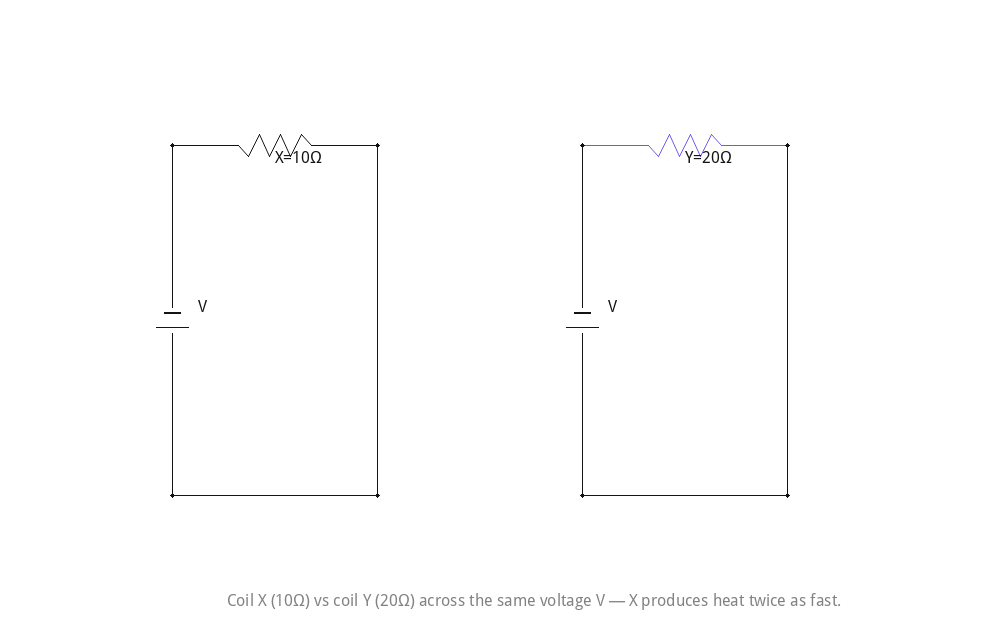
Coil X (10Ω) vs coil Y (20Ω) across the same voltage V — X produces heat twice as fast.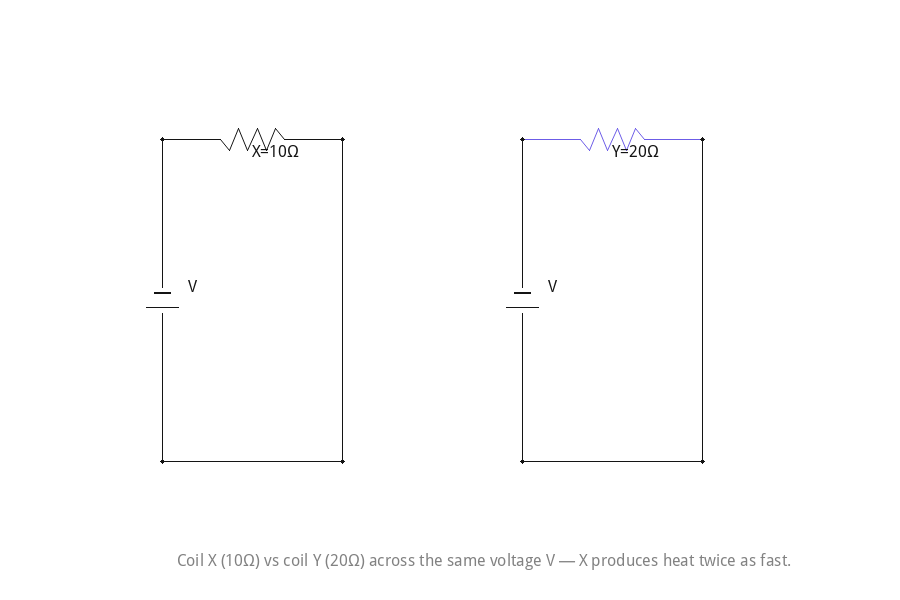
Solution: For the same V, P = V²/R, so power (rate of heat production) is inversely proportional to resistance. Coil X (10 Ω) produces heat at twice the rate of coil Y (20 Ω), since P_X/P_Y = R_Y/R_X = 20/10 = 2.
- Chapter 1: Chemical Reactions and Equations
- Chapter 2: Acids, Bases and Salts
- Chapter 3: Metals and Non-metals
- Chapter 4: Carbon and its Compounds
- Chapter 5: Life Processes
- Chapter 6: Control and Coordination
- Chapter 7: – How do Organisms Reproduce?
- Chapter 8: Extra Questions - Heredity (HOTS)
- Chapter 9: Extra Questions - Light: Reflection and Refraction (HOTS)
- Chapter 10: Human Eye and Colourful World Extra Questions (HOTS)
- Chapter 12: Magnetic Effects of Electric Current Extra Questions (HOTS)
- Chapter 13: Our Environment Extra Questions (HOTS)
Frequently Asked Questions
What is the difference between resistors connected in series and resistors connected in parallel?
In a series connection, resistors are connected end to end so the same current flows through each one, while in a parallel connection, resistors are connected across common points so the voltage across each is the same but the current can differ.
How does the resistance of a conductor change with its length and area of cross-section?
Resistance increases with an increase in length, since electrons must travel further, and decreases with an increase in the area of cross-section, since a wider path allows more electrons to flow through easily.
Chapter Quiz — Test Your Understanding
Class 10 Science Chapter 11 – Solutions and Notes
For complete step-by-step answers and a quick summary, check the Class 10 Science Chapter 11 Solutions and Class 10 Science Chapter 11 Revision Notes.
Recommended: Buy the Printed NCERT Class 10 Science Book
Contains Amazon affiliate links.
If you’d like a printed copy alongside the PDF, here’s a verified option:
Check the latest price on Amazon
Price and availability may change on Amazon. As an Amazon Associate, ncertbooks.org earns from qualifying purchases.


