
NCERT Solutions for Class 6 Science Chapter 4, “Exploring Magnets” from the Curiosity textbook (2026-27 edition). This chapter looks at magnetic and non-magnetic materials, the poles of a magnet, how magnets attract and repel, and how a magnetic compass helps us find direction.
Last Updated: September 23, 2026
Magnets in Ancient Times
Long before modern compasses or GPS, sailors used lodestone (a natural form of the mineral magnetite) to find direction at sea. In India, a magnetised, fish-shaped iron piece called the Matsya-yantra was floated in a bowl of oil and used as an early navigational aid. Today, magnets are found in everyday objects such as pencil boxes, toys, and refrigerator doors.
Magnetic and Non-Magnetic Materials
A magnet is an object that attracts certain materials — mainly iron, nickel, and cobalt (and their alloys). These are called magnetic materials. Materials that are not attracted by a magnet — such as wood, plastic, rubber, paper, cloth, and most other metals like aluminium, copper, gold, and silver — are called non-magnetic materials.
Poles of a Magnet
Every magnet has two poles — a North pole and a South pole — where the magnetic force is strongest. The middle of the magnet is the weakest point. If a magnet is broken into pieces, each new piece forms its own complete North and South pole — it is impossible to isolate a single pole.
Finding Directions: The Magnetic Compass
A magnetic compass is a small, pivoted, needle-shaped magnet inside a rotatable dial. When allowed to move freely, the needle always settles pointing along the North-South direction, because Earth itself behaves like a giant magnet. This property is used to find directions — the needle’s north-seeking end always points toward geographic North.
Attraction and Repulsion Between Magnets
Like poles repel each other (North-North or South-South), while unlike poles attract each other (North-South). A plain iron bar (not a magnet) will only ever be attracted to a magnet — it will never repel one. This makes repulsion the definitive test for confirming whether an object is actually a magnet.
Magnetic Force Through Non-Magnetic Materials
A magnet’s force can pass through non-magnetic materials — such as wood, cardboard, plastic, and glass — without appreciable weakening. This is why a magnet can still deflect a compass needle even with a sheet of paper or glass placed in between.
Keeping Magnets Safe
Magnets should be stored carefully to avoid losing their magnetism — for example, storing bar magnets in pairs with unlike poles adjacent (using a soft-iron keeper across the ends), and avoiding heat, hammering, or dropping them, which can disturb the internal alignment that gives them their magnetism.
Solved Textbook Questions (Let Us Enhance Our Learning)
Q1. Fill in the blanks: (i) Unlike poles ____, like poles ____. (ii) Iron, nickel, and cobalt are ____ materials. (iii) A freely suspended magnet aligns in the ____ direction. (iv) Every magnet has ____ poles.
Answer: (i) attract, repel. (ii) magnetic. (iii) north-south. (iv) two.
Q2. True or False: (i) Breaking a magnet gives you one piece with a single pole. (ii) Like poles repel each other. (iii) Iron filings stick most strongly to the middle of a magnet. (iv) A magnetic compass needle points north-south when freely suspended.
Answer: (i) False (each broken piece gets its own N and S pole). (ii) True. (iii) False (they stick most strongly at the poles/ends, not the middle). (iv) True.
Q3. Complete the pole-interaction table: N-N, N-S, S-N, S-S.
Answer: N-N = repel. N-S = attract. S-N = attract. S-S = repel.
Q4. In an experiment, more U-shaped paperclips stick to the ends of a bar magnet than to its middle. What does this show?
Answer: It confirms that the magnetic force is strongest at the poles (ends) of a magnet and weakest at its middle.
Q5. Reshma has three iron/steel bars and wants to find out which ones (if any) are magnets, using only these three bars. How can she do this?
Answer: Bring pairs of bars close to each other and observe. If two bars ever repel each other, both must be magnets (since only two magnets, with like poles facing, can repel). A plain iron bar will only ever attract, never repel — so repulsion is the key test.
Q6. You have one magnet with its poles already marked, and another unmarked magnet. How can you find the poles of the unmarked magnet?
Answer: Bring the known pole of the marked magnet close to one end of the unmarked magnet. If they repel, that end of the unmarked magnet is the same type of pole as the known one. If they attract, that end is the opposite type of pole.
Q7. How can you find the North pole of a magnet without using another magnet?
Answer: Suspend the magnet freely by a thread from its middle, letting it hang and rotate without obstruction. The end that comes to rest pointing toward geographic North is the magnet’s North pole.
Q8. A compass needle’s north-seeking end always points toward Earth’s geographic North. What does this tell us about Earth’s own magnetic poles?
Answer: Since unlike poles attract, and the needle’s north-seeking end is attracted toward geographic North, Earth’s magnetic South pole must actually be located near the geographic North Pole (and Earth’s magnetic North pole is near the geographic South Pole).
Q9. A mechanic keeps dropping small iron screws while working. How could a magnet help, and how would the mechanic prepare a screwdriver for this?
Answer: The mechanic can magnetise the steel screwdriver by stroking it repeatedly (many times, always in the same direction, lifting the magnet away and returning to the starting point after each stroke — not rubbing it back and forth) with one pole of a strong magnet. This temporarily turns the screwdriver into a weak magnet, letting it hold small steel screws in place and preventing them from falling.
Q10. Two ring magnets, X and Y, are placed on a vertical rod, and X hovers above Y without touching it. Explain why, and how you could make X rest directly on Y instead.
Answer: X hovers because the poles facing each other between X and Y are the same type (like poles), so they repel and push X upward. To make X rest directly on Y, flip X over so that the poles facing each other become unlike poles, which will attract instead of repel.
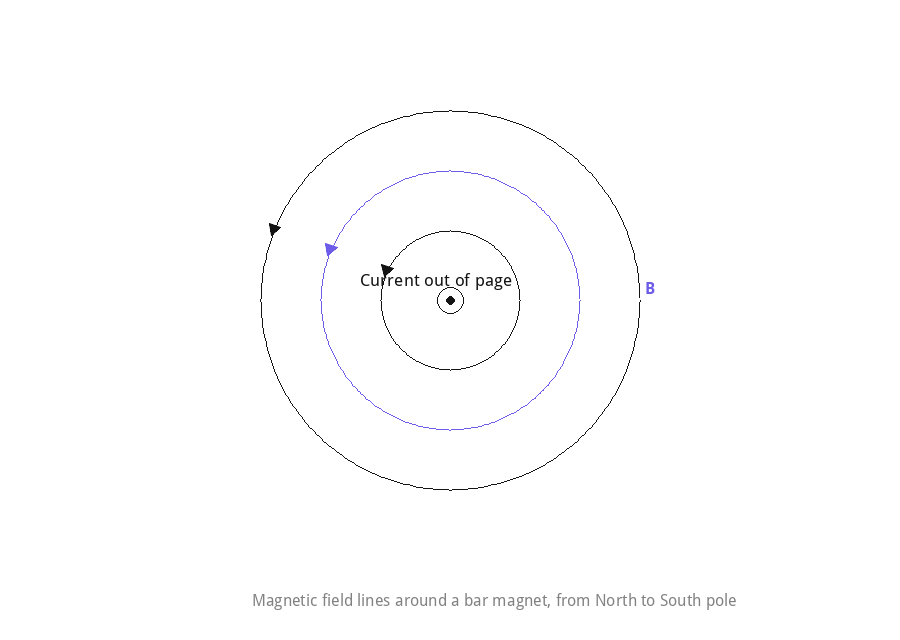
Magnetic field lines always emerge from the North pole and curve back into the South pole.
Q11. In a diagram showing three magnets placed together, with one end (point 5) given as a North pole, identify the type of pole at another marked point (point 6).
Answer: Using the like-poles-repel, unlike-poles-attract rule and tracing the arrangement of the magnets, point 6 works out to be a South pole (the exact answer depends on the specific figure in your textbook copy — always trace through the chain of adjacent poles using the attract/repel rule to confirm).
See also: Extra Questions | Revision Notes for this chapter.
- Chapter 1: The Wonderful World of Science - Curiosity
- Chapter 2: Diversity in the Living World NCERT Solutions
- Chapter 3: Mindful Eating: A Path to a Healthy Body NCERT Solutions
- Chapter 5: Measurement of Length and Motion NCERT Solutions
- Chapter 6: Materials Around Us NCERT Solutions
- Chapter 7: Temperature and its Measurement NCERT Solutions
- Chapter 8: A Journey through States of Water NCERT Solutions
- Chapter 9: Methods of Separation in Everyday Life – Free PDF Download
- Chapter 10: Living Creatures – Exploring their Characteristics – Free PDF Download
- Chapter 11: Nature's Treasures – Free PDF Download
- Chapter 12: Beyond Earth – Free PDF Download
Frequently Asked Questions
What are the two poles of a magnet called, and how do they behave?
Every magnet has a north pole and a south pole; like poles (N-N or S-S) repel each other, while unlike poles (N-S) attract each other — this rule is the basis for most magnet-related questions in this chapter.
What is the difference between magnetic and non-magnetic materials?
Magnetic materials (like iron, nickel, cobalt) are attracted to a magnet and can sometimes be magnetised themselves; non-magnetic materials (like wood, plastic, aluminium) are not attracted to a magnet at all.
Chapter Quiz — Test Your Understanding
Class 6 Science Chapter 4 – Notes and Extra Questions
Along with these NCERT Solutions, students can also use the Class 6 Science Chapter 4 Extra Questions and Class 6 Science Chapter 4 Revision Notes for quick revision and extra practice.
Recommended: Buy the Printed NCERT Class 6 Science Book
Contains Amazon affiliate links.
If you’d like a printed copy alongside the PDF, here’s a verified option:
4.2 out of 5 stars (463 ratings) · Rs. 65
Price and availability may change on Amazon. As an Amazon Associate, ncertbooks.org earns from qualifying purchases.


