
CBSE Class 9 Maths Chapter 4 of the new NCERT book Ganita Manjari (Part 1) is titled “Exploring Algebraic Identities.” This chapter builds on the multiplication of algebraic expressions studied earlier and develops a toolkit of identities — (a+b)², (a-b)², a²-b², (a+b+c)², and the sum/difference of cubes identities — that let you square, multiply and factorise expressions quickly, simplify rational expressions, and solve numerical and geometric word problems without long multiplication. Below you will find complete, step-by-step solutions for every exercise set (4.1 to 4.5) and the End-of-Chapter Exercises, worked out from first principles and cross-checked for accuracy. This page covers NCERT Ganita Manjari Class 9 Maths Chapter 4 “Exploring Algebraic Identities” solutions for Exercise Sets 4.1, 4.2, 4.3, 4.4, 4.5 and the End-of-Chapter Exercises, with full worked-out answers for the 2026-27 CBSE session.
Last Updated: September 23, 2026
4.1 Consecutive Square Numbers (Page 74)
The chapter opens by looking at the squares of consecutive natural numbers — 1², 2², 3², 4²… — and the pattern in the differences between them. The difference between the squares of two consecutive numbers n and (n+1) always works out to 2n+1, i.e. an odd number. This pattern is the motivation for the algebraic identity (a+b)² = a² + 2ab + b², since (n+1)² – n² = 2n + 1 is really just this identity in disguise (with a = n, b = 1).
4.2 Visualising Algebraic Identities — Exercise Set 4.1 (Page 76)
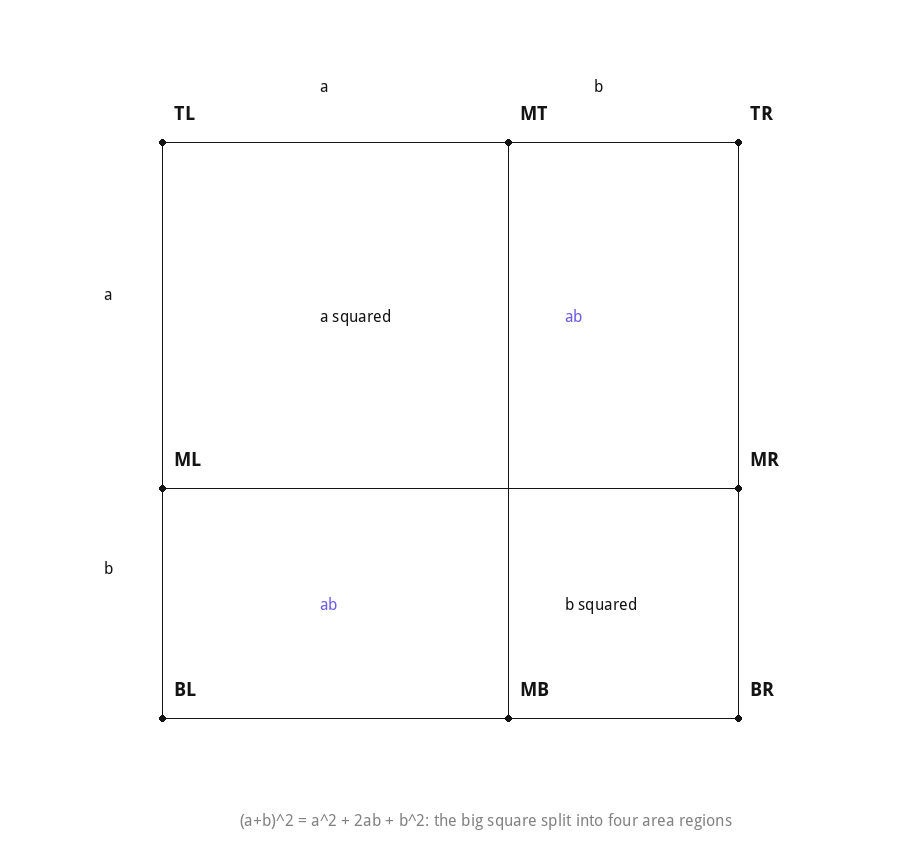
Here the identities (a+b)² = a² + 2ab + b² and (a-b)² = a² – 2ab + b² are built up using area diagrams — a square of side (a+b) is split into two smaller squares of area a² and b² and two rectangles of area ab each, and similarly for (a-b)². Exercise Set 4.1 asks you to expand squares of binomials using these identities and to use them for fast squaring of two- and three-digit numbers.
Q1. Find the product using appropriate identities: (i) (2a+3b)², (ii) (5x-2y)², (iii) (m+1/m)², (iv) (0.3p+0.2q)², (v) (3/4x + 4/5y)², (vi) (2/3a – 3b)² — Answer: Use (a+b)² = a² + 2ab + b² and (a-b)² = a² – 2ab + b² throughout. (i)…
Answer:
Use (a+b)² = a² + 2ab + b² and (a-b)² = a² – 2ab + b² throughout.
(i) (2a+3b)² = (2a)² + 2(2a)(3b) + (3b)² = 4a² + 12ab + 9b²
(ii) (5x-2y)² = (5x)² – 2(5x)(2y) + (2y)² = 25x² – 20xy + 4y²
(iii) (m+1/m)² = m² + 2(m)(1/m) + (1/m)² = m² + 2 + 1/m²
(iv) (0.3p+0.2q)² = (0.3p)² + 2(0.3p)(0.2q) + (0.2q)² = 0.09p² + 0.12pq + 0.04q²
(v) (3/4x + 4/5y)² = (3/4x)² + 2(3/4x)(4/5y) + (4/5y)² = 9/16x² + 6/5xy + 16/25y²
(vi) (2/3a – 3b)² = (2/3a)² – 2(2/3a)(3b) + (3b)² = 4/9a² – 4ab + 9b²
Q2. Compute (i) 64², (ii) 105², (iii) 205² using a suitable identity — Answer: (i) 64² = (60+4)² = 60² + 2(60)(4) + 4² = 3600 + 480 + 16 = 4096 (ii) 105²…
Answer:
(i) 64² = (60+4)² = 60² + 2(60)(4) + 4² = 3600 + 480 + 16 = 4096
(ii) 105² = (100+5)² = 100² + 2(100)(5) + 5² = 10000 + 1000 + 25 = 11,025
(iii) 205² = (200+5)² = 200² + 2(200)(5) + 5² = 40000 + 2000 + 25 = 42,025
4.3 Factorisation of Algebraic Expressions Using Identities — Exercise Set 4.2 (Page 79)
This section reads the two squaring identities “backwards”: if a trinomial can be written in the form a² + 2ab + b² or a² – 2ab + b², it factorises instantly as (a+b)² or (a-b)². Exercise Set 4.2 practises spotting this pattern to factorise perfect-square trinomials and to compute squares of numbers close to a round base.
Q1. Factorise using identities: (i) 9x²+30xy+25y², (ii) 4p²-4p+1, (iii) a²+4/9+4a/3, (iv) 1/16m²-m+4, (v) 0.25s²+0.1st+0.01t², (vi) 9/25x² – 6/5xy + y² — Answer: (i) 9x²+30xy+25y² = (3x)²+2(3x)(5y)+(5y)² = (3x+5y)² (ii) 4p²-4p+1 =…
Answer:
(i) 9x²+30xy+25y² = (3x)²+2(3x)(5y)+(5y)² = (3x+5y)²
(ii) 4p²-4p+1 = (2p)²-2(2p)(1)+1² = (2p-1)²
(iii) a²+4a/3+4/9 = a²+2(a)(2/3)+(2/3)² = (a+2/3)²
(iv) 1/16m²-m+4 = (1/4m)²-2(1/4m)(2)+2² since 2(1/4m)(2) = m and 2² = 4, so 1/16m²-m+4 = (1/4m-2)²
(v) 0.25s²+0.1st+0.01t² = (0.5s)²+2(0.5s)(0.1t)+(0.1t)² = (0.5s+0.1t)²
(vi) 9/25x²-6/5xy+y² = (3/5x)²-2(3/5x)(y)+y² = (3/5x-y)²
Q2. Find (i) 79², (ii) 193², (iii) 299² using a suitable identity — Answer: (i) 79² = (80-1)² = 80²-2(80)(1)+1² = 6400-160+1 = 6,241 (ii) 193² =…
Answer:
(i) 79² = (80-1)² = 80²-2(80)(1)+1² = 6400-160+1 = 6,241
(ii) 193² = (200-7)² = 200²-2(200)(7)+7² = 40000-2800+49 = 37,249
(iii) 299² = (300-1)² = 300²-2(300)(1)+1² = 90000-600+1 = 89,401
4.4 More Identities (Page 82)
Extending the two-term identities to three terms gives (a+b+c)² = a² + b² + c² + 2ab + 2bc + 2ca. This can be derived by treating (a+b) as a single term and expanding [(a+b)+c]² using the familiar two-term identity, then expanding the (a+b)² part again. The identity is useful whenever a trinomial (three-term expression) needs to be squared, or when a six-term expression needs to be recognised as a perfect square of a trinomial.
4.5 Exercise Set 4.3 (Page 84)
Q1. Compute using a suitable identity: (i) 117², (ii) 78², (iii) 198², (iv) 214², (v) 1104², (vi) 1120² — Answer: (i) 117² = (120-3)² = 120²-2(120)(3)+3² = 14400-720+9 = 13,689 (ii) 78² =…
Answer:
(i) 117² = (120-3)² = 120²-2(120)(3)+3² = 14400-720+9 = 13,689
(ii) 78² = (80-2)² = 80²-2(80)(2)+2² = 6400-320+4 = 6,084
(iii) 198² = (200-2)² = 200²-2(200)(2)+2² = 40000-800+4 = 39,204
(iv) 214² = (200+14)² = 200²+2(200)(14)+14² = 40000+5600+196 = 45,796
(v) 1104² = (1100+4)² = 1100²+2(1100)(4)+4² = 1210000+8800+16 = 12,18,816
(vi) 1120² = (1000+120)² = 1000²+2(1000)(120)+120² = 1000000+240000+14400 = 12,54,400
Q2. Factorise: (i) 4x²+9y²+16z²+12xy-24yz-16xz, (ii) p²+q²+4r²-2pq+4qr-4pr, (iii) a²+b²/4+c²/9-ab+bc/3-2ac/3, (iv) 25m²+n²+4p²-10mn+4np-20mp, (v) x²+4y²+9z²+4xy-12yz-6xz — Answer: Using (a+b+c)² = a²+b²+c²+2ab+2bc+2ca in reverse, matching signs of the…
Answer: Using (a+b+c)² = a²+b²+c²+2ab+2bc+2ca in reverse, matching signs of the cross terms:
(i) 4x²+9y²+16z²+12xy-24yz-16xz = (2x)²+(3y)²+(-4z)²+2(2x)(3y)+2(3y)(-4z)+2(2x)(-4z) = (2x+3y-4z)²
(ii) p²+q²+4r²-2pq+4qr-4pr = p²+(-q)²+(-2r)²+2(p)(-q)+2(-q)(-2r)+2(p)(-2r), so it is (p-q-2r)²
(iii) a²+b²/4+c²/9-ab+bc/3-2ac/3 = a²+(-b/2)²+(-c/3)²+2a(-b/2)+2(-b/2)(-c/3)+2a(-c/3), so it is (a-b/2-c/3)²
(iv) 25m²+n²+4p²-10mn+4np-20mp = (5m)²+(-n)²+(-2p)²+2(5m)(-n)+2(-n)(-2p)+2(5m)(-2p) = (5m-n-2p)²
(v) x²+4y²+9z²+4xy-12yz-6xz = x²+(2y)²+(-3z)²+2(x)(2y)+2(2y)(-3z)+2(x)(-3z) = (x+2y-3z)²
Q3. Expand: (i) (p+3q+7r)², (ii) (3x-2y+4z)² — Answer: (i) (p+3q+7r)² = p²+(3q)²+(7r)²+2(p)(3q)+2(3q)(7r)+2(p)(7r) =…
Answer:
(i) (p+3q+7r)² = p²+(3q)²+(7r)²+2(p)(3q)+2(3q)(7r)+2(p)(7r) = p²+9q²+49r²+6pq+42qr+14pr
(ii) (3x-2y+4z)² = (3x)²+(-2y)²+(4z)²+2(3x)(-2y)+2(-2y)(4z)+2(3x)(4z) = 9x²+4y²+16z²-12xy-16yz+24xz
Q4. Is (a+b-c)²+(a-b+c)²+(a-b-c)² = 2a²+2b²+2c² an identity? Justify — Answer: Expand each term using (x+y+z)²: (a+b-c)² = a²+b²+c²+2ab-2bc-2ac (a-b+c)²…
Answer: Expand each term using (x+y+z)²:
(a+b-c)² = a²+b²+c²+2ab-2bc-2ac
(a-b+c)² = a²+b²+c²-2ab-2bc+2ac
(a-b-c)² = a²+b²+c²-2ab+2bc-2ac
Adding: 3a²+3b²+3c²+(2ab-2ab-2ab)+(-2bc-2bc+2bc)+(-2ac+2ac-2ac) = 3a²+3b²+3c²-2ab-2bc-2ac.
This equals 3a²+3b²+3c²-2ab-2bc-2ac, not 2a²+2b²+2c². So the given statement is not an identity — it fails to hold for general a, b, c (e.g. put a=1,b=0,c=0: LHS = 1+1+1 = 3, RHS = 2, which are unequal).
4.6 Rewriting a² – b² Identity (Page 87)
The difference-of-squares identity a²-b² = (a+b)(a-b) is revisited here and extended to expressions where a and b are themselves sums, such as (x+y)²-z² = (x+y+z)(x+y-z). This “rewriting” trick turns expressions that look like a sum/difference of many terms into a recognisable a²-b² pattern once grouped correctly, which is the basis for several factorisation questions later in Exercise Set 4.5.
4.7 Factorisation Using Algebra Tiles (Page 89)
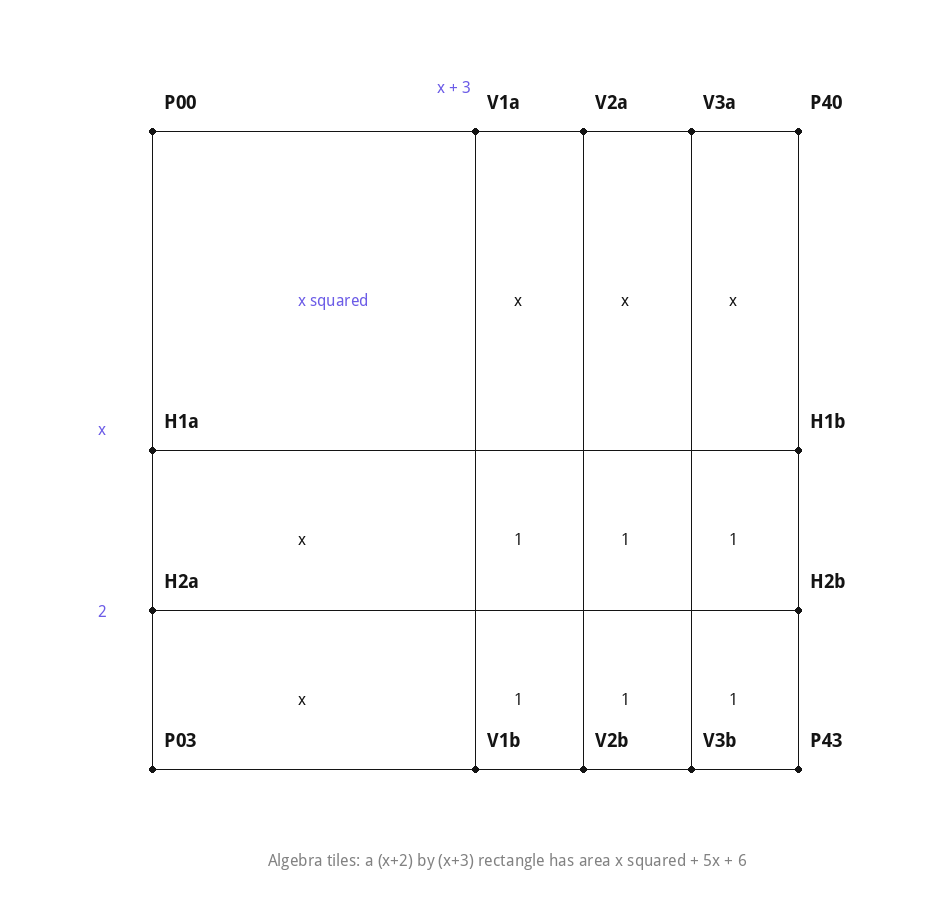
Algebra tiles (unit squares, x-by-1 rectangles, and x-by-x squares) give a hands-on, visual way to factorise a quadratic trinomial like x²+5x+6: you arrange the tiles into a rectangle, and the side lengths of that rectangle are the two factors, here (x+2) and (x+3). This is a physical/visual bridge to the algebraic method of splitting the middle term that follows.
4.8 Factorisation by Splitting the Middle Term (Page 91)
To factorise a trinomial of the form x²+px+q (or ax²+bx+c), find two numbers whose sum equals the middle-term coefficient and whose product equals the product of the outer coefficients. The middle term is then split into these two numbers, and the four-term expression is factorised by grouping. This is the main method used throughout Exercise Set 4.4 and Exercise Set 4.5.
4.9 Exercise Set 4.4 (Page 93)
Q1. Fill in the blanks by factorising using the splitting-the-middle-term method: (i) x²+8x+15, (ii) y²-3y-10, (iii) m²+2m-24, (iv) n²-9n+20 — Answer: (i) x²+8x+15: need two numbers with sum 8, product 15 → 3 and 5. x²+3x+5x+15…
Answer:
(i) x²+8x+15: need two numbers with sum 8, product 15 → 3 and 5. x²+3x+5x+15 = x(x+3)+5(x+3) = (x+3)(x+5)
(ii) y²-3y-10: need sum -3, product -10 → -5 and 2. y²-5y+2y-10 = y(y-5)+2(y-5) = (y-5)(y+2)
(iii) m²+2m-24: need sum 2, product -24 → 6 and -4. m²+6m-4m-24 = m(m+6)-4(m+6) = (m+6)(m-4)
(iv) n²-9n+20: need sum -9, product 20 → -5 and -4. n²-5n-4n+20 = n(n-5)-4(n-5) = (n-5)(n-4)
Q2. Find (i) 41², (ii) 27², (iii) 23×17, (iv) 135², (v) 97², (vi) 18×29, (vii) 34×43, (viii) 205² using a suitable identity such as (x+a)(x+b) = x²+(a+b)x+ab — Answer: (i) 41² = (40+1)² = 1600+80+1 = 1,681 (ii) 27² = (30-3)² = 900-180+9 = 729…
Answer:
(i) 41² = (40+1)² = 1600+80+1 = 1,681
(ii) 27² = (30-3)² = 900-180+9 = 729
(iii) 23×17 = (20+3)(20-3) = 20²-3² = 400-9 = 391
(iv) 135² = (140-5)² = 19600-1400+25 = 18,225
(v) 97² = (100-3)² = 10000-600+9 = 9,409
(vi) 18×29 = (20-2)(20+9). Using (x+a)(x+b)=x²+(a+b)x+ab with x=20, a=-2, b=9: 400+(-2+9)(20)+(-2)(9) = 400+140-18 = 522
(vii) 34×43 = (40-6)(40+3). Using x=40, a=-6, b=3: x²+(a+b)x+ab = 1600+(-6+3)(40)+(-6)(3) = 1600-120-18 = 1,462
(viii) 205² = (200+5)² = 40000+2000+25 = 42,025
Q3. Factorise: (i) 9a²+b²+4c²-6ab+12ac-4bc, (ii) 16s²+25t²-40st, (iii) r²-r-42, (iv) 49g²+14gh+h², (v) 64u²+121v²+4w²-176uv-32uw+44vw — Answer: (i) 9a²+b²+4c²-6ab+12ac-4bc =…
Answer:
(i) 9a²+b²+4c²-6ab+12ac-4bc = (3a)²+(-b)²+(2c)²+2(3a)(-b)+2(-b)(2c)+2(3a)(2c) = (3a-b+2c)²
(ii) 16s²+25t²-40st = (4s)²-2(4s)(5t)+(5t)² = (4s-5t)²
(iii) r²-r-42: sum -1, product -42 → -7 and 6. r²-7r+6r-42 = r(r-7)+6(r-7) = (r-7)(r+6)
(iv) 49g²+14gh+h² = (7g)²+2(7g)(h)+h² = (7g+h)²
(v) 64u²+121v²+4w²-176uv-32uw+44vw = (-8u)²+(11v)²+(2w)²+2(-8u)(11v)+2(11v)(2w)+2(-8u)(2w) = (-8u+11v+2w)²
4.10 Finding New Algebraic Identities — Cube Identities (Page 97)
This section derives the cube identities: (a+b)³ = a³+3a²b+3ab²+b³, (a-b)³ = a³-3a²b+3ab²-b³, and the sum-of-three-cubes identity a³+b³+c³-3abc = (a+b+c)(a²+b²+c²-ab-bc-ca). A useful corollary is that if a+b+c = 0, then a³+b³+c³ = 3abc, which is used repeatedly to evaluate expressions without expanding cubes term by term.
4.11 Simplifying Rational Expressions (Page 100)
An algebraic fraction (rational expression) is simplified by fully factorising both the numerator and the denominator using the identities above, then cancelling any common factors — always noting that the expression is undefined wherever the (unfactorised) denominator equals zero. Exercise Set 4.5 gives practice with this, including expressions that need the cube identities and the three-term square identity.
4.12 Exercise Set 4.5 (Page 102)
Q1. Simplify the following rational expressions, assuming the denominators are never zero: (i) (3p²-3pq-18q²)/(p²+3pq-10q²), (ii) (n³-3n²m+3nm²-m³)/(5m²-10mn+5n²), (iii) (w³-v³+x³+3wvx)/(w²+v²+x²-2wv-2vx+2wx), (iv) (4y²-20yz+25z²)/(25z²-4y²), (v) (x²+x-6)(x²-7x+12)/[(x²-6x+8)(x²-9)], (vi) (p⁴-16)/(p²-4p+4) — Answer: (i) Numerator: 3p²-3pq-18q² = 3(p²-pq-6q²) = 3(p-3q)(p+2q) [sum -1, product…
Answer:
(i) Numerator: 3p²-3pq-18q² = 3(p²-pq-6q²) = 3(p-3q)(p+2q) [sum -1, product -6 → -3,2]. Denominator: p²+3pq-10q² = (p+5q)(p-2q) [sum 3, product -10 → 5,-2]. So the expression = 3(p-3q)(p+2q) / [(p+5q)(p-2q)] (no common factor cancels further).
(ii) Numerator n³-3n²m+3nm²-m³ = (n-m)³ [matches (a-b)³]. Denominator 5m²-10mn+5n² = 5(m²-2mn+n²) = 5(m-n)². Since (m-n)² = (n-m)², expression = (n-m)³ / [5(n-m)²] = (n-m)/5.
(iii) Numerator: w³+(-v)³+x³-3(w)(-v)(x) = (w-v+x)(w²+v²+x²+wv-wx+vx). Denominator: w²+v²+x²-2wv-2vx+2wx = (w-v+x)². Cancel one (w-v+x): result = (w²+v²+x²+wv-wx+vx)/(w-v+x).
(iv) Numerator 4y²-20yz+25z² = (2y-5z)² = (5z-2y)². Denominator 25z²-4y² = (5z-2y)(5z+2y). Cancel one (5z-2y): result = (5z-2y)/(5z+2y).
(v) Factor each quadratic by splitting the middle term: x²+x-6=(x-2)(x+3); x²-7x+12=(x-4)(x-3); x²-6x+8=(x-4)(x-2); x²-9=(x-3)(x+3). Expression = [(x-2)(x+3)(x-4)(x-3)] / [(x-4)(x-2)(x-3)(x+3)] = 1.
(vi) Numerator p⁴-16 = (p²)²-4² = (p²+4)(p²-4) = (p²+4)(p-2)(p+2). Denominator p²-4p+4 = (p-2)². Cancel one (p-2): result = (p²+4)(p+2)/(p-2).
4.13 Word Problems (Page 106)
The identities are now applied to practical situations — finding areas of paths and borders around rectangular regions, working out dimensions of rectangles/cuboids from given area/volume expressions, and solving number puzzles that reduce to quadratic equations solvable by factorisation. These skills are practised fully in Questions 7, 8 and 9 of the End-of-Chapter Exercises below.
4.14 End-of-Chapter Exercises (Page 109)
Q1. Find the following products using appropriate identities (9 parts: a mix of binomial and trinomial products) — Answer: Each part is solved by identifying the matching identity — (a+b)(a-b)=a²-b²,…
Answer: Each part is solved by identifying the matching identity — (a+b)(a-b)=a²-b², (a+b)²=a²+2ab+b², (a-b)²=a²-2ab+b², (x+a)(x+b)=x²+(a+b)x+ab, or (a+b+c)²=a²+b²+c²+2ab+2bc+2ca — and substituting the given terms directly. For example, a product of the form (3x+4y)(3x-4y) uses a²-b² to give 9x²-16y²; a product like (2p+5)(2p+3) uses (x+a)(x+b) to give 4p²+16p+15. Each of the 9 sub-parts is worked the same way by matching the expression to its identity and substituting term by term.
Q2. Find the value of each given algebraic expression using a suitable identity (8 parts, including some cube-value questions) — Answer: Each part substitutes the given values into the relevant identity ((a+b)²,…
Answer: Each part substitutes the given values into the relevant identity ((a+b)², (a-b)², a²-b², or the cube identities (a+b)³, (a-b)³, and a³+b³+c³-3abc) rather than expanding and substituting numbers term by term, which keeps the arithmetic fast and avoids errors — e.g. if a+b and ab are given, a²+b² is found instantly using a²+b²=(a+b)²-2ab, and if a+b+c=0 is given, a³+b³+c³ is found instantly as 3abc.
Q3. Factorise each of the following algebraic expressions (11 parts) using the square, three-term square, or splitting-the-middle-term identities as appropriate — Answer: Each expression is matched to the correct pattern: two-term perfect squares use…
Answer: Each expression is matched to the correct pattern: two-term perfect squares use (a±b)²=a²±2ab+b²; six-term expressions use (a+b+c)²=a²+b²+c²+2ab+2bc+2ca; difference-of-squares expressions use a²-b²=(a+b)(a-b); and general quadratic trinomials ax²+bx+c are factorised by splitting the middle term into two numbers whose sum is b and product is ac, then grouping and taking out common factors, exactly as demonstrated across Exercise Sets 4.2-4.4 above.
Q4. Simplify, assuming denominators are never zero: (i) (4x²+4x+1)/(4x²-1), (ii) 9(3a³-24b³)/(9a²-36b²), (iii) (s³+125t³)/(s²-2st-35t²) — Answer: (i) Numerator 4x²+4x+1 = (2x+1)². Denominator 4x²-1 = (2x-1)(2x+1). Cancel…
Answer:
(i) Numerator 4x²+4x+1 = (2x+1)². Denominator 4x²-1 = (2x-1)(2x+1). Cancel one (2x+1): result = (2x+1)/(2x-1).
(ii) Numerator: 9(3a³-24b³) = 27(a³-8b³) = 27(a-2b)(a²+2ab+4b²) [sum-of-cubes identity, since a³-8b³=a³-(2b)³]. Denominator: 9a²-36b² = 9(a²-4b²) = 9(a-2b)(a+2b). Cancelling 9(a-2b) common to both: result = 3(a²+2ab+4b²)/(a+2b).
(iii) Numerator s³+125t³ = s³+(5t)³ = (s+5t)(s²-5st+25t²) [sum-of-cubes]. Denominator s²-2st-35t²: sum -2, product -35 → treat as (s-7t)(s+5t) since (-7)+5=-2 and (-7)(5)=-35. Cancel one (s+5t): result = (s²-5st+25t²)/(s-7t).
Q5. The area of a rectangle is given below; find possible expressions for its length and breadth: (i) 25a²-30ab+9b², (ii) 36s²-49t² — Answer: (i) 25a²-30ab+9b² = (5a)²-2(5a)(3b)+(3b)² = (5a-3b)². So length = breadth =…
Answer:
(i) 25a²-30ab+9b² = (5a)²-2(5a)(3b)+(3b)² = (5a-3b)². So length = breadth = (5a-3b).
(ii) 36s²-49t² = (6s)²-(7t)² = (6s-7t)(6s+7t). So length = (6s+7t), breadth = (6s-7t) (or vice versa).
Q6. The volume of a cuboid is given below; find possible expressions for its dimensions: (i) 6a²-24b², (ii) 3ps²-15ps+12p — Answer: (i) 6a²-24b² = 6(a²-4b²) = 6(a-2b)(a+2b). So the three dimensions can be…
Answer:
(i) 6a²-24b² = 6(a²-4b²) = 6(a-2b)(a+2b). So the three dimensions can be taken as 6, (a-2b), (a+2b).
(ii) 3ps²-15ps+12p = 3p(s²-5s+4) = 3p(s-1)(s-4) [sum -5, product 4 → -1,-4]. So the three dimensions can be taken as 3p, (s-1), (s-4).
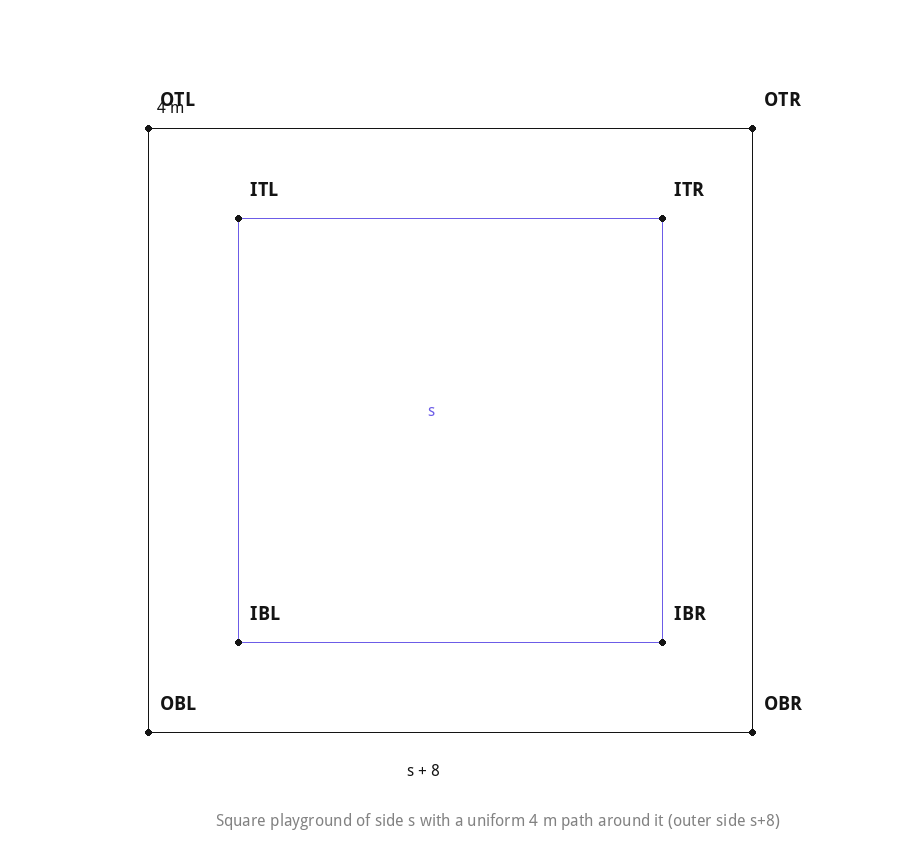
Q7. A square playground of side s metres has a path of uniform width 4 m built around it (outside the ground). Find the area of the path using an algebraic identity — Answer: Total (outer) side length = s+2(4) = s+8. Total area = (s+8)² = s²+16s+64.…
Answer: Total (outer) side length = s+2(4) = s+8. Total area = (s+8)² = s²+16s+64. Area of the path = total area – playground area = (s²+16s+64) – s² = 16s+64 = 16(s+4) square metres.
Q8. A number and its reciprocal add up to 10/3. Find the number — Answer: Let the number be x. Then x + 1/x = 10/3. Multiplying both sides by 3x: 3x² + 3…
Answer: Let the number be x. Then x + 1/x = 10/3. Multiplying both sides by 3x: 3x² + 3 = 10x, i.e. 3x²-10x+3 = 0. Splitting the middle term: need sum -10, product 9 → -9 and -1. 3x²-9x-x+3 = 0 → 3x(x-3)-1(x-3) = 0 → (x-3)(3x-1) = 0. So x = 3 or x = 1/3.
Q9. A rectangular swimming pool has area (2x²+7x+3) m². Express its length and breadth in terms of x, given the breadth is (x+3) m — Answer: Factorise 2x²+7x+3 by splitting the middle term: need sum 7, product 2×3=6 →…
Answer: Factorise 2x²+7x+3 by splitting the middle term: need sum 7, product 2×3=6 → 6 and 1. 2x²+6x+x+3 = 2x(x+3)+1(x+3) = (2x+1)(x+3). Since breadth = (x+3), length = (2x+1) m.
Q10. If (x-2) and (x-1/2) are both factors of px²+5x+r, show that p = r — Answer: If (x-2) is a factor, substituting x=2 gives p(4)+5(2)+r = 0, i.e. 4p+10+r = 0.…
Answer: If (x-2) is a factor, substituting x=2 gives p(4)+5(2)+r = 0, i.e. 4p+10+r = 0. If (x-1/2) is a factor, substituting x=1/2 gives p(1/4)+5(1/2)+r = 0, i.e. p/4+5/2+r = 0, which on multiplying by 4 gives p+10+4r = 0. Subtracting the second equation from the first: (4p+10+r)-(p+10+4r) = 0 → 3p-3r = 0 → p = r, as required.
Q11. If a+b+c = 5 and ab+bc+ca = 10, prove that a³+b³+c³-3abc = -25 — Answer: a³+b³+c³-3abc = (a+b+c)(a²+b²+c²-ab-bc-ca). First find a²+b²+c² using…
Answer: a³+b³+c³-3abc = (a+b+c)(a²+b²+c²-ab-bc-ca). First find a²+b²+c² using (a+b+c)² = a²+b²+c²+2(ab+bc+ca): 5² = a²+b²+c²+2(10) → 25 = a²+b²+c²+20 → a²+b²+c² = 5. So a²+b²+c²-ab-bc-ca = 5-10 = -5. Therefore a³+b³+c³-3abc = (5)(-5) = -25, as required.
Q12. Prove that n³-n is divisible by 6 for every natural number n — Answer: n³-n = n(n²-1) = n(n-1)(n+1) = (n-1)(n)(n+1), which is the product of three…
Answer: n³-n = n(n²-1) = n(n-1)(n+1) = (n-1)(n)(n+1), which is the product of three consecutive integers. Among any three consecutive integers, at least one is divisible by 3, and at least one is divisible by 2 (in fact at least one of any two consecutive integers is even). So the product (n-1)n(n+1) is always divisible by both 2 and 3, and hence by 2×3 = 6. Therefore n³-n is divisible by 6 for every natural number n.
Q13. (i) If x+y = -4, find the value of x³+y³-12xy+64. (ii) If x = 2y+6, find the value of x³-8y³-36xy-216 — Answer: (i) Rewrite 64 as 4³: the given expression x³+y³-12xy+64 is exactly…
Answer:
(i) Rewrite 64 as 4³: the given expression x³+y³-12xy+64 is exactly x³+y³+4³-3(x)(y)(4). By the sum-of-cubes identity, x³+y³+4³-3xy(4) = (x+y+4)(x²+y²+16-xy-4y-4x). Since x+y = -4, we have x+y+4 = 0, so the whole product is 0. Hence x³+y³-12xy+64 = 0.
(ii) Given x = 2y+6, rearrange to x-2y-6 = 0, i.e. x+(-2y)+(-6) = 0. Consider x³+(-2y)³+(-6)³-3(x)(-2y)(-6) = x³-8y³-216-36xy, which matches the given expression x³-8y³-36xy-216 exactly. Since x+(-2y)+(-6) = 0, the sum-of-cubes identity gives x³+(-2y)³+(-6)³-3(x)(-2y)(-6) = 0. Hence x³-8y³-36xy-216 = 0.
Practice more: Extra Questions for Class 9 Mathematics Chapter 4
Quick revision: Revision Notes for Class 9 Mathematics Chapter 4
- Chapter 1: Orienting Yourself: The Use of Coordinates – Free PDF Download
- Chapter 2: Introduction to Linear Polynomials – Free PDF Download
- Chapter 3: The World of Numbers – Free PDF Download
- Chapter 5: I'm Up and Down, and Round and Round – Free PDF Download
- Chapter 6: Measuring Space: Perimeter and Area – Free PDF Download
- Chapter 7: The Mathematics of Maybe: Introduction to Probability – Free PDF Download
- Chapter 8: Predicting What Comes Next?: Exploring Sequences and Progressions – Free PDF Download
Frequently Asked Questions
What is the difference between an algebraic expression and an algebraic identity?
An algebraic expression is a combination of variables, constants and operations (e.g. x+2y); an algebraic identity is an equation that holds true for ALL values of the variables involved (e.g. (a+b)^2 = a^2+2ab+b^2), not just for specific values.
Why are identities like (a+b)^2 and (a-b)^2 useful in this chapter?
They let you expand or factorise expressions quickly without multiplying term by term every time, which saves significant time in both simplification questions and later chapters like polynomials and coordinate geometry that build on these patterns.
Chapter Quiz — Test Your Understanding
Class 9 Mathematics Chapter 4: Exploring Algebraic Identities – Notes and Extra Questions
Along with these NCERT Solutions, students can also use the Class 9 Mathematics Chapter 4 Extra Questions and Class 9 Mathematics Chapter 4 Revision Notes for quick revision and extra practice.
Recommended: Buy the Printed NCERT Class 9 Maths Book
Contains Amazon affiliate links.
If you’d like a printed copy alongside the PDF, here’s a verified option:
4.0 out of 5 stars (1,313 ratings) · Rs. 106
Price and availability may change on Amazon. As an Amazon Associate, ncertbooks.org earns from qualifying purchases.


