
Class 11 Maths Chapter 9, Straight Lines, is one of the most important coordinate geometry chapters for the CBSE 2026–27 session. In the current rationalised NCERT textbook, this chapter carries the number Chapter 9 (in the older, pre-2023 edition it was Chapter 10). The chapter has three exercises – Exercise 9.1 (slope of a line), Exercise 9.2 (various forms of the equation of a line) and Exercise 9.3 (general equation of a line, distance of a point from a line) – followed by a Miscellaneous Exercise. Below you will find every question from the rationalised edition solved step by step, with each answer derived from first principles using the slope formula, the standard forms of the equation of a line, the angle-between-two-lines formula and the point-to-line distance formula.
Last Updated: September 23, 2026
Exercise 9.1
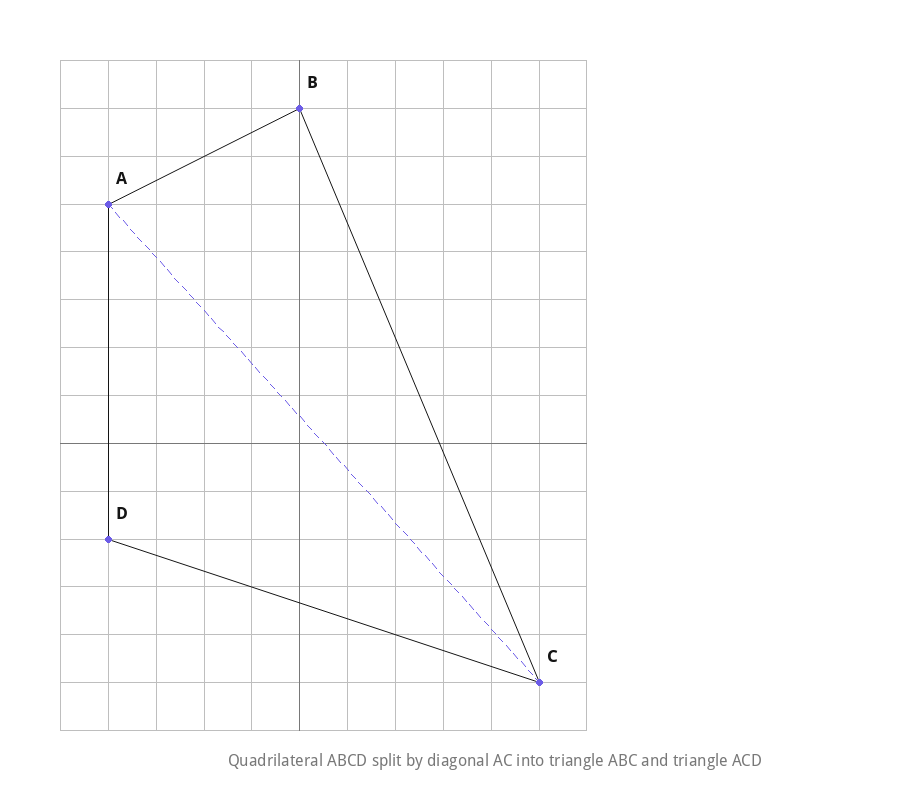
Q1. Draw a quadrilateral in the Cartesian plane, whose vertices are (−4, 5), (0, 7), (5, −5) and (−4, −2). Also, find its area — Let ABCD be the quadrilateral with A(−4, 5), B(0, 7), C(5, −5) and D(−4, −2).…
Let ABCD be the quadrilateral with A(−4, 5), B(0, 7), C(5, −5) and D(−4, −2). Plotting these four points on the Cartesian plane and joining AB, BC, CD and DA gives the required quadrilateral. Draw diagonal AC to split ABCD into △ABC and △ACD, so that area(ABCD) = area(△ABC) + area(△ACD). The area of a triangle with vertices (x1, y1), (x2, y2), (x3, y3) is ½|x1(y2−y3) + x2(y3−y1) + x3(y1−y2)|. Area(△ABC) = ½|−4(7−(−5)) + 0((−5)−5) + 5(5−7)| = ½|−48−10| = 29 sq units. Area(△ACD) = ½|−4((−5)−(−2)) + 5((−2)−5) + (−4)(5−(−5))| = ½|12−35−40| = 63/2 sq units. So area(ABCD) = 29 + 63/2 = 121/2 square units.
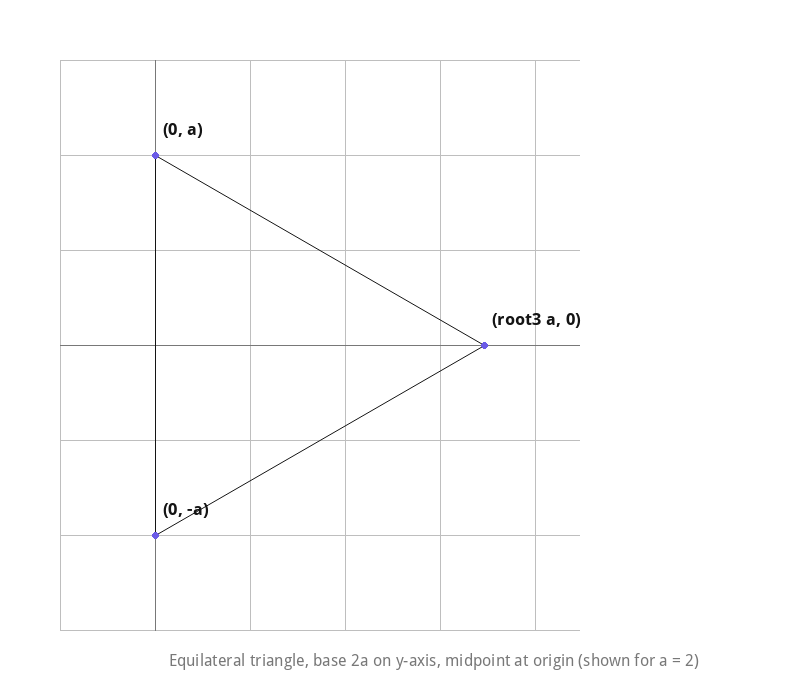
Q2. The base of an equilateral triangle with side 2a lies along the y-axis such that the mid-point of the base is at the origin. Find vertices of the triangle — Let △ABC be equilateral with AB = BC = CA = 2a, base BC on the y-axis and the midpoint…
Let △ABC be equilateral with AB = BC = CA = 2a, base BC on the y-axis and the midpoint of BC at the origin O. Then B = (0, −a) and C = (0, a). Since the median from a vertex of an equilateral triangle to the midpoint of the opposite side is perpendicular to that side, vertex A lies on the x-axis, say A = (h, 0). By the Pythagoras theorem in △AOC: AC2 = OA2 + OC2, so (2a)2 = h2 + a2, giving h2 = 3a2, h = ±√3 a. Hence the vertices are (0, a), (0, −a), (√3 a, 0) or (0, a), (0, −a), (−√3 a, 0).
Q3. Find the distance between P(x1, y1) and Q(x2, y2) when:
- PQ is parallel to the y-axis – here x1 = x2, so PQ = √((x2−x1)2+(y2−y1)2) = √((y2−y1)2) = |y2−y1|.
- PQ is parallel to the x-axis – here y1 = y2, so PQ = √((x2−x1)2) = |x2−x1|.
Q4. Find a point on the x-axis, which is equidistant from the points (7, 6) and (3, 4) — Let (a, 0) be the required point. Setting the distances equal: (7−a)2+36 =…
Let (a, 0) be the required point. Setting the distances equal: (7−a)2+36 = (3−a)2+16. Expanding: 49−14a+a2+36 = 9−6a+a2+16, so 85−14a = 25−6a, which gives −8a = −60, so a = 15/2. The required point is (15/2, 0).
Q5. Find the slope of a line, which passes through the origin, and the mid-point of the line segment joining the points P(0, −4) and B(8, 0) — Midpoint of PB = ((0+8)/2, (−4+0)/2) = (4, −2). Slope of the line joining (0, 0) and…
Midpoint of PB = ((0+8)/2, (−4+0)/2) = (4, −2). Slope of the line joining (0, 0) and (4, −2) is m = (−2−0)/(4−0) = −1/2. The required slope is −1/2.
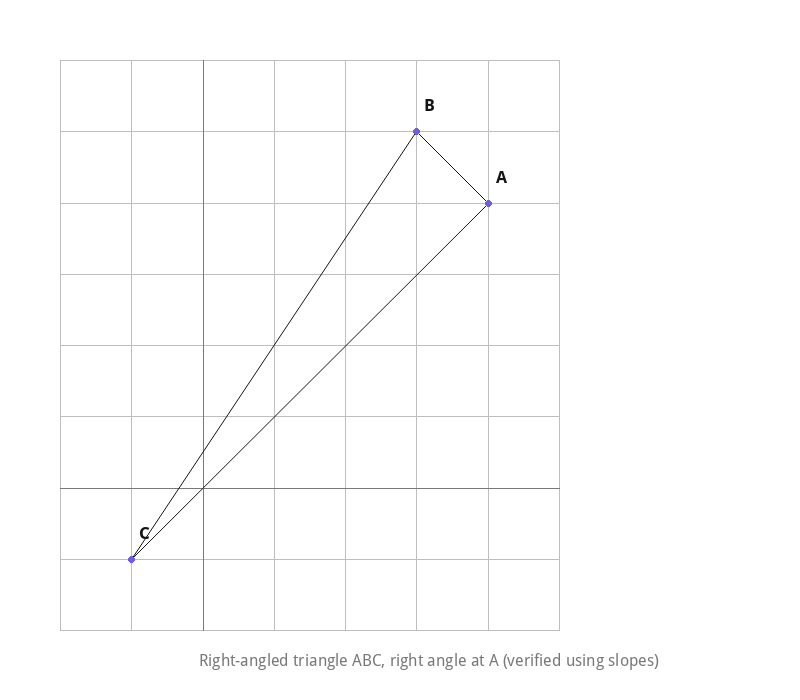
Q6. Without using the Pythagoras theorem, show that the points (4, 4), (3, 5) and (−1, −1) are the vertices of a right-angled triangle — Let A(4, 4), B(3, 5), C(−1, −1). Slope of AB = (5−4)/(3−4) = −1. Slope of AC =…
Let A(4, 4), B(3, 5), C(−1, −1). Slope of AB = (5−4)/(3−4) = −1. Slope of AC = (−1−4)/(−1−4) = 1. Slope of BC = (−1−5)/(−1−3) = 3/2. Since (slope of AB) × (slope of AC) = (−1)(1) = −1, AB is perpendicular to AC. Hence the triangle is right-angled at A(4, 4).
Q7. Find the slope of the line, which makes an angle of 30° with the positive direction of y-axis measured anticlockwise — If a line makes 30° with the positive y-axis (anticlockwise), the angle it makes with…
If a line makes 30° with the positive y-axis (anticlockwise), the angle it makes with the positive x-axis is 90° + 30° = 120°. So the slope is tan 120° = tan(180°−60°) = −tan 60° = −√3.
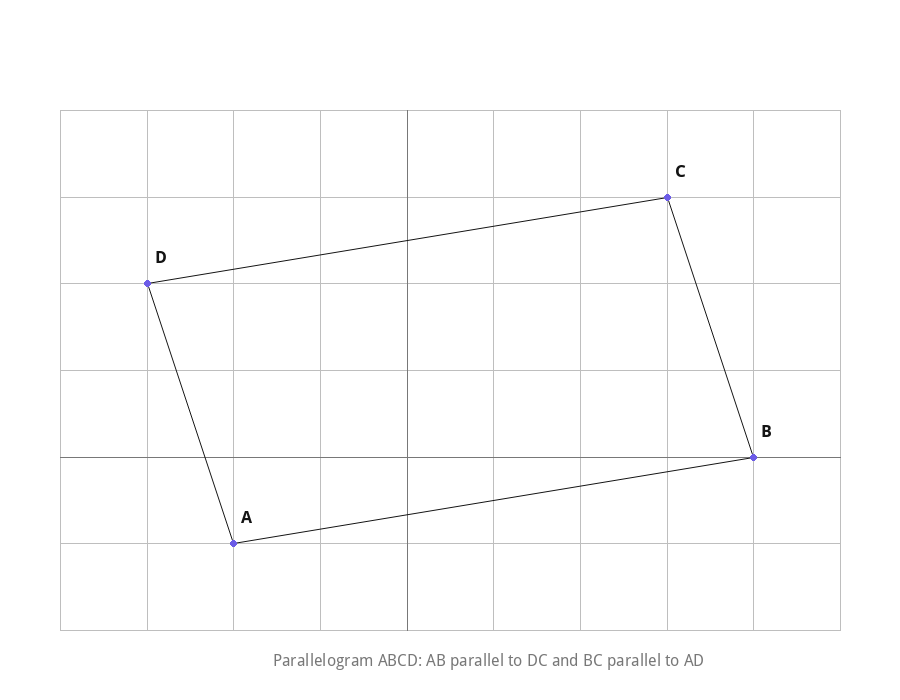
Q8. Without using distance formula, show that points (−2, −1), (4, 0), (3, 3) and (−3, 2) are the vertices of a parallelogram — Let A(−2, −1), B(4, 0), C(3, 3), D(−3, 2). Slope of AB = (0−(−1))/(4−(−2))…
Let A(−2, −1), B(4, 0), C(3, 3), D(−3, 2). Slope of AB = (0−(−1))/(4−(−2)) = 1/6. Slope of DC = (3−2)/(3−(−3)) = 1/6, so AB ∥ DC. Slope of BC = (3−0)/(3−4) = −3. Slope of AD = (2−(−1))/(−3−(−2)) = −3, so BC ∥ AD. Since both pairs of opposite sides are parallel, ABCD is a parallelogram.
Q9. Find the angle between the x-axis and the line joining the points (3, −1) and (4, −2) — Slope of the line = ((−2)−(−1))/(4−3) = −1. If θ is the inclination, tanθ =…
Slope of the line = ((−2)−(−1))/(4−3) = −1. If θ is the inclination, tanθ = −1, so θ = 180°−45° = 135°. The angle between the x-axis and the given line is 135°.
Q10. The slope of a line is double of the slope of another line. If tangent of the angle between them is 1/3, find the slopes of the lines — Let the slopes be m and 2m. Using tanθ = |(m2−m1)/(1+m1m2)| with θ such that tanθ =…
Let the slopes be m and 2m. Using tanθ = |(m2−m1)/(1+m1m2)| with θ such that tanθ = 1/3: 1/3 = |(m−2m)/(1+2m2)| = |m|/(1+2m2). Case 1: 1/3 = m/(1+2m2) ⇒ 2m2−3m+1 = 0 ⇒ (m−1)(2m−1) = 0 ⇒ m = 1 or m = 1/2, giving slope pairs (1, 2) and (1/2, 1). Case 2: 1/3 = −m/(1+2m2) ⇒ 2m2+3m+1 = 0 ⇒ (m+1)(2m+1) = 0 ⇒ m = −1 or m = −1/2, giving slope pairs (−1, −2) and (−1/2, −1). So the required slopes are 1 and 2, or 1/2 and 1, or −1 and −2, or −1/2 and −1.
Q11. A line passes through (x1, y1) and (h, k). If slope of the line is m, show that k − y1 = m(h − x1).
The slope of the line through (x1, y1) and (h, k) is (k−y1)/(h−x1). Since the slope is given to be m, (k−y1)/(h−x1) = m, so k − y1 = m(h − x1), as required.
Note on rationalisation: The pre-2023 edition’s Exercise 10.1 (old numbering) had 14 questions. Three questions were removed while rationalising this exercise to the current Exercise 9.1: “find x for which (x, −1), (2, 1), (4, 5) are collinear,” “if (h, 0), (a, b), (0, k) are collinear show a/h + b/k = 1,” and a population-vs-year graph slope question. The 11 questions above are the complete, current Exercise 9.1.
Exercise 9.2
Q1. Write the equations for the x- and y-axes — Every point on the x-axis has y-coordinate 0, so the equation of the x-axis is y = 0.…
Every point on the x-axis has y-coordinate 0, so the equation of the x-axis is y = 0. Every point on the y-axis has x-coordinate 0, so the equation of the y-axis is x = 0.
Q2. Find the equation of the line passing through the point (−4, 3) with slope 1/2 — Using the point-slope form (y−y0) = m(x−x0): (y−3) = ½(x+4) ⇒ 2y−6 = x+4 ⇒…
Using the point-slope form (y−y0) = m(x−x0): (y−3) = ½(x+4) ⇒ 2y−6 = x+4 ⇒ x − 2y + 10 = 0.
Q3. Find the equation of the line passing through (0, 0) with slope m — (y−0) = m(x−0) ⇒ y = mx.
(y−0) = m(x−0) ⇒ y = mx.
Q4. Find the equation of the line passing through (2, 2√3) and inclined with the x-axis at an angle of 75° — Slope m = tan75° = tan(45°+30°) = (1+1/√3)/(1−1/√3) = (√3+1)/(√3−1).…
Slope m = tan75° = tan(45°+30°) = (1+1/√3)/(1−1/√3) = (√3+1)/(√3−1). Using point-slope form: (y−2√3) = [(√3+1)/(√3−1)](x−2). Cross-multiplying and simplifying: (√3+1)x − (√3−1)y = 4√3−4, i.e. (√3+1)x − (√3−1)y = 4(√3−1).
Q5. Find the equation of the line intersecting the x-axis at a distance of 3 units to the left of origin with slope −2 — Here the x-intercept d = −3 and m = −2. Using y = m(x−d): y = −2(x−(−3)) =…
Here the x-intercept d = −3 and m = −2. Using y = m(x−d): y = −2(x−(−3)) = −2x−6, i.e. 2x + y + 6 = 0.
Q6. Find the equation of the line intersecting the y-axis at a distance of 2 units above the origin and making an angle of 30° with the positive x-axis — Here c = 2, m = tan30° = 1/√3. Using y = mx+c: y = x/√3 + 2 ⇒ √3y = x+2√3 ⇒…
Here c = 2, m = tan30° = 1/√3. Using y = mx+c: y = x/√3 + 2 ⇒ √3y = x+2√3 ⇒ x − √3y + 2√3 = 0.
Q7. Find the equation of the line passing through the points (−1, 1) and (2, −4) — Using two-point form: (y−1) = [(−4−1)/(2−(−1))](x+1) = (−5/3)(x+1). So…
Using two-point form: (y−1) = [(−4−1)/(2−(−1))](x+1) = (−5/3)(x+1). So 3y−3 = −5x−5, i.e. 5x + 3y + 2 = 0.
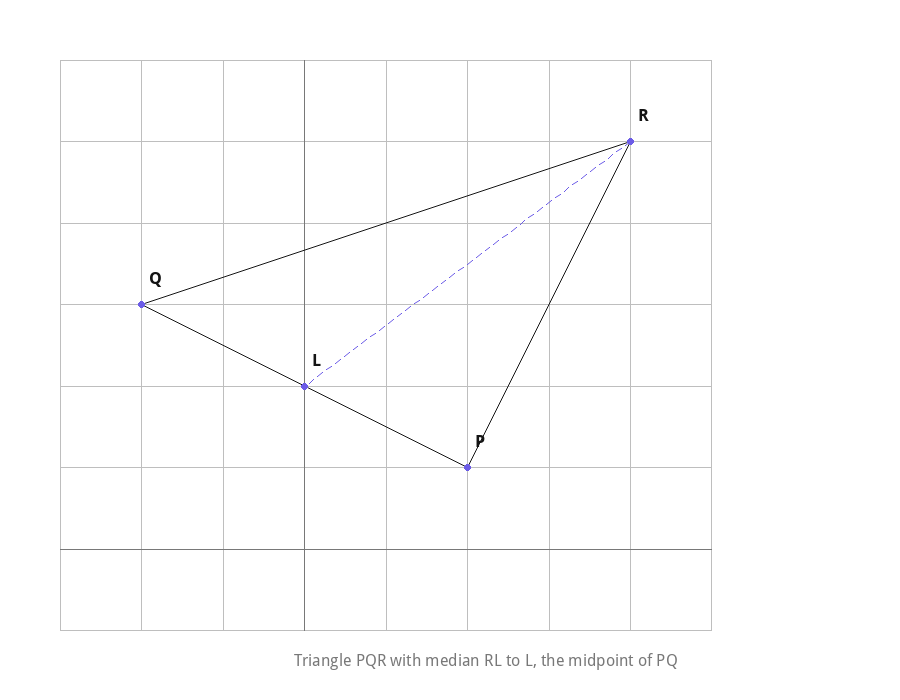
Q8. The vertices of △PQR are P(2, 1), Q(−2, 3) and R(4, 5). Find the equation of the median through the vertex R — Let RL be the median from R, so L is the midpoint of PQ: L = ((2−2)/2, (1+3)/2) = (0,…
Let RL be the median from R, so L is the midpoint of PQ: L = ((2−2)/2, (1+3)/2) = (0, 2). Line through R(4, 5) and L(0, 2): (y−5) = [(2−5)/(0−4)](x−4) = (3/4)(x−4). So 4y−20 = 3x−12, i.e. 3x − 4y + 8 = 0.
Q9. Find the equation of the line passing through (−3, 5) and perpendicular to the line through the points (2, 5) and (−3, 6) — Slope of the line through (2,5) and (−3,6) is m = (6−5)/(−3−2) = −1/5. The…
Slope of the line through (2,5) and (−3,6) is m = (6−5)/(−3−2) = −1/5. The perpendicular slope is the negative reciprocal: −1/(−1/5) = 5. Line through (−3, 5) with slope 5: (y−5) = 5(x+3) ⇒ y−5 = 5x+15 ⇒ 5x − y + 20 = 0.
Q10. A line perpendicular to the line segment joining the points (1, 0) and (2, 3) divides it in the ratio 1 : n. Find the equation of the line — By the section formula, the dividing point is ((n+2)/(n+1), 3/(n+1)). Slope of the…
By the section formula, the dividing point is ((n+2)/(n+1), 3/(n+1)). Slope of the segment joining (1,0) and (2,3) is 3, so the perpendicular’s slope is −1/3. Equation: y − 3/(n+1) = (−1/3)[x − (n+2)/(n+1)]. Clearing denominators gives (1+n)x + 3(1+n)y = n + 11.
Q11. Find the equation of a line that cuts off equal intercepts on the coordinate axes and passes through the point (2, 3) — Intercept form: x/a + y/b = 1. With a = b, this becomes x + y = a. Since the line passes…
Intercept form: x/a + y/b = 1. With a = b, this becomes x + y = a. Since the line passes through (2, 3): 2+3 = a, so a = 5. The equation is x + y = 5.
Q12. Find equation of the line passing through the point (2, 2) and cutting off intercepts on the axes whose sum is 9 — Let intercepts be a and 9−a, so x/a + y/(9−a) = 1. Through (2, 2): 2/a + 2/(9−a) =…
Let intercepts be a and 9−a, so x/a + y/(9−a) = 1. Through (2, 2): 2/a + 2/(9−a) = 1 ⇒ 18 = 9a−a2 ⇒ a2−9a+18 = 0 ⇒ (a−6)(a−3) = 0, so a = 6 or a = 3. If a = 6, b = 3: x/6 + y/3 = 1, i.e. x + 2y − 6 = 0. If a = 3, b = 6: x/3 + y/6 = 1, i.e. 2x + y − 6 = 0.
Q13. Find equation of the line through the point (0, 2) making an angle 2π/3 with the positive x-axis. Also, find the equation of the line parallel to it and crossing the y-axis at a distance of 2 units below the origin — Slope = tan(2π/3) = tan120° = −√3. Line through (0, 2): y−2 = −√3(x−0) ⇒…
Slope = tan(2π/3) = tan120° = −√3. Line through (0, 2): y−2 = −√3(x−0) ⇒ √3x + y − 2 = 0. The parallel line through (0, −2) has the same slope: y−(−2) = −√3(x−0) ⇒ √3x + y + 2 = 0.
Q14. The perpendicular from the origin to a line meets it at the point (−2, 9). Find the equation of the line — Slope of the segment joining (0,0) and (−2, 9) is 9/(−2) = −9/2. Since this…
Slope of the segment joining (0,0) and (−2, 9) is 9/(−2) = −9/2. Since this segment is perpendicular to the required line, the line’s slope is the negative reciprocal: 2/9. Line through (−2, 9) with slope 2/9: y−9 = (2/9)(x+2) ⇒ 9y−81 = 2x+4 ⇒ 2x − 9y + 85 = 0.
Q15. The length L (in cm) of a copper rod is a linear function of its Celsius temperature C. If L = 124.942 when C = 20, and L = 125.134 when C = 110, express L in terms of C — Treat (C, L) as coordinates: (20, 124.942) and (110, 125.134). The equation of the line…
Treat (C, L) as coordinates: (20, 124.942) and (110, 125.134). The equation of the line through them is L − 124.942 = [(125.134−124.942)/(110−20)](C−20) = (0.192/90)(C−20). So L = (0.192/90)(C−20) + 124.942.
Q16. The owner of a milk store finds that he can sell 980 litres of milk each week at Rs 14/litre and 1220 litres of milk each week at Rs 16/litre. Assuming a linear relationship, how many litres could he sell weekly at Rs 17/litre? — Treat (price, demand) as coordinates: (14, 980) and (16, 1220). Equation: y−980 =…
Treat (price, demand) as coordinates: (14, 980) and (16, 1220). Equation: y−980 = [(1220−980)/(16−14)](x−14) = 120(x−14). At x = 17: y = 980 + 120(3) = 980+360 = 1340. He could sell 1340 litres weekly at Rs 17/litre.
Q17. P(a, b) is the mid-point of a line segment between the axes. Show that the equation of the line is x/a + y/b = 2 — Let the segment AB meet the axes at A(0, y) and B(x, 0), with P(a, b) as midpoint: (x/2,…
Let the segment AB meet the axes at A(0, y) and B(x, 0), with P(a, b) as midpoint: (x/2, y/2) = (a, b), so x = 2a, y = 2b, i.e. A = (0, 2b), B = (2a, 0). Equation through A and B: (y−2b) = [(0−2b)/(2a−0)](x−0) = (−b/a)x. So ay − 2ab = −bx ⇒ bx + ay = 2ab. Dividing by ab: x/a + y/b = 2, as required.
Q18. Point R(h, k) divides a line segment between the axes in the ratio 1 : 2. Find the equation of the line — Let the line meet the axes at A(x, 0) and B(0, y). By the section formula, R divides AB…
Let the line meet the axes at A(x, 0) and B(0, y). By the section formula, R divides AB (1:2) so h = 2x/3 and k = y/3, giving x = 3h/2, y = 3k, i.e. A = (3h/2, 0), B = (0, 3k). Equation through A, B: y = [(3k−0)/(0−3h/2)](x−3h/2) = (−2k/h)(x−3h/2). So hy = −2kx + 3hk, i.e. 2kx + hy = 3hk.
Q19. Using the concept of the equation of a line, prove that the points (3, 0), (−2, −2) and (8, 2) are collinear — Equation of the line through (3, 0) and (−2, −2): (y−0) =…
Equation of the line through (3, 0) and (−2, −2): (y−0) = [(−2−0)/(−2−3)](x−3) = (2/5)(x−3), i.e. 2x − 5y = 6. Substituting (8, 2): 2(8)−5(2) = 16−10 = 6, which satisfies the equation. So (8, 2) also lies on this line, proving the three points are collinear.
Exercise 9.3
Q1. Reduce the following equations into slope-intercept form and find their slopes and y-intercepts:
- x + 7y = 0 ⇒ y = −(1/7)x + 0, so slope = −1/7, y-intercept = 0.
- 6x + 3y − 5 = 0 ⇒ y = −2x + 5/3, so slope = −2, y-intercept = 5/3.
- y = 0 ⇒ y = 0·x + 0, so slope = 0, y-intercept = 0.
Q2. Reduce the following equations into intercept form and find their intercepts on the axes:
- 3x + 2y − 12 = 0 ⇒ x/4 + y/6 = 1, so x-intercept = 4, y-intercept = 6.
- 4x − 3y = 6 ⇒ x/(3/2) + y/(−2) = 1, so x-intercept = 3/2, y-intercept = −2.
- 3y + 2 = 0 ⇒ y = −2/3, so there is no x-intercept and the y-intercept is −2/3.
Q3. Find the distance of the point (−1, 1) from the line 12(x+6) = 5(y−2) — The line simplifies to 12x + 72 = 5y − 10, i.e. 12x − 5y + 82 = 0. Using d =…
The line simplifies to 12x + 72 = 5y − 10, i.e. 12x − 5y + 82 = 0. Using d = |Ax1+By1+C|/√(A2+B2) with A=12, B=−5, C=82, (x1,y1)=(−1,1): d = |12(−1)−5(1)+82|/√(144+25) = |65|/13 = 5 units.
Q4. Find the points on the x-axis, whose distances from the line x/3 + y/4 = 1 are 4 units — The line is 4x+3y−12=0. Let (a, 0) be the point: 4 = |4a−12|/5 ⇒ |4a−12| = 20…
The line is 4x+3y−12=0. Let (a, 0) be the point: 4 = |4a−12|/5 ⇒ |4a−12| = 20 ⇒ 4a−12 = 20 or 4a−12 = −20 ⇒ a = 8 or a = −2. The required points are (8, 0) and (−2, 0).
Q5. Find the distance between parallel lines:
- 15x + 8y − 34 = 0 and 15x + 8y + 31 = 0. Using d = |C1−C2|/√(A2+B2): d = |−34−31|/√(225+64) = 65/17 units.
- l(x+y)+p = 0 and l(x+y)−r = 0. Here A=B=l, C1=p, C2=−r: d = |p−(−r)|/√(2l2) = |p+r|/(l√2) units.
Q6. Find the equation of the line parallel to the line 3x−4y+2=0 and passing through the point (−2, 3) — The given line has slope 3/4, so the parallel line also has slope 3/4. Through (−2,…
The given line has slope 3/4, so the parallel line also has slope 3/4. Through (−2, 3): (y−3) = (3/4)(x+2) ⇒ 4y−12 = 3x+6 ⇒ 3x − 4y + 18 = 0.
Q7. Find the equation of the line perpendicular to the line x−7y+5=0 and having x-intercept 3 — The given line has slope 1/7, so the perpendicular slope is −7. Using y = m(x−d)…
The given line has slope 1/7, so the perpendicular slope is −7. Using y = m(x−d) with d=3: y = −7(x−3) = −7x+21, i.e. 7x + y − 21 = 0.
Q8. Find the angle between the lines √3x + y = 1 and x + √3y = 1 — Slopes: m1 = −√3, m2 = −1/√3. tanθ = |(m1−m2)/(1+m1m2)| =…
Slopes: m1 = −√3, m2 = −1/√3. tanθ = |(m1−m2)/(1+m1m2)| = |(−√3+1/√3)/(1+1)| = |(−2/√3)/2| = 1/√3, so θ = 30°. The angle between the lines is 30° (or, equivalently, the obtuse angle is 150°).
Q9. The line through the points (h, 3) and (4, 1) intersects the line 7x−9y−19=0 at a right angle. Find the value of h — Slope of the first line: m1 = (1−3)/(4−h) = −2/(4−h). Slope of 7x−9y−19=0 is…
Slope of the first line: m1 = (1−3)/(4−h) = −2/(4−h). Slope of 7x−9y−19=0 is m2 = 7/9. For perpendicularity, m1m2 = −1: (−2/(4−h))(7/9) = −1 ⇒ −14 = −9(4−h) ⇒ 14 = 36−9h ⇒ h = 22/9.
Q10. Prove that the line through the point (x1, y1) and parallel to the line Ax+By+C=0 is A(x−x1)+B(y−y1)=0.
The given line has slope −A/B, so the parallel line also has slope −A/B. Through (x1, y1): y−y1 = (−A/B)(x−x1) ⇒ B(y−y1) = −A(x−x1) ⇒ A(x−x1) + B(y−y1) = 0, as required.
Q11. Two lines passing through the point (2, 3) intersect each other at an angle of 60°. If the slope of one line is 2, find the equation of the other line — Let the other slope be m2. tan60° = √3 = |(2−m2)/(1+2m2)|. Solving both signs gives…
Let the other slope be m2. tan60° = √3 = |(2−m2)/(1+2m2)|. Solving both signs gives m2 = (2−√3)/(2√3+1) or m2 = −(2+√3)/(2√3−1). Using the point-slope form through (2, 3) with each value gives the two possible equations: (√3−2)x + (2√3+1)y = 8√3−1, or (2+√3)x + (2√3−1)y = 8√3+1.
Q12. Find the equation of the right bisector of the line segment joining the points (3, 4) and (−1, 2) — Midpoint = (1, 3). Slope of the segment = (2−4)/(−1−3) = 1/2, so the perpendicular…
Midpoint = (1, 3). Slope of the segment = (2−4)/(−1−3) = 1/2, so the perpendicular bisector’s slope is −2. Equation through (1, 3): (y−3) = −2(x−1) ⇒ 2x + y = 5.
Q13. Find the coordinates of the foot of perpendicular from the point (−1, 3) to the line 3x−4y−16=0 — Let (a, b) be the foot. Slope of the segment from (−1,3) to (a,b) is (b−3)/(a+1);…
Let (a, b) be the foot. Slope of the segment from (−1,3) to (a,b) is (b−3)/(a+1); this must be perpendicular to the line (slope 3/4), giving 4a+3b = 5. Also (a, b) lies on the line: 3a−4b = 16. Solving these simultaneously: multiplying the first by 4 and second by 3 and adding gives 25a = 68, so a = 68/25; back-substituting gives b = −49/25. The foot of the perpendicular is (68/25, −49/25).
Q14. The perpendicular from the origin to the line y=mx+c meets it at the point (−1, 2). Find the values of m and c — Slope of the segment from (0,0) to (−1,2) is −2; since this is perpendicular to the…
Slope of the segment from (0,0) to (−1,2) is −2; since this is perpendicular to the line, m×(−2) = −1, so m = 1/2. Since (−1, 2) lies on the line: 2 = (1/2)(−1)+c ⇒ c = 2 + 1/2 = 5/2. So m = 1/2 and c = 5/2.
Q15. If p and q are the lengths of perpendiculars from the origin to the lines xcosθ−ysinθ=kcos2θ and xsecθ+ycosecθ=k respectively, prove that p2+4q2=k2.
For the first line, A=cosθ, B=−sinθ, C=−kcos2θ, so p = |−kcos2θ|/√(cos2θ+sin2θ) = |kcos2θ|. For the second line, A=secθ, B=cosecθ, C=−k, so q = |k|/√(sec2θ+cosec2θ). Now p2+4q2 = k2cos22θ + 4k2/(sec2θ+cosec2θ). Since sec2θ+cosec2θ = 1/(sin2θcos2θ), the second term becomes 4k2sin2θcos2θ = k2(2sinθcosθ)2 = k2sin22θ. So p2+4q2 = k2cos22θ + k2sin22θ = k2, as required.
Q16. In the triangle ABC with vertices A(2, 3), B(4, −1) and C(1, 2), find the equation and length of the altitude from the vertex A — Slope of BC = (2−(−1))/(1−4) = −1, so the altitude AD from A is perpendicular to…
Slope of BC = (2−(−1))/(1−4) = −1, so the altitude AD from A is perpendicular to BC and has slope 1. Equation of AD through (2, 3): (y−3) = 1(x−2) ⇒ x − y + 1 = 0. Equation of BC through B(4,−1) with slope −1: (y+1) = −1(x−4) ⇒ x + y − 3 = 0. Length of AD = perpendicular distance from A(2,3) to line x+y−3=0 = |2+3−3|/√2 = 2/√2 = √2 units.
Q17. If p is the length of the perpendicular from the origin to the line whose intercepts on the axes are a and b, show that 1/p2 = 1/a2 + 1/b2.
The line is x/a+y/b=1, i.e. bx+ay−ab=0. Distance from origin: p = |−ab|/√(a2+b2). Squaring: p2(a2+b2) = a2b2, so (a2+b2)/(a2b2) = 1/p2, i.e. 1/p2 = 1/a2 + 1/b2, as required.
Miscellaneous Exercise
Q1. Find the values of k for which the line (k−3)x − (4−k2)y + k2−7k+6 = 0 is (a) parallel to the x-axis, (b) parallel to the y-axis, (c) passing through the origin.
(a) The slope of the line is (k−3)/(4−k2); for it to equal the x-axis slope of 0, we need k−3 = 0, so k = 3. (b) For the line to be vertical, its slope must be undefined, so 4−k2 = 0, giving k = ±2 (and the numerator k−3 is nonzero at both values, confirming a genuine vertical line). (c) For the line to pass through the origin, substituting (0,0) gives k2−7k+6 = 0 ⇒ (k−1)(k−6) = 0, so k = 1 or k = 6.
Q2. Find the equations of the lines which cut off intercepts on the axes whose sum and product are 1 and −6, respectively — Let intercepts be a, b with a+b=1 and ab=−6. Solving, a=3, b=−2 or a=−2, b=3.…
Let intercepts be a, b with a+b=1 and ab=−6. Solving, a=3, b=−2 or a=−2, b=3. Using x/a+y/b=1: for a=3,b=−2, the line is 3x−2y=6; for a=−2,b=3, the line is 2x−3y=6.
Q3. What are the points on the y-axis whose distance from the line x/3+y/4=1 is 4 units? — The line is 4x+3y−12=0. Let (0, b) be the point: 4 = |3b−12|/5 ⇒ |3b−12| = 20…
The line is 4x+3y−12=0. Let (0, b) be the point: 4 = |3b−12|/5 ⇒ |3b−12| = 20 ⇒ b = 32/3 or b = −8/3. The required points are (0, 32/3) and (0, −8/3).
Q4. Find the perpendicular distance from the origin to the line joining the points (cosθ, sinθ) and (cosφ, sinφ) — The equation of the line through the two points simplifies to x(sinθ−sinφ) +…
The equation of the line through the two points simplifies to x(sinθ−sinφ) + y(cosφ−cosθ) + sin(φ−θ) = 0. Its perpendicular distance from the origin is |sin(φ−θ)| / √[(sinθ−sinφ)2+(cosφ−cosθ)2]. Expanding the denominator using sin2+cos2=1 and the cosine-difference identity gives √[2(1−cos(φ−θ))] = 2|sin((φ−θ)/2)|. So the distance is |sin(φ−θ)| / |2sin((φ−θ)/2)|.
Q5. Find the equation of the line parallel to the y-axis and drawn through the point of intersection of the lines x−7y+5=0 and 3x+y=0 — Solving the two equations simultaneously: x = −5/22, y = 15/22. A line parallel to the…
Solving the two equations simultaneously: x = −5/22, y = 15/22. A line parallel to the y-axis has the form x = a, so the required equation is x = −5/22.
Q6. Find the equation of a line drawn perpendicular to the line x/4+y/6=1 through the point where it meets the y-axis — The given line, 3x+2y−12=0, has slope −3/2, so the perpendicular slope is 2/3. The…
The given line, 3x+2y−12=0, has slope −3/2, so the perpendicular slope is 2/3. The line meets the y-axis at (0, 6) (setting x=0 gives y=6). Equation through (0,6) with slope 2/3: (y−6) = (2/3)(x−0) ⇒ 2x − 3y + 18 = 0.
Q7. Find the area of the triangle formed by the lines y−x=0, x+y=0 and x−k=0 — Intersection of y=x and x+y=0 is (0,0). Intersection of x+y=0 and x=k is (k, −k).…
Intersection of y=x and x+y=0 is (0,0). Intersection of x+y=0 and x=k is (k, −k). Intersection of x=k and y=x is (k, k). So the vertices are (0,0), (k,−k), (k,k). Area = ½|0(−k−k) + k(k−0) + k(0−(−k))| = ½|2k2| = k2 square units.
Q8. Find the value of p so that the three lines 3x+y−2=0, px+2y−3=0 and 2x−y−3=0 may intersect at one point — Solving the first and third equations: x=1, y=−1. Since all three lines are…
Solving the first and third equations: x=1, y=−1. Since all three lines are concurrent, this point must satisfy the second equation: p(1)+2(−1)−3=0 ⇒ p = 5.
Q9. If three lines y=m1x+c1, y=m2x+c2 and y=m3x+c3 are concurrent, show that m1(c2−c3) + m2(c3−c1) + m3(c1−c2) = 0.
Solving the first two equations gives their intersection point x = (c2−c1)/(m1−m2), y = (m1c2−m2c1)/(m1−m2). Since the third line also passes through this point, substituting and clearing the denominator (m1−m2) leads directly to m1(c2−c3) + m2(c3−c1) + m3(c1−c2) = 0, as required.
Q10. Find the equation of the lines through the point (3, 2) which make an angle of 45° with the line x−2y=3 — The given line has slope 1/2. Let the required slope be m1. tan45° = 1 =…
The given line has slope 1/2. Let the required slope be m1. tan45° = 1 = |(1/2−m1)/(1+m1/2)|. Solving both signs: m1 = 3 or m1 = −1/3. Through (3,2) with slope 3: y−2=3(x−3) ⇒ 3x−y=7. Through (3,2) with slope −1/3: y−2=(−1/3)(x−3) ⇒ x+3y=9. The required lines are 3x−y=7 and x+3y=9.
Q11. Find the equation of the line passing through the point of intersection of the lines 4x+7y−3=0 and 2x−3y+1=0 that has equal intercepts on the axes — Solving the two lines: x=1/13, y=5/13. A line with equal intercepts is x+y=a. Since it…
Solving the two lines: x=1/13, y=5/13. A line with equal intercepts is x+y=a. Since it passes through (1/13, 5/13): a = 6/13. So the equation is x+y = 6/13, i.e. 13x + 13y = 6.
Q12. Show that the equation of the line passing through the origin and making an angle θ with the line y=mx+c is y/x = (m ± tanθ)/(1 ∓ m tanθ) — Let the required line be y = m1x, so m1 = y/x. Since it makes angle θ with y=mx+c:…
Let the required line be y = m1x, so m1 = y/x. Since it makes angle θ with y=mx+c: tanθ = ±[(y/x − m)/(1 + (y/x)m)]. Taking the positive sign and solving for y/x gives y/x = (m+tanθ)/(1−m tanθ); taking the negative sign gives y/x = (m−tanθ)/(1+m tanθ). Combined: y/x = (m ± tanθ)/(1 ∓ m tanθ).
Q13. In what ratio is the line joining (−1, 1) and (5, 7) divided by the line x+y=4? — Equation of the line joining (−1,1) and (5,7): (y−1) = 1(x+1) ⇒ x−y+2=0. Solving…
Equation of the line joining (−1,1) and (5,7): (y−1) = 1(x+1) ⇒ x−y+2=0. Solving with x+y=4 gives the intersection point (1, 3). Let this point divide the segment in ratio 1:k. By the section formula, ((−k+5)/(1+k), (k+7)/(1+k)) = (1, 3). From the x-coordinate: −k+5=1+k ⇒ k=2. So the line divides the segment in the ratio 1:2.
Q14. Find the distance of the line 4x+7y+5=0 from the point (1, 2) along the line 2x−y=0 — A(1,2) lies on 2x−y=0. Solving 2x−y=0 with 4x+7y+5=0 gives the intersection point…
A(1,2) lies on 2x−y=0. Solving 2x−y=0 with 4x+7y+5=0 gives the intersection point B(−5/18, −5/9). Distance AB = √[(1+5/18)2+(2+5/9)2] = √[(23/18)2+(23/9)2] = (23/9)√(1/4+1) = (23/9)(√5/2) = 23√5/18 units.
Q15. Find the direction in which a straight line must be drawn through the point (−1, 2) so that its point of intersection with the line x+y=4 is at a distance of 3 units from this point — Let the line be y=mx+m+2 (passing through (−1,2)). Solving with x+y=4 gives the…
Let the line be y=mx+m+2 (passing through (−1,2)). Solving with x+y=4 gives the intersection point ((2−m)/(m+1), (5m+2)/(m+1)). Setting its distance from (−1,2) to 3 and simplifying leads to (1+m2)/(m+1)2 = 1, which gives 2m=0, so m=0. The required line must be parallel to the x-axis (horizontal).
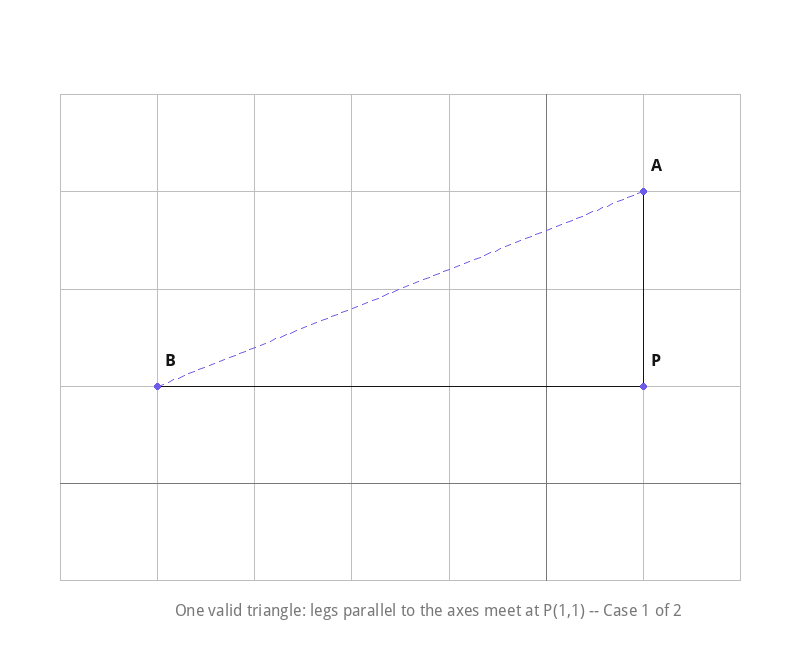
Q16. The hypotenuse of a right-angled triangle has its ends at (1, 3) and (−4, 1). Find the equations of the legs (perpendicular sides) of the triangle which are parallel to the axes — There are two possible right-angle vertices where the legs meet the hypotenuse's…
There are two possible right-angle vertices where the legs meet the hypotenuse’s endpoints’ horizontal/vertical lines. Case 1 (right angle vertex directly below/right): one leg is y=1 (parallel to x-axis, through the point with y=1) and the other is x=1 (parallel to y-axis, through the point with x=1). Case 2: one leg is y=3 and the other is x=−4. So the equations of the legs are x=1, y=1 or x=−4, y=3.
Q17. Find the image of the point (3, 8) with respect to the line x+3y=7, assuming the line to be a plane mirror — Let B(a, b) be the image of A(3, 8). Since the mirror line is the perpendicular bisector…
Let B(a, b) be the image of A(3, 8). Since the mirror line is the perpendicular bisector of AB, its slope (−1/3) must satisfy (b−8)/(a−3) × (−1/3) = −1, giving 3a−b=1. Also, the midpoint ((a+3)/2, (b+8)/2) lies on the line: (a+3)/2 + 3(b+8)/2 = 7 ⇒ a+3b = −13. Solving the two equations simultaneously: a = −1, b = −4. The image is (−1, −4).
Q18. If the lines y=3x+1 and 2y=x+3 are equally inclined to the line y=mx+4, find the value of m — Slopes: m1=3, m2=1/2, m3=m. Equal inclination means |(m1−m)/(1+m1m)| =…
Slopes: m1=3, m2=1/2, m3=m. Equal inclination means |(m1−m)/(1+m1m)| = |(m2−m)/(1+m2m)|. The case with matching signs leads to m2+1=0 (not real), so it is rejected. The case with opposite signs leads to 7m2−2m−7=0, giving m = (1 ± 5√2)/7.
Q19. If the sum of the perpendicular distances of a variable point P(x, y) from the lines x+y−5=0 and 3x−2y+7=0 is always 10, show that P must move on a line — The distances are d1=|x+y−5|/√2 and d2=|3x−2y+7|/√13. Given d1+d2=10, once the…
The distances are d1=|x+y−5|/√2 and d2=|3x−2y+7|/√13. Given d1+d2=10, once the signs of the two expressions inside the modulus are fixed (each is either always positive or always negative for points on one side), the equation reduces to a linear equation of the form Ax+By+C=0 in each case. Since removing the modulus signs in any consistent way always yields a linear equation, point P must move along a straight line.
Q20. Find the equation of the line which is equidistant from the parallel lines 9x+6y−7=0 and 3x+2y+6=0 — Let P(h, k) be equidistant from both lines: |9h+6k−7|/(3√13) = |3h+2k+6|/√13,…
Let P(h, k) be equidistant from both lines: |9h+6k−7|/(3√13) = |3h+2k+6|/√13, which gives |9h+6k−7| = 3|3h+2k+6|. Taking the “+” sign leads to the absurd statement −7=18, so it is rejected. Taking the “−” sign: 9h+6k−7 = −3(3h+2k+6) ⇒ 18h+12k+11=0. The required equation is 18x+12y+11=0.
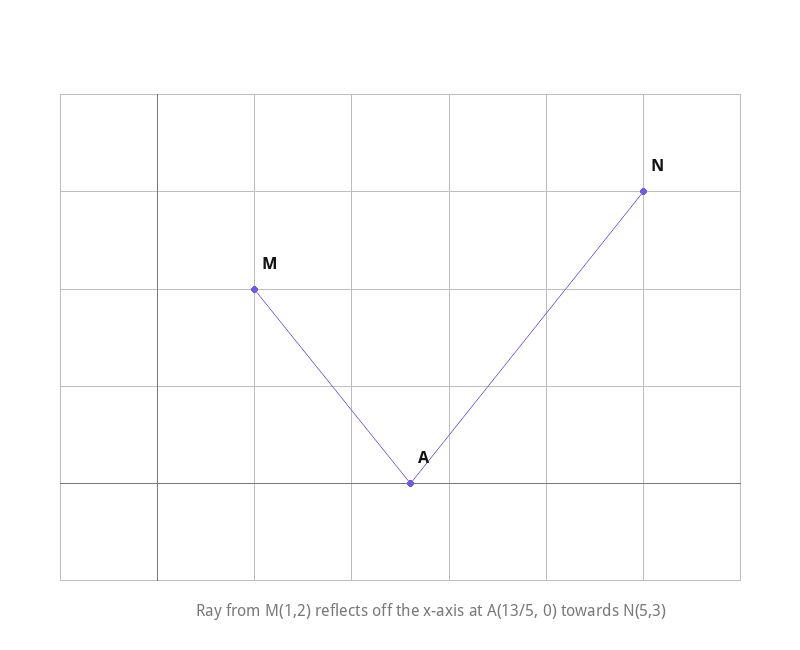
Q21. A ray of light passing through the point (1, 2) reflects on the x-axis at point A, and the reflected ray passes through the point (5, 3). Find the coordinates of A — Let A=(a, 0). Since the angle of incidence equals the angle of reflection, the slope…
Let A=(a, 0). Since the angle of incidence equals the angle of reflection, the slope from (1,2) to A and the slope from A to (5,3) are related by tanθ = 3/(5−a) = 2/(a−1) (using the reflection geometry). Cross-multiplying: 3(a−1) = 2(5−a) ⇒ 3a−3 = 10−2a ⇒ 5a=13 ⇒ a=13/5. So A = (13/5, 0).
Q22. Prove that the product of the lengths of the perpendiculars drawn from the points (√(a2−b2), 0) and (−√(a2−b2), 0) to the line (x/a)cosθ+(y/b)sinθ=1 is b2.
The line is bxcosθ+aysinθ−ab=0. The perpendicular distances from the two points are p1 = |bcosθ√(a2−b2)−ab|/√(b2cos2θ+a2sin2θ) and p2 = |bcosθ√(a2−b2)+ab|/√(b2cos2θ+a2sin2θ). Multiplying, the numerator becomes |(bcosθ√(a2−b2))2 − (ab)2| = |b2cos2θ(a2−b2) − a2b2| = b2|a2cos2θ−b2cos2θ−a2| = b2(b2cos2θ+a2sin2θ) (using sin2θ+cos2θ=1). Dividing by the denominator (b2cos2θ+a2sin2θ) gives p1p2 = b2, as required.
Q23. A person standing at the junction of two straight paths represented by 2x−3y+4=0 and 3x+4y−5=0 wants to reach the path 6x−7y+8=0 in the least time. Find the equation of the path they should follow — Solving the two junction equations simultaneously: x=−1/17, y=22/17. To reach the…
Solving the two junction equations simultaneously: x=−1/17, y=22/17. To reach the third path in the least time, the person must walk along the perpendicular from this point to that path. The path 6x−7y+8=0 has slope 6/7, so the perpendicular has slope −7/6. Equation through (−1/17, 22/17) with slope −7/6: (y−22/17) = (−7/6)(x+1/17). Simplifying: 119x + 102y = 125.
Class 11 Maths Chapter 9 – Notes and Extra Questions
Chapter 9, Straight Lines, builds the coordinate-geometry foundation for the rest of Class 11 and 12 Maths – from Conic Sections and 3D Geometry in Class 11 to Application of Derivatives in Class 12. The key ideas to revise are: the slope formula m = (y2−y1)/(x2−x1); the five standard forms of a line’s equation (point-slope, two-point, slope-intercept, intercept, and normal form); the condition for two lines to be parallel (m1=m2) or perpendicular (m1m2=−1); the angle-between-two-lines formula tanθ = |(m1−m2)/(1+m1m2)|; and the perpendicular-distance formula d = |Ax1+By1+C|/√(A2+B2). For extra practice, try proving collinearity of three points using slopes instead of the area formula, finding the equation of the median/altitude/perpendicular bisector of a triangle, and working out distance-between-parallel-lines problems – these question types repeat often in board exams and competitive exams like JEE.
- Chapter 1: Sets (2026-27)
- Chapter 2: Relations and Functions – Free PDF Download
- Chapter 3: Trigonometric Functions – Free PDF Download
- Chapter 4: Complex Numbers and Quadratic Equations – Free PDF Download
- Chapter 5: Linear Inequalities – Free PDF Download
- Chapter 6: Permutations and Combinations – Free PDF Download
- Chapter 7: Binomial Theorem – Free PDF Download
- Chapter 8: Sequences and Series – Free PDF Download
- Chapter 10: Conic Sections – Free PDF Download
- Chapter 11: Introduction to Three Dimensional Geometry – Free PDF Download
- Chapter 12: Limits and Derivatives – Free PDF Download
- Chapter 13: Statistics – Free PDF Download
- Chapter 14: Probability – Free PDF Download
Frequently Asked Questions
How many exercises are there in Class 11 Maths Chapter 9 Straight Lines, and how many questions does each have?
The current rationalised NCERT textbook has three exercises plus a Miscellaneous Exercise: Exercise 9.1 has 11 questions (slope of a line), Exercise 9.2 has 19 questions (forms of the equation of a line), Exercise 9.3 has 17 questions (general equation, angle between lines, distance formulas), and the Miscellaneous Exercise has 23 questions, making 70 questions in total.
Was Straight Lines renumbered in the 2023 NCERT rationalisation?
Yes. In the pre-2023 textbook, Straight Lines was Chapter 10. After NCERT dropped the standalone “Mathematical Induction” chapter that used to sit earlier in the book, every subsequent chapter shifted down by one number, so Straight Lines is now Chapter 9 in the 2023-rationalised edition used for the 2026-27 session. A small number of questions were also trimmed from each exercise during this rationalisation (for example, Exercise 9.1 dropped from 14 to 11 questions).
Why does the angle-between-two-lines formula always use a modulus (absolute value)?
The formula tanθ = |(m1−m2)/(1+m1m2)| is written with a modulus because two intersecting lines actually form two pairs of angles that are supplementary (adding up to 180°) – one acute and one obtuse. NCERT convention is to report the acute angle between the lines, so the modulus is essential; dropping it can give a negative tangent value that corresponds to the obtuse angle instead of the intended acute one.
What is the difference between the distance formula and the perpendicular-distance-from-a-line formula?
The distance formula √[(x2−x1)2+(y2−y1)2] finds the distance between two points. The perpendicular-distance formula d = |Ax1+By1+C|/√(A2+B2) finds the shortest (perpendicular) distance from a single point (x1, y1) to a line Ax+By+C=0. Both appear throughout Chapter 9 and are easy to confuse, so it helps to remember that the second formula always needs the line written in general form Ax+By+C=0 first.
Recommended: Buy the Printed NCERT Class 11 Maths Book
Contains Amazon affiliate links.
If you’d like a printed copy alongside the PDF, here’s a verified option:
4.2 out of 5 stars (953 ratings) · Rs. 170
Price and availability may change on Amazon. As an Amazon Associate, ncertbooks.org earns from qualifying purchases.



Pingback: Class 11 Maths Chapter 9 Straight Lines Extra Questions (2026-27)